
About Our Tenth Issue

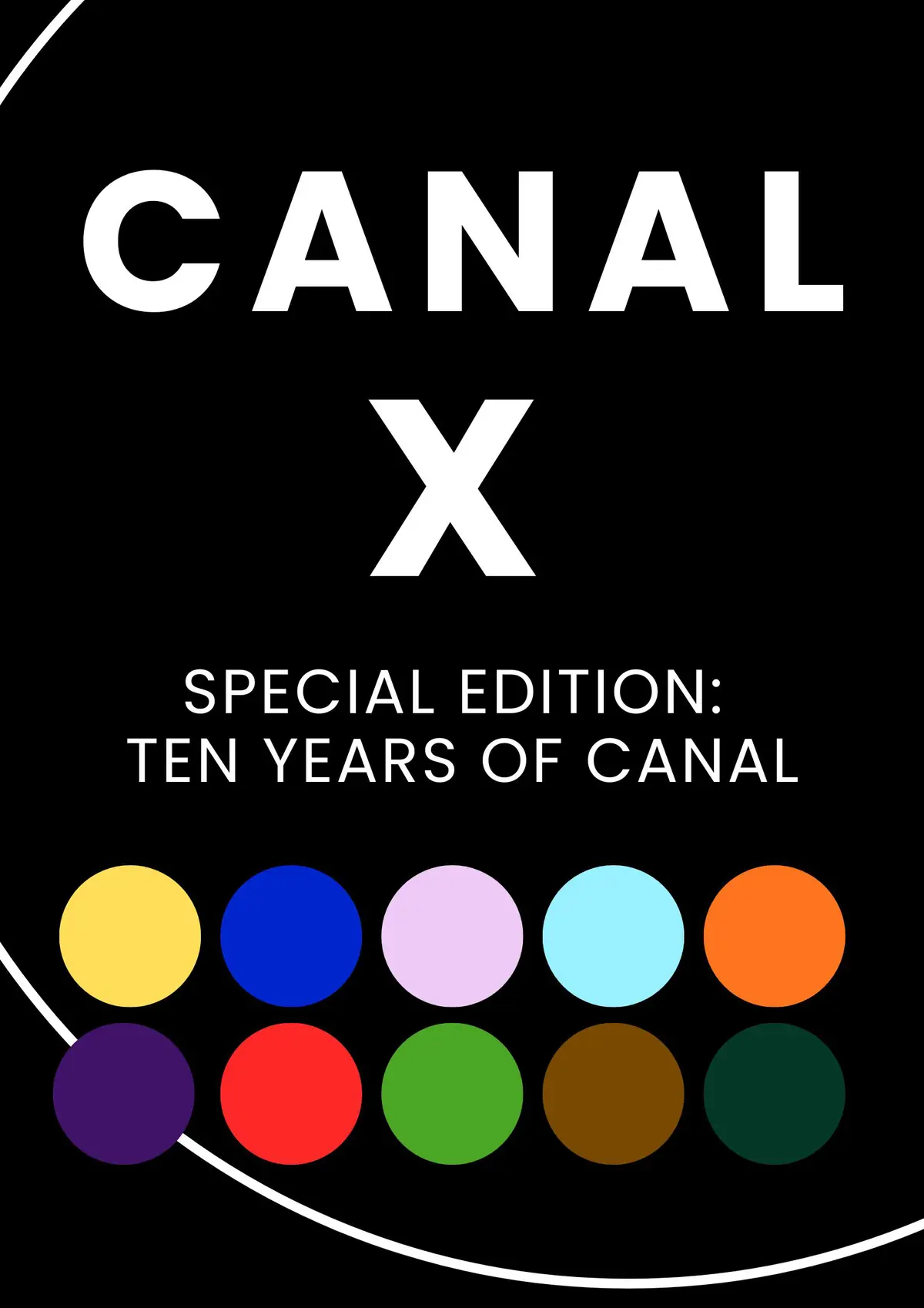
Magazine Cover: “Canal X Special Edition: Ten Years of Canal” on black background with ten multi-colored circles below.

The tenth issue of CANAL is something to truly celebrate.

For ten years, CANAL has provided students with unique mentorship opportunities as they refine their research and creative projects for publication in Spanish, French, Italian, Portuguese, Chinese, Khmer, German, and English.

We have published 55 essays (thirty in Spanish, sixteen in Italian, seven in French, one in Portuguese, and one in Chinese) with an incredibly diverse range of topics. You will find writing on community policing, the environmental sciences, the history of fashion,l esbian, gay, bisexual, transgender, and queer/questioning+ (LGBTQ+) identity, literary analysis, autism research, and multilingual education.

CANAL has featured 11 unique poetry projects (four in Portuguese, three in Spanish, two in Khmer, one in Italian, and one in French) as well as 37 language-learning projects involving fiction, open-resource creation, and diverse approaches to linguistic development (twenty in Italian, ten in Portuguese, two in German, four in Spanish). Students have conducted nine fascinating interview projects—three in Italian, two in Spanish, one in Chinese, one in German, one in Portuguese, and one in Khmer.

While each project has been unique—with its own trajectory and process—it is often the case that students who submit their work to CANAL engage in careful discussions about language, academic research, interpretation, history, and writing. A project that begins as a class assignment can, through this editorial process, grow into a much more complex, multilayered work.

When we were discussing how to celebrate this decade of student creativity and faculty mentorship, we decided that it would be meaningful to ask all our past contributors to reflect on their experiences with CANAL (Melany De Los Santos and Monica Melo provided invaluable help in seeking out their contact information). We asked these contributors what they remembered, specifically, about their experiences with CANAL, what impact it had on their lives afterwards, and if there were any thoughts that they wanted to share with readers now about their work.

Reading these responses was very special.

It showed us the far-reaching impact of CANAL and the importance of working beyond the limits of the classroom to strengthen student voices as writers and creators—particularly in languages other than English.

Many contributors highlighted how important it was to work with an editor to take their writing and creative work seriously as it was prepared for publication. These were experiences that strengthened their understanding of themselves as writers and creators and opened them to new possibilities as they began their careers.

We were able to see how CANAL directly impacted their professional lives—how writing and publishing was, in many ways, a career-connected experience.

Jannelis Medina explained how her experience publishing an essay, in Spanish, on Puerto Rican identity and activism led to her career as a special education teacher in Lowell, where she uses her Spanish abilities working with multilingual families.

Leonel Contreras wrote that publishing in CANAL helped him get a job at the Massachusetts Executive Office of Labor and Workforce Development as a bilingual employment counselor.

Kat Claybaugh wrote that after presenting their work in CANAL at a gender studies conference the year it was published, it led to an Honors College thesis and then to working in immigration law after graduation.

Montana Heise reflected on how publishing in CANAL deepened her confidence in her writing abilities and influenced her decision to do her graduate studies practicum in Costa Rica—a choice which led to her work supporting students in study abroad programs at UMass Lowell (UML) and now as part of the Tufts Global Education Team.

Darnnellyz Batista explained that her essay in CANAL helped with her admission into Merrimack College’s Clinical Mental Health Counseling Program and that now, as a clinical mental health counselor, the themes of her writing (particularly understanding generational trauma) are part of her daily work.

Julian Viviescas Mejia decided to travel to Northern Greece to volunteer in the refugee camps of the nonprofit Lifting Hands International after interviewing Dr. Pietro Bartolo, a prominent advocate for migrants’ rights in Italy, for CANAL and his honor thesis. He described how the skills he developed within both of his CANAL projects transferred directly to his current role as communications director for Boston City Councilor Ruthzee Louijeune. He emphasized that supporting the rights of migrants is a part of his current role that he strongly values.

We invite you to read these reflections from 18 of our past contributors because they are windows into the lives of UML alumni who are building on what they learned and experienced at the university. They include compelling thoughts on the importance of writing, researching, and publishing in languages other than English—and how it allowed them to connect to new international communities and develop stronger relationships with family histories, cultures, and knowledge. They show UML graduates engaging in deeply meaningful service to others and participating in the world with intellectual rigor, curiosity, and passion.

Our Current Issue

The 10th issue of CANAL features exciting new original work from current UML students.

It includes three original essays in Spanish and Italian.

In “Benvenuti al Sud: Stereotipi, identità regionale e unità nell’Italia contemporanea,” Dylan Hubbard expanded a presentation he gave with Aleks Kollcinaku in the Modern and Contemporary Italian Culture class taught by Fabiana Viglione in the fall 2025 semester. Hubbard analyzes the 2010 Italian film Benvenuti al Sud, focusing on the representation of regional stereotypes in Italy and exploring how cinematic humor serves as a lens for historical reflection and commentary on Italian identity.

Sotara Rorn, in “El arte y el genocidio de Camboya,” presents an analysis of the arts in Cambodia that draws from both careful research and family conversations. It shows how different art practices have been vital for cultural life, healing, and transformation in Cambodia and its diaspora, pointing toward the centrality of cultural expression for the future.

Alessia Pari di Monriva, a graduate of UML now pursuing a doctorate in Italian at the University of Wisconsin-Madison, offers an incisive analysis of the musical structure in Dante’s Inferno in “La struttura musicale e i paesaggi sonori nell’Inferno di Dante.” Drawing on scholars like Margaret Bent, Francesco Ciabattoni, and Robert Alexander Lee, she shows how Dante made deliberate choices about sound, rhythm, and language that give the whole canticle of the Inferno a deeply musical quality.

Our 10th issue also offers four unique translation projects. All originated in our department’s Spanish Translation Seminar, taught by Max Ubelaker Andrade in the spring of 2025.

The first, by Cassie Larkin, is titled: “‘No hay señales sin respuesta’: Traduciendo a Rayos Láser.” It offers the first English translations of five songs by the Argentinian band Rayos Láser and is accompanied by a text analyzing the theories of translation that were most influential for her project. Larkin, at the end of the course, contacted the band who offered their enthusiastic support.

The second project, by Alejandro Bonilla, offers translations into English of four songs by the Spanish musician Nino Bravo along with careful analysis of the choices he made as he fashioned these new versions of each song. Bonilla’s musicology background deeply influenced his choices as a translator and his text presents a fascinating theoretical and practical guide for readers interested in the musical and cultural dimensions of literary translation.

The translation section of our issue concludes with two reflections on the role of Artificial Intelligence (AI) in literary translation. Jason Rodriguez and Reese Valle present different ways of thinking about AI’s capabilities and limits in translation. Both writers observe that the AI Large Language Models (LLMs), as pattern-seeking programs designed to predict the next-most-likely word in responses to textual prompts, do not actually read, analyze, interpret, or contextualize the texts that they are being asked to translate. While they are capable of producing texts that serve as translations in many respects, the absence of interpretation means that no choices have been made in terms of what is worth communicating and what is worth sacrificing. The centrality of interpretation to these choices was the focus of the seminar and both Valle and Rodriguez point to the loss of technologically sidestepping them with specific examples from their own work.

The language acquisition projects in CANAL X include two videos. The first, by Andrew Savard, grew out of an “Italian 1 and Culture” final assignment in which Savard turned a basic speaking exercise into a thoughtful glimpse into Italy’s rich philosophical heritage. Carlie Molonson, a nursing student minoring in Italian, developed a guide for using Italian in medical situations and recorded a video demonstrating one of its chapters, which focuses on the nurses’ responsibility for taking vital signs. Her project grew out of a directed study with Giulia Po DeLisle in the fall of 2025, following literary readings from Italian women writers on illness and the body. Those readings shaped her approach to the project by giving her a deeper understanding of what it feels like to suddenly be sick, and the resulting project shows her initiative, commitment, and ability to create an interdisciplinary work that combines language, nursing, practical experience, and human sensitivity.

Gabriel Martins offers his work of creative nonfiction in Portuguese, “Apprender a Dirigir nos Tempos de COVID,” which involves advanced storytelling strategies to describe and analyze a personal memory.

Three of our students wrote about their international experiences in UML programs and events. Tiffany Rodriguez, in “Una práctica preprofessional en Santiago de Compostela,” writes about what she learned in Spain while working as an intern in different hospitals. Abigayle Rettman, in “Manuel de Segura y una introducción a la copla Española,” considers the importance of connecting with international traditions and perspectives after describing a virtual event with a prominent Spanish musician. Celia Schoenfeld in “La mia esperienza a Modena” writes about the importance of her study abroad experience at the University of Modena and Reggio Emilia, Italy.

The final project of CANAL X is a documentary film created by Lucero Walsh-García. It involves two sets of interviews—each conducted one year apart from one another—with Mexican immigrants in Massachusetts. The participants discuss what it has been like to live in the United States at a time when there has been both widespread political demonization of immigrants and growing state violence against immigrants and people who support them. It is at once a unique historical document and a film that offers a chance to listen to thoughtful, personal, intimate conversations that are not often represented in the media.


ESSAYS


ON TRANSLATION: THEORY + PRACTICE


LANGUAGE


REFLECTIONS ON CAREER AND INTERNATIONAL EXPERIENCES


DOCUMENTARY


Fair Use

All works are presented under Fair Use guidelines. Please contact Max Ubelaker Andrade by email: max_ubelaker@uml.edu with any questions.