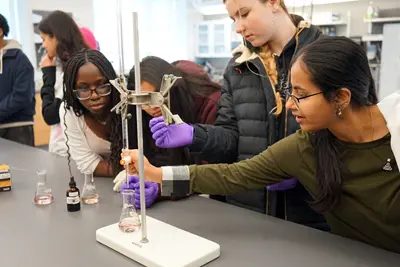
More than 100 local high school students visited UMass Lowell for an International Day of Women and Girls in STEM event that connected them with faculty and student researchers and highlighted the importance of mentorship in supporting women in science, technology, engineering and mathematics.
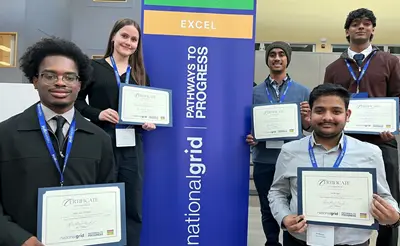
Eleven UMass Lowell students completed National Grid’s Clean Energy Careers Academy, an eight-week program designed to provide college students with a better understanding of career opportunities within the energy sector.
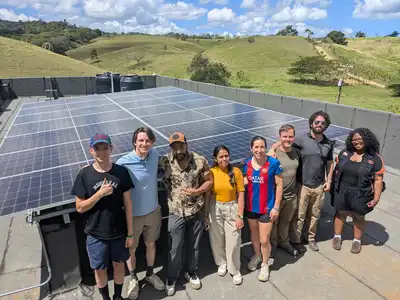
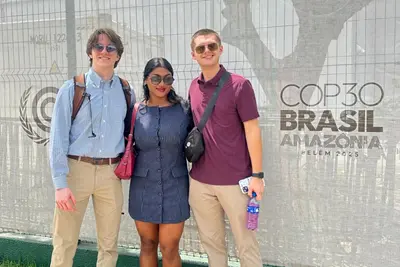
The UMass Lowell delegation, consisting of four students and two professors, was the only delegation from a Massachusetts public university to attend Conference of the Parties 30 (COP30).
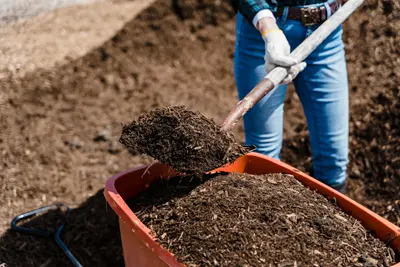
Assistant Professor of Environmental, Earth and Atmospheric Sciences Joy Winbourne has joined forces with two engineering professors to advance research into sustainable mulch.
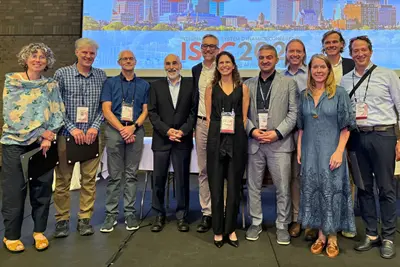
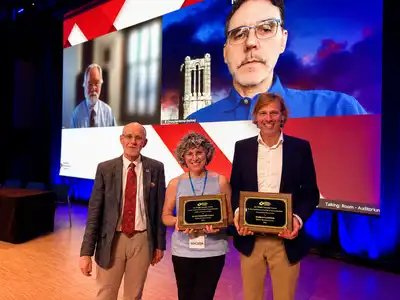
The System Dynamics Society honored a team of researchers, including Environmental, Earth and Atmospheric Sciences Professor Juliette Rooney-Varga, for its global climate simulator, En-ROADS.
Sixteen Kennedy College of Sciences students explored evolution and development firsthand during a two-week study abroad course in the Galápagos Islands, combining classroom learning with immersive field research and cultural experiences.
UMass Lowell environmental science alum William Stefanov ’88 is using his Earth science expertise at NASA to coordinate disaster response, train astronauts and advance remote sensing technologies aboard the International Space Station.
A warming climate is leading to greater extremes of wet and dry weather, a pattern called hydroclimate whiplash. One example is the Los Angeles fires, which were followed by torrential rains and mudslides, says Environmental, Earth and Atmospheric Sciences Prof. Christopher Skinner.
Work is set to begin on the expansion and renovation of the Olney Science Center, providing modern labs, collaborative spaces and amenities to enhance the learning experience for Kennedy College of Sciences students.
Environmental, Earth and Atmospheric Sciences Prof. Juliette Rooney-Varga and her collaborators developed a computational model to guide strategies for propagating educational tools on sustainability.
Funded by a $400,000 grant from the National Science Foundation, Environmental, Earth and Atmospheric Sciences Asst. Prof. Christopher Skinner and Prof. Mathew Barlow are studying how changes in vegetation affect climate.
The Massachusetts Gateway Cities Climate Resilience Center seeks to develop a community-driven climate resilience model in Lowell that can be replicated in other cities.
Robert Gamache, a professor emeritus in the Department of Environmental, Earth and Atmospheric Sciences, was recently recognized as being in the top 0.05% of scholars worldwide by ScholarGPS.
Climate scientist Juliette Rooney-Varga and environmental studies master’s student Lucia Cheney recently presented to local lawmakers at the Massachusetts State House.
A trio of professors from the Climate Change Initiative will research how communities of various socioeconomic statuses are able to respond to severe weather events.
Environmental, Earth and Atmospheric Sciences Asst. Prof. Joy Winbourne is researching how trees respond to urban environments and climate change by deploying sap flow sensors throughout Lowell.
A ceremonial planting on South Campus signified UMass Lowell’s new role as a certified arboretum – a place where trees and other plants are cultivated for scientific and educational purposes.
A team of researchers, including Assoc. Prof. Richard Gaschnig of the Department of Environmental, Earth and Atmospheric Sciences, found that the Earth’s crust went through a major transition three billion years ago.
The new River Hawk Experience Distinction in sustainability helps students expand their sustainability knowledge through courses and experiential learning.
The Earth System Science Ph.D. program provides a deeper understanding of all major Earth system components to students with varying research interests.
Three students and three faculty members traveled to Sharm El Sheikh, Egypt, for COP27, the United Nations climate summit, where they were the only delegation from a public university in Massachusetts.
UMass Lowell researchers have teamed up with local organizations in search of effective strategies that will encourage underserved communities to participate in energy efficiency programs.
Civil engineering alum Julie Eaton Ernst ’14, ’17 spoke about her work to make Boston’s waterfront more climate-resilient at the inaugural James B. Francis Lecture on the Built Environment.
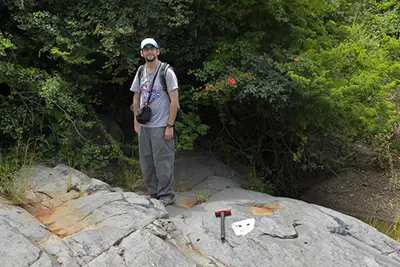
Field experience courses offered during the summer allowed students to explore New England, Montana and Idaho while gaining new skills in ecology and geology.
Environmental, Earth & Atmospheric Sciences Prof. Mathew Barlow led the Storms, Precipitation, Flooding and Groundwater section of a new report that assesses likely climate changes for the Greater Boston area.
Robert Gamache, a professor emeritus in the Department of Environmental, Earth and Atmospheric Sciences, has achieved an academic milestone, with his scientific publications garnering more than 30,000 Google Scholar citations.
UMass Lowell was once again designated a Tree Campus by the Arbor Day Foundation — and is on track to become classified as an arboretum this fall by the nonprofit organization ArbNet.
Prof. Juliette Rooney-Varga and a team of researchers are looking at ways to empower students to address climate change by advancing their climate literacy and STEM efficacy.
UML’s Society of Environmental Scientists teamed up with two local organizations for a cleanup along the riverbank behind LeLacheur Park. Together, they filled more than 30 60-gallon bags with trash.
The Kennedy College of Sciences hosted its fourth annual “Spring into Science” showcase, featuring educational and social events to highlight the importance of the field.
Environmental Science Prof. Mathew Barlow used data from NOAA’s GOES-West satellite to create an animation that demonstrated the intensity of Tonga's volcanic blast.
The National Science Foundation (NSF) awarded Asst. Prof. James Heiss a $680,000 faculty early-career development award to understand water and chemical exchanges between groundwater and surface water along the land-sea transition zone.
Asst. Prof. Christopher Skinner, who researches atmospheric rivers, explains why the weather phenomenon has been making headlines recently — and why it’s important to understand them.
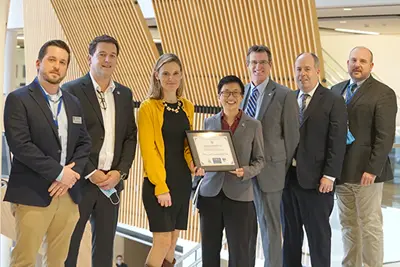
UMass Lowell received a Leading by Example award from the state’s Department of Energy Resources for its collaborative efforts with fellow honorees UMass Amherst, UMass Dartmouth and Salem State University to decarbonize their campuses.
An interdisciplinary group of faculty members from UMass Lowell’s Climate Change Initiative attended the recent United Nations global climate summit, aka COP26, in Glasgow, Scotland, where they observed progress being made — but also missed opportunities.
An interdisciplinary team of UML faculty, led by Assoc. Profs. Meg Sobkowicz-Kline and Chris Hansen, have received a nearly $3 million National Science Foundation Research Traineeship award for a new graduate student program focused on developing sustainable materials and chemicals that won’t harm water resources.
“Integrating Climate Change into the K-12 Classroom,” a free professional development workshop hosted by EEAS Assoc. Teaching Prof. Lori Weeden and the university’s Climate Change Initiative, showed teachers how they can address the topic through a variety of educational lenses.
Toxic mercury is being deposited in forests in much higher quantities than previously thought, posing a concern for the health and well-being of people, wildlife and waterways, according to Prof. Daniel Obrist, who is investigating the source of the pollution.
The UTeach program, which turns science, math and engineering majors into classroom teachers, is now in its 10th year at UMass Lowell. Graduates are in great demand at local high schools, and one was named a finalist for Massachusetts STEM Teacher of the Year.
A recent discovery by a research team that includes Kennedy College of Sciences Prof. Nelson Eby is shedding light on the debris created by an atomic blast, and it could set the stage for advances in materials research, including potential applications in energy, health care and nuclear forensics.
This story looks at research led by Prof. Daniel Obrist that determined a vast amount of mercury gas in the atmosphere is absorbed by plants, leading it to deposit into soils.
Environmental Science Prof. Juliette Rooney-Varga, director of UMass Lowell’s Climate Change Initiative, says we must depolarize the politics of climate change — an issue that President Biden has made a top priority in his new administration.
UMass Lowell’s Climate Change Initiative, in partnership with the Environmental, Earth & Atmospheric Sciences Department and the Rist Institute for Sustainability and Energy, is hosting a virtual spring seminar series featuring experts from across the country.
Four Environmental, Earth and Atmospheric Sciences faculty members and graduate students from the Kennedy College of Sciences presented research at the virtual AGU Fall Meeting, the largest gathering of Earth and space scientists from around the world.
Environmental, Earth and Atmospheric Sciences Asst. Prof. James Heiss and the Woods Hole Oceanographic Institution were awarded a three-year, $784,000 National Science Foundation grant to study how powerful coastal storms affect the fresh water flowing below the ground along the seashore.
UMass Lowell is No. 16 on Sierra magazine’s “Cool Schools” list for 2020, the university’s highest ranking ever in a survey that assesses colleges’ performances on everything from sustainability-focused courses, carbon-neutral energy and land policies, eco-friendly dining halls and student engagement.
Profs. Mathew Barlow and Christopher Skinner of the Department of Environmental, Earth and Atmospheric Sciences will study the cause of heat waves and droughts in the Northeast and how they interact with each other under a three-year, $478,000 grant from the National Oceanic and Atmospheric Administration.
Environmental science students from the Kennedy College of Sciences led free educational sessions on Zoom for middle and high school students who, like them, are stuck at home because of the coronavirus pandemic.
James Heiss' research aims to understand effects of extreme multi-hazard coastal storms, including surge, heavy precipitation, and coastal erosion, on groundwater flow and mixing patterns in beach aquifers.
Asst. Prof. Richard Gaschnig of the Department of Environmental, Earth and Atmospheric Sciences has been awarded a three-year, $222,600 grant by the National Science Foundation to study the chemical exchange that occurs between the ocean crust and the earth’s mantle during a geological process called subduction.
Richard Gaschnig received an NSF award from the Petrology and Geochemistry program entitled “Collaborative Research: Tracking novel metal isotope signatures during subduction metamorphism.”
Climate change was the central issue at the 100th annual meeting of the American Meteorological Society in Boston, where students, faculty and alumni from the Kennedy College of Sciences shared their environmental and atmospheric science research and networked with meteorologists, climate scientists and academics from around the country.
The university’s Climate Change Initiative hosted members of the state’s House Committee on Global Warming and Climate Change for a roundtable discussion on climate science and policy at which faculty members shared scientific research and expertise to help inform policy decisions.
The National Science Foundation (NSF) has awarded a three-year, $873,000 grant to a research project led by Prof. Daniel Obrist to study mercury pollution in forests.
The Kennedy College of Sciences celebrated nearly 90 freshman students who made the fall semester Dean’s List at a recent dinner reception at the UML Inn & Conference Center in Lowell.
Students majoring in geoscience, civil engineering, environmental science and meteorology got hazmat-certified to broaden their skills, giving them an advantage in the job market.
For an optimum web experience we recommend the latest version of Firefox, Chrome, Edge, or Safari. Please use one of the links below to install a supported browser.