As a computer science major, you will learn to design and implement effective, economical and creative solutions using computer systems.

Bachelor of Science in Computer Science

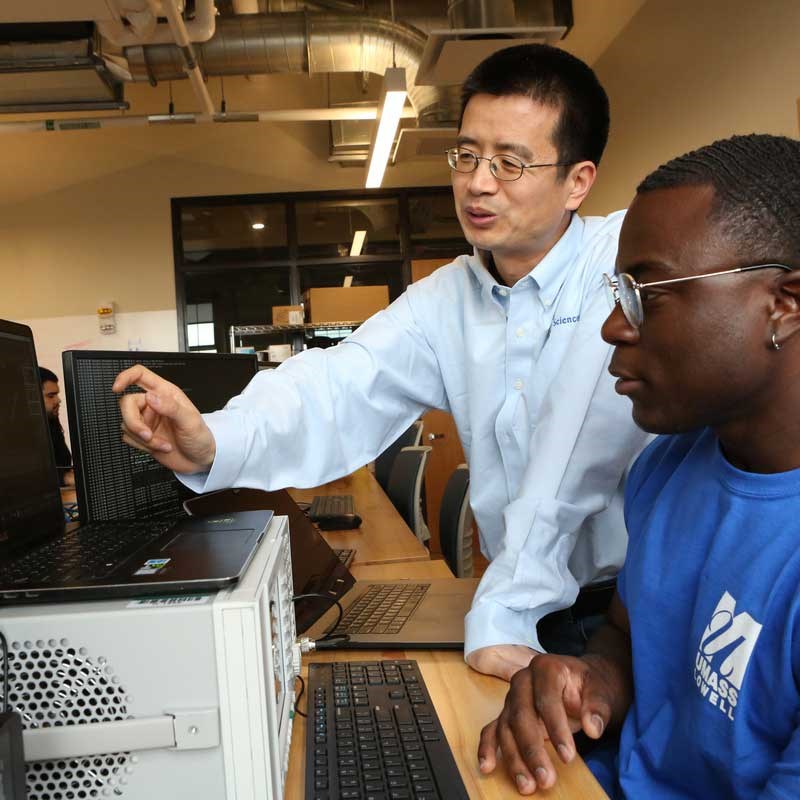
Professor and student work on a computer at the UMass Lowell Cyber Range

At UMass Lowell, you’ll learn to design, build and troubleshoot the technologies that power our world — from software and apps to intelligent systems and cybersecurity tools. 

As a computer science major, you'll benefit from:

  • Hands-on learning through project-based courses and undergraduate research with faculty
  • Internships and co-ops with regional and national industry partners, like Google and Bose
  • Career versatility across industries such as finance, healthcare, manufacturing, education and public service
  • A strong professional network with employers throughout Lowell, Boston and New England
  • Student engagement opportunities, including computing clubs, innovation initiatives like the DifferenceMaker, and participation in events such as the Grace Hopper Celebration.

Together, these experiences help you build technical expertise, professional connections and adaptable skills that support long-term career success.

What Can You Do with a Computer Science Major?

Computing and data skills are increasingly essential across industries, giving our graduates the versatility to pursue careers across diverse industries, including: 

  • Technology
  • Finance 
  • Healthcare
  • Manufacturing
  • Education
  • Public Service
Two students look at a laptop computer screen

Located in the vibrant Lowell-Boston corridor, UMass Lowell connects students with a strong regional network of employers throughout Lowell, Boston and New England.

Where Our Graduates Work

  • Analog Devices
  • Cisco
  • Fidelity
  • Google
  • Raytheon 
  • Beijing University
  • Pfizer Research
  • 3Com
  • AstraZeneca
  • BAE Systems
  • Cisco
  • Dell EMC
  • IMB
  • Microsoft
  • NASA
  • Oracle
  • Segway
  • Toyota Research Institute

Graduate School Placements Include

  • Harvard University
  • Tufts University
  • MIT
  • Brown University
  • Worcester Polytechnic Institute
  • University of South Florida

Hear from Our Students

Jessica Vu poses outside of Nvidia’s Silicon Valley headquarters.
Jessica Vu '26
Computer science

Computer science major Jessica Vu is gaining invaluable experience and honing automation skills during a prestigious eight-month co-op at chipmaker Nvidia, where she contributes to cutting-edge autonomous vehicle technology.

In tech, especially in software, you have to update your knowledge every day.
Ariana Brown works at a computer
Ariana Brown '25
Computer Science

SoarCS, a summer program for incoming computer science majors, helped shape Ariana Brown’s college experience.

Being selected for the Immersive Scholars program was a big draw for me to UMass Lowell.
John Kilgo smiling in front of MITRE signage
John Kilgo '19
Computer Science

John Kilgo VI began working at MITRE Corporation more than three years ago as an intern, when he was a UMass Lowell undergraduate. Now, he’s employed there full time as a software systems engineer, while enrolled part time in the master’s program in computer science.

The flexibility of the program allows the courses to sync up with what I’m doing at work.

Year-by-Year Course Plan

Check out our degree pathways, which offer sample plans for completing your degree in four years.

For students who entered fall 2020 and beyond.

Freshman Year

Fall Semester

Course NumberCourse NameCredits
ENGL.1010 /
HONR.1100
College Writing I /
First Year Seminar in Honors: Text in the City (CW)
3
COMP.1010Computing I (STEM)3
COMP.1030LComputing I Lab1
MATH.1310Calculus I (MATH)14
xxxx.xxxxSocial Sciences Perspective (SS)23
Total14

Spring Semester

Course NumberCourse NameCredits
ENGL.1020College Writing II (CW)3
COMP.1020Computing II3
COMP.1040LComputing II Lab1
MATH.1320Calculus II4
xxxx.xxxxArts and Humanities Perspective (AH)23
Total14

Sophomore Year

Fall Semester

Course NumberCourse NameCredits
Total14
COMP.2010Computing III3
COMP.2010RComputing III Lab1
COMP.2030Assembly Language Programming3
COMP.2030RAssembly Language Programming Lab1
COMP.2300Introduction to Computer Security3
MATH.2190Discrete Structures I3

Spring Semester

Course NumberCourse NameCredits
Total15
COMP.2040Computing IV (AIL)3
EECE.2650Logic Design3
MATH.3220Discrete Structures II3
COMP.xxxxCybersecurity Elective53
xxxx.xxxxSocial Sciences Perspective (SS)2 - CRIM course recommended33

Junior Year

Fall Semester

Course NumberCourse NameCredits
Total15
ENGL.2200Oral & Written Communication for Computer Science (AH), (WOC)3
COMP.3040Foundations of Computer Science3
COMP.3050Computer Architecture3
COMP.4130Data Communications I3
MATH.3860Probability & Statistics3

Spring Semester

Course NumberCourse NameCredits
Total16
COMP.3010Organization of Programming Languages3
COMP.3080Introduction to Operating Systems3
COMP.3300Introduction to Malware Analysis3
xxxx.xxxxNatural Science Elective with Lab (SCL)44
xxxx.xxxxArts and Humanities Perspective (AH)2 - CS Ethics3

Senior Year

Fall Semester

Course NumberCourse NameCredits
Total16
COMP.3090Database I3
COMP.4040Analysis of Algorithms (CTPS), (IL), (QL)3
COMP.xxxxCybersecurity Elective53
xxxx.xxxxNatural Science Elective with Lab (SCL)44
xxxx.xxxxSocial Sciences Perspective (SS)2 - CRIM course recommended33

Spring Semester

Course NumberCourse NameCredits
xxxx.xxxxNatural Science Elective with Lab44
xxxx.xxxxFree Elective63
Total16

Total Minimum Credits = 120

1Your Math sequence pathway will be determined based on your ALEKS placement score and/or previous AP courses taken.

2The Core Curriculum Essential Learning Outcomes for Diversity and Cultural Awareness (DCA) and Social Responsibility and Ethics (SRE) are fulfilled outside the Computer Science major. See the DCA course listing and the SRE course listing for a full list of classes that fulfill these requirements.

3CRIM%20courseCybersecurity students must complete at least two courses from School of Criminology & Justice Studies. The following CRIM (SS) courses are recommended:

4Natural Science Elective Requirements

  • Students must complete at least 12 credits of Natural Science Elective courses.
  • At least two of these courses must be scheduled with the co-requisite lab.
  • This requirement may be satisfied by taking three courses with lab (12 credits total), or by taking two courses with lab and two courses without lab (14 credits total).
  • The following courses fulfill this requirement:
  • Courses fulfilling this requirement must be classified as required or elective courses for the majors in those departments. There are some exception to this rule. For more details, contact program coordinator.

5Cybersecurity Electives

6Free Electives

  • All students must complete a minimum of 120 credits to graduate.
  • Free Electives are credits, beyond the specifically required coursework, necessary to meet this 120-credit minimum.
  • Courses below the lowest-level required courses in the Computer Science major cannot be used as Free Electives. For example, no MATH course below Calculus I is acceptable.
  • INFO.xxxx courses cannot be used as Free Electives.

No more than two Breadth of Knowledge courses can be taken with the same prefix. The Core Curriculum courses may be taken in any sequence. Refer to the Core Curriculum policy for further details. You should meet with your faculty advisor to determine how you will meet the Core Curriculum requirements.

Current UMass Lowell students should use their Advisement Report in SIS. If you need assistance, please contact your adviser.

Restriction on off-campus study:

Be advised that any course taken at another institution must be formally approved prior to enrollment. See the catalog policy for details.


Breadth of Knowledge (BOK) Glossary

  • SS - Social Sciences Perspective - 9 credits
  • AH - Arts and Humanities Perspective - 9 credits
  • SCL - Sciences with Lab Perspective - 6 credits
  • STEM - Science, Technology, Engineering and Math Perspective - 3 credits
  • CW - College Writing I and II - 6 credits
  • MATH - Math Perspective - 3 credits

Read more about the Breadth of Knowledge requirements.

Essential Learning Outcomes (ELO) Glossary

  • AIL - Applied and Integrative Learning
  • CTPS - Critical Thinking and Problem Solving
  • DCA - Diversity and Cultural Awareness
  • IL - Information Literacy
  • QL - Quantitative Literacy
  • SRE - Social Responsibility and Ethics
  • WOC - Written and Oral Communication

Read more about the Essential Learning Outcomes.

For students who entered fall 2020 and beyond.

Freshman Year

Fall Semester

Course NumberCourse NameCredits
Total14
ENGL.1010 /
HONR.1100
College Writing I /
First Year Seminar in Honors: Text in the City (CW)
3
COMP.1010Computing I (STEM)3
COMP.1030LComputing I Lab1
MATH.1310Calculus I (MATH)14
xxxx.xxxxSocial Sciences Perspective (SS)23

Spring Semester

Course NumberCourse NameCredits
Total15
ENGL.1020College Writing II (CW)3
CHEM.1210Chemistry I (SCL)3
CHEM.1230LChemistry I Lab1
COMP.1020Computing II3
COMP.1040LComputing II Lab1
MATH.1320Calculus II4

Sophomore Year

Fall Semester

Course NumberCourse NameCredits
Total14
BIOL.1110Principals of Biology I3
BIOL.1170LExperimental Biology I1
COMP.2010Computing III3
COMP.2010RComputing III Lab1
MATH.2190Discrete Structures I3
EECE.2650Logic Design3

Spring Semester

Course NumberCourse NameCredits
Total17
COMP.2030Assembly Language Programming3
COMP.2030RAssembly Language Programming Lab1
COMP.2040Computing IV (AIL)3
MATH.3220Discrete Structures II3
ENGL.2200Oral and Written Communication for Computer Science (AH), (WOC)3
CHEM.1220Chemistry II3
CHEM.1240LChemistry II Lab1

Junior Year

Fall Semester

Course NumberCourse NameCredits
COMP.3040Foundations of Computer Science3
COMP.3050Computer Architecture3
MATH.3860Probability and Statistics I3
BIOL.2350Genetics33
BIOL.2370Problems in Genetics1
xxxx.xxxxSocial Sciences Perspective (SS)23
Total16

Spring Semester

Course NumberCourse NameCredits
COMP.3010Organization of Programming Languages3
COMP.3080Operating Systems3
xxxx.xxxxTechnical Elective33
xxxx.xxxxArts and Humanities Perspective (AH)23
xxxx.xxxxFree Elective3
Total15

Senior Year

Fall Semester

Course NumberCourse NameCredits
COMP.4040Analysis of Algorithms (CTPS), (IL), (QL)3
COMP.xxxxProject Course I3
COMP.xxxxBio-Cheminformatics Elective43
xxxx.xxxxArts and Humanities Perspective (AH)23
xxxx.xxxxFree Elective3
Total15

Spring Semester

Course NumberCourse NameCredits
COMP.xxxxProject Course II3
COMP.xxxxBio-Cheminformatics Elective43
xxxx.xxxxSocial Sciences Perspective (SS)23
xxxx.xxxxFree Elective3
Total15

Total Minimum Credits = 121

1Your Math sequence pathway will be determined based on your ALEKS placement score and/or previous AP courses taken.

2The Core Curriculum Essential Learning Outcomes for Diversity and Cultural Awareness (DCA) and Social Responsibility and Ethics (SRE) are fulfilled outside the Computer Science major. See the DCA course listing and the SRE course listing for a full list of classes that fulfill these requirements.

3Technical Elective: BIOL.2xxx, BIOL.3xxx, BIOL.4xxx, CHEM.2xxx, CHEM.3xxx, CHEM.4xxx.

4Bio-Cheminformatics Electives: COMP.4200, COMP.4210, COMP.4220, COMP.5400, COMP.5411 (When Bio-Cheminformatics electives satisfy Computer Science project courses, any two Computer Science electives satisfy Computer Science elective requirement).

No more than two Breadth of Knowledge (BOK) courses can be taken with the same prefix. The Core Curriculum courses may be taken in any sequence. Refer to the Core Curriculum policy for further details. You should meet with your faculty advisor to determine how you will meet the Core Curriculum requirements.

Current UMass Lowell students should use their Advisement Report in SIS. If you need assistance, please contact your adviser.

Restriction on Off-campus Study

Be advised that any course taken at another institution must be formally approved prior to enrollment. See the catalog policy for details.

Breadth of Knowledge (BOK) Glossary

  • SS - Social Sciences Perspective - 9 credits
  • AH - Arts and Humanities Perspective - 9 credits
  • SCL - Sciences with Lab Perspective - 6 credits
  • STEM - Science, Technology, Engineering and Math Perspective - 3 credits
  • CW - College Writing I and II - 6 credits
  • MATH - Math Perspective - 3 credits

Read more about the Breadth of Knowledge requirements.

Essential Learning Outcomes (ELO) Glossary

  • AIL - Applied and Integrative Learning
  • CTPS - Critical Thinking and Problem Solving
  • DCA - Diversity and Cultural Awareness
  • IL - Information Literacy
  • QL - Quantitative Literacy
  • SRE - Social Responsibility and Ethics
  • WOC - Written and Oral Communication

Read more about the Essential Learning Outcomes.

For students who entered fall 2025 and beyond.

Freshman Year

Fall Semester

Course NumberCourse NameCredits
ENGL.1010 /
HONR.1100
College Writing I /
First Year Seminar in Honors: Text in the City (CW)
3
DATA.1010
DATA.1010L
OR
COMP.1010
COMP.1030L
Data Structures in Python I
Programming Lab I
OR
Computing I
Computing I Lab
4
MATH.1310Calculus I (MATH)4
xxxx.xxxxSocial Sciences Perspective (SS)13
Total14

Spring Semester

Course NumberCourse NameCredits
ENGL.1020College Writing II (CW)3
DATA.1020
DATA.1020L
OR
COMP.1020
COMP.1040L
Data Structures in Python II
Programming Lab II
OR
Computing II
Computing II Lab
4
MATH.1320Calculus II4
xxxx.xxxxArts and Humanities Perspective (AH)13
Total14

Sophomore Year

Fall Semester

Course NumberCourse NameCredits
DATA.2010Data Science with R Programming3
DATA.2251Data Management with SQL3
MATH.2190Discrete Structures I3
xxxx.xxxxNatural Science Elective (SCL)24
xxxx.xxxxSocial Sciences Perspective (SS)13
Total16

Spring Semester

Course NumberCourse NameCredits
DATA.2101Linear Algebra with Computers4
DATA.2051Data Visualization3
MATH.3850Applied Statistics3
xxxx.xxxxArts and Humanities Perspective (AH)13
xxxx.xxxxFree Elective33
Total16

Junior Year

Fall Semester

Course NumberCourse NameCredits
DATA.2012Data Science Studio (IL)4
DATA.3210Data Mining (QL)3
MATH.3860Probability and Statistics I (STEM)3
xxxx.xxxxSocial Sciences Perspective (SS)13
xxxx.xxxxTechnical Elective43
Total16

Spring Semester

Course NumberCourse NameCredits
DATA.3102Data Modeling and Statistical Inference (CTPS)3
DATA.3220Applied Machine Learning3
xxxx.xxxxDomain Application Elective53
xxxx.xxxxNatural Science Elective (SCL)24
xxxx.xxxxArts and Humanities Perspective (AH)13
Total16

Senior Year

Fall Semester

Course NumberCourse NameCredits
DATA.3221Deep Learning3
xxxx.xxxxProject Pair Course 163
xxxx.xxxxDomain Application Elective53
xxxx.xxxxNatural Science Elective24
xxxx.xxxxFree Elective33
Total16

Spring Semester

Course NumberCourse NameCredits
DATA.4900Capstone Project (AIL), (WOC)6
xxxx.xxxxProject Pair Course 263
xxxx.xxxxTechnical Elective43
Total12

Total Minimum Credits = 120

Minimum [major] Credits: 49 (DATA and COMP prefixes)

Maximum [major] credits that can be counted toward graduation: 60

1Core Curriculum:

  • No more than two Breadth of Knowledge (BOK) courses can be taken with the same prefix. The Core Curriculum courses may be taken in any sequence. Refer to the Core Curriculum policy for further details. You should meet with your faculty advisor to determine how you will meet the Core Curriculum requirements.
  • The Core Curriculum Essential Learning Outcomes for Diversity and Cultural Awareness (DCA) and Social Responsibility and Ethics (SRE) are fulfilled outside the Data Science major. See the DCA course listing and the SRE course listing for a full list of classes that fulfill these requirements.

2Natural Electives:

  • Natural Science Electives are courses offered by one of the four natural science departments in the College of Sciences: Biological Sciences, Chemistry, Environmental, Earth, and Atmospheric Sciences, Physics and Applied Physics.
  • Each course must include a 3-credit lecture accompanied by a 1-credit lab.
  • Courses that fulfill this requirement must be classified as required or elective courses for the majors in those departments.

3Free Electives:

  • Free Elective courses must not be below the level of any course specifically required by the Data Science major and cannot simultaneously be used to satisfy any other major or elective requirements.
  • A maximum of 60 credits of DATA and COMP courses can be counted towards the minimum 120 credits required to graduate.

4Technical Electives:

  • Technical Electives are courses offered by departments in the College of Sciences or the College of Engineering, provided they are not used to satisfy any other requirements and are not INFO courses.
  • Courses that fulfill this requirement must be classified as required or elective courses for the majors in those departments.
  • To use a DATA course as a Technical Elective, it must be at the 3000 or 4000-level.
  • To use COMP course as a Technical Elective, it must be at the 2000, 3000,4000, or 5000-level.
  • However, no more than 60 credits  of DATA and COMP courses can be counted towards the minimum 120 credits required to graduate.

5Domain Application Electives:

  • Domain Application Electives are data-driven courses offered by other departments for their majors, involving the analysis, processing, and management of data.
  • Students must select two courses (6 credits) from one of the approved domain areas.
  • There are two Domain Application areas:
    • Economics (select 2 courses)
    • Environmental Sciences (select 2 courses)
      • ENVI.3010 GIS in Earth and Environmental Science
      • ENVI.4970 Research: Environmental Studies
      • ATMO.4130 Regional Weather and Climate Modeling
      • ATMO.4200 Intro to Operational Numerical Weather Prediction
      • ATMO.4970 Research: Atmospheric Science

Note: Other Domain Application areas may be approved by the department.

6Project Pair Courses:

  • A Project Pair consists of two courses, which deepen a student’s knowledge in a specific area in Data/Computer Science.
  • The Project Pair is selected from the following list:

Note: Other combinations of courses from the pairs listed above may also be used to form a different project pair, subject to the approval of the Program Coordinator.

Current UMass Lowell students should use their Advisement Report in the Student Information System (SiS). If you need assistance, please contact your adviser.

Restriction on off-campus study:

Be advised that any course taken at another institution must be formally approved prior to enrollment. See the catalog policy for details.

Breadth of Knowledge (BOK) Glossary

  • SS - Social Sciences Perspective - 9 credits
  • AH - Arts and Humanities Perspective - 9 credits
  • SCL - Sciences with Lab Perspective - 6 credits
  • STEM - Science, Technology, Engineering and Math Perspective - 3 credits
  • CW - College Writing I and II - 6 credits
  • MATH - Math Perspective - 3 credits

Read more about the Breadth of Knowledge requirements.

Essential Learning Outcomes (ELO) Glossary

  • AIL - Applied and Integrative Learning
  • CTPS - Critical Thinking and Problem Solving
  • DCA - Diversity and Cultural Awareness
  • IL - Information Literacy
  • QL - Quantitative Literacy
  • SRE - Social Responsibility and Ethics
  • WOC - Written and Oral Communication

Read more about the Essential Learning Outcomes.

For students who entered fall 2020 and beyond.

Freshman Year

Fall Semester

Course NumberCourse NameCredits
ENGL.1010 /
HONR.1100
College Writing I /
First Year Seminar in Honors: Text in the City (CW)
3
COMP.1010Computing I (STEM)3
COMP.1030LComputing I Lab1
MATH.1310Calculus I (MATH)14
xxxx.xxxxSocial Sciences Perspective (SS)23
Total14

Spring Semester

Course NumberCourse NameCredits
ENGL.1020College Writing II (CW)3
COMP.1020Computing II3
COMP.1040LComputing II Lab1
MATH.1320Calculus II4
xxxx.xxxxArts and Humanities Perspective (AH)23
Total14

Sophomore Year

Fall Semester

Course NumberCourse NameCredits
Total14
COMP.2010Computing III3
COMP.2010RComputing III Lab1
MATH.2190Discrete Structures I3
EECE.2650Logic Design3
xxxx.xxxxNatural Science with Lab34

Spring Semester

Course NumberCourse NameCredits
Total16
ENGL.2200Oral & Written Communication for Computer Science (AH), (WOC)3
COMP.2030Assembly Language Programming3
COMP.2030RAssembly Language Programming Lab1
COMP.2040Computing IV (AIL)3
MATH.3220Discrete Structures II3
MATH.3860Probability & Statistics I3

Junior Year

Fall Semester

Course NumberCourse NameCredits
COMP.3040Foundations of Computer Science3
COMP.3050Computer Architecture3
xxxx.xxxxNatural Science with Lab (SCL)34
xxxx.xxxxArts and Humanities Perspective (AH)2 - CS Ethics3
xxxx.xxxxFree Elective63
Total16

Spring Semester

Course NumberCourse NameCredits
COMP.3010Organization of Programming Languages3
COMP.3080Operating Systems3
xxxx.xxxxNatural Science with Lab (SCL)34
xxxx.xxxxSocial Sciences Perspective (SS)23
xxxx.xxxxFree Elective63
Total16

Senior Year

Fall Semester

Course NumberCourse NameCredits
COMP.4040Analysis of Algorithms (CTPS), (IL), (QL)3
COMP.xxxxProject Course I3
COMP.xxxxComputer Science Elective53
xxxx.xxxxTechnical Elective43
xxxx.xxxxSocial Sciences Perspective (SS)23
Total15

Spring Semester

Course NumberCourse NameCredits
COMP.xxxxProject Course II3
COMP.xxxxComputer Science Elective53
xxxx.xxxxTechnical Elective43
xxxx.xxxxFree Elective63
Total15

Total Minimum Credits = 120

1Your Math sequence pathway will be determined based on your ALEKS placement score and/or previous AP courses taken.

2The Core Curriculum Essential Learning Outcomes for Diversity and Cultural Awareness (DCA) and Social Responsibility and Ethics (SRE) are fulfilled outside the Computer Science major. See the DCA course listing and the SRE course listing for a full list of classes that fulfill these requirements.

3Natural Science Electives

  • CS students must complete 12 credits of natural science courses.
  • These are courses offered by one of the four natural science departments in the College of Sciences:
    • Biological Sciences
    • Chemistry
    • Environmental, Earth, and Atmospheric Sciences
    • Physics and Applied Physics
  • Courses that fulfill this requirement must be classified as required or elective courses for the majors in those departments (with some exceptions).
  • This requirement may also be satisfied by completing three 3-credit courses that do not include labs plus one 4-credit course that does include a lab (totaling 13 credits rather than 12), but the Computer Science faculty recommends that students take three 4-credit courses that do include labs as laid out in the course grid.
  • This requirement may also be satisfied by completing two 4-credit courses including their lab for eight credits and then taking two more 3-credit lectures (totaling 14 credits rather than 12), but the Computer Science faculty recommends that students take three 4-credit courses that do include labs as laid out in the course grid.
  • Specific courses may be recommended for different CS Options.
  • See the CS Dept. Policy on Natural Science Electives for more detailed information.

4Technical Electives

  • CS students must complete 6 credits of technical electives.
  • These are courses offered by the College of Sciences (this is our college) or the College of Engineering.
  • Courses that fulfill this requirement must be classified as required or elective courses for the majors in those departments.
  • In general, INFO.xxxx courses may not be used to fulfill this requirement.
  • To use a CS course as a technical elective, it must at the 3000, 4000, or 5000 level.
  • Specific courses may be recommended for different CS Options.

5Computer Science Electives

  • CS students must complete two courses (6 credits) of computer science electives.
  • These courses must be at the 3000 level or higher.
  • These may be any non-required courses offered by the CS Department that are not taken to fill other slots. (That is, courses cannot be “double counted.”)
  • Specific courses may be recommended for different CS Options.

6Free Electives

  • CS students must complete 12 credits of almost any course offered by the university.
  • Courses taken to fulfill this requirement must not be below the level of any required course.
  • Specific courses may be recommended for different CS Options.
  • More detailed information may be found on the CS Dept. Policy on General Electives.

Notes:

  • Courses listed in “slots” may generally be taken in any order, within the confines of specified course prerequisites.
  • Some CS Options may put constraints on the ordering of these electives.
  • Faculty advisors recommend that two-course sequences (such as Chemistry I and II) be taken in successive semesters rather than taking part 1 and then waiting one or more semesters to take part 2.

No more than two Breadth of Knowledge (BOK) courses can be taken with the same prefix. The Core Curriculum courses may be taken in any sequence. Refer to the Core Curriculum policy for further details. You should meet with your faculty advisor to determine how you will meet the Core Curriculum requirements.

Current UMass Lowell students should use their Advisement Report in SIS. If you need assistance, please contact your adviser.

Restriction on off-campus study:

Be advised that any course taken at another institution must be formally approved prior to enrollment. See the catalog policy for details.


Breadth of Knowledge (BOK) Glossary

  • SS - Social Sciences Perspective - 9 credits
  • AH - Arts and Humanities Perspective - 9 credits
  • SCL - Sciences with Lab Perspective - 6 credits
  • STEM - Science, Technology, Engineering and Math Perspective - 3 credits
  • CW - College Writing I and II - 6 credits
  • MATH - Math Perspective - 3 credits

Read more about the Breadth of Knowledge requirements.

Essential Learning Outcomes (ELO) Glossary

  • AIL - Applied and Integrative Learning
  • CTPS - Critical Thinking and Problem Solving
  • DCA - Diversity and Cultural Awareness
  • IL - Information Literacy
  • QL - Quantitative Literacy
  • SRE - Social Responsibility and Ethics
  • WOC - Written and Oral Communication

Read more about the Essential Learning Outcomes.

Why study computer science at UMass Lowell?

Two students work with a robot and laptop in the NERVE Center at UMass Lowell.

Research Labs

Our research labs have close ties with regional and national high-tech companies that employ our current students and alumni. Research topics include: 

  • Artificial intelligence
  • Assistive technology
  • Bioinformatics
  • Cybersecurity and privacy
  • Data mining
  • Human-computer interaction
  • Machine learning
Student wearing a virtual reality headset control in a computer science classroom at UMass Lowell

Robotics Minor

Gain a solid foundation in robotics with a Robotics minor, which combines computer science with electrical engineering, mechanical engineering and other STEM-related disciplines.

Student uses a calculator while working on a laptop in a UMass Lowell computer science classroom.

Co-ops & Internships

Apply to be part of the co-op program after your first year. Students have worked as interns at regional, national and international companies, including: 

  • Dell EMC
  • Facebook
  • Google
  • iRobot
  • Raytheon Technologies
  • IBM
  • Bose
male-student-pointing-at-model-on-computer-screen

Specialized Facilities & Equipment

  • Our laboratories support research in cybersecurity, natural language processing, computer architecture and more.
  • The New England Robotics Validation and Experimentation (NERVE) Center, focuses on robotics research with motion capture systems, a split-belt treadmill and a wide variety of robot systems.

Visit UMass Lowell

Launch virtual tour

Visit campus, meet our people and picture yourself here. Find in-person and virtual tours and events.

Still Exploring Majors?

We've got 120+ programs. Browse our Program Finder to find the one that's right for you.

View All Programs