Chemical engineers manipulate chemical processes to solve problems and improve the well-being of humanity, through innovations in pharmaceuticals, biotechnology, clean energy, advanced materials and more.

What courses will you take?

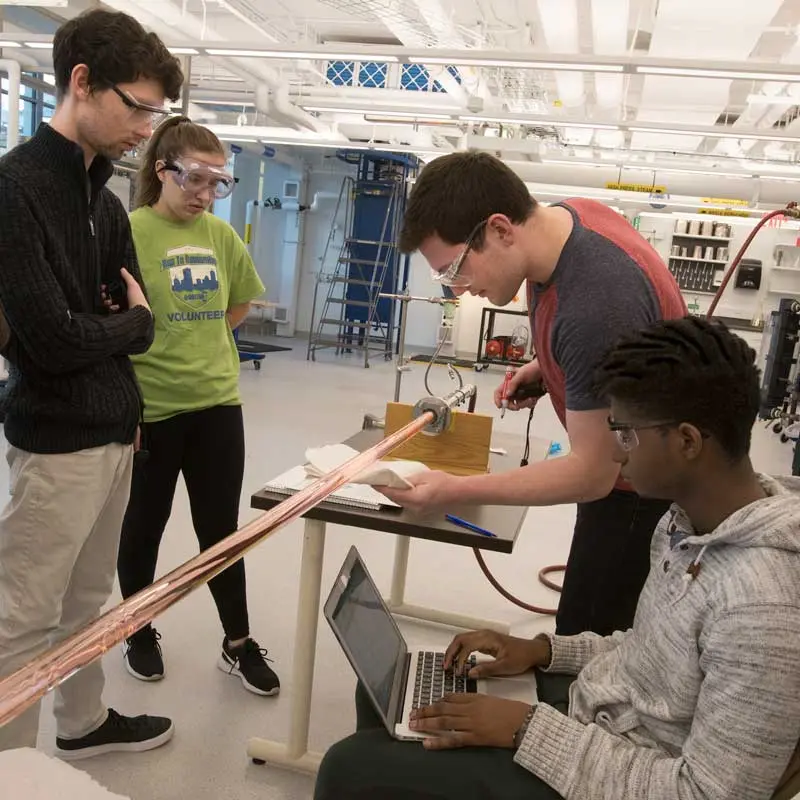
Chemical Engineering student working in lab.

The Chemical Engineering major offers courses across four degree options, which lead to a wide range of career opportunities:

  • General Option — Gain a broad foundation in chemical engineering. You'll prepare for careers that address diverse problems in either traditional or emerging fields of chemical engineering. 
  • Nuclear Engineering Option— Build a strong foundation in nuclear science, engineering and technology to pursue careers in the nuclear energy and technology field. 
  • Bioengineering Option — Gain skills and knowledge to work in the bio-pharmaceutical or biotechnology industry. 
  • Advanced Materials Option — Prepare to design, develop and improve advanced materials like polymers, composites, ceramics and nanomaterials.

All students take courses in the humanities and social sciences to broaden perspectives, improve communication skills, and explore concepts of values and ethics.

The Chemical Engineering program is accredited by the Engineering Accreditation Commission of ABET under the commission’s General Criteria and Program Criteria for Chemical Engineering. The Chemical Engineering: Nuclear Engineering Option program is accredited by the Engineering Accreditation Commission of ABET under the commission’s General Criteria and Program Criteria for Chemical Engineering and Nuclear Engineering.

Visit the Academic Catalog for:

Year-by-Year Course Plan

Check out our degree pathways, which offer sample plans for completing your degree in four years.

For students who entered fall 2020 and beyond.

Freshman Year

Fall Semester

Course NumberCourse NameCredits
CHEN.1070Introduction to Chemical Engineering2
ENGL.1010 /
HONR.1100
College Writing I5 /
First Year Seminar in Honors: Text in the City (CW)
3
CHEM.1210Chemistry I Sciences with Lab Perspective (SCL)53
CHEM.1230LChemistry I Lab (SCL)1
MATH.1310Calculus I (MATH)4/54
xxxx.xxxxSocial Sciences Perspective (SS)63
Total16

Spring Semester

Course NumberCourse NameCredits
ENGL.1020College Writing II (CW)53
CHEM.1220Chemistry II53
CHEM.1240LChemistry II Lab1
MATH.1320Calculus II54
PHYS.1410Physics I (SCL)53
PHYS.1410LPhysics I Lab (SCL)1
Total15

Sophomore Year

Fall Semester

Course NumberCourse NameCredits
CHEN.2010Principles of Chemical Engineering3
CHEN.2050Fundamentals of Electricity3
CHEM.2210Organic Chemistry I1/53
MATH.2310Calculus III54
BIOL.2100Biology for Engineers3
BIOL.2120LBiology for Engineers Lab1
Total17

Spring Semester

Course NumberCourse NameCredits
CHEN.2020Chemical Engineering Thermodynamics3
CHEN.3030Fluid Mechanics3
CHEM.2050LOrganic Chemistry Lab11
CHEM.2220Organic Chemistry II1/53
MATH.2340 /
MATH.2360
Differential Equations /
Engineering Differential Equations5
3
PHIL.1030 /
PHIL.2410
Introduction to Ethics /
Engineering and Ethics (AH), (SRE)
3
Total16

Junior Year

Fall Semester

Course NumberCourse NameCredits
CHEN.3040Heat Transfer and Unit Operations3
CHEN.3060Transport Phenomena3
CHEN.3110Phase and Chemical Equilibria3
CHEN.3150Unit Operations Lab (WOC), (QL)3
CHEM.3440Physical Chemistry I23
xxxx.xxxxArts and Humanities Perspective (AH)63
Total18

Spring Semester

Course NumberCourse NameCredits
CHEN.3080Introduction to Material Science and Engineering3
CHEN.3100Separation Processes3
CHEN.3170Applied Engineering Problem Solving3
CHEN.4030Chemical Reaction Engineering3
CHEM.3470LPhysical Chemistry Lab II21
ECON.2010 /
ECON.2020
Principles of Microeconomics /
Principles of Macroeconomics (SS)
3
Total16

Senior Year

Fall Semester

Course NumberCourse NameCredits
CHEN.4090Engineering Economics and Process Analysis (IL), (CTPS), (AIL)3
CHEN.4130Process Dynamics and Control3
CHEN.4150Process Operations and Controls Laboratory3
CHEN.xxxxChemical Engineering Technical Elective33
xxxx.xxxxTechnical Elective33
Total15

Spring Semester

Course NumberCourse NameCredits
CHEN.4100Plant Design (IL), (CTPS), (AIL)3
CHEN.xxxxChemical Engineering Technical Elective33
xxxx.xxxxTechnical Elective33
xxxx.xxxxSocial Sciences Perspective (SS)63
xxxx.xxxxArts and Humanities Perspective (AH)63
Total15

Total Minimum Credits = 128

1The listed co-requisite, CHEM.2290L or CHEM.2300L, Organic Chemistry Lab, is not required for Chemical Engineering majors. CHEM.2050L is the required lab.

2The listed co-requisite, CHEM.3460L, Physical Chemistry Lab, is not required for Chemical Engineering majors. CHEM.3470L is the required lab.

3All Technical Electives should be chosen from an approved list. Consult with your advisor.

4Calculus IA, and Calculus IB instead of Calculus I, will be required for students that do not pass the Calculus Readiness Test.

5Honors level courses may be taken instead.

6Chemical Engineering majors meet the Diversity and Cultural Awareness (DCA) ELO with an approved course outside the major requirements.

The University Core Curriculum requirements must be satisfied. Either ECON.2010 Principles of Microeconomics or ECON.2020 Principles of Macroeconomics must be used to satisfy one of the Social Sciences Perspective (SS) requirements. Either PHIL.1030 Introduction to Ethics or PHIL.2410 Engineering and Ethics must be used to satisfy one of the Arts and Humanities Perspective (AH) requirements.

No more than two Breadth of Knowledge (BOK) courses can be taken with the same prefix. The Core Curriculum courses may be taken in any sequence. Refer to the Core Curriculum policy for further details. You should meet with your faculty advisor to determine how you will meet the Core Curriculum requirements.

Current UMass Lowell students should use their Advisement Report in SiS. If you need assistance, please contact your advisor.

Restriction on off-campus study:

Be advised that any course taken at another institution must be formally approved prior to enrollment. See the catalog policy for details.

Breadth of Knowledge (BOK) Glossary

  • SS - Social Sciences Perspective - 9 credits
  • AH - Arts and Humanities Perspective - 9 credits
  • SCL - Sciences with Lab Perspective - 6 credits
  • STEM - Science, Technology, Engineering and Math Perspective - 3 credits
  • CW - College Writing I and II - 6 credits
  • MATH - Math Perspective - 3 credits

Read more about the Breadth of Knowledge requirements.

Essential Learning Outcomes (ELO) Glossary

  • AIL - Applied and Integrative Learning
  • CTPS - Critical Thinking and Problem Solving
  • DCA - Diversity and Cultural Awareness
  • IL - Information Literacy
  • QL - Quantitative Literacy
  • SRE - Social Responsibility and Ethics
  • WOC - Written and Oral Communication

Read more about the Essential Learning Outcomes.

For students who entered fall 2025 and beyond.

Freshman Year

Fall Semester

Course NumberCourse NameCredits
CHEN.1070Introduction to Chemical Engineering 2
ENGL.1010 /
HONR.1100
College Writing I5 /
First Year Seminar in Honors: Text in the City (CW)
3
CHEM.1210Chemistry I (SCL)53
CHEM.1230LChemistry I Lab (SCL)1
MATH.1310Calculus I (MATH)4/54
xxxx.xxxxSocial Sciences Perspective (SS)63
Total16

Spring Semester

Course NumberCourse NameCredits
ENGL.1020College Writing II (CW)53
CHEM.1220Chemistry II53
CHEM.1240LChemistry II Lab1
MATH.1320Calculus II54
PHYS.1410Physics I (SCL)53
PHYS.1410LPhysics I Lab (SCL)1
Total15

Sophomore Year

Fall Semester

Course NumberCourse NameCredits
Total17
CHEN.2010Principles of Chemical Engineering3
CHEN.2050Fundamentals of Electricity3
CHEN.2000Chemical Engineering Sophomore Seminar0
CHEM.2210Organic Chemistry I1/53
MATH.2310Calculus III54
BIOL.2100Biology for Engineers3
BIOL.2120LBiology for Engineers Lab1

Spring Semester

Course NumberCourse NameCredits
Total17
CHEN.2020Chemical Engineering Thermodynamics3
CHEN.3030Fluid Mechanics3
CHEN.2000Chemical Engineering Sophomore Seminar0
CHEN.2080Introduction to Material Science3
CHEM.2050LOrganic Chemistry Lab11
CHEM.2240Industrial Chemistry3
MATH.2360Engineering Differential Equations53
ENGN.2100Professional Development Seminar1

Junior Year

Fall Semester

Course NumberCourse NameCredits
Total18
CHEN.3000Chemical Engineering Junior Seminar0
CHEN.3040Heat Transfer and Unit Operations3
CHEN.3110Phase and Chemical Equilibria 3
CHEN.3150Unit Operations Lab (WOC), (QL)3
CHEN.3060 Transport Phenomena3
BIOL.4190Biochemistry3
CHEM.3440Physical Chemistry23

Spring Semester

Course NumberCourse NameCredits
Total16
CHEN.3000Chemical Engineering Junior Seminar0
CHEN.3170 Computational Methods in Chemical Engineering  3
CHEN.3100Separation Processes 3
CHEM.3470LPhysical Chemistry Lab II2 1
CHEN.4030Chemical Reaction Engineering 3
ECON.2010 /
ECON.2020
Principles of Microeconomics /
Principles of Macroeconomics (SS)
3
PHIL.1030 /
PHIL.2410
Introduction to Ethics /
Engineering and Ethics (AH), (SRE)
3

Senior Year

Fall Semester

Course NumberCourse NameCredits
Total15
CHEN.4000Chemical Engineering Senior Seminar0
CHEN.4090Engineering Economics and Process Analysis (IL), (CTPS), (AIL)3
CHEN.4130Process Dynamics and Control3
CHEN.4150Process Operations and Controls Laboratory3
CHEN.5350Cell and Microbe Cultivation3
xxxx.xxxxArts and Humanities Perspective (AH)63

Spring Semester

Course NumberCourse NameCredits
Total15
CHEN.4000Chemical Engineering Senior Seminar0
CHEN.4100Plant Design (IL), (CTPS), (AIL)3
CHEN.5450Isolation and Purification3
xxxx.xxxxBioengineering Technical Elective3 3
xxxx.xxxxSocial Sciences Perspective (SS)63
xxxx.xxxxArts and Humanities Perspective (AH)63

Total Minimum Credits = 129

Minimum [major] Credits: 44

Maximum [major] that can be counted toward graduation: 44

1The listed co-requisite, CHEM.2290L or CHEM.2300L, Organic Chemistry Lab, is not required for Chemical Engineering majors. CHEM.2050 is the required lab.

2The listed co-requisite, CHEM.3460L, Physical Chemistry Lab, is not required for Chemical Engineering majors. CHEM.3470L is the required lab.

3All Technical Electives should be chosen from an approved list for this option. Consult with your advisor.

4Calculus IA, and Calculus IB instead of Calculus I, will be required for students who do not pass the Calculus Readiness Test.

5Honors level courses may be taken instead.

6Chemical Engineering majors meet the Diversity and Cultural Awareness (DCA) ELO with an approved course outside the major requirements.

The university Core Curriculum requirements must be satisfied. Either ECON.2010 Principles of Microeconomics or ECON.2020 Principles of Macroeconomics must be used to satisfy one of the Social Sciences Perspective (SS) requirements. Either PHIL.1030 Introduction to Ethics or PHIL.2410 Engineering and Ethics must be used to satisfy one of the Arts and Humanities Perspective (AH) requirements.

No more than two Breadth of Knowledge (BOK) courses can be taken with the same prefix. The Core Curriculum courses may be taken in any sequence. Refer to the ;Core Curriculum policy for further details. You should meet with your faculty advisor to determine how you will meet the Core Curriculum requirements.

Current UMass Lowell students should use their Advisement Report in SiS. If you need assistance, please contact your adviser.

Restriction on off-campus study:

Be advised that any course taken at another institution must be formally approved prior to enrollment. See the catalog policy for details.

Breadth of Knowledge (BOK) Glossary

  • SS - Social Sciences Perspective - 9 credits
  • AH - Arts and Humanities Perspective - 9 credits
  • SCL - Sciences with Lab Perspective - 6 credits
  • STEM - Science, Technology, Engineering and Math Perspective - 3 credits
  • CW - College Writing I and II - 6 credits
  • MATH - Math Perspective - 3 credits

Read more about the Breadth of Knowledge requirements.

Essential Learning Outcomes (ELO) Glossary

  • AIL - Applied and Integrative Learning
  • CTPS - Critical Thinking and Problem Solving
  • DCA - Diversity and Cultural Awareness
  • IL - Information Literacy
  • QL - Quantitative Literacy
  • SRE - Social Responsibility and Ethics
  • WOC - Written and Oral Communication

Read more about the Essential Learning Outcomes.

For students who entered fall 2025 and beyond.

Freshman Year

Fall Semester

Course NumberCourse NameCredits
CHEN.1070Introduction to Chemical Engineering2
ENGL.1010 /
HONR.1100
College Writing I5 /
First Year Seminar in Honors: Text in the City (CW)
3
CHEM.1210Chemistry I (SCL)53
CHEM.1230LChemistry I Lab (SCL)1
MATH.1310Calculus I (MATH)4/54
xxxx.xxxxSocial Sciences Perspective (SS)63
Total16

Spring Semester

Course NumberCourse NameCredits
ENGL.1020College Writing II (CW)53
CHEM.1220Chemistry II53
CHEM.1240LChemistry II Lab1
MATH.1320Calculus II54
PHYS.1410Physics I (SCL)53
PHYS.1410LPhysics I Lab (SCL)1
Total15

Sophomore Year

Fall Semester

Course NumberCourse NameCredits
Total17
CHEN.2000Chemical Engineering Sophomore Seminar0
CHEN.2010Principles of Chemical Engineering3
CHEN.2050Fundamentals of Electricity3
CHEM.2210Organic Chemistry I1/53
MATH.2310Calculus III54
BIOL.2100Biology for Engineers3
BIOL.2120LBiology for Engineers Lab1

Spring Semester

Course NumberCourse NameCredits
Total17
CHEN.2000Chemical Engineering Sophomore Seminar0
CHEN.2020Chemical Engineering Thermodynamics3
CHEN.2080Introduction to Material Science3
CHEN.3030Fluid Mechanics3
CHEM.2050LOrganic Chemistry Lab1
CHEM.2240Industrial Organic Chemistry3
MATH.2360Engineering Differential Equations53
ENGN.2100Professional Development Seminar1

Junior Year

Fall Semester

Course NumberCourse NameCredits
Total18
CHEN.3000Chemical Engineering Junior Seminar0
CHEN.3040Heat Transfer and Unit Operations3
CHEN.3060Transport Phenomena3
CHEN.3110Phase and Chemical Equilibria3
CHEN.3150Unit Operations Lab (WOC), (QL)3
ENGY.4310Fundamentals of Nuclear Science and Engineering3
ECON.2010 /
ECON.2020
Principles of Microeconomics /
Principles of Macroeconomics (SS)
3

Spring Semester

Course NumberCourse NameCredits
Total16
CHEN.3000Chemical Engineering Junior Seminar0
CHEN.3100Separation Processes3
CHEN.3170Computational Methods in Chemical Engineering3
CHEN.4030Chemical Reaction Engineering3
CHEM.3440Physical Chemistry I3
CHEM.3470LPhysical Chemistry Lab II21
ENGY.4340Nuclear Reactor Theory and Analysis3

Senior Year

Fall Semester

Course NumberCourse NameCredits
Total18
CHEN.4000Chemical Engineering Senior Seminar0
CHEN.4090Engineering Economics and Process Analysis (IL), (CTPS), (AIL)3
CHEN.4130Process Dynamics and Control3
ENGY.4350Nuclear Reactor Engineering3
PHIL.1030 /
PHIL.2410
Introduction to Ethics /
Engineering and Ethics (AH), (SRE)
3
PHYS.4060Nuclear Instrumentation3
xxxx.xxxxSocial Sciences Perspective (SS)63

Spring Semester

Course NumberCourse NameCredits
Total18
CHEN.4000Chemical Engineering Senior Seminar0
CHEN.4100Plant Design (IL), (CTPS), (AIL)3
CHEN.4150Process Operations and Controls Laboratory3
ENGY.5390Nuclear Systems Design and Analysis3
PHYS.4410 /
ENGY.5140
Radiochemistry /
Nuclear and Chemical Waste
3
xxxx.xxxxArts and Humanities Perspective AHS)63
xxxx.xxxxArts and Humanities Perspective (AH)63

Total Minimum Credits = 135

Minimum [major] Credits: 50

Maximum [major] that can be counted toward graduation: 50

1The listed co-requisite, CHEM.2290L or CHEM.2300L, Organic Chemistry Lab, is not required for Chemical Engineering majors. CHEM.2050L is the required lab.

2The listed co-requisite, CHEM.3460L, Physical Chemistry Lab, is not required for Chemical Engineering majors. CHEM.3470L is the required lab.

3All Technical Electives should be chosen from an approved list. Consult with your advisor.

4Calculus IA and Calculus IB instead of Calculus I will be required for students who do not pass the Calculus Readiness Test.

5Honors level courses may be taken instead.

6Chemical Engineering majors meet the Diversity and Cultural Awareness (DCA) ELO with an approved course outside the major requirements.

The university Core Curriculum requirements must be satisfied. Either ECON.2010 Principles of Microeconomics or ECON.2020 Principles of Macroeconomics must be used to satisfy one of the Social Sciences Perspective (SS) requirements. Either PHIL.1030 Introduction to Ethics or PHIL.2410 Engineering and Ethics must be used to satisfy one of the Arts and Humanities Perspective (AH) requirements.

No more than two Breadth of Knowledge (BOK) courses can be taken with the same prefix. The Core Curriculum courses may be taken in any sequence. Refer to the Core Curriculum policy for further details. You should meet with your faculty advisor to determine how you will meet the Core Curriculum requirements.

Current UMass Lowell students should use their Advisement Report in SIS. If you need assistance, please contact your advisor.

Restriction on off-campus study:

Be advised that any course taken at another institution must be formally approved prior to enrollment. See the catalog policy for details.

Breadth of Knowledge (BOK) Glossary

  • SS - Social Sciences Perspective - 9 credits
  • AH - Arts and Humanities Perspective - 9 credits
  • SCL - Sciences with Lab Perspective - 6 credits
  • STEM - Science, Technology, Engineering and Math Perspective - 3 credits
  • CW - College Writing I and II - 6 credits
  • MATH - Math Perspective - 3 credits

Read more about the Breadth of Knowledge requirements.

Essential Learning Outcomes (ELO) Glossary

  • AIL - Applied and Integrative Learning
  • CTPS - Critical Thinking and Problem Solving
  • DCA - Diversity and Cultural Awareness
  • IL - Information Literacy
  • QL - Quantitative Literacy
  • SRE - Social Responsibility and Ethics
  • WOC - Written and Oral Communication

Read more about the Essential Learning Outcomes.

For students who entered fall 2025 and beyond.

Freshman Year

Fall Semester

Course NumberCourse NameCredits
CHEN.1070Introduction to Chemical Engineering2
ENGL.1010 /
HONR.1100
College Writing I /
First Year Seminar in Honors: Text in the City (CW)
3
CHEM.1210Chemistry I (SCL)3
CHEM.1230LChemistry I Lab1
MATH.1310Calculus I (MATH)4
ECON.2010 /
ECON.2020
Principles of Microeconomics /
Principles of Macroeconomics (SS)
3
Total16

Spring Semester

Course NumberCourse NameCredits
ENGL.1020College Writing II (CW)3
CHEM.1220Chemistry II3
CHEM.1240LChemistry II Lab1
MATH.1320Calculus II4
PHYS.1410Physics I (SCL)3
PHYS.1410LPhysics I Lab1
Total15

Sophomore Year

Fall Semester

Course NumberCourse NameCredits
Total17
CHEN.2010Principles of Chemical Engineering3
CHEN.2050Fundamentals of Electricity3
CHEM.2210Organic Chemistry I3
MATH.2310Calculus III4
BIOL.2100Biology for Engineers3
BIOL.2120LBiology for Engineers Lab1
CHEN.2000Chemical Engineering Sophomore Seminar0

Spring Semester

Course NumberCourse NameCredits
Total17
CHEN.2020Chemical Engineering Thermodynamics3
CHEN.2080Introduction to Material Science3
CHEN.3030Fluid Mechanics3
CHEM.2050LOrganic Chemistry Laboratory1
CHEM.2240Industrial Organic Chemistry3
MATH.2360Differential Equations
3
ENGN.2100Professional Development Seminar1
CHEN.2000Chemical Engineering Sophomore Seminar0

Junior Year

Fall Semester

Course NumberCourse NameCredits
Total18
CHEN.3040Heat Transfer and Unit Operations3
CHEN.3060Transport Phenomena3
CHEN.3110Phase and Chemical Equilibria 3
CHEN.3150Unit Operations Lab (WOC), (QL)3
CHEN.3000Chemical Engineering Junior Seminar0
CHEM.3440Physical Chemistry I3
xxxx.xxxxSocial Sciences Perspective  (SS)3

Spring Semester

Course NumberCourse NameCredits
Total16
CHEN.3100Separation Processes3
CHEN.3170Computational Methods in Chemical Engineering3
CHEN.3000Chemical Engineering Junior Seminar0
CHEM.3470LPhysical Chemistry Lab1
CHEN.4030Chemical Reactor Design3
PHIL.1030 /
PHIL.2410
Introduction to Ethics /
Engineering and Ethics (AH), (SRE)
3
xxxx.xxxxSocial Sciences Perspective (SS)3

Senior Year

Fall Semester

Course NumberCourse NameCredits
CHEN.4090Engineering Economics and Process Analysis (IL), (CTPS), (AIL)3
CHEN.4130Process Dynamics and Control3
CHEN.4150Process Operations and Controls Laboratory3
CHEN.4000Chemical Engineering Senior Seminar0
CHEN.5080Advanced Material Science3
xxxx.xxxxArts and Humanities Perspective (AH)3
Total15

Spring Semester

Course NumberCourse NameCredits
CHEN.4100Plant Design (IL), (CTPS), (AIL)3
CHEN.4000Chemical Engineering Senior Seminar0
CHEN.xxxxAdvanced Materials Electives3
xxxx.xxxxAdvanced Materials Technical Electives3
xxxx.xxxxAdvanced Materials Technical Electives3
xxxx.xxxxArts and Humanities Perspective (AH)3
Total15

Total Minimum Credits = 129

Minimum [major] Credits: 44

Maximum [major] that can be counted toward graduation: 44

No more than two Breadth of Knowledge (BOK) courses can be taken with the same prefix. The Core Curriculum courses may be taken in any sequence. Refer to the Core Curriculum policy for further details. You should meet with your faculty advisor to determine how you will meet the Core Curriculum requirements.

Current UMass Lowell students should use their Advisement Report in SiS. If you need assistance, please contact your advisor.

Restriction on off-campus study:

Be advised that any course taken at another institution must be formally approved prior to enrollment. See the catalog policy for details.
Breadth of Knowledge (BOK) Glossary

  • SS - Social Sciences Perspective - 9 credits
  • AH - Arts and Humanities Perspective - 9 credits
  • SCL - Sciences with Lab Perspective - 6 credits
  • STEM - Science, Technology, Engineering and Math Perspective - 3 credits
  • CW - College Writing I and II - 6 credits
  • MATH - Math Perspective - 3 credits

Read more about the Breadth of Knowledge requirements.

Essential Learning Outcomes (ELO) Glossary

  • AIL - Applied and Integrative Learning
  • CTPS - Critical Thinking and Problem Solving
  • DCA - Diversity and Cultural Awareness
  • IL - Information Literacy
  • QL - Quantitative Literacy
  • SRE - Social Responsibility and Ethics
  • WOC - Written and Oral Communication

Read more about the Essential Learning Outcomes.

What Can You Do with a Degree in Chemical Engineering?

With a Bachelor of Science in Chemical Engineering, you will be prepared for diverse positions as practicing chemical engineers or for graduate studies in chemical and other forms of engineering.

Chemical engineering student bending over equipment in a UMass Lowell lab

What Our Graduates Do

  • Advanced engineering materials
  • Alternative energy sources
  • Biotechnology, biomanufacturing and bioengineering

Where Our Graduates Work

  • Abbott Laboratories
  • Amgen
  • Boston Scientific
  • General Electric
  • Genzyme
  • NextEra Seabrook Station
  • Pfizer
  • 3M
  • Teradyne
  • U.S. Environmental Protection Agency


Why Study Chemical Engineering at UMass Lowell?

Two chemical engineering students pouring liquid in a UMass Lowell lab

Research Opportunities

Combine classroom theories with laboratory experiments by working in one of several UMass Lowell research and teaching laboratories specializing in: 

  • Biotechnology, biomanufacturing and bioengineering
  • Nuclear engineering
  • Advanced materials
  • Modeling and simulation
  • Renewables and sustainability
Group of students work with equipment and a laptop in a chemical engineering lab at UMass Lowell

Experiential Learning

Build career-ready skills through experiences outside the classroom, including:

  • Research in a faculty laboratory 
  • Co-ops and internships 
  • Paid work on campus 
  • Service learning 
  • Study abroad
American Nuclear Society (ANS) UMass Lowell Chapter working on building a foam reactor model.

Student Organizations

Put your learning into practice by joining student-run clubs and organizations, including: 

  • Engineers for a Sustainable World
  • American Institute of Chemical Engineers
  • American Nuclear Society
A UMass Lowell chemical engineering student working on equipment

Career Connected Experience: The UMass Lowell Guarantee

Every first-time, first-year UMass Lowell student will have the opportunity to pursue at least one Career Connected Experience (internships, co-ops, clinical placements, service learning, study abroad and more) during their undergraduate career — earning pay, credits or both before they graduate.

Meet Our Students

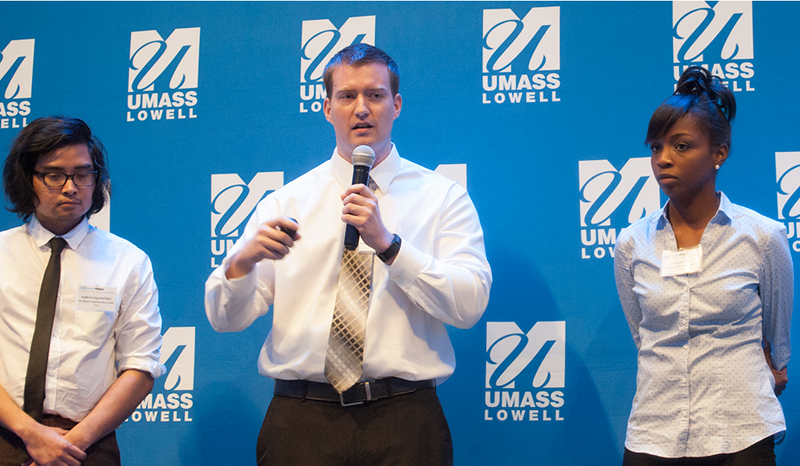
Chemical engineering student Nicholas Langberg presenting on stage
Nicholas Langberg '20
Chemical Engineering

By working with the Office of International Experiences & Study Abroad, chemical engineering major Nicholas Langberg was able to add a two-month internship to his summer school program in Germany.

It ended up being one of the best experiences of my life. Not only was I able to have this great experience abroad, but I was able to gain real-world experience in my field of study.
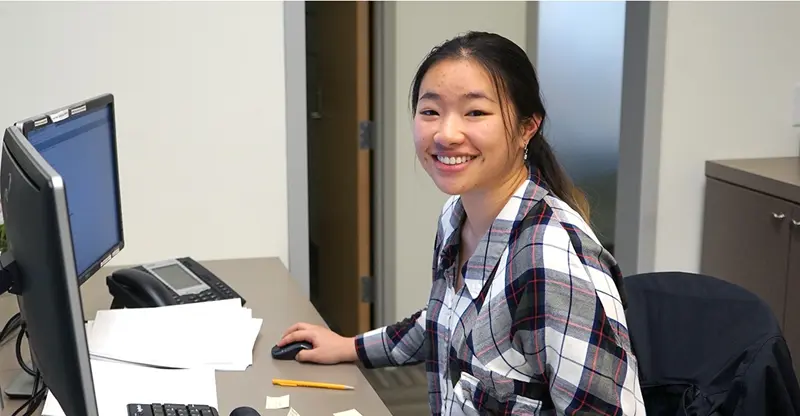
Mina Le sits at the front desk in front of a computer at the Student Employment Office at University Crossing
Mina Le '18
Chemical Engineering

Senior chemical engineering major Mina Le chose a work-study job at the front desk of the Student Employment Office because she wanted to improve her communication skills. She’s done that and more, being named the university’s Student Employee of the Year.

I was surprised just to be nominated for the Student Employee of the Year award. When I won, it made my entire year.
Aaron Stella
Michael Doane '19
Chemical Engineering, Biology

Honors student Michael Doane has won several prestigious fellowships and scholarships for his cancer-related and biofuel research. He says UMass Lowell does a great job of structuring both classes and learning experiences that build on one another.

There are so many different programs and entities that all build on each other and combine to give you anything you’re willing to get out of your undergraduate experience.
Alyssa Puglisi stands on an agricultural field with a blue sky above her
Alyssa Puglisi ’25
Chemical Engineering

Alyssa Puglisi was awarded a three-year, $75,000 scholarship by Entegris, the second UML student to receive this support from the company.

UMass Lowell believes in its students.

Visit UMass Lowell

Launch virtual tour

Visit campus, meet our people and picture yourself here. Find in-person and virtual tours and events.

Still Exploring Majors?

We've got 120+ programs. Browse our Program Finder to find the one that's right for you.

View All Programs

Contact Us

For more information, please contact: 

Zhiyong Gu
Department Chair
Zhiyong_Gu@uml.edu