Gain the knowledge and skillset to focus on human performance, athlete health and injury prevention.

Why Study Strength and Conditioning at UMass Lowell?

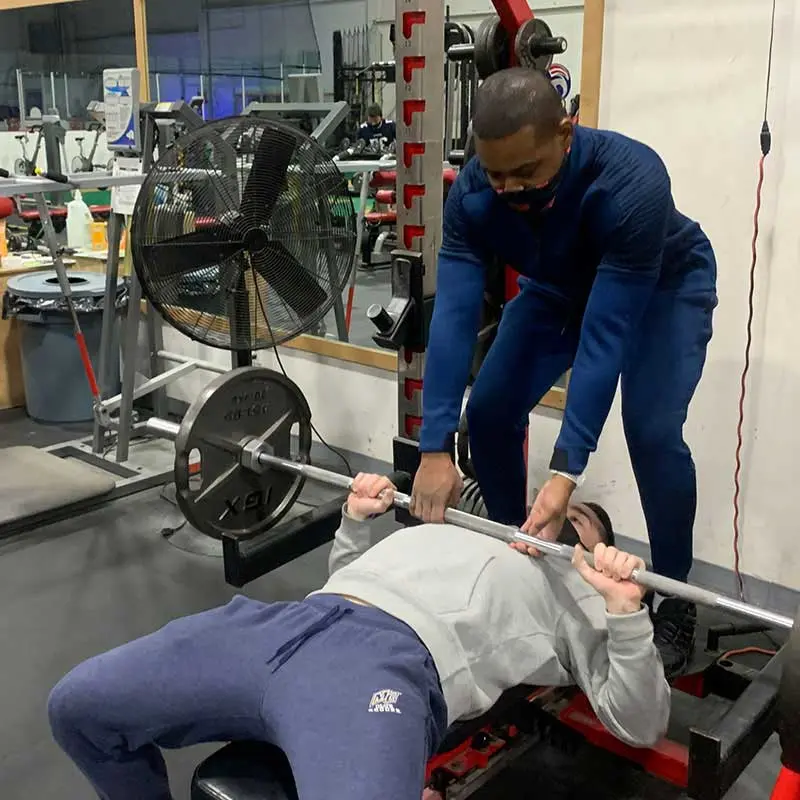
A UMass Lowell exercise science student assists another student on weight training equipment
  • Become confident in your evidence-based, applied science knowledge and skills related to:
    • human and sport performance
    • program design and implementation
    • training progression and recovery strategies
    • injury prevention and athlete health
  • Train with state-of-the-art equipment in program laboratories and UMass Lowell Athletics, gaining the hands-on experience for safe and effective professional success.
  • Eligibility for review to enter the Exercise Science-Doctor of Physical Therapy cohort.
  • Eligibility upon graduation to sit for the Certified Strength and Conditioning Specialist (CSCS) certification examination from the National Strength and Conditioning Association (NSCA), the gold standard certification for the field.

Careers and Graduate Studies

Graduates are prepared for entry-level careers in strength and conditioning, sport performance, personal training and fitness- and health-related professions that work directly with:

  • recreational athletes in a private sports performance facility
  • professional athletes on a collegiate or professional team 
  • clients looking to transition to functional training following rehabilitation

Graduates can also continue on to graduate programs in human performance, strength and conditioning, or exercise science, as well as allied health programs in many fields, such as:

  • Master’s in Clinical Exercise Physiology
  • Doctor of Physical Therapy (DPT)
  • Doctor of Chiropractic (DC)
  • Master's or Doctor of Athletic Training (MSAT/DAT)
  • Master's or Doctor of Occupational Therapy (MSOT/OTD)

Internships

Students enrolled in the strength and conditioning concentration are required to complete two (2) field experiences or internships during their undergraduate career. This is completed through the EXER.4120 course.

UMass Lowell has field experience/internship partnerships with world-renowned sites like:

Courses You’ll Take

Sample courses include:

  • Exercise Physiology
  • Anatomical Kinesiology
  • Foundations of Strength and Conditioning
  • Exercise Testing and Prescription
  • Motor Control and Learning
  • Clinical Exercise Physiology
  • Sport and Exercise Psychology
  • Sports Nutrition

For students who entered fall 2024 and beyond.

Freshman Year

Fall Semester

Course NumberCourse NameCredits
Total15
BIOL.1110Principles of Biology I3
BIOL.1170LPrinciples of Biology I Lab 1
HSCI.1010Human Anatomy and Physiology I (SCL)3
HSCI.1030Human Anatomy and Physiology Lab I1
HSCI.1051Interprofessional Education First Year Seminar  1
ENGL.1010 /
HONR.1100
College Writing I /
First Year Seminar in Honors: Text in the City (CW)
3
PSYC.1010Introduction to Psychological Science (SS)3

Spring Semester

Course NumberCourse NameCredits
Total17
BIOL.1120Principles of Biology II3
BIOL.1180LPrinciples of Biology II Lab1
ENGL.1020College Writing II (CW)3
EXER.2020Introduction to Exercise Science (DCA)3
HSCI.1020Human Anatomy and Physiology II (SCL)3
HSCI.1040Human Anatomy and Physiology Lab II1
MATH.2830Introduction to Statistics (MATH)3

Sophomore Year

Fall Semester

Course NumberCourse NameCredits
Total14
HSCI.2510Physiological Chemistry I13
HSCI.2530Physiological Chemistry I Lab11
HSCI.3400IPE Research Methods (IL), (QL)3
NUTR.2060Human Nutrition3
PHYS.1030General Physics I (STEM)3
PHYS.1030LGeneral Physics I Lab1

Spring Semester

Course NumberCourse NameCredits
Total15
HSCI.1011Medical Terminology for Health Professionals1
HSCI.2520Physiological Chemistry II13
HSCI.2540Physiological Chemistry II Lab11
PHYS.1040General Physics II3
PHYS.1040LGeneral Physics II Lab1
PSYC.2720Abnormal Psychology (SS)3
PUBH.1021Introduction to Public Health (SS)3

Junior Year

Fall Semester

Course NumberCourse NameCredits
Total17
HSCI.3500Human Biochemistry3
EXER.3050Exercise Physiology (WOC), (CTPS)3
EXER.3070Exercise Physiology Lab1
EXER.3150Anatomical Kinesiology3
EXER.3170Anatomical Kinesiology Lab1
NUTR.3570Sports Nutrition3
xxxx.xxxxArts and Humanities Perspective (AH)3

Spring Semester

Course NumberCourse NameCredits
Total17
EXER.3560Pharmacology3
EXER.4060Foundations of Strength and Conditioning3
EXER.4080Foundations of Strength and Conditioning Lab1
EXER.4220Exercise Testing and Prescription3
EXER.4280Exercise Testing and Prescription Lab1
PSYC.3550Sport and Exercise Psychology3
xxxx.xxxxFree Elective3

Senior Year

Fall Semester

Course NumberCourse NameCredits
Total13
EXER.4120Clinical Practicum I and II (SRE), (AIL)4
EXER.4240Motor Control and Learning3
EXER.4250Clinical Exercise Physiology3
xxxx.xxxxFree Elective3

Spring Semester

Course NumberCourse NameCredits
Total13
EXER.4120Clinical Practicum I and II (SRE), (AIL)4
xxxx.xxxxLifespan Elective23
xxxx.xxxxArts and Humanities Perspective (AH)3

Total Minimum Credits = 121

1HSCI.2510 / HSCI.2530 AND HSCI.2520 / HSCI.2540 can be substituted with CHEM.1210 / CHEM.1230L AND CHEM.1220 / CHEM.1240L

2Lifespan Electives:

No more than two Breadth of Knowledge courses can be taken with the same prefix. The Core Curriculum courses may be taken in any sequence. Refer to the Core Curriculum policy for further details. You should meet with your faculty advisor to determine how you will meet the Core Curriculum requirements. 

Current UMass Lowell students should be using their Advisement Report in SiS. If you need assistance, please contact your adviser.

Restriction on off-campus study:

Be advised that any course taken at another institution must be formally approved prior to enrollment.

See the catalog policy for details.

Breadth of Knowledge (BOK) Glossary

  • SS - Social Sciences Perspective - 9 credits
  • AH - Arts and Humanities Perspective - 9 credits
  • SCL - Sciences with Lab Perspective - 6 credits
  • STEM - Science, Technology, Engineering and Math Perspective - 3 credits
  • CW - College Writing I and II - 6 credits
  • MATH - Math Perspective - 3 credits

Read more about the Breadth of Knowledge requirements.

Essential Learning Outcomes (ELO) Glossary

  • AIL - Applied and Integrative Learning
  • CTPS - Critical Thinking and Problem Solving
  • DCA - Diversity and Cultural Awareness
  • IL - Information Literacy
  • QL - Quantitative Literacy
  • SRE - Social Responsibility and Ethics
  • WOC - Written and Oral Communication

Read more about the Essential Learning Outcomes.

Contact Us

For program-specific questions, please contact:

Kyle Coffey PT, DPT, ACSM-EP
Exercise Science Program Director
Phone: 978-934-6462
Email: Kyle_Coffey@uml.edu