Help people improve health, fitness and performance as well as prevent injury and disease.

Make a Difference to People’s Lives

Two people stand inside UMass Lowell's Exercise Science lab with icons and screen tags that say "Metabolic Cart" and "Vertical Jump."

Gain hands-on experience working with the latest equipment under faculty supervision. Tour the Exercise Science Lab

With rising awareness about the importance of physical activity and exercise in preventing chronic diseases and improving quality of life, exercise science professionals are in high demand across a wide range of careers. 

As a student in UMass Lowell’s B.S. in Exercise Science program, you’ll gain a high-quality education in the study of bodily movement that improves fitness, performance and wellness.

Note: Students in the following concentrations are eligible for review to enter the Exercise Science-Doctor of Physical Therapy cohort - Clinical, Strength and Conditioning or Pre-Physician Assistant.

Exercise Science Career Options

Graduates of UMass Lowell's exercise science program launch exciting careers in health, wellness and fitness and many students pursue graduate studies in advanced allied health degrees.

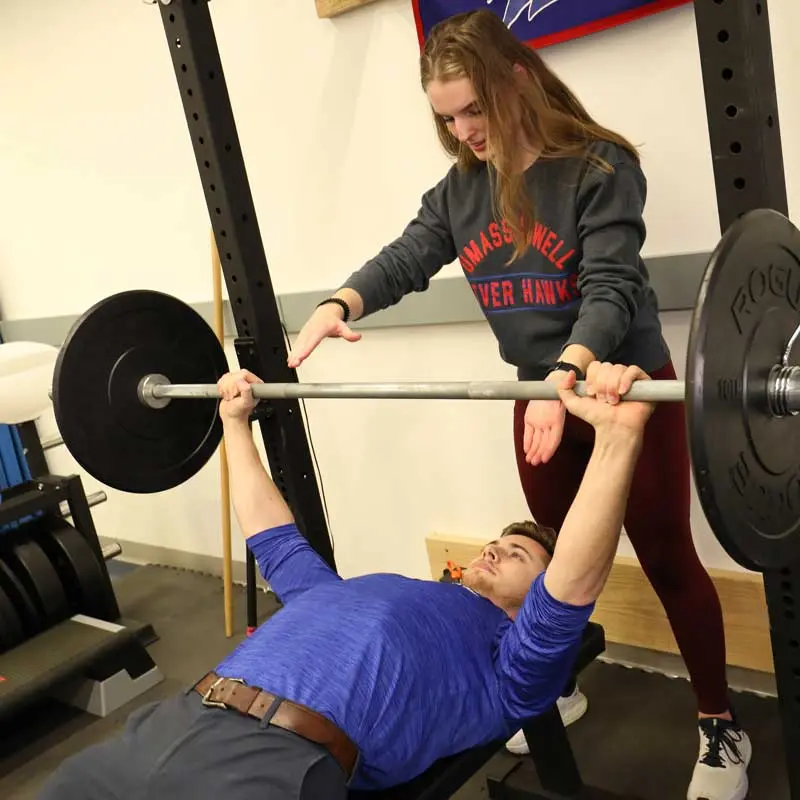
A student lifts weights as another in a UMass Lowell River Hawks shirt spots in an exercise science facility.

Exercise Science: Clinical Concentration

Our graduates work in clinical, corporate and research settings; many apply to graduate health care degree programs. Learn more about the careers in the Clinical Concentration.

Exercise Science: Strength and Conditioning Concentration

Graduates prepare for careers working for professional sports teams, college and high school athletics and private sports performance facilities. Learn more about careers in the Strength and Conditioning Concentration.

Exercise Science: Pre-Physician Assistant Concentration

Our graduates have successfully applied to and been admitted to many Physician Assistant colleges. Learn more about careers in the Pre-Physician Assistant Concentration.

Exercise Science: Exercise and Fitness Management Concentration

Our graduates are prepared for careers in biotechnology, community centers and the medical device industry. Learn more about careers in the Exercise and Fitness Management Concentration.

Year-by-Year Course Plan

Check out our degree pathways, which offer sample plans for completing your degree in four years.

For students who entered fall 2024 and beyond.

First Year

Fall Semester

Course NumberCourse NameCredits
Total15
BIOL.1110Principles of Biology I3
BIOL.1170LPrinciples of Biology I Lab1
ENGL.1010College Writing I (CW)3
HSCI.1010Human Anatomy and Physiology I (SCL)3
HSCI.1030Human Anatomy and Physiology I Lab1
HSCI.1051Interprofessional Education First Year Seminar1
MATH.2830Introduction to Statistics (MATH)3

Winter Semester

Course NumberCourse NameCredits
Total6
PSYC.1010Introduction to Psychological Science (SS)3
xxxx.xxxxArts and Humanities Perspective (AH)3

Spring Semester

Course NumberCourse NameCredits
Total15
HSCI.1011Medical Terminology for Health Professionals1
HSCI.1020Human Anatomy and Physiology II (SCL)3
HSCI.1040Human Anatomy and Physiology II Lab1
BIOL.1120Principles of Biology II3
BIOL.1180LPrinciples of Biology II Lab1
EXER.2020Introduction to Exercise Science (DCA)3
ENGL.1020College Writing II (CW)3

Summer I Semester

Course NumberCourse NameCredits
Total8
HSCI.2510Physiological Chemistry I13
HSCI.2530Physiological Chemistry I Lab11
PHYS.1030General Physics I (STEM)3
PHYS.1030LGeneral Physics I Lab1

Summer II Semester

Course NumberCourse NameCredits
Total8
HSCI.2520Physiological Chemistry II13
HSCI.2540Physiological Chemistry II Lab11
PHYS.1040General Physics II3
PHYS.1040LGeneral Physics II Lab1

Second Year

Fall Semester

Course NumberCourse NameCredits
Total14
EXER.3050Exercise Physiology (WOC)3
EXER.3070Exercise Physiology Lab1
EXER.3150Anatomical Kinesiology3
EXER.3170Anatomical Kinesiology Lab1
HSCI.3500Human Biochemistry3
NUTR.2060Human Nutrition3

Spring Semester

Course NumberCourse NameCredits
Total17
EXER.4060Foundations of Strength and Conditioning3
EXER.4080Foundations of Strength and Conditioning Lab1
EXER.3560Pharmacology3
EXER.4220Exercise Testing and Prescription (CTPS)3
EXER.4280Exercise Testing and Prescription Lab1
HSCI.3400IPE Research Methods (IL), (QL)3
PSYC.3550Sport and Exercise Psychology3

Summer I Semester

Course NumberCourse NameCredits
Total7
EXER.4120Clinical Practicum I and II (SRE), (AIL)4
PUBH.1021Introduction to Public Health (SS)3

Summer II Semester

Course NumberCourse NameCredits
Total3
EXER.4120Clinical Practicum I and II (SRE), (AIL)0
xxxx.xxxxLifespan Elective23

Third Year

Fall Semester

Course NumberCourse NameCredits
Total15
EXER.4240Motor Control and Learning3
EXER.4250Clinical Exercise Physiology3
NUTR.3570Sports Nutrition3
xxxx.xxxxFree Elective3

Spring Semester

Course NumberCourse NameCredits
Total12
PSYC.2720Abnormal Psychology (SS)3
xxxx.xxxxArts and Humanities Perspective (AH)3
xxxx.xxxxxArts and Humanities Perspective (AH)3
xxxx.xxxxFree Elective3

Total Minimum Credits = 120

1HSCI.2510 / HSCI.2530 AND HSCI.2520 / HSCI.2540 can be substituted with CHEM.1210 / CHEM.1230L AND CHEM.1220 / CHEM.1240L

2Lifespan Electives:

No more than two Breadth of Knowledge courses can be taken with the same prefix. The Core Curriculum courses may be taken in any sequence. Refer to the Core Curriculum policy for further details. You should meet with your faculty advisor to determine how you will meet the Core Curriculum requirements.

Current UMass Lowell students should use their Advisement Report in SIS. If you need assistance, please contact your advisor.

Restriction on off-campus study:

Be advised that any course taken at another institution must be formally approved prior to enrollment.

See the catalog policy for details.

Breadth of Knowledge (BOK) Glossary

  • SS - Social Sciences Perspective - 9 credits
  • AH - Arts and Humanities Perspective - 9 credits
  • SCL - Sciences with Lab Perspective - 6 credits
  • STEM - Science, Technology, Engineering and Math Perspective - 3 credits
  • CW - College Writing I and II - 6 credits
  • MATH - Math Perspective - 3 credits

Read more about the Breadth of Knowledge requirements.

Essential Learning Outcomes (ELO) Glossary

  • AIL - Applied and Integrative Learning
  • CTPS - Critical Thinking and Problem Solving
  • DCA - Diversity and Cultural Awareness
  • IL - Information Literacy
  • QL - Quantitative Literacy
  • SRE - Social Responsibility and Ethics
  • WOC - Written and Oral Communication

Read more about the Essential Learning Outcomes.

For students who entered fall 2024 and beyond.

Freshman Year

Fall Semester

Course NumberCourse NameCredits
Total15
BIOL.1110Principles of Biology I3
BIOL.1170LPrinciples of Biology I Lab 1
HSCI.1010Human Anatomy and Physiology I (SCL)3
HSCI.1030Human Anatomy and Physiology Lab I1
HSCI.1051Interprofessional Education First Year Seminar  1
ENGL.1010 /
HONR.1100
College Writing I /
First Year Seminar in Honors: Text in the City (CW)
3
PSYC.1010Introduction to Psychological Science (SS)3

Spring Semester

Course NumberCourse NameCredits
Total17
BIOL.1120Principles of Biology II3
BIOL.1180LPrinciples of Biology II Lab1
ENGL.1020College Writing II (CW)3
EXER.2020Introduction to Exercise Science (DCA)3
HSCI.1020Human Anatomy and Physiology II (SCL)3
HSCI.1040Human Anatomy and Physiology Lab II1
MATH.2830Introduction to Statistics (MATH)3

Sophomore Year

Fall Semester

Course NumberCourse NameCredits
Total14
HSCI.2510Physiological Chemistry I13
HSCI.2530Physiological Chemistry I Lab11
HSCI.3400IPE Research Methods (IL), (QL)3
NUTR.2060Human Nutrition3
PHYS.1030General Physics I (STEM)3
PHYS.1030LGeneral Physics I Lab1

Spring Semester

Course NumberCourse NameCredits
Total15
HSCI.1011Medical Terminology for Health Professionals1
HSCI.2520Physiological Chemistry II13
HSCI.2540Physiological Chemistry II Lab11
PHYS.1040General Physics II3
PHYS.1040LGeneral Physics II Lab1
PSYC.2720Abnormal Psychology (SS)3
PUBH.1021Introduction to Public Health (SS)3

Junior Year

Fall Semester

Course NumberCourse NameCredits
Total17
HSCI.3500Human Biochemistry3
EXER.3050Exercise Physiology (WOC), (CTPS)3
EXER.3070Exercise Physiology Lab1
EXER.3150Anatomical Kinesiology3
EXER.3170Anatomical Kinesiology Lab1
NUTR.3570Sports Nutrition3
xxxx.xxxxArts and Humanities Perspective (AH)3

Spring Semester

Course NumberCourse NameCredits
Total14
EXER.3560Pharmacology3
EXER.4060Foundations of Strength and Conditioning3
EXER.4080Foundations of Strength and Conditioning Lab1
EXER.4220Exercise Testing and Prescription3
EXER.4280Exercise Testing and Prescription Lab1
PSYC.3550Sport and Exercise Psychology3

Senior Year

Fall Semester

Course NumberCourse NameCredits
Total13
EXER.4120Clinical Practicum I and II (SRE), (AIL)4
EXER.4240Motor Control and Learning3
EXER.4250Clinical Exercise Physiology3
xxxx.xxxxLifespan Elective23

Spring Semester

Course NumberCourse NameCredits
Total15
xxxx.xxxxArts and Humanities Perspective (AH)3
xxxx.xxxxFree Elective3

OR

Senior Year

Fall Semester

Course NumberCourse NameCredits
Total15
EXER.4240Motor Control and Learning3
EXER.4250Clinical Exercise Physiology3
xxxx.xxxxArts and Humanities Perspective (AH)3
xxxx.xxxxFree Elective3

Spring Semester

Course NumberCourse NameCredits
Total13
EXER.4120Clinical Practicum I and II (SRE), (AIL)4
xxx.xxxxLifespan Elective23
xxxx.xxxxArts and Humanities Perspective (AH)3
xxxx.xxxxFree Elective3

Total Minimum Credits = 120

1HSCI.2510 / HSCI.2530 AND HSCI.2520 / HSCI.2540 can be substituted with CHEM.1210 / CHEM.1230L AND CHEM.1220 / CHEM.1240L

2Lifespan Electives:

No more than two Breadth of Knowledge courses can be taken with the same prefix. The Core Curriculum courses may be taken in any sequence. Refer to the Core Curriculum policy for further details. You should meet with your faculty advisor to determine how you will meet the Core Curriculum requirements. 

Current UMass Lowell students should be using their Advisement Report in SiS. If you need assistance, please contact your adviser.

Restriction on off-campus study:

Be advised that any course taken at another institution must be formally approved prior to enrollment.

See the catalog policy for details.
Breadth of Knowledge (BOK) Glossary

  • SS - Social Sciences Perspective - 9 credits
  • AH - Arts and Humanities Perspective - 9 credits
  • SCL - Sciences with Lab Perspective - 6 credits
  • STEM - Science, Technology, Engineering and Math Perspective - 3 credits
  • CW - College Writing I and II - 6 credits
  • MATH - Math Perspective - 3 credits

Read more about the Breadth of Knowledge requirements.

Essential Learning Outcomes (ELO) Glossary

  • AIL - Applied and Integrative Learning
  • CTPS - Critical Thinking and Problem Solving
  • DCA - Diversity and Cultural Awareness
  • IL - Information Literacy
  • QL - Quantitative Literacy
  • SRE - Social Responsibility and Ethics
  • WOC - Written and Oral Communication

Read more about the Essential Learning Outcomes.

For students who entered fall 2024 and beyond.

Freshman Year

Fall Semester

Course#Course NameCredits
Total14
HSCI.1010Human Anatomy and Physiology I (SCL)3
HSCI.1030Human Anatomy and Physiology I Lab1
HSCI.1051Interprofessional Education First Year Seminar1
ENGL.1010 /
HONR.1100
College Writing I /
First Year Seminar in Honors: Text in the City (CW)
3
PUBH.1021Introduction to Public Health (SS)3
xxxx.xxxxArts and Humanities Perspective (AH)3

Spring Semester

Course#Course NameCredits
Total17
HSCI.1011Medical Terminology for Healthcare Professionals1
HSCI.1020Human Anatomy and Physiology II (SCL)3
HSCI.1040Human Anatomy and Physiology II Lab1
ENGL.1020College Writing II (CW)  3
EXER.2020Introduction to Exercise Science (DCA)3
MATH.2830Introduction to Statistics (MATH), (QL)3
PSYC.1010Introduction to Psychological Science (SS)3

Sophomore Year

Fall Semester

Course#Course NameCredits
Total16
PUBH.2050Social Determinants of Health3
HSCI.1900Chemistry of Health and Environment3
HSCI.1900LChemistry of Health and Environment Lab1
HSCI.3400IPE Research Methods (IL)3
NUTR.2060Human Nutrition3
xxxx.xxxxArts and Humanities Perspective (AH)3

Spring Semester

Course#Course NameCredits
Total15
POMS.2010Introduction to Business Analytics3
PSYC.2720Abnormal Psychology (SS)3
xxxx.xxxxLifespan Elective13
xxxx.xxxxArts and Humanities Perspective (AH)3
xxxx.xxxxFree Elective3

Junior Year

Fall Semester

Course#Course NameCredits
Total16
ACCT.2010Accounting/Financial3
EXER.3050Exercise Physiology (WOC)3
EXER.3070Exercise Physiology Lab1
MGMT.3010Organizational Behavior3
MKTG.2010Marketing Principles3
PUBH.2070The U.S. Healthcare System3

Spring Semester

Course#Course NameCredits
Total14
EXER.4060Foundations of Strength and Conditioning3
EXER.4080Foundations of Strength and Conditioning Lab1
EXER.4220Exercise Testing and Prescription (CTPS)3
EXER.4280Exercise Testing and Prescription Lab1
PSYC.3550Sport and Exercise Psychology3
xxxx.xxxxBusiness Elective23

Senior Year

Fall Semester

Course#Course NameCredits
Total15
ENTR.3000Principles of Innovation3
NUTR.3720Body Diversity and Health3
PSYC.3450Health Psychology3
xxxx.xxxxFree Elective3

Spring Semester

Course#Course NameCredits
Total13
EXER.4120Clinical Practicum I and II (SRE), (AIL)34
EXER.4300Exercise is Medicine3
xxxx.xxxxFree Elective3

Total Minimum Credits = 120

1Lifespan Electives:

2Business Electives:

3EXER.4120 can be taken in the fall semester of senior year if needed.

No more than two Breadth of Knowledge courses can be taken with the same prefix. The Core Curriculum courses may be taken in any sequence. Refer to the CoreCurriculum policy for further details. You should meet with your faculty advisor to determine how you will meet the Core Curriculum requirements.

Current UMass Lowell students should be using their Advisement Report in SiS. If you need assistance, please contact your adviser.

Restriction on off-campus study:

Be advised that any course taken at another institution must be formally approved prior to enrollment. See the catalog policy for details.
Breadth of Knowledge (BOK) Glossary

  • SS - Social Sciences Perspective - 9 credits
  • AH - Arts and Humanities Perspective - 9 credits
  • SCL - Sciences with Lab Perspective - 6 credits
  • STEM - Science, Technology, Engineering and Math Perspective - 3 credits
  • CW - College Writing I and II - 6 credits
  • MATH - Math Perspective - 3 credits

Read more about the Breadth of Knowledge requirements.

Essential Learning Outcomes (ELO) Glossary

  • AIL - Applied and Integrative Learning
  • CTPS - Critical Thinking and Problem Solving
  • DCA - Diversity and Cultural Awareness
  • IL - Information Literacy
  • QL - Quantitative Literacy
  • SRE - Social Responsibility and Ethics
  • WOC - Written and Oral Communication

Read more about the Essential Learning Outcomes.

For students who entered fall 2024 and beyond.

Freshman Year

Fall Semester

Course NumberCourse NameCredits
Total16
BIOL.1110Principles of Biology I3
BIOL.1170LPrinciples of Biology I Lab1
HSCI.1011Medical Terminology for Healthcare Professionals1
HSCI.1010Human Anatomy and Physiology I (SCL)3
HSCI.1030Human Anatomy and Physiology Lab I (SCL)1
HSCI.1051Interprofessional Education First Year Seminar1
ENGL.1010 /
HONR.1100
College Writing I /
First Year Seminar in Honors: Text in the City (CW)
3
PSYC.1010Introduction to Psychological Science (SS)3

Spring Semester

Course NumberCourse NameCredits
Total17
BIOL.1120Principles of Biology II3
BIOL.1180LPrinciples of Biology II Lab1
ENGL.1020College Writing II (CW)3
EXER.2020Introduction to Exercise Science (DCA)3
HSCI.1020Human Anatomy and Physiology II (SCL)3
HSCI.1040Human Anatomy and Physiology Lab II (SCL)1
xxxx.xxxxArts and Humanities Perspective (AH)3

Sophomore Year

Fall Semester

Course NumberCourse NameCredits
Total14
HSCI.2510 /
CHEM.1210
Physiological Chemistry I /
Chemistry I
3
HSCI.2530 /
CHEM.1230L
Physiological Chemistry I Lab /
Chemistry I Laboratory
1
MATH.2830Introduction to Statistics (MATH)3
NUTR.2060Human Nutrition3
PHYS.1030General Physics I (STEM)3
PHYS.1030LGeneral Physics I Lab1

Spring Semester

Course NumberCourse NameCredits
Total17
HSCI.2520 /
CHEM.1220
Physiological Chemistry II /
Chemistry II
3
HSCI.2540 /
CHEM.1240L
Physiological Chemistry II Lab /
Chemistry II Laboratory
1
HSCI.3400IPE Research Methods (IL), (QL)3
PHYS.1040General Physics II3
PHYS.1040LGeneral Physics II Lab1
PUBH.1021Introduction to Public Health (SS)3
xxxx.xxxxArts and Humanities Perspective (AH)3

Junior Year

Fall Semester

Course NumberCourse NameCredits
Total15
HSCI.2110Clinical Microbiology and Microbial Pathogenesis3
HSCI.2130Clinical Microbiology and Microbial Pathogenesis Lab1
HSCI.3500Human Biochemistry3
EXER.3050Exercise Physiology (WOC), (CTPS)3
EXER.3070Exercise Physiology Lab1
EXER.3150Anatomical Kinesiology3
EXER.3170Anatomical Kinesiology Lab1

Spring Semester

Course NumberCourse NameCredits
Total14
EXER.3560Pharmacology3
EXER.4060Foundations of Strength and Conditioning3
EXER.4080Foundations of Strength and Conditioning Lab1
EXER.4220Exercise Testing and Prescription3
EXER.4280Exercise Testing and Prescription Lab1
xxxx.xxxxArts and Humanities Perspective (AH)3

Senior Year

Fall Semester

Course NumberCourse NameCredits
Total16
BIOL.2350Genetics3
BMSC.2420Organic Structures and Reactions I13
BMSC.2440Organic Structures and Reactions I Lab1
EXER.4240Motor Control and Learning3
EXER.4250Clinical Exercise Physiology3
PSYC.2720Abnormal Psychology (SS)3

Spring Semester

Course NumberCourse NameCredits
Total13
EXER.4120Clinical Practicum I and II (SRE), (AIL)4
HSCI.3060 /
PSYC.3600
Introduction to Gerontology /
Adult Development and Aging
3
PSYC.2600Child and Adolescent Development3
xxxx.xxxxSocial Sciences Perspective (SS), (DCA)3

Total Minimum Credits = 122.

1Taking Organic Structures and Reactions I is equivalent to Organic Chemistry I for most PA schools that require it. Students should reach out to interested PA schools to confirm. If this course is not needed, please substitute with free electives during senior year.

No more than two Breadth of Knowledge (BOK) courses can be taken with the same prefix. The Core Curriculum courses may be taken in any sequence. Refer to the Core Curriculum policy for further details. You should meet with your faculty advisor to determine how you will meet the Core Curriculum requirements.

Current UMass Lowell students should be using their Advisement Report in SiS. If you need assistance, please contact your adviser.

Restriction on off-campus study:

Be advised that any course taken at another institution must be formally approved prior to enrollment.

See the catalog policy for details.

Breadth of Knowledge (BOK) Glossary

  • SS - Social Sciences Perspective - 9 credits
  • AH - Arts and Humanities Perspective - 9 credits
  • SCL - Sciences with Lab Perspective - 6 credits
  • STEM - Science, Technology, Engineering and Math Perspective - 3 credits
  • CW - College Writing I and II - 6 credits
  • MATH - Math Perspective - 3 credits

Read more about the Breadth of Knowledge requirements.

Essential Learning Outcomes (ELO) Glossary

  • AIL - Applied and Integrative Learning
  • CTPS - Critical Thinking and Problem Solving
  • DCA - Diversity and Cultural Awareness
  • IL - Information Literacy
  • QL - Quantitative Literacy
  • SRE - Social Responsibility and Ethics
  • WOC - Written and Oral Communication

Read more about the Essential Learning Outcomes.

For students who entered fall 2024 and beyond.

Freshman Year

Fall Semester

Course NumberCourse NameCredits
Total15
BIOL.1110Principles of Biology I3
BIOL.1170LPrinciples of Biology I Lab 1
HSCI.1010Human Anatomy and Physiology I (SCL)3
HSCI.1030Human Anatomy and Physiology Lab I1
HSCI.1051Interprofessional Education First Year Seminar  1
ENGL.1010 /
HONR.1100
College Writing I /
First Year Seminar in Honors: Text in the City (CW)
3
PSYC.1010Introduction to Psychological Science (SS)3

Spring Semester

Course NumberCourse NameCredits
Total17
BIOL.1120Principles of Biology II3
BIOL.1180LPrinciples of Biology II Lab1
ENGL.1020College Writing II (CW)3
EXER.2020Introduction to Exercise Science (DCA)3
HSCI.1020Human Anatomy and Physiology II (SCL)3
HSCI.1040Human Anatomy and Physiology Lab II1
MATH.2830Introduction to Statistics (MATH)3

Sophomore Year

Fall Semester

Course NumberCourse NameCredits
Total14
HSCI.2510Physiological Chemistry I13
HSCI.2530Physiological Chemistry I Lab11
HSCI.3400IPE Research Methods (IL), (QL)3
NUTR.2060Human Nutrition3
PHYS.1030General Physics I (STEM)3
PHYS.1030LGeneral Physics I Lab1

Spring Semester

Course NumberCourse NameCredits
Total15
HSCI.1011Medical Terminology for Health Professionals1
HSCI.2520Physiological Chemistry II13
HSCI.2540Physiological Chemistry II Lab11
PHYS.1040General Physics II3
PHYS.1040LGeneral Physics II Lab1
PSYC.2720Abnormal Psychology (SS)3
PUBH.1021Introduction to Public Health (SS)3

Junior Year

Fall Semester

Course NumberCourse NameCredits
Total17
HSCI.3500Human Biochemistry3
EXER.3050Exercise Physiology (WOC), (CTPS)3
EXER.3070Exercise Physiology Lab1
EXER.3150Anatomical Kinesiology3
EXER.3170Anatomical Kinesiology Lab1
NUTR.3570Sports Nutrition3
xxxx.xxxxArts and Humanities Perspective (AH)3

Spring Semester

Course NumberCourse NameCredits
Total17
EXER.3560Pharmacology3
EXER.4060Foundations of Strength and Conditioning3
EXER.4080Foundations of Strength and Conditioning Lab1
EXER.4220Exercise Testing and Prescription3
EXER.4280Exercise Testing and Prescription Lab1
PSYC.3550Sport and Exercise Psychology3
xxxx.xxxxFree Elective3

Senior Year

Fall Semester

Course NumberCourse NameCredits
Total13
EXER.4120Clinical Practicum I and II (SRE), (AIL)4
EXER.4240Motor Control and Learning3
EXER.4250Clinical Exercise Physiology3
xxxx.xxxxFree Elective3

Spring Semester

Course NumberCourse NameCredits
Total13
EXER.4120Clinical Practicum I and II (SRE), (AIL)4
xxxx.xxxxLifespan Elective23
xxxx.xxxxArts and Humanities Perspective (AH)3

Total Minimum Credits = 121

1HSCI.2510 / HSCI.2530 AND HSCI.2520 / HSCI.2540 can be substituted with CHEM.1210 / CHEM.1230L AND CHEM.1220 / CHEM.1240L

2Lifespan Electives:

No more than two Breadth of Knowledge courses can be taken with the same prefix. The Core Curriculum courses may be taken in any sequence. Refer to the Core Curriculum policy for further details. You should meet with your faculty advisor to determine how you will meet the Core Curriculum requirements. 

Current UMass Lowell students should be using their Advisement Report in SiS. If you need assistance, please contact your adviser.

Restriction on off-campus study:

Be advised that any course taken at another institution must be formally approved prior to enrollment.

See the catalog policy for details.

Breadth of Knowledge (BOK) Glossary

  • SS - Social Sciences Perspective - 9 credits
  • AH - Arts and Humanities Perspective - 9 credits
  • SCL - Sciences with Lab Perspective - 6 credits
  • STEM - Science, Technology, Engineering and Math Perspective - 3 credits
  • CW - College Writing I and II - 6 credits
  • MATH - Math Perspective - 3 credits

Read more about the Breadth of Knowledge requirements.

Essential Learning Outcomes (ELO) Glossary

  • AIL - Applied and Integrative Learning
  • CTPS - Critical Thinking and Problem Solving
  • DCA - Diversity and Cultural Awareness
  • IL - Information Literacy
  • QL - Quantitative Literacy
  • SRE - Social Responsibility and Ethics
  • WOC - Written and Oral Communication

Read more about the Essential Learning Outcomes.

The Exercise Science program prepares all students to be able to:
  1. Promote and guide healthy lifestyles in diverse populations that include physical activity, exercise and wellness programs by utilizing current theories and research literature.
  2. Design exercise and wellness programs which maximize compliance, motivation and prevent injury and illness.
  3. Apply analytical and critical thinking to advance exercise and wellness initiatives for individuals and communities.
  4. Collaborate with individuals, families, communities, businesses and other health care professionals in the delivery of care.
  5. Develop a self-directed plan for professional development and lifelong learning which includes self-assessment, self-reflection and self-correction.
  6. Demonstrate professional and ethical behavior during all interactions.
  7. Communicate effectively in ways that are congruent with situational needs, including appropriate body language, written communication, active listening skills and questioning.
  8. Develop leadership skills of accountability, delegation, education and supervision.

Why study exercise science at UMass Lowell?

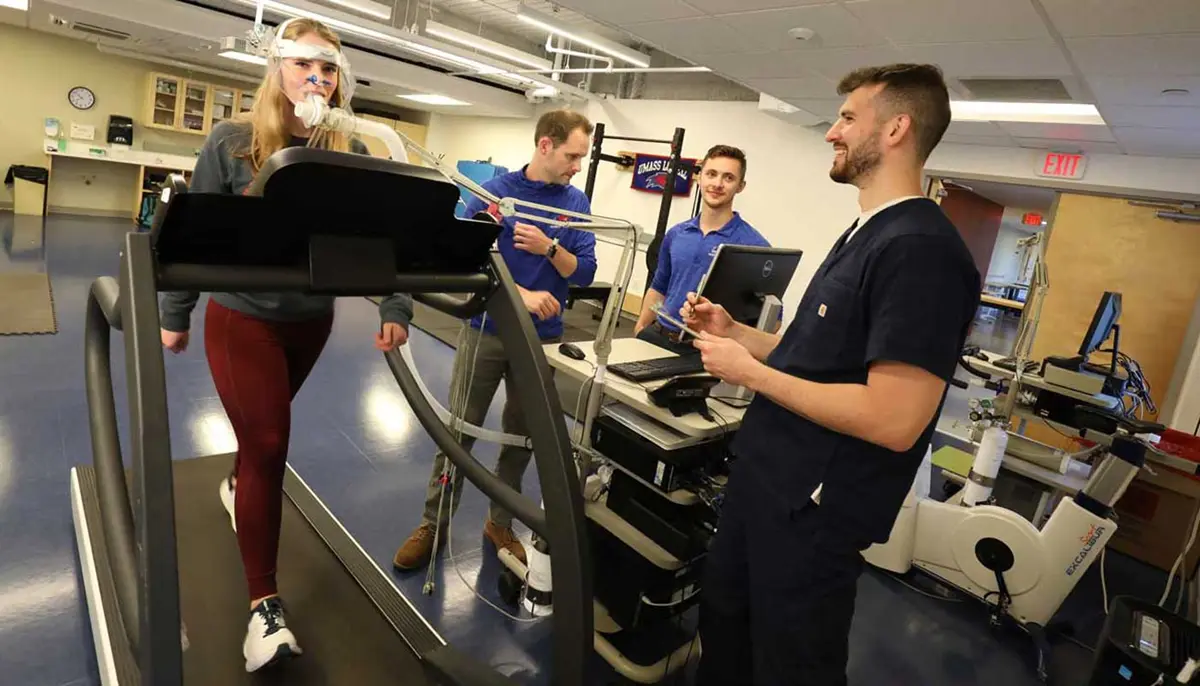
A student walks on a treadmill while wearing testing equipment on her mouth as another student observes in a UMass Lowell exercise science lab

Experiential Learning

Gain hands-on learning through a placement with training, fitness, cardiac rehabilitation and research centers. You will:

  • Work in a professional practice
  • Get immersed in exercise science technologies and practices
  • Make connections to further your professional career
Exercise Science students in UMass Lowell River Hawks gear pose with their professors.

Exceptional Faculty

Our program features small classes and attentive faculty. You will learn from seasoned practitioners who hold advanced degrees and have years of professional practice in:

  • Kinesiology
  • Human Performance
  • Neurorehabilitation
  • Health, Fitness, and Performance Enhancement
Donald Rogers holding award.

Flexible Options

Earn your degree full time or part time, graduating in as little as three years or four years depending upon your goals.

A student reaches for a target held by another student in a UMass Lowell exercise science lab

Doctor of Physical Therapy Program

Prepare to become a physical therapist by continuing into the accredited Doctor of Physical Therapy (DPT) program.

  • Annually, tuition and fees average half the cost of private higher education peers
  • 100% of DPT graduates are fully employed within six months

Students in the following concentrations are eligible for review to enter the Exercise Science-Doctor of Physical Therapy cohort - Clinical, Strength and Conditioning or Pre-Physician Assistant.

Sergio Rodriguez sits at an event table with two other people.
Sergio Rodriguez '24
Exercise Science

Sergio Rodriguez mentors incoming transfer students as a TAP peer ally.

I realized I can help people with small hacks.
Alexander Sarazen stands next to an athlete who is riding a training bike.
Alexander Sarazen '17
Exercise Science

Exercise science alum Alex Sarazen ’17 went on to chiropractic school and now treats athletes at his own clinic. He also teaches classes at the University of Alabama in Huntsville.

I love what I do every day. I have the flexibility to make it work, and it all started with the experiences and advice I received at UMass Lowell.
Exercise Physiology major Patrick Pang does research at The New England Robotics Validation and Experimentation (NERVE) Center at UMass Lowell
Patrick Pang '21
Exercise Physiology

Patrick Pang knew he wanted hands-on experience conducting research. As a college freshman in the Immersive Scholar program, he conducted research on protective wear that helps prevent injuries.

My experience in the Immersive Scholar program has unlocked a gateway to a whole new world of research and knowledge previously hidden to me.

Visit UMass Lowell

Launch virtual tour

Visit campus, meet our people and picture yourself here. Find in-person and virtual tours and events.

Still Exploring Majors?

We've got 120+ programs. Browse our Program Finder to find the one that's right for you.

View All Programs

Contact Us

For program-specific questions, please contact:

Kyle Coffey PT, DPT, ACSM-EP
Exercise Science Program Director
Phone: 978-934-6462
Email: Kyle_Coffey@uml.edu