Electrical engineers are problem-solvers who develop electronic devices and systems that transform the world—from cell phones and medical imaging to power grids and satellite communications.

What Courses Will You Take?

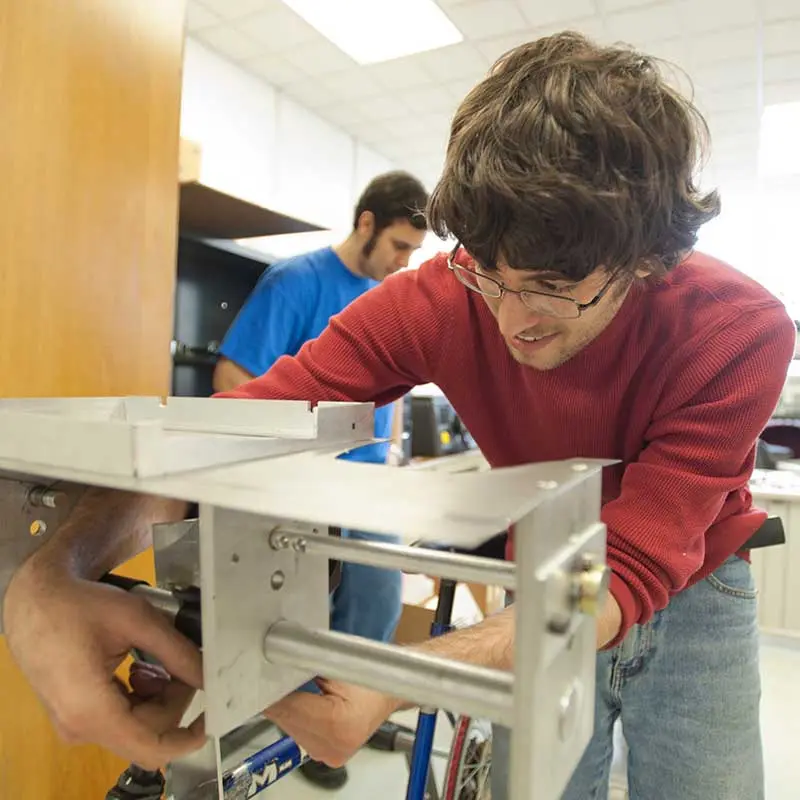
Student works with electrical equipment in UMass Lowell electrical engineering lab

The Electrical Engineering program is accredited by the Engineering Accreditation Commission of ABET under the commission’s General Criteria and Program Criteria for Electrical Engineering. Through the Electrical Engineering major, you will learn the fundamentals of electrical engineering, beginning with basic mathematics and science, followed by their application to courses in engineering science and engineering design. 

Courses in engineering science and design provide a balanced view of hardware, software, application tradeoffs, basic modeling techniques and the use of computer-aided design tools. 

You will also take courses in the humanities and social sciences that help broaden your understanding of the role that non-technical knowledge plays in determining a high level of professional responsibility.

An important aspect of our curriculum is the senior-year technical elective program, intended to broaden or deepen technical knowledge based on students’ interests and competencies. In addition, the project-based capstone experience challenges students to develop a custom-designed product for a client with a disability through the Assistive Technology Program.

Our hands-on program emphasizes experimental science and technology through investigative laboratory work and classroom lectures and demonstrations.

Visit the Academic Catalog for a complete course listing and to learn about the Electrical Engineering/Computer Science Double Major and Electrical Engineering/Physics Double Major.

What Can You Do with a Degree in Electrical Engineering?

As an electrical engineering graduate, you'll gain the necessary fundamentals of electrical engineering to launch a successful career in industry or continue on to graduate school.

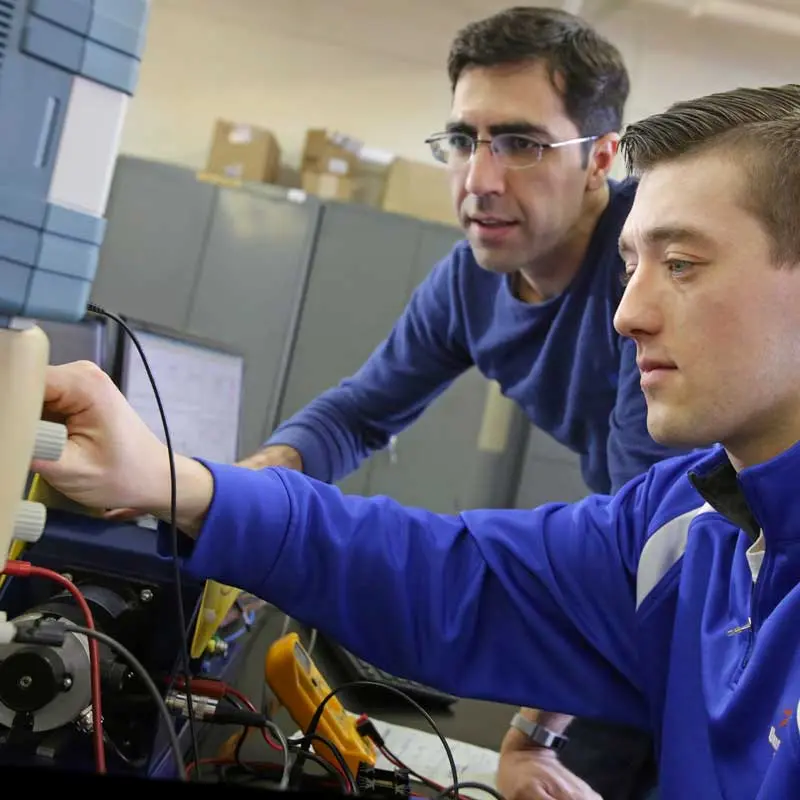
Student and professor at a computer in a UMass Lowell electrical and computer engineering lab

Where Our Graduates Work

  • Amazon Robotics 
  • Analog Devices 
  • BAE Systems 
  • Bose Corp. 
  • Eversource 
  • Hanscom Air Force Base 
  • Intel 
  • iRobot 
  • National Grid 
  • Raytheon Technologies

Year-by-Year Course Plan

Check out our degree pathways, which offer sample plans for completing your degree in four years.

For students who entered fall 2025 and beyond.

Freshman Year

Fall Semester

Course NumberCourse NameCredits
Total16
EECE.1070Introduction to ECE2
MATH.1310Calculus I (MATH)14
PHYS.1410Physics I (SCL)3
PHYS.1410LPhysics Lab I (SCL)1
ENGL.1010 /
HONR.1100
College Writing I /
First Year Seminar in Honors: Text in the City (CW)
3
xxxx.xxxxSocial Science Perspectives (SS)3

Spring Semester

Course NumberCourse NameCredits
Total14
MATH.1320Calculus II24
PHYS.1440Physics II (SCL)3
PHYS.1440LPhysics II Lab (SCL)1
ENGL.1020College Writing II (CW)3
EECE.2160ECE Applications Programming3

Sophomore Year

Fall Semester

Course NumberCourse NameCredits
Total16
EECE.2010Circuit Theory I3
EECE.2070Basic Circuits Lab I2
EECE.2650Logic Design3
MATH.2310Calculus III (MATH)4
ENGN.2100Professional Development Seminar1
xxxx.xxxxArts and Humanities Perspective (AH)3

Spring Semester

Course NumberCourse NameCredits
Total14
EECE.2020Circuit Theory II3
EECE.2080Basic Circuits Lab II2
EECE.2460Introduction to Data Communication Networks3
ECON.2010 /
ECON.2020
Principles of Microeconomics /
Principles of Macroeconomics (SS)
3
MATH.2340Differential Equations (CTPS), (QL)3

Junior Year

Fall Semester

Course NumberCourse NameCredits
Total17
EECE.3110Electronics I Lab (CTPS)2
EECE.3170Microprocessors I3
EECE.3620Signals and Systems I3
EECE.3640Engineering Mathematics3
EECE.3650Electronics I (QL)3
PHIL.2410Engineering and Ethics (AH), (SRE)3

Spring Semester

Course NumberCourse NameCredits
Total14
EECE.3120Electronics II Lab2
EECE.3600Engineering Electromagnetics I3
EECE.3630Introduction to Probability and Random Processes3
EECE.3660Electronics II3
xxxx.xxxxArts and Humanities Perspective (AH)3

Senior Year

Fall Semester

Course NumberCourse NameCredits
Total15
EECE.3991Capstone Proposal (IL), (WOC)3
EECE.4610Engineering Electromagnetics II3
EECE.3550 /
EECE.4200
Electromechanics /
Computer Aided Simulation and Design
3
EECE.4330Electronic Materials3
EECE.4/5xxxTechnical Electives33

Spring Semester

Course NumberCourse NameCredits
EECE.4130Linear Feedback Systems3
EECE.4991Capstone Project (AIL)3
EECE.4/5xxxTechnical Electives33
xxxx.xxxxSocial Sciences Perspective (SS)43
Total15

Total Minimum Credits = 121

Minimum [major] Credits: 73

Maximum [major] that can be counted toward graduation: 73

1Or MATH.1280 Calculus 1A and MATH.1290 Calculus 1B followed by MATH.1320 Calculus II.

2A grade of C or better in Calculus II is required

3Technical electives are non-required courses numbered EECE.4xxx or EECE.5xxx.

4Electrical Engineering students meet the Core Curriculum Essential Learning Outcome of Diversity and Cultural Awareness (DCA) outside of the major. See the DCA course listing for a complete list of options.

No more than two Breadth of Knowledge (BOK) courses can be taken with the same prefix. The Core Curriculum courses may be taken in any sequence. Refer to the Core Curriculum policy for further details. You should meet with your faculty advisor to determine how you will meet the Core Curriculum requirements.

Current UMass Lowell students should use their Advisement Report in SIS. If you need assistance, please contact your adviser.

Restriction on off-campus study:

Be advised that any course taken at another institution must be formally approved prior to enrollment. See the catalog policy for details.

Breadth of Knowledge (BOK) Glossary

  • SS - Social Sciences Perspective - 9 credits
  • AH - Arts and Humanities Perspective - 9 credits
  • SCL - Sciences with Lab Perspective - 6 credits
  • STEM - Science, Technology, Engineering and Math Perspective - 3 credits
  • CW - College Writing I and II - 6 credits
  • MATH - Math Perspective - 3 credits

Read more about the Breadth of Knowledge requirements.

Essential Learning Outcomes (ELO) Glossary

  • AIL - Applied and Integrative Learning
  • CTPS - Critical Thinking and Problem Solving
  • DCA - Diversity and Cultural Awareness
  • IL - Information Literacy
  • QL - Quantitative Literacy
  • SRE - Social Responsibility and Ethics
  • WOC - Written and Oral Communication

Read more about the Essential Learning Outcomes.

For students who entered fall 2025 and beyond.

Freshman Year

Fall Semester

Course NumberCourse NameCredits
Total16
EECE.1070Introduction to Electrical and Computer Engineering2
MATH.1310Calculus I (MATH)14
COMP.1010Computing I3
COMP.1030LComputing I Lab1
ENGL.1010College Writing I (CW)3
xxxx.xxxxSocial Sciences Perspective (SS)33

Spring Semester

Course NumberCourse NameCredits
Total18
COMP.1020Computing II3
COMP.1040LComputing II Lab1
MATH.1320Calculus II24
CHEM.1210Chemistry I (SCL)3
CHEM.1230LChemistry I Laboratory (SCL)1
ENGL.1020College Writing II (CW)3
xxxx.xxxxArts and Humanities Perspective (AH)33

Sophomore Year

Fall Semester

Course NumberCourse NameCredits
Total18
EECE.2010Circuit Theory I3
EECE.2070Basic Electrical Engineering Laboratory I2
COMP.2010Computing III3
COMP.2010RComputing III Lab1
MATH.2310Calculus III4
PHYS.1410Physics I (SCL)3
PHYS.1410LPhysics I Lab (SCL)1
ENGN.2100Professional Development Seminar1

Spring Semester

Course NumberCourse NameCredits
Total18
EECE.2020Circuit Theory II3
EECE.2080Basic Electrical Engineering Lab II2
EECE.2650Logic Design3
MATH.2190 /
MATH.3600
Discrete Structures I /
Mathematic Structure for Computer Engineers
3
MATH.2340Differential Equations3
PHYS.1440Physics II3
PHYS.1440LPhysics II Lab1

Junior Year

Fall Semester

Course NumberCourse NameCredits
EECE.3110Electronics I Lab (CTPS)2
EECE.3170 /
COMP.2030
Microprocessors I /
Assembly Language Programming
3
EECE.3620Signals and Systems I3
EECE.3650Electronics I (QL)3
COMP.2040Computing IV3
xxxx.xxxxArts and Humanities Perspective (AH)33
Total17

Spring Semester

Course NumberCourse NameCredits
EECE.3120Electronics II Laboratory2
EECE.3630 /
MATH.3860
Introduction to Probability and Random Processes /
Probability and Statistics I
3
EECE.3640Engineering Mathematics3
EECE.3660Electronics II3
COMP.3040Foundations of Computer Science3
COMP.3050Computer Architecture3
Total17

Senior Year

Fall Semester

Course NumberCourse NameCredits
EECE.3600Engineering Electromagnetics I3
EECE.3991Capstone Proposal (IL), (WOC)3
COMP.3080Operating Systems3
COMP.xxxxCS Project Sequence I3
PHIL.2410Engineering and Ethics (AH), (SRE)3
ECON.2010 /
ECON.2020
Principles of Microeconomics /
Principles of Macroeconomics (SS)
3
Total18

Spring Semester

Course NumberCourse NameCredits
EECE.4130 /
EECE.4610
Linear Feedback System /
Engineering Electromagnetics II
3
EECE.4991Capstone Project (AIL)3
COMP.3010Organization of Programming Languages3
COMP.4040Analysis of Algorithms3
COMP.xxxxCS Project Sequence II3
xxxx.xxxxSocial Sciences Perspective (SS)33
Total18

Total Minimum Credits = 140

Minimum [major] Credits: 36

Maximum [major] that can be counted toward graduation: 54

1Or MATH.1280 Calculus 1A and MATH.1290 Calculus 1B, followed by MATH.1320 Calculus II.

2A grade of C or better in Calculus II is required.

3Electrical Engineering & Computer Science students meet the Core Curriculum Essential Learning Outcome of Diversity and Cultural Awareness (DCA) outside of the major. See the DCA course listing for a complete list of options.

No more than two Breadth of Knowledge (BOK) courses can be taken with the same prefix. The Core Curriculum courses may be taken in any sequence. Refer to the Core Curriculum policy for further details. You should meet with your faculty advisor to determine how you will meet the Core Curriculum requirements.

Current UMass Lowell students should use their Advisement Report in SIS. If you need assistance, please contact your advisor.

Restriction on off-campus study:

Be advised that any course taken at another institution must be formally approved prior to enrollment. See the catalog policy for details.
Breadth of Knowledge (BOK) Glossary

  • SS - Social Sciences Perspective - 9 credits
  • AH - Arts and Humanities Perspective - 9 credits
  • SCL - Sciences with Lab Perspective - 6 credits
  • STEM - Science, Technology, Engineering and Math Perspective - 3 credits
  • CW - College Writing I and II - 6 credits
  • MATH - Math Perspective - 3 credits

Read more about the Breadth of Knowledge requirements.

Essential Learning Outcomes (ELO) Glossary

  • AIL - Applied and Integrative Learning
  • CTPS - Critical Thinking and Problem Solving
  • DCA - Diversity and Cultural Awareness
  • IL - Information Literacy
  • QL - Quantitative Literacy
  • SRE - Social Responsibility and Ethics
  • WOC - Written and Oral Communication

Read more about the Essential Learning Outcomes.

For students who entered fall 2025 and beyond.

Freshman Year

Fall Semester

Course NumberCourse NameCredits
EECE.1070Introduction to Electrical and Computer Engineering2
ENGL.1010College Writing I (CW)3
CHEM.1210Chemistry I (SCL)3
CHEM.1230LChemistry I Laboratory (SCL)1
MATH.1310Calculus I (MATH)14
PHYS.1410Physics I (SCL)3
PHYS.1410LPhysics I Lab (SCL)1
Total17

Spring Semester

Course NumberCourse NameCredits
Total19
EECE.2160ECE Application Programming3
ENGL.1020College Writing II (CW)3
CHEM.1220Chemistry II (SCL)3
CHEM.1240LChemistry II Laboratory (SCL)1
MATH.1320Calculus II24
PHYS.1120Freshman Physics Seminar1
PHYS.1440Physics II3
PHYS.1440LPhysics II Lab1

Sophomore Year

Fall Semester

Course NumberCourse NameCredits
Total17
EECE.2010Circuit Theory I3
EECE.2070Basic Electrical Engineering Laboratory I2
EECE.2650Logic Design3
MATH.2310Calculus III4
PHYS.2450Physical Properties of Matter3
PHYS.2450LPhysics III Lab1
ENGN.2100Professional Development Seminar1

Spring Semester

Course NumberCourse NameCredits
Total17
EECE.2020Circuit Theory II3
EECE.2080Basic Electrical Engineering Lab II2
EECE.3170Microprocessors I3
MATH.2340Differential Equations3
PHYS.2100Introductory Modern Physics3
PHYS.2620LPrinciples in Laboratory Automation3

Junior Year

Fall Semester

Course NumberCourse NameCredits
EECE.3110Electronics I Lab (CTPS)2
EECE.3550Electromechanics3
EECE.3620Signals & Systems I3
EECE.3650Electronics I (QL)3
PHYS.3810Mathematical Physics I3
ECON.2010 /
ECON.2020
Principles of Microeconomics /
Principles of Macroeconomics (SS)
3
Total17

Spring Semester

Course NumberCourse NameCredits
Total17
EECE.3120Electronics II Lab2
EECE.3600Engineering Electromagnetics I3
EECE.3630 /
MATH.3860
Introduction to Probability and Random Processes /
Probability and Statistics
3
EECE.3660Electronics II3
PHYS.3820Mathematical Physics II3
PHYS.4350Introductory Quantum Mechanics I3

Senior Year

Fall Semester

Course NumberCourse NameCredits
Total18
EECE.3991Capstone Proposal (IL), (WOC)3
EECE.4610Engineering Electromagnetics II3
PHIL.2410Engineering and Ethics (AH), (SRE)3
PHYS.xxxxElective33
xxxx.xxxxSocial Sciences Perspective (SS)53
xxxx.xxxxArts and Humanities Perspective (AH)53

Spring Semester

Course NumberCourse NameCredits
Total17
EECE.4130Linear Feedback Systems3
EECE.4991Capstone Project (AIL)3
EECE.4/5xxxTechnical Elective43
PHYS.3930LAdvanced Experimental Physics Laboratory I2
xxxx.xxxxSocial Sciences Perspective (SS)53
xxxx.xxxxArts and Humanities Perspective (AH)53

Total Minimum Credits = 139

Minimum [major] Credits: 36

Maximum [major] that can be counted toward graduation: 54

1Or MATH.1280 Calculus 1A and MATH.1290 Calculus 1B, followed by MATH.1320 Calculus II.

2A grade of C or better in Calculus II is required.

3PHYS.3380 Optics and Waves satisfies the prerequisite for PHYS.5390 Electro-Optics, a core course in the Optical Sciences option for the M.S. in Physics.

4EECE.5680 Electro-Optic Systems, also offered as EECE.4680, satisfies an elective course in the Optical Sciences option for the M.S. in Physics.

5Electrical Engineering & Physics students meet the Core Curriculum Essential Learning Outcome of Diversity and Cultural Awareness (DCA) outside of the major. See the DCA course listing for a complete list of options.

No more than two Breadth of Knowledge (BOK) courses can be taken with the same prefix. The Core Curriculum courses may be taken in any sequence. Refer to the Core Curriculum policy for further details. You should meet with your faculty advisor to determine how you will meet the Core Curriculum requirements.

Current UMass Lowell students should use their Advisement Report in SIS. If you need assistance, please contact your advisor.

Restriction on off-campus study:

Be advised that any course taken at another institution must be formally approved prior to enrollment. See the catalog policy for details.

Breadth of Knowledge (BOK) Glossary

  • SS - Social Sciences Perspective - 9 credits
  • AH - Arts and Humanities Perspective - 9 credits
  • SCL - Sciences with Lab Perspective - 6 credits
  • STEM - Science, Technology, Engineering and Math Perspective - 3 credits
  • CW - College Writing I and II - 6 credits
  • MATH - Math Perspective - 3 credits

Read more about the Breadth of Knowledge requirements.

Essential Learning Outcomes (ELO) Glossary

  • AIL - Applied and Integrative Learning
  • CTPS - Critical Thinking and Problem Solving
  • DCA - Diversity and Cultural Awareness
  • IL - Information Literacy
  • QL - Quantitative Literacy
  • SRE - Social Responsibility and Ethics
  • WOC - Written and Oral Communication

Read more about the Essential Learning Outcomes.

Why Study Electrical Engineering at UMass Lowell?

Student builds with equipment in a UMass Lowell electrical and computer engineering lab

Experiential Learning

Build career-ready skills through experiences outside the classroom, including: 

  • Research in a faculty laboratory 
  • Co-ops and internships 
  • Service learning 
  • Study abroad
Student looks through a microscope as a professor stands nearby in a UMass Lowell electrical and computer engineering lab

Research Opportunities

Work closely with renowned faculty and graduate students on groundbreaking research in areas such as: 

  • Control systems
  • Digital signal processing 
  • Microwave technology
  • Electromagnetics 
  • Optoeletronic and optical devices and systems
  • Power systems
  • Telecommunications
  • Wireless communications
Student works with a robot while others watch in a UMass Lowell electrical and computer engineering classroom

Student Organizations

Put your learning into practice. Check out some of the fun ways UML students come together.

Student next to electrical equipment in a UMass Lowell electrical and computer engineering lab

Career Connected Experience: The UMass Lowell Guarantee

Every first-time, first-year UMass Lowell student will have the opportunity to pursue at least one Career Connected Experience (internships, co-ops, clinical placements, service learning, study abroad and more) during their undergraduate career — earning pay, credits or both before they graduate.

Visit UMass Lowell

Launch virtual tour

Visit campus, meet our people and picture yourself here. Find in-person and virtual tours and events.

Still Exploring Majors?

We've got 120+ programs. Browse our Program Finder to find the one that's right for you.

View All Programs