
 Image by Ed Brennen
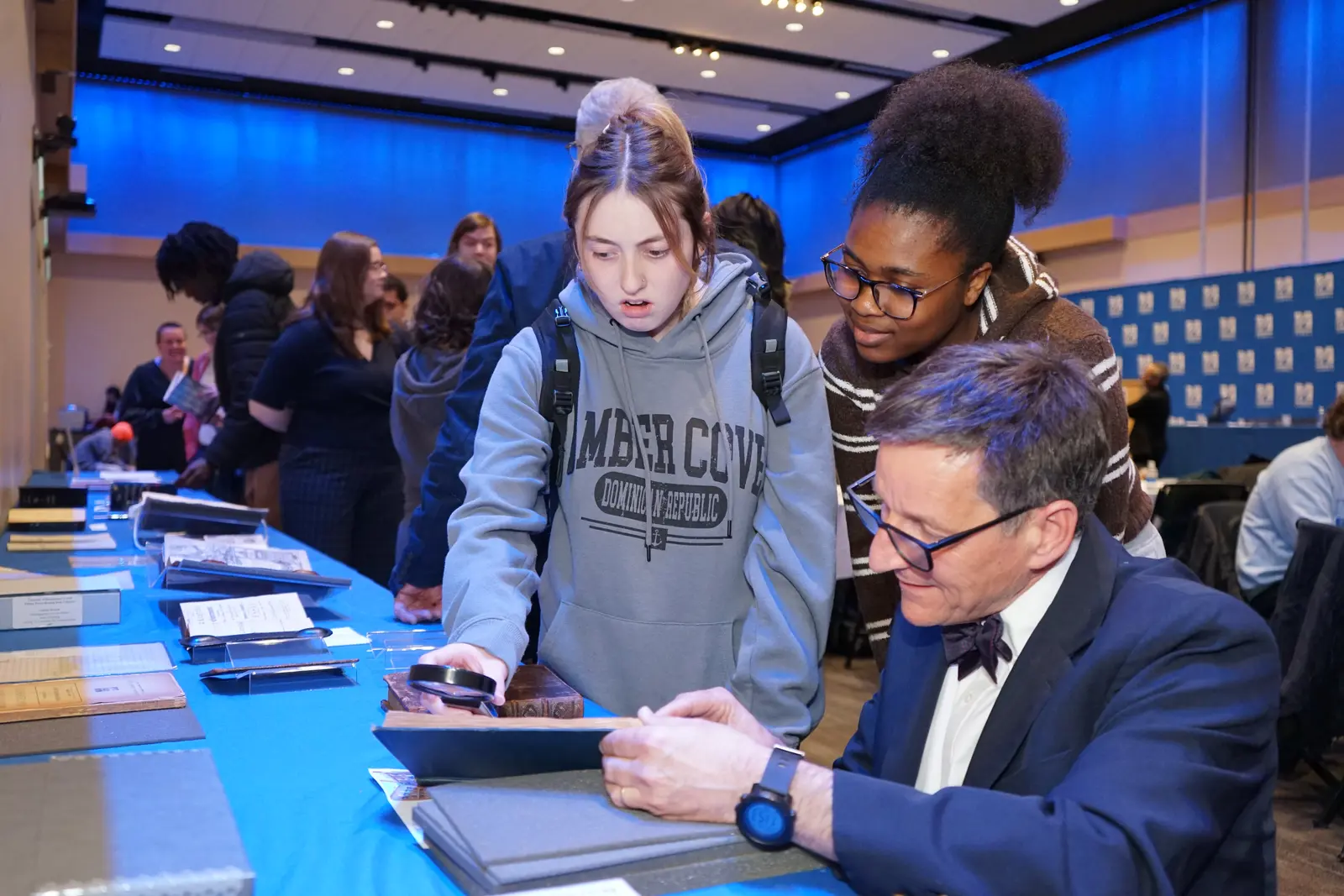
 History Professor Christopher Carlsmith shows first-year students Tea Pucillo, left, and Selina Budu a work from the university's rare book collection during the recent "Thomas Hobbes & His Leviathan" conference at University Crossing.
First-year business major Tea Pucillo had just read “Leviathan,” English philosopher Thomas Hobbes’ 1651 book about the role of government and human nature, in her Introduction to Ethics course.
At a recent interdisciplinary conference about the work that was co-hosted by the College of Fine Arts, Humanities and Social Sciences (FAHSS) and the UMass Lowell Library, Pucillo got to touch the yellowed pages of a first edition of the 17th-century text from the university’s rare book collection.
“I feel weird touching the book because it’s so old, but it’s also amazing,” Pucillo said. “I didn't know that UMass Lowell had a book like this, which is pretty awesome.”
The conference, “Thomas Hobbes & His Leviathan,” brought together nearly 100 faculty, students and staff from across campus, using the university’s valuable first edition as a centerpiece for discussion and hands-on learning.
“Coming together around a shared topic — this is exactly the kind of interdisciplinary collaboration that we want to see,” said FAHSS Dean Sue Kim.
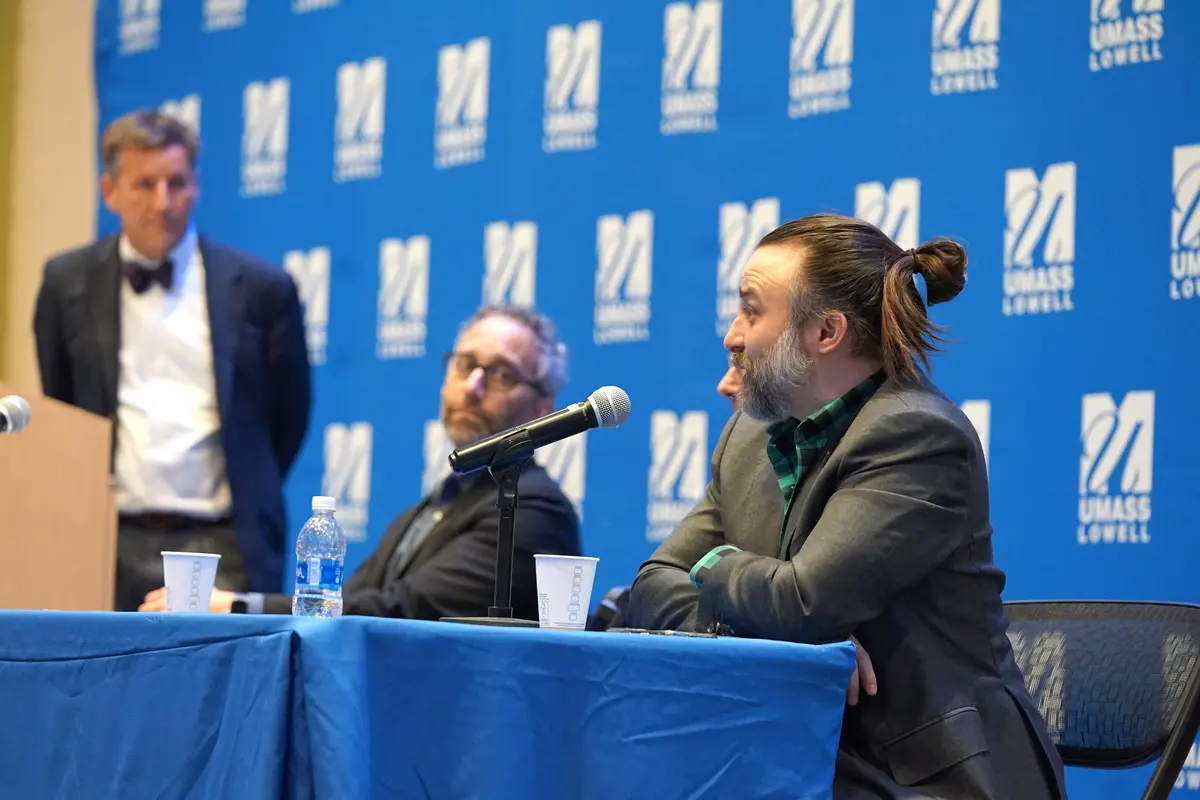 Image by Ed Brennen
 Philosophy Associate Professor Nicholas Evans, right, discusses "Leviathan" while History Professor Christopher Carlsmith, left, and English Teaching Professor Kevin Petersen look on.
“We’re a large research university, but in many ways, we operate like a small liberal arts college where people are exchanging ideas, wrestling with challenges and making connections across disciplines,” Petersen said.
Petersen and Carlsmith led a faculty panel that included Art History Assistant Teaching Professor Jennifer Cadero-Gillette, Philosophy Associate Professor Nicholas Evans, Philosophy Professor John Kaag, English Associate Teaching Professor Katie Shrieves and Library Head Archivist Tony Sampas.
Carlsmith opened with an overview of Hobbes’ life and work, situating “Leviathan” in the context of the English Civil War and the scientific revolution. Hobbes, he explained, argued that without strong central authority, society would descend into disorder — a view that has shaped political thought for more than three centuries.
Evans connected those ideas to the present, describing how Hobbes’ concept of a chaotic “state of nature” continues to influence modern theories of international relations. He noted that scholars today are reexamining how Hobbes’ ideas have been interpreted, particularly whether his observations about conflict between states point to the need for stronger systems of cooperation and control.
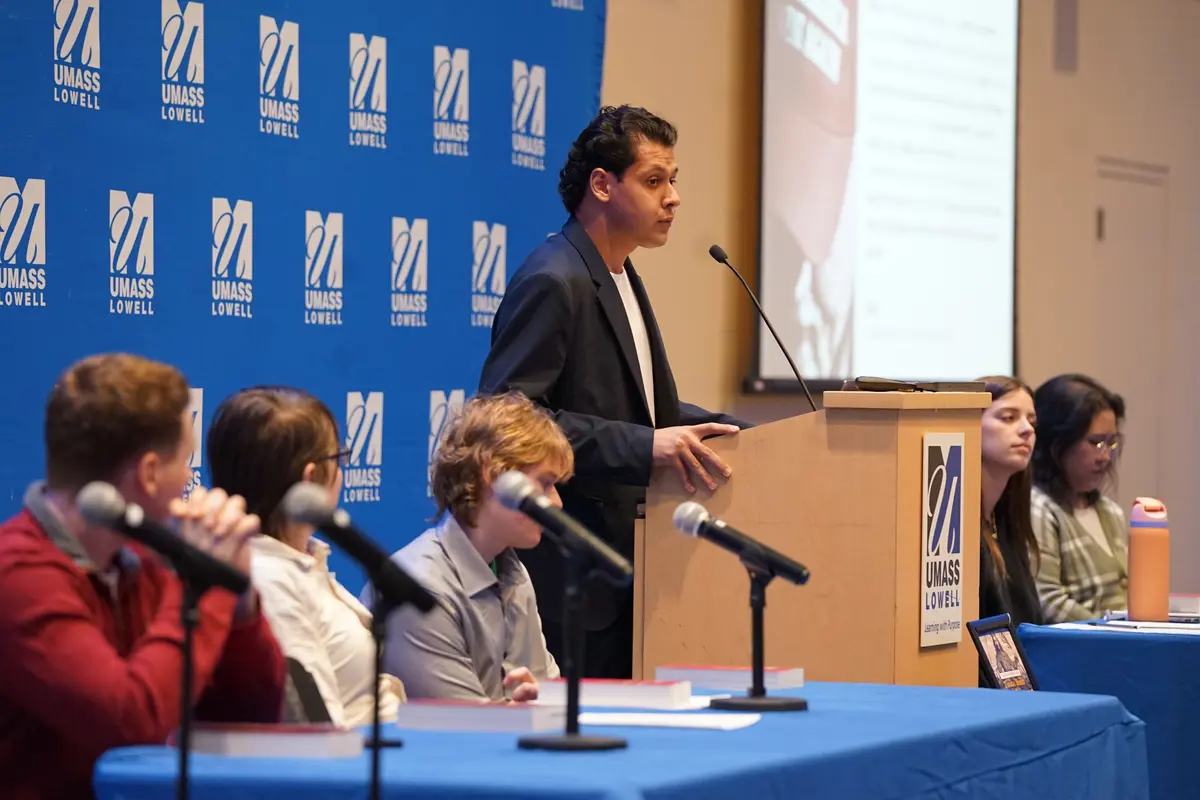 Image by Ed Brennen
 Mechanical engineering major Matheus Queiroz shares his thoughts on "Leviathan" and how it relates to modern American politics while fellow student panelists look on.
Ranging from 1637 to the mid-20th century, the collection includes an early edition of René Descartes’ “Discourse on Method,” which introduced “I think, therefore I am,” and John Locke’s “Two Treatises of Government” from 1690. Several of the volumes were on display at the conference and are now used in UML classrooms.
“It’s important for students to have the chance to engage with these books firsthand,” said Kaag, who used the experience of discovering the collection as the basis for his 2016 book “American Philosophy: A Love Story.”
The student panel included political science majors Rena McFall and Siri Wolf, history major Daranee Khoeun, mechanical engineering major Matheus Queiroz, electrical engineering major Colin Benvenuto and mathematics and world languages double-major Kevin Jacobson. They developed their talks from papers they wrote on “Leviathan” in a philosophy course with Kaag last semester.
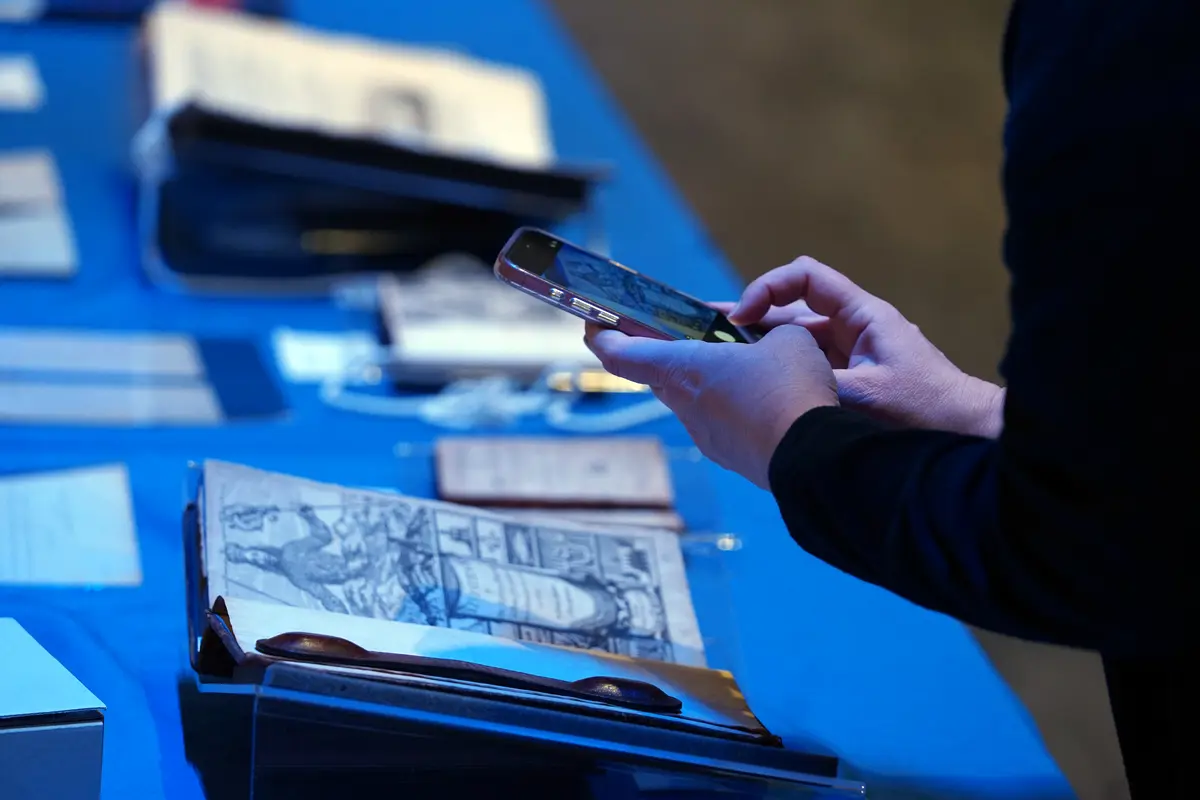 Image by Ed Brennen
 A conference attendee snaps a photo of the university's rare first edition of Thomas Hobbes' "Leviathan," published in 1651.
Jacobson looked at how Hobbes’ ideas about sovereignty and the social contract apply to modern American democracy.
“Hobbes’ theory assumes that people give up rights for security, but American democracy is built on the idea of inalienable rights,” Jacobson said.
Library Dean Galadriel Chilton said the event reflects a broader effort to connect teaching, research and library collections across disciplines.
“This really exemplifies what is phenomenal about an academic community,” said Chilton, who hopes to see the conference become an annual fixture at UML.
Public administration graduate student Owen Fryns ’25, a member of the Model United Nations team, was interested in applying Hobbes’ ideas to modern international relations theories. As an archives intern at the Center for Lowell History, he said the opportunity to handle the nearly 400-year-old “Leviathan” was also too good to miss.
“You can see a PDF online, but to actually hold it and turn the pages — there’s nothing better,” he said.
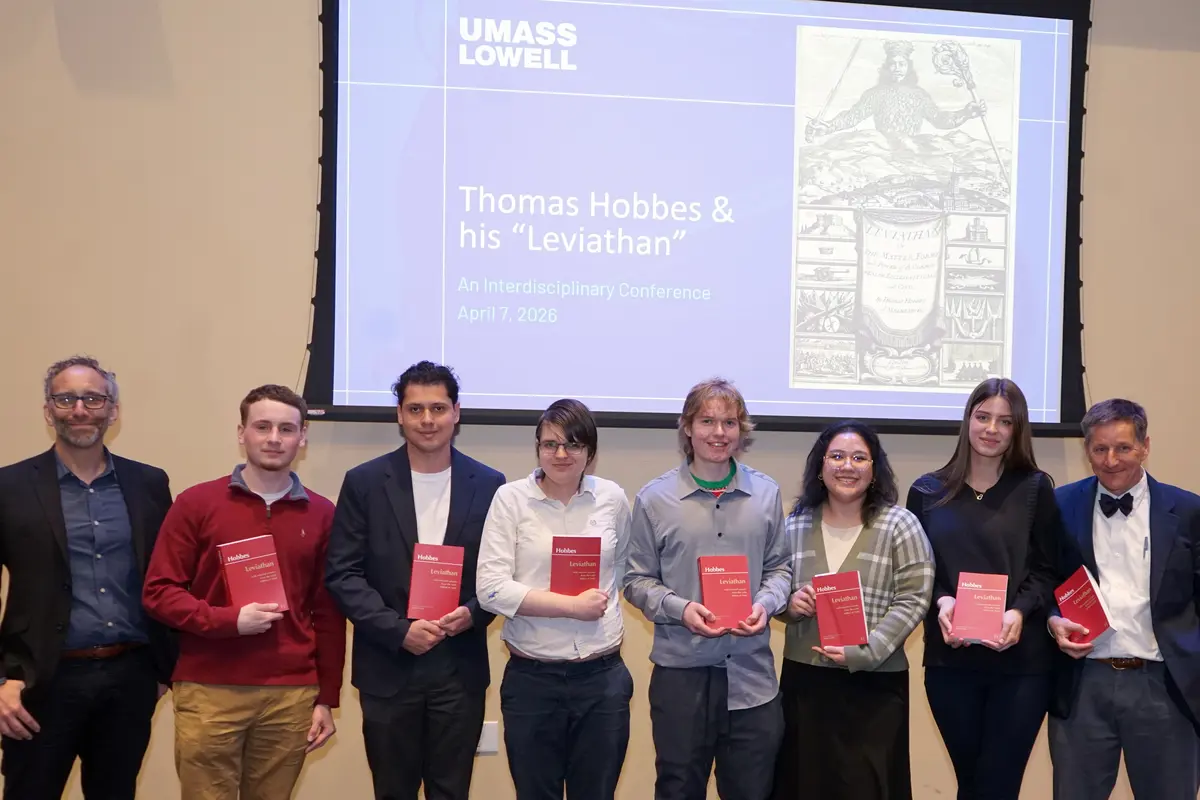 Image by Ed Brennen
 Student panelists, flanked by conference organizers Kevin Petersen, left, and Christopher Carlsmith, right, received their own copies of "Leviathan" from the UMass Lowell Library.