As a nutritional science major, you will be prepared for a career in public health, education, health and wellness, research or industry. 

Prepare for a career in health and wellness, dietetics, research or industry.

With a nutritional science major, you can help people live healthier lives. While in our program, you will explore the various disciplines within the field of nutritional science to turn your passion for health into a fulfilling career.

What is Nutritional Science?

Career Options for Nutritional Science Majors

Students who graduate from the B.S. in Nutritional Science program find jobs right away in the fields of wellness, business or as nutritionists. Many students decide to build on their undergraduate degree and are well prepared for master's or doctoral programs and go on to become registered dietitians, physicians, dentists, physician assistants, epidemiologists, and nutrition scientists.

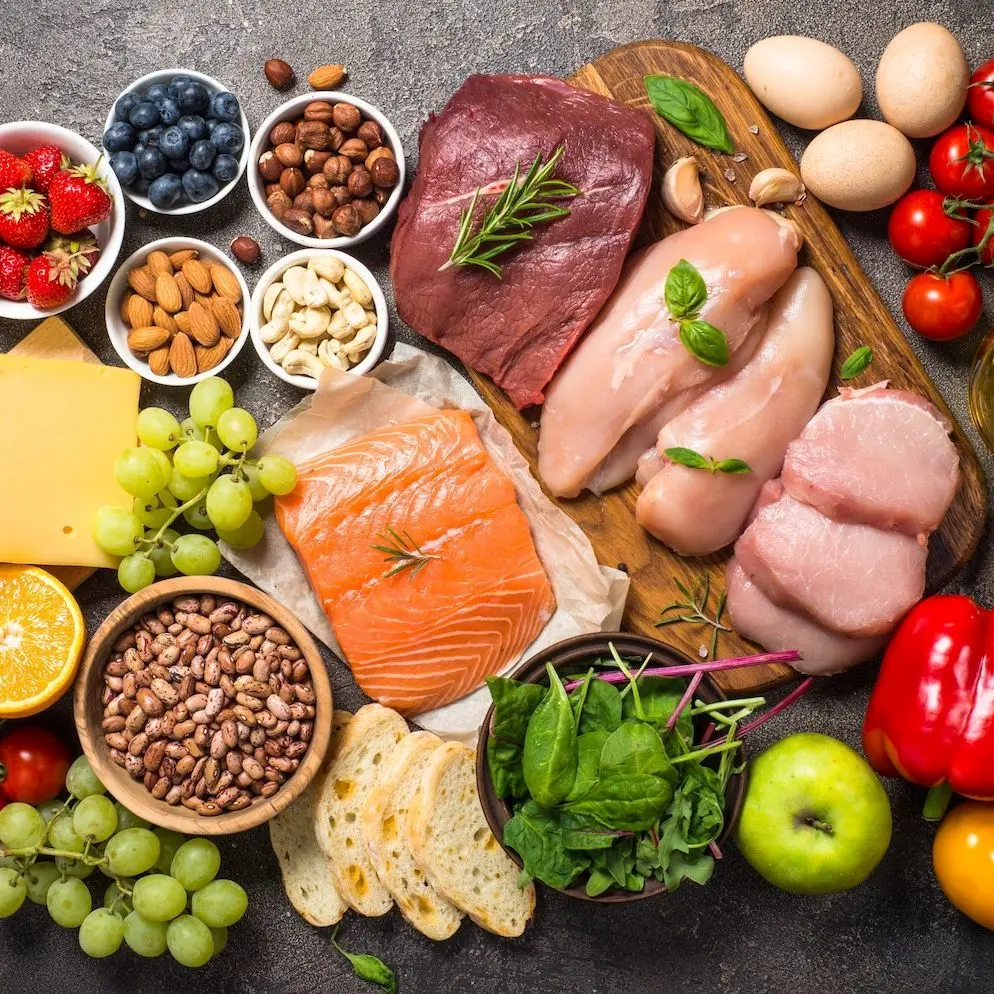
A variety of nutritional foods including fresh meats and poultry, fruits, vegetables, grains, bread, nuts, legumes, eggs and olive oil.

Recent UMass Lowell graduates have worked in:

Health Care

  • Walden Behavioral Care
  • Dana Farber
  • Next Step Healthcare
  • Healthcare Services Group, Inc
  • CHI Baylor St. Luke’s Medical Center
  • Boston Children’s Hospital 
  • Lowell General Hospital
  • Tufts Medical Center
  • Uphams Corner Health Center
  • Tewksbury Hospital
  • Beth Israel Deaconess Medical Center
  • Army National Guard Medical Command
  • Sodexo
  • Atrius Health
  • Lahey Hospital and Medical Center
  • Functional Forward Nutrition (Private Practice)

Sports Nutrition

  • University of North Carolina Athletic Department
  • InnerStrenth Coaching LLC
  • Lifetime Inc.
  • Rutgers, Sports Dietitian
  • The Executive Health and Sports Center

Industry

  • ZOLL Medical Corporation
  • Astellas Gene Therapies
  • NourishRX
  • Innovive Health
  • Covestro
  • Dicerna Pharmaceuticals, Novo Nordisk
  • Cell Line Development, AbbVie
  • MilliporeSigma
  • HelloFresh

Public Health & Policy

  • Hudson Public Schools, Methuen Public Schools, Acton Boxborough Reginal School District
  • Greater Lawrence Community Action Council
  • North Andover Water Treatment Plant
  • Women, Infant and Children

Year-by-Year Course Plan

Check out our degree pathways, which offer sample plans for completing your degree in four years.

For students who entered fall 2024 and beyond.

Freshman Year

Fall Semester

Course NumberCourse NameCredits
HSCI.1010Human Anatomy and Physiology I (SCL)3
HSCI.1030Human Anatomy and Physiology Lab I1
HSCI.1051Interprofessional Education First Year Seminar1
HSCI.1011Medical Terminology for Health Professional1
ENGL.1010 /
HONR.1100
College Writing I /
First Year Seminar in Honors: Text in the City (CW)
3
PSYC.1010Introduction to Psychological Science (SS)13
SOCI.1010Introduction to Sociology (SS)13
Total15

Spring Semester

Course NumberCourse NameCredits
PUBH.1021Introduction to Public Health (SS)13
HSCI.1020Human Anatomy and Physiology II (SCL)3
HSCI.1040Human Anatomy and Physiology Lab II1
ENGL.1020College Writing II (CW)3
MATH.1210Management Precalculus (MATH)3
NUTR.1100Nutrition and Wellness3
Total16

Sophomore Year

Fall Semester

Course NumberCourse NameCredits
HSCI.2110Clinical Microbiology and Microbial Pathogenesis3
HSCI.2130Clinical Microbiology and Microbial Pathogenesis Lab 1
HSCI.2510Physiological Chemistry I23
HSCI.2530Physiological Chemistry Lab I21
NUTR.2310Practice of the Nutrition Professional3
xxxx.xxxxArts and Humanities Perspective (AH)3
Total14

Spring Semester

Course NumberCourse NameCredits
BMSC.2420Organic Structures and Reactions I43
HSCI.2520Physiological Chemistry II33
HSCI.2540Physiological Chemistry Lab II31
MATH.2830Introduction to Statistics (STEM)3
NUTR.2060Human Nutrition3
xxxx.xxxxArts and Humanities Perspective (AH)3
Total16

Junior Year

Fall Semester

Course NumberCourse NameCredits
HSCI.3500Human Biochemistry3
NUTR.3450Community Nutrition (DCA), (SRE)3
NUTR.3570Sports Nutrition3
NUTR.3720Body Diversity and Health3
xxxx.xxxxFree Elective3
Total15

Spring Semester

Course NumberCourse NameCredits
NUTR.3010Food Science with Lab3
NUTR.3360Life Cycle Nutrition3
NUTR.3710Nutrition and Metabolism3
MGMT.3010Organizational Behavior3
xxxx.xxxxFree Elective3
Total15

Senior Year

Fall Semester

Course NumberCourse NameCredits
HSCI.3400IPE Research Methods3
NUTR.4630Vitamins and Minerals3
NUTR.4810Medical Nutrition Therapy for Chronic Disease I3
MGMT.3100Human Resources Management3
xxxx.xxxxArts and Humanities Perspective (AH)3
Total15

Spring Semester

Course NumberCourse NameCredits
NUTR.4050Food and Nutrition Management3
NUTR.4720Nutrigenetics3
NUTR.4820Medical Nutrition Therapy for Complex Disease3
PUBH.3050Introduction to Epidemiology (IL)3
xxxx.xxxxFree Elective3
Total15

Total Minimum Credits = 120

1Meets Core Curriculum Social Sciences Perspective (SS) requirement.

2Can be replaced with CHEM.1110 / CHEM.1130L Survey of Chemistry I: General Chemistry w/Lab OR CHEM.1210 / CHEM.1230L Chemistry I w/Lab.

3Can be replaced with CHEM.1120 / CHEM.1140L Survey of Chemistry II: Organic and Biochemistry w/Lab OR CHEM.1220 / CHEM.1240L Chemistry II w/Lab.

4Organic Chemistry is required for the MPH Coordinated Program in Dietetics; Organic lecture and lab may also be required for other graduate programs

Note: All students must come for pre-registration advising every semester.

No more than two Breadth of Knowledge courses can be taken with the same prefix. The Core Curriculum courses may be taken in any sequence. Refer to the Core Curriculum policy for further details. You should meet with your faculty advisor to determine how you will meet the Core Curriculum requirements.

Current UMass Lowell students should be using their Advisement Report in SiS. If you need assistance, please contact your adviser.

Restriction on off-campus study:

Be advised that any course taken at another institution must be formally approved prior to enrollment.

See the catalog policy for details.

Breadth of Knowledge (BOK) Glossary

  • SS - Social Sciences Perspective - 9 credits
  • AH - Arts and Humanities Perspective - 9 credits
  • SCL - Sciences with Lab Perspective - 6-8 credits
  • STEM - Science, Technology, Engineering and Math Perspective - 3 credits
  • CW - College Writing I and II - 6 credits
  • MATH - Math Perspective - 3 credits

Read more about the Breadth of Knowledge requirements.

Essential Learning Outcomes (ELO) Glossary

  • AIL - Applied and Integrative Learning
  • CTPS - Critical Thinking and Problem Solving
  • DCA - Diversity and Cultural Awareness
  • IL - Information Literacy
  • QL - Quantitative Literacy
  • SRE - Social Responsibility and Ethics
  • WOC - Written and Oral Communication

Read more about the Essential Learning Outcomes.

For students who entered fall 2024 and beyond.

Freshman Year

Fall Semester

Course NumberCourse NameCredits
Total15
HSCI.1010Human Anatomy and Physiology I (SCL)3
HSCI.1030Human Anatomy and Physiology Lab I (SCL)1
HSCI.1011Medical Terminology for Health Professionals1
HSCI.1051Interprofessional Education First Year Seminar 1
ENGL.1010 /
HONR.1100
College Writing I /
First Year Seminar in Honors: Text in the City (CW)
3
PSYC.1010Introduction to Psychological Science (SS)13
SOCI.1010Introduction to Sociology (SS)13

Spring Semester

Course NumberCourse NameCredits
Total16
PUBH.1021Introduction to Public Health (SS)13
HSCI.1020Human Anatomy & Physiology II (SCL)3
HSCI.1040Human Anatomy & Physiology II Lab (SCL)1
ENGL.1020College Writing II (CW)3
MATH.1210Management Precalculus (MATH)3
NUTR.1100Nutrition and Wellness3

Sophomore Year

Fall Semester

Course NumberCourse NameCredits
Total14
HSCI.2110Clinical Microbiology and Microbial Pathogenesis3
HSCI.2130Clinical Microbiology and Microbial Pathogenesis Lab1
HSCI.2510Physiological Chemistry I23
HSCI.2530Physiological Chemistry Lab I21
NUTR.2310Practice of the Nutrition Professional3
PUBH.2070The US Healthcare System3

Spring Semester

Course NumberCourse NameCredits
Total16
EXER.2020Introduction to Exercise Science3
HSCI.2220Health and Disease Across the Lifespan3
HSCI.2520Physiological Chemistry II33
HSCI.2540Physiological Chemistry Lab II31
MATH.2830Introduction to Statistics (STEM)3
NUTR.2060Human Nutrition3

Junior Year

Fall Semester

Course NumberCourse NameCredits
Total15
NUTR.3450Community Nutrition (DCA), (SRE)3
NUTR.3570Sports Nutrition3
NUTR.3720Body Diversity and Health3
MKTG.2010Marketing Principles3
PUBH.2050Social Determinants of Health3

Spring Semester

Course NumberCourse NameCredits
Total15
NUTR.3360Life Cycle Nutrition3
NUTR.3710Nutrition and Metabolism3
PSYC.3120Learning and Behavior3
PUBH.3070Introduction to Public Health Policy3
xxxx.xxxxArts and Humanities Perspective (AH)3

Senior Year

Fall Semester

Course NumberCourse NameCredits
Total15
HSCI.3400IPE Research Methods3
NUTR.4810Medical Nutrition Therapy for Chronic Disease I3
xxxx.xxxxArts and Humanities Perspective (AH)3
xxxx.xxxxFree Elective3

Spring Semester

Course NumberCourse NameCredits
Total15
EXER.4300Exercise is Medicine3
PUBH.3050Introduction to Epidemiology3
PSYC.3450Health Psychology3
xxxx.xxxxArts and Humanities Perspective (AH)3
xxxx.xxxxFree Elective3

Total Minimum Credits = 121

1Meets Core Curriculum Social Sciences Perspective (SS) requirement.

2Can be replaced with CHEM.1110 / CHEM.1130L Survey of Chemistry I: General Chemistry w/Lab OR CHEM.1210 / CHEM.1230L Chemistry I w/Lab.

3Can be replaced with CHEM.1120 / CHEM.1140L Survey of Chemistry II: Organic and Biochemistry w/Lab OR CHEM.1220 / CHEM.1240L Chemistry II w/Lab

Note: All students must come for pre-registration advising every semester.

No more than two Breadth of Knowledge courses can be taken with the same prefix. The Core Curriculum courses may be taken in any sequence. Refer to the Core Curriculum policy for further details. You should meet with your faculty advisor to determine how you will meet the Core Curriculum requirements.

Current UMass Lowell students should be using their Advisement Report in SiS. If you need assistance, please contact your adviser.

Restriction on off-campus study:

Be advised that any course taken at another institution must be formally approved prior to enrollment.

See the catalog policy for details.
Breadth of Knowledge (BOK) Glossary

  • SS - Social Sciences Perspective - 9 credits
  • AH - Arts and Humanities Perspective - 9 credits
  • SCL - Sciences with Lab Perspective - 6-8 credits
  • STEM - Science, Technology, Engineering and Math Perspective - 3 credits
  • CW - College Writing I and II - 6 credits
  • MATH - Math Perspective - 3 credits

Read more about the Breadth of Knowledge requirements.

Essential Learning Outcomes (ELO) Glossary

  • AIL - Applied and Integrative Learning
  • CTPS - Critical Thinking and Problem Solving
  • DCA - Diversity and Cultural Awareness
  • IL - Information Literacy
  • QL - Quantitative Literacy
  • SRE - Social Responsibility and Ethics
  • WOC - Written and Oral Communication

Read more about the Essential Learning Outcomes.

For students who entered fall 2024 and beyond.

Freshman Year

Fall Semester

Course NumberCourse NameCredits
Total15
HSCI.1010Human Anatomy and Physiology I (SCL)3
HSCI.1011Medical Terminology for Health Professionals1
HSCI.1030Human Anatomy and Physiology Lab I (SCL)1
HSCI.1051Interprofessional Education First Year Seminar1
ENGL.1010 /
HONR.1100
College Writing I /
First Year Seminar in Honors: Text in the City (CW)
3
PSYC.1010Introduction to Psychological Science (SS)13
SOCI.1010Introduction to Sociology (SS)13

Spring Semester

Course NumberCourse NameCredits
PUBH.1021Introduction to Public Health (SS)13
HSCI.1020Human Anatomy and Physiology II (SCL)3
HSCI.1040Human Anatomy and Physiology Lab II (SCL)1
ENGL.1020College Writing II (CW)3
MATH.1210Management Precalculus (MATH)3
NUTR.1100Nutrition and Wellness3
Total16

Sophomore Year

Fall Semester

Course NumberCourse NameCredits
Total14
HSCI.2110Clinical Microbiology and Microbial Pathogenesis3
HSCI.2130Clinical Microbiology and Microbial Pathogenesis Lab1
HSCI.2510Physiological Chemistry I23
HSCI.2530Physiological Chemistry Lab I21
NUTR.2310Practice of the Nutrition Profession3
xxxx.xxxxArts and Humanities Perspective (AH)3

Spring Semester

Course NumberCourse NameCredits
HSCI.2520Physiological Chemistry II43
HSCI.2540Physiological Chemistry Lab II41
MATH.2830Introduction to Statistics (STEM)3
BMSC.2420Organic Structures and Reactions I33
BMSC.2440Organic Structures and Reactions Lab I31
NUTR.2060Human Nutrition3
Total14

Junior Year

Fall Semester

Course NumberCourse NameCredits
Total14
BMSC.3630Analytical Instrumentation Laboratory (QL)2
HSCI.3400IPE Research Methods3
HSCI.3500Human Biochemistry3
NUTR.3450Community Nutrition (DCA), (SRE)3
NUTR.3720Body Diversity and Health3

Spring Semester

Course NumberCourse NameCredits
Total18
HSCI.3190Pathophysiology3
NUTR.3010Food Science with Lab3
NUTR.3360Lifecycle Nutrition3
NUTR.3710Nutrition and Metabolism3
PUBH.3010Introduction to Biostatistics3
xxxx.xxxxArts and Humanities Perspective (AH)3

Senior Year

Fall Semester

Course NumberCourse NameCredits
Total15
NUTR.4630Vitamins and Minerals3
NUTR.4650Lab Methods in Nutrition Assessment3
NUTR.4810Medical Nutrition Therapy for Chronic Disease I3
xxxx.xxxxFree Elective3

Spring Semester

Course NumberCourse NameCredits
Total14
BMSC.3220Clinical Molecular Biology3
MLSC.3810Molecular Diagnostics Lab2
NUTR.4720Nutrigenetics3
PUBH.3050Introduction to Epidemiology (IL)3
xxxx.xxxxArts and Humanities Perspective (AH)3

Total Minimum Credits = 120

1Meets Core Curriculum Social Sciences Perspective (SS) requirement.

2Can be replaced with CHEM.1110 / CHEM.1130L Survey of Chemistry I: General Chemistry w/Lab OR CHEM.1210 / CHEM.1230L Chemistry I w/Lab.

3Can be replaced with CHEM.2210 Organic Chemistry I AND one of the labs CHEM.2270L / CHEM.2290L Organic Chemistry Laboratory IA / Organic Chemistry Laboratory IB

4Can be replaced with CHEM.1120 / CHEM.1140L Survey of Chemistry II: Organic & Biochemistry w/Lab OR CHEM.1220 / CHEM.1240L Chemistry II w/Lab

Note: All students must come for pre-registration advising every semester.

No more than two Breadth of Knowledge courses can be taken with the same prefix. The Core Curriculum courses may be taken in any sequence. Refer to the Core Curriculum policy for further details. You should meet with your faculty advisor to determine how you will meet the Core Curriculum requirements.

Current UMass Lowell students should be using their Advisement Report in SiS. If you need assistance, please contact your adviser.

Restriction on off-campus study:

Be advised that any course taken at another institution must be formally approved prior to enrollment.

See the catalog policy for details.

Breadth of Knowledge (BOK) Glossary

  • SS - Social Sciences Perspective - 9 credits
  • AH - Arts and Humanities Perspective - 9 credits
  • SCL - Sciences with Lab Perspective - 6-8 credits
  • STEM - Science, Technology, Engineering and Math Perspective - 3 credits
  • CW - College Writing I and II - 6 credits
  • MATH - Math Perspective - 3 credits

Read more about the Breadth of Knowledge requirements.

Essential Learning Outcomes (ELO) Glossary

  • AIL - Applied and Integrative Learning
  • CTPS - Critical Thinking and Problem Solving
  • DCA - Diversity and Cultural Awareness
  • IL - Information Literacy
  • QL - Quantitative Literacy
  • SRE - Social Responsibility and Ethics
  • WOC - Written and Oral Communication

Read more about the Essential Learning Outcomes.

  1. Apply analytical and critical thinking to solve problems in laboratory and clinical settings.
  2. Demonstrate leadership skills of accountability, delegation, education, and supervision.
  3. Clearly communicate scientific information both orally and in writing.
  4. Interpret research results and apply to the general understanding of nutritional science and health.
  5. Earn admittance and be successful in graduate/professional programs.
  6. Secure a bachelor’s-prepared position in their preferred profession.
  7. Disseminate evidence-based information related to nutritional science and health.

Why study nutritional science at UMass Lowell?

Three young children smile and hold carrots above their heads.

Real-world Experiences

Participate in experiential learning opportunities and community-engaged research under the supervision of faculty. Potential sites include:

  • Girls Inc.
  • Granite State Fit Kid
  • Lowell Public Schools
  • Lowell Boys & Girls Club
  • U.S. Air Force ROTC
Two female dietetics students help a ROTC student compare labels on jars of nut butter.

Research Opportunities

Work alongside faculty and graduate students to master practical research skills. Examples of research projects led and authored by students:

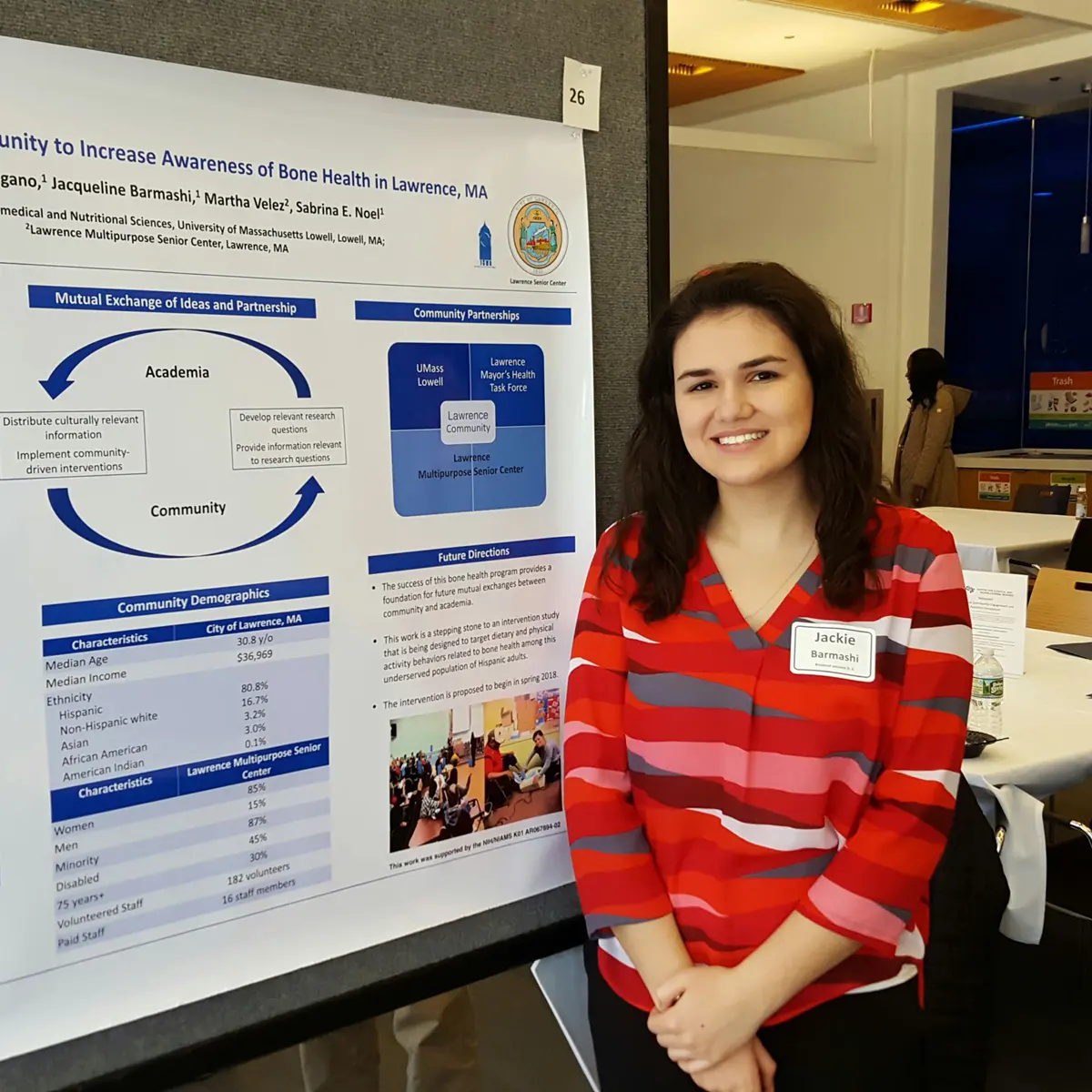
A student presenting her nutritional science project.

Path to Graduate School

Nutritional science provides a strong foundation for health profession graduate degree programs.

Assorted fruit with a measuring tape, stethoscope, and person taking notes in the background.

Become a Registered Dietitian

The Nutritional Science Dietetics and General Options satisfy all prerequisite courses for the UMass Lowell Master of Public Health (MPH) in Dietetics program.

  • The MPH program is accredited by ACEND for both coursework and internship requirements.
  • Upon successful completion of the MPH program, you will be qualified to take the Registered Dietitian exam.

Meet Our Students and Alumni

UMass Lowell student Rabia Haider
Rabia Haider '21
Nutritional Sciences and Master of Public Health

Knowing how cultural differences make an impact on health, Rabia Haider is pursuing a Master of Public Health degree.

There is so much work to be done related to nutrition and health care, especially for historically overlooked populations.
Bryanna Ippolito sitting on a bench outside working on her laptop
Bryanna Ippolito '20
Nutritional Science

After working with Alzheimer’s patients while in high school, Bryanna Ippolito is pursuing her bachelor's in nutritional science and developed a program for students who someday may be working with Alzheimer’s patients to understand what it’s like to live with the disease.

I fell in love with UMass Lowell when I toured here. It's close to my home in Billerica, and South Campus was the homelike feeling that I wanted to find in a school.
Kyle Mehan at his desk
Kyle Mehan '21
Nutritional Science

Kyle Mehan began researching nutrition when trying to heal his own injuries. Now he promotes a plant-based diet.

I knew that fitness and nutrition go hand in hand, so I thought if I wasn’t going to go into sports medicine, I’d go into the nutrition side of it.

Visit UMass Lowell

Launch virtual tour

Visit campus, meet our people and picture yourself here. Find in-person and virtual tours and events.

Still Exploring Majors?

We've got 120+ programs. Browse our Program Finder to find the one that's right for you.

View All Programs

Contact Us

Kelsey Mangano, PhD, RDN
Associate Professor, Undergraduate Nutrition Program Director
Email: Kelsey_Mangano@uml.edu