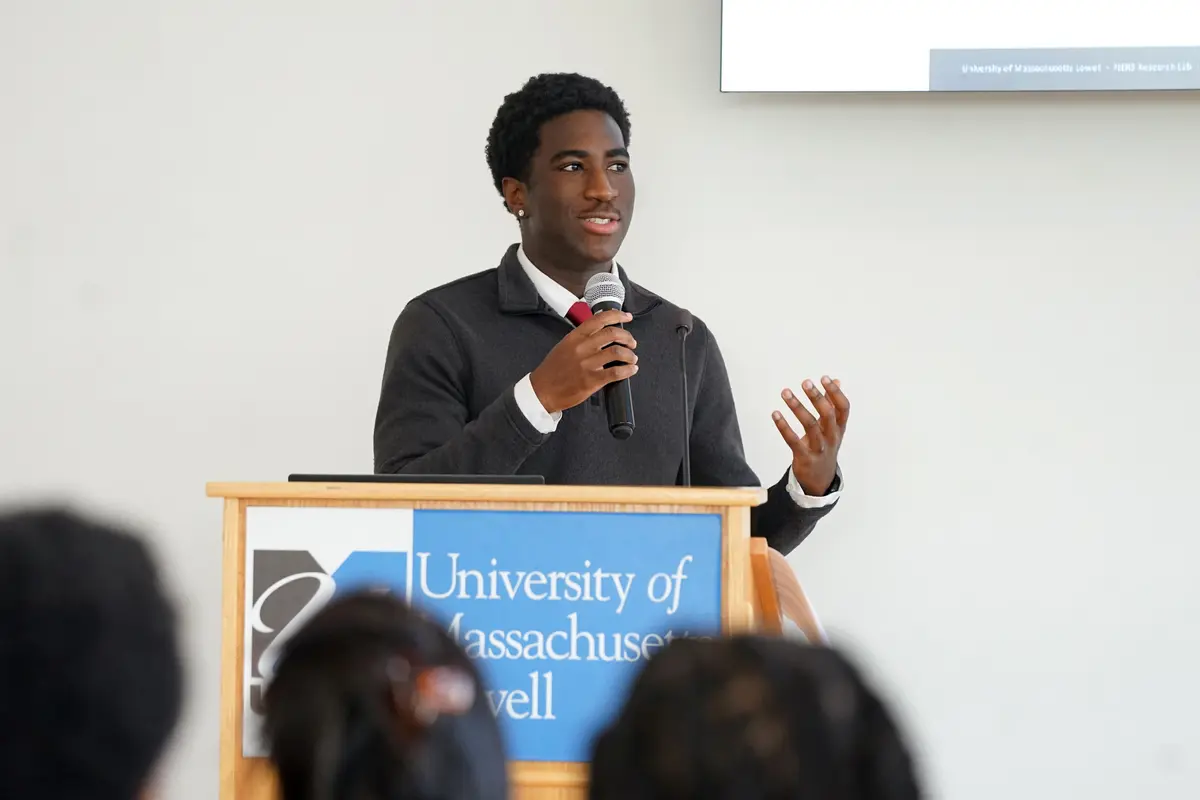
The Office of Multicultural Affairs’ STEP Research Initiative is an application-based initiative sponsored by the Rising 360, STEM Training & Excellence Program (STEP). This initiative aims to connect students with hands-on research experiences and further develop their research skill set. Selected applicants will be paired with a faculty mentor to conduct research throughout the 2026-2027 academic year, participate in research skill-building workshops, and receive an award of $2,500.

By combining mentorship, experience, and skill-building workshops, the STEP Research Initiative empowers students to deepen their understanding of their field, build confidence, and prepare for future opportunities in research, graduate programs, and careers in STEM.

Qualifications

  • Must be an enrolled sophomore, junior, or senior full time undergraduate at UMass Lowell for the 2026-2027 academic year
  • Preference will be given to students who are currently active participants in the Rising 360, STEM Training & Excellence Program
  • Must be in good academic standing (preference to candidates with 2.50 cumulative grade point average)
  • Must be in good judicial standing 

2026-2027 Application Timeline

  • Applications open March 16
  • Application deadline April 17
  • Decisions announced May 4
  • Deadline to accept is May 8

For additional information and questions, please email Alisa_Michel@uml.edu.

Amanda Lodi

Amanda Lodi, Biology

Melanin-Matched Phantom Skin Models: Enhancing Accuracy and Equity in Biomedical Optics Across Diverse Skin Phenotypes with Walfre Franco

This research focuses on developing a spectrophotometrically calibrated phantom skin model to improve biomedical optical technologies across various skin phenotypes. Using dual integrating spheres and spectrophotometry, I am creating optical phantom skin models with melanin concentrations matched to target wavelengths. Conventional diagnostic tools are developed for lighter skin tones, which reduces their effectiveness in populations with darker skin tones. This research aims to fill that gap in medical optics. This phantom model serves as a testing platform for validating erythema detection algorithms and other biomedical optical instruments across diverse patient populations. A promising future direction in my research with phantom skin development is the ability to model disease-specific, dynamic, and physiologically relevant dermatological manifestations of medical conditions, including hypoxia, shock states, and peripheral ischemia, within subcutaneous vascular models across diverse skin phenotypes. Ultimately, this research aims to improve diagnostic accuracy, support early clinical intervention, and promote health equity in optical medical detection.

The STEP Research Initiative has allowed me to pursue a lifelong dream of conducting meaningful research. This program has truly reshaped my self-perception, launched my research career as an undergraduate, and ultimately affirmed my capacity for rigorous scientific work. It has shown me that I am capable and that I belong in spaces I once considered beyond reach. As an undergraduate student, initiating contact with professors for laboratory positions can feel intimidating and uncertain. The STEP Research Initiative removed that barrier by providing direct access to research opportunities. This program has allowed me to build meaningful professional and academic relationships with a research team early on in my education at UMass Lowell. The mentorship I have received through this program has been invaluable as I pursue my graduate education and my future goal of becoming a physician-scientist.

Rojann Jermaine Portacion

Rojann Jermaine Portacion, Computer Engineering

Using Low-Pressure Chemical Vapor Deposition (LPCVD) for High Quality Gallium Oxide (Ga2O3) Ultra-wide Bandgap Semiconductors for Next-Generation Power Electronics with Anhar Bhuiyan

This research focuses on the growth of high-quality gallium oxide (β-Ga₂O₃), an ultrawide bandgap semiconductor with great potential for next-generation power electronics. While materials such as GaN and SiC dominate current UWBG research, our work is centered on gallium oxide due to its exceptionally high breakdown field and suitability for high-voltage applications.

In contrast to commonly used growth techniques such as MBE and MOCVD, our lab employs low-pressure chemical vapor deposition (LPCVD) as a scalable, high-purity growth platform. We investigate how LPCVD process parameters influence film quality, carrier concentration, and electrical performance, with the goal of identifying the most efficient and reproducible growth conditions for Ga₂O₃ epitaxial layers. Our results demonstrate that LPCVD can produce smooth, crystalline Ga₂O₃ films with excellent electrical properties, highlighting LPCVD as a promising alternative for manufacturable gallium oxide power devices.

The STEP Research Initiative has been extremely impactful in shaping my experience as an undergraduate student by helping me identify and target my research interests and gain meaningful access to research opportunities. While I had a strong interest in participating in research, STEP provided the structure and support that made it possible for me to join a laboratory environment early in my academic career. Beyond lab placement, the initiative has supported my development through bi-weekly workshops that emphasize research skills, leadership, and academic success, as well as through financial support that has helped offset tuition costs. These combined experiences have strengthened me not only as a researcher, but also as a scholar. Having the opportunity to present something of substance at this spring’s research symposium has been a particularly meaningful highlight of the program for me.

2025-2026 Researchers

  • Bright Agyapong, Electrical Engineering: Web-based Human Robot Interaction (HRI) Task Repository that Enables Researchers to Find Specific Research Papers Relating to HRI with Sam Reig.
  • Rosa Rodriguez Mora, Mechanical Engineering: From Requirements to Prototype: Designing a Motion Platform with Haptic Feedback for Virtual Reality Wheelchair Training with Kelilah Wolkowicz.
  • Tayshaun Lindsay, Mathematics: Photon Irradiation Energy Deposition: Creating a Mathematical Model for Photon-tissue Interactions with Romy Guthier.
  • Rojann Jermaine Portacion, Computer Engineering: Using Low-Pressure Chemical Vapor Deposition (LPCVD) for High Quality Gallium Oxide (Ga2O3) Ultra-wide Bandgap Semiconductors for Next-Generation Power Electronics with Anhar Bhuiyan.
  • Amanda Lodi, Biology: Melanin-Matched Phantom Skin Models: Enhancing Accuracy and Equity in Biomedical Optics Across Diverse Skin Phenotypes with Walfre Franco.
  • Anika Ziobro, Bioengineering: Using Bioinformatics to Analyze the Relationship Between Germline and Somatic Mutations in the Development of Neuroblastoma with Rachel Melamed.

Faculty Sponsor

  • Maria Velazquez, Ph.D.
    Associate Teaching Professor
    Mechanical and Industrial Engineering

    Industrial Engineering, Human Factors and Ergonomics, Usability Engineering, Design and Emotion, and Engineering Education. Diversity, Equity and Inclusion.