
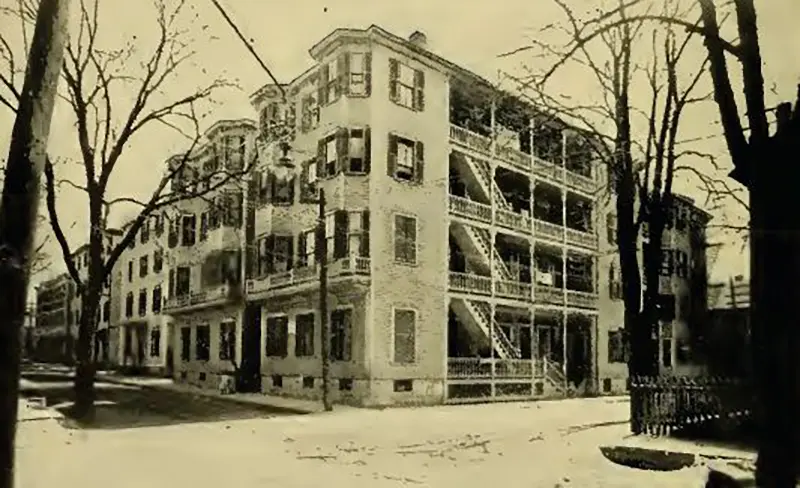
The A.G. Pollard residence after its conversion to a tenement known as Wonderland, from George F. Kenngott’s The Record of a City, 1912, photograph 24, p. 110.
By 1900, the neighborhood no longer drew the city’s elite and their large single-family homes were turned to other purposes. The years around World War I witnessed a pivotal shift: the Wentworth mansion sold in 1917 and became a boarding house; the Wood mansion on Hosford Square sold in 1916 to the Lowell Children’s Home; the Hocum Hosford house sold after the war, was divided into a multifamily, and a bakery was added to the property; Wheelock purchased the Nichols house and added a substantial tenement at the rear.
The fate of “Wonderland” best encapsulates this shift: originally built in the late 1860s as the home of Arthur G. Pollard, a wealthy merchant who had been a partner with Hocum Hosford in the city’s largest department store, it was among the finest estates in Back Central. By the 1880s Pollard moved out of the increasingly Irish neighborhood to the exclusive Belvidere section of Lowell and first rented then sold the house in 1904 to Joseph Flynn, a real estate speculator and popular Irish-American grocer on Gorham Street. Flynn purchased a number of tenements in Back Central, but for the Pollard house he hired a contractor to expand it into a four-story, 32-room tenement with spacious balconies, modern plumbing, and new gas fixtures. It was soon popularly known as the “Wonderland” and quickly filled with tenants. It was one of the most ethnically diverse tenements in Lowell with families representing fourteen nationalities, living under one roof.
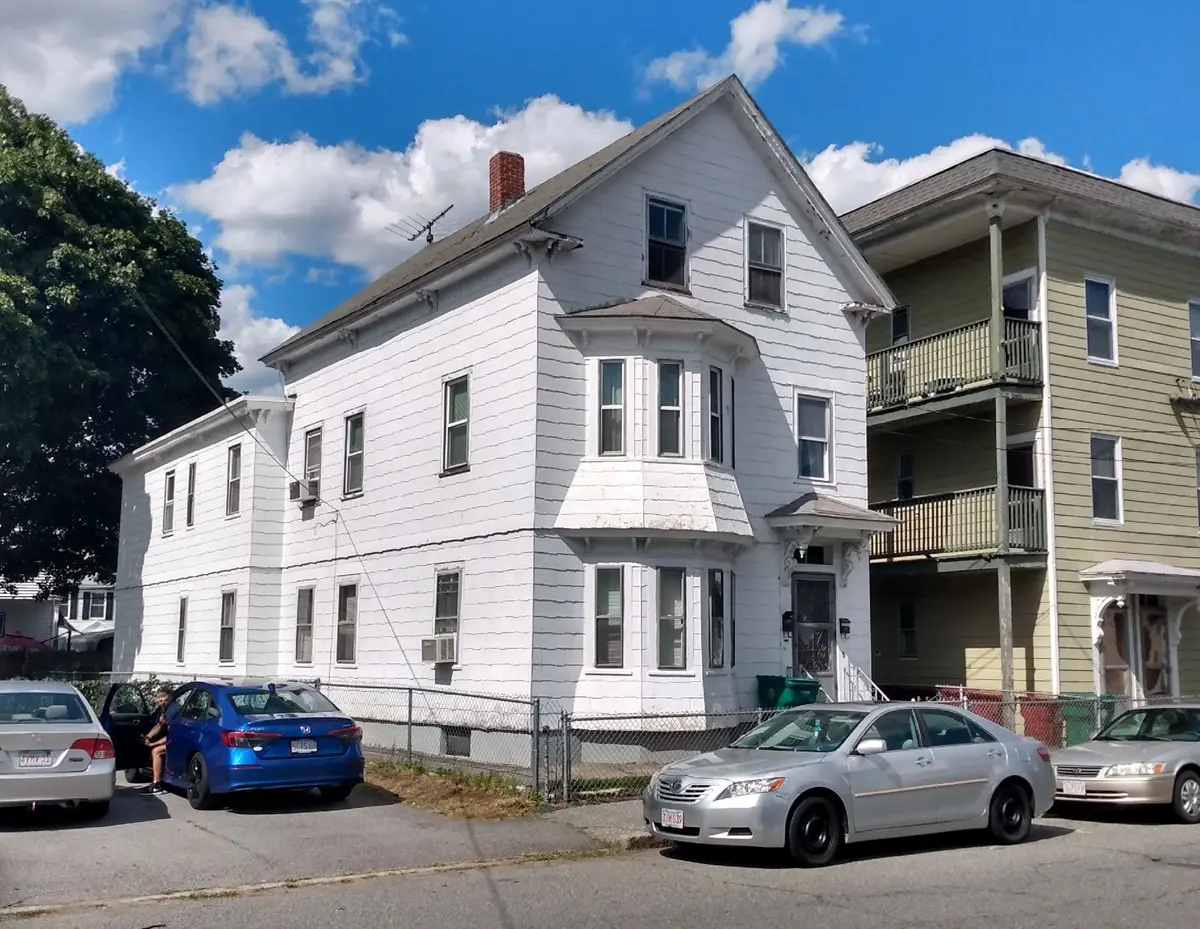
5 Watson Street.
In this first wave of migration, the Portuguese joined other immigrant groups that also made their mark on the landscape. The Polish community purchased the fire station at 490 on Central for their club in the 1930s; the Italians purchased Scripture’s Bakery in 1942 to serve as the Italian-American Civic Club, the Armenians settled near Charles and Tyler Streets and built a church on Lawrence. There is one early reference to a Portuguese Club in 1926 in the tenement at 448 Central. The longer-established Irish purchased some of the older large homes—such as the Abbott House at 571-73 Central bought by Redmond Welch, the Superintendent of Police.
By 1910, Back Central had become the most populated Portuguese neighborhood in Lowell. Commonly referred to as “the Portuguese Colony,” its residents were largely Azorean immigrants but also with growing numbers of Madeirans. Initially, they settled around the area of Church, Tyler, Charles, Central and Gorham streets. This area at the base of Central gave them easy access to the Appleton/Hamilton mills and downtown Lowell. The tenements of Bent’s Court where many of the Portuguese lived were described by George Kenngott in his 1912 book, Record of a City:
“The largest Portuguese tenement house is in Central Street near Charles, with 23 rooms occupied by forty persons, mostly young married people….The houses are old and dilapidated. Some of them have holes in the floor and the walls are hardly fit for human habitation, and should be torn down. Although the Portuguese are cleanly and thrifty in their native homes, it is almost impossible for them to keep clean and healthy in the miserable, over-crowded tenements which they occupy here.” (P. 53 book, 111 of digital file)
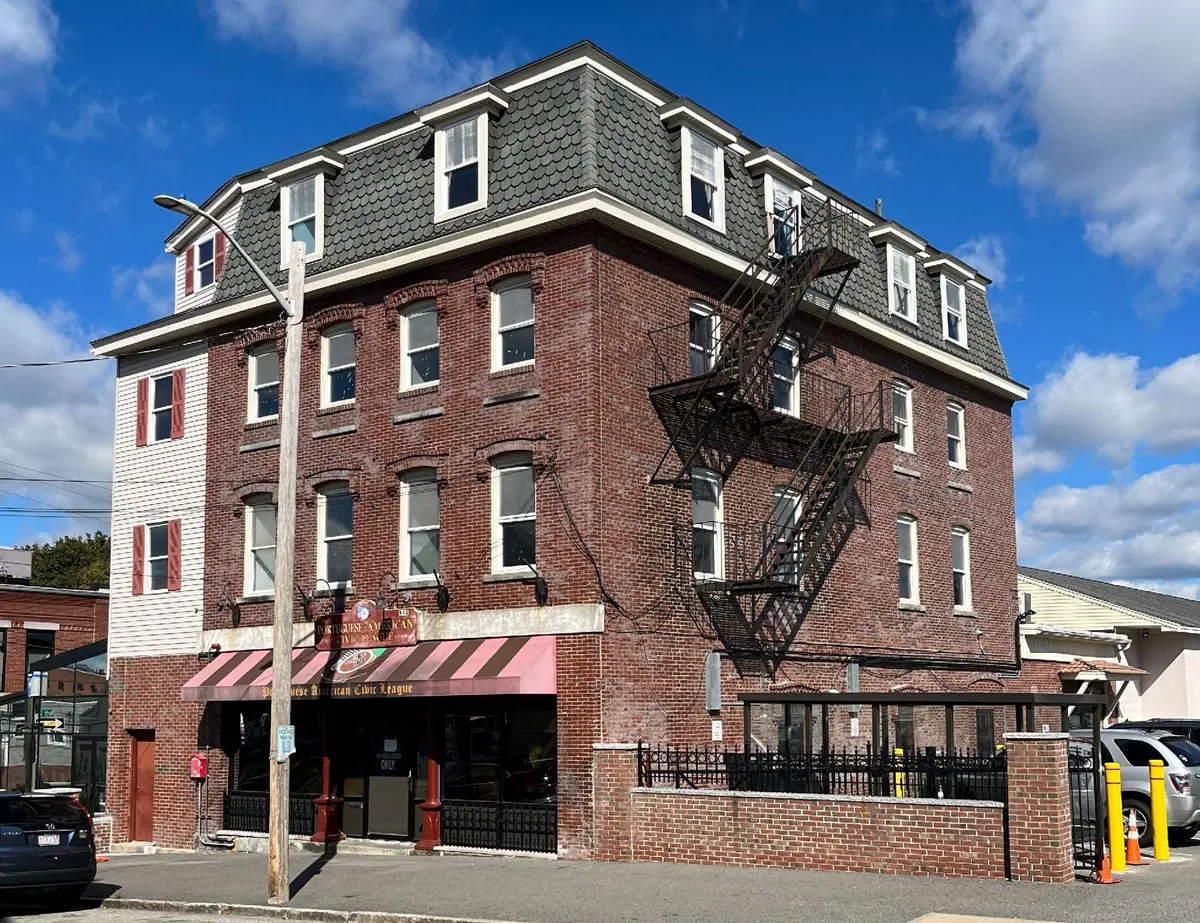
512 Central Street. Originally John J. Donovan’s grocery and now home to Portuguese American Civic League (PACL).
Census reports reveal a consistent pattern of Portuguese families saving their money to move out of Bent’s Court (or other tenements) and purchase homes in Back Central—see for example, the Furtado and Machado families of 5 Watson Street and 9-11 Watson Street. The majority of these immigrants toiled in the city’s textile mills, although dozens of Portuguese men worked in local tanneries. A few owned small businesses, primarily located in Back Central.
Among these businesses was the grocery of Manuel de Sousa Netto, one of Lowell’s first Portuguese grocery store owners. It was located near the corner of Gorham and Appleton streets in a wood-frame commercial block (likely demolished in the 1950s). Most of the Portuguese-owned businesses, however, were on Central Street. As indicated in the city directory, by 1926 there were ten Portuguese businesses on Central Street with the largest concentration between Tyler and Union Streets. In addition to grocers and bakers, the most common Portuguese enterprises were barber shops.
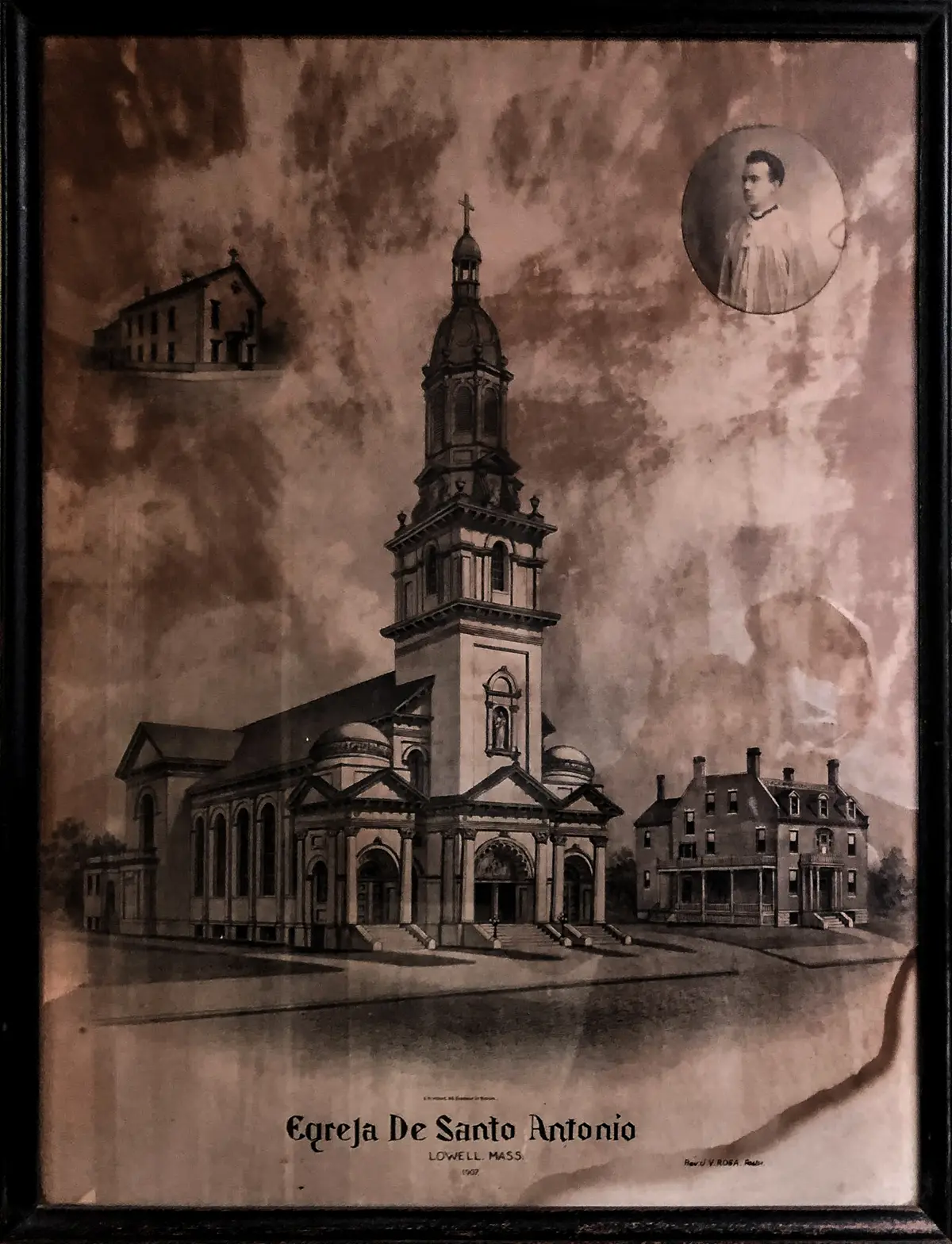
The original design for St. Anthony’s Church that includes the adjacent rectory, c. 1907.
Apart from these businesses, the Portuguese in Back Central also operated a handful of social clubs. In 1938 the Portuguese Colonial Band acquired a wood-frame tenement at the corner of Chapel and Charles Streets; in 1955 the Portuguese American Center club purchased the building and hosted numerous civic and social events. By the 1930s, the most important of these clubs was the Portuguese American Civic League (PACL). Initially the PACL rented a building on Thorndike Street, but in 1955 purchased the former Donovan Grocery building at 512 Central Street where it remains today.
Despite the urban density, gardens and memorials were also cultivated. In 1944 the Portuguese community dedicated Charles A. Pereira Memorial Park, at the corner of Charles and Central Streets, to honor the first Lowellian killed in World War II.
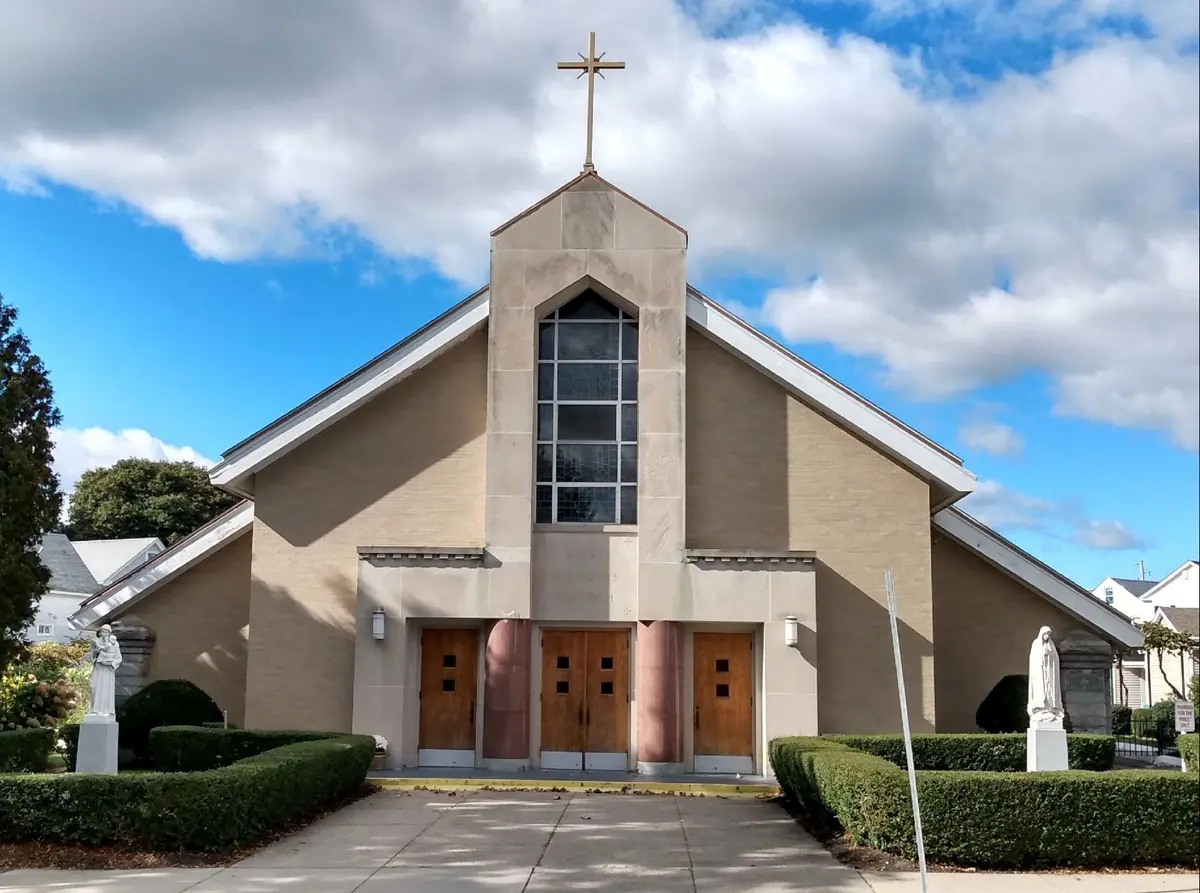
St. Anthony’s Church in 2023.
To many of Lowell’s Portuguese, the most important building in the city was St. Anthony’s Church on Central Street. Although St. Anthony’s parish had been established in 1901 with services initially held in the former Primitive Methodist Church on Gorham Street (subsequently demolished as part of the Lowell Connector Highway Project), by 1906 this wood-frame structure was too small for the growing number of parishioners. From funds raised by many of the Portuguese in Back Central, a parcel of land on Central Street was purchased and a new church was designed in 1907 in the Spanish Colonial Revival style, likely by Boston-based architect Timothy Edward Sheehan (1866-1933). Lacking money to build the entire structure, only the basement of the church was finished with a flat roof installed (although they did complete the adjacent Federal Colonial Revival rectory in 1906). The partially completed church served St. Anthony’s parishioners for nearly a half century. Finally, in 1960, a new superstructure, designed in a modernized Spanish Mission style by Boston architect Mario V. Caputo, was completed.