
571-573 Central Street
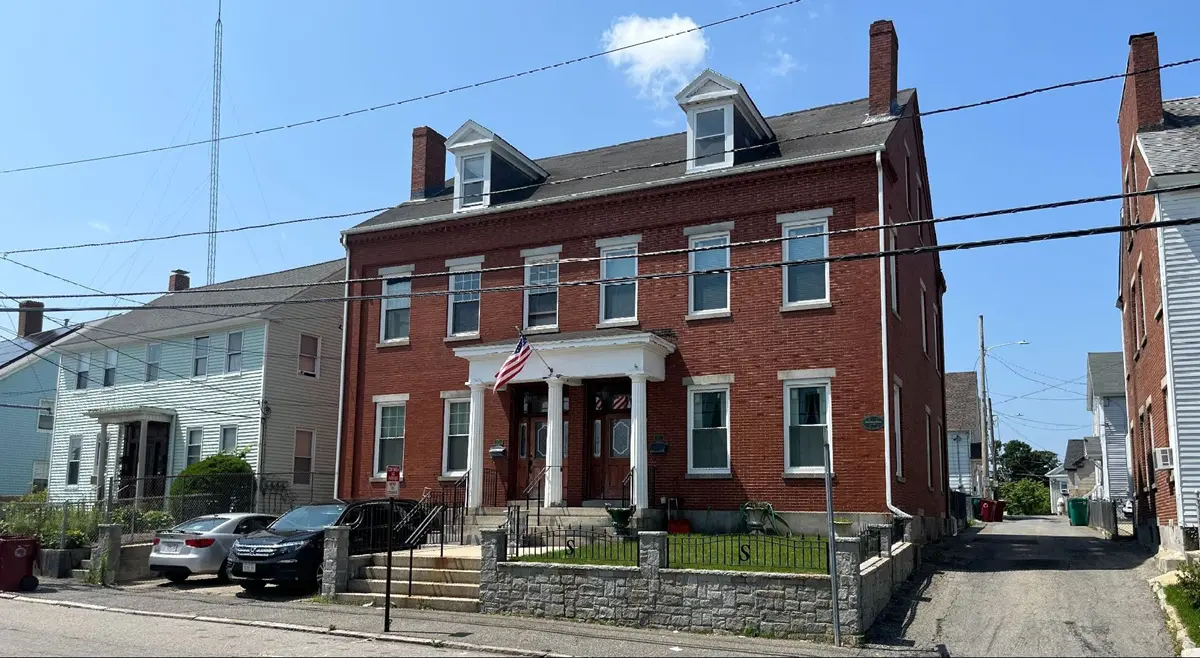
- Historic Name: Abbott House
- Uses: Residential
- Date of Construction: Circa 1848
- Style/Form: Greek Revival
- Architect/Builder: Unknown
- Foundation: Granite
- Wall/Trim: Brick
- Roof: Gable
- Major Alterations: None
- Condition: Good
- Included in Hengen survey? Yes
- Related oral interview? No
- Portuguese owned? Unknown
- Recorded by: Gregory Gray Fitzsimons and Marie Frank
- Organization: UMass Lowell
- Date: July 2023
Description
With Scripture’s Bakery and the Locke House, this building provides yet another sophisticated example of the Greek Revival on Central Street. A two -story brick double house with the main entrances paired at the center, it has six bays across the front with two dormers in the gable attic over the second and fifth bays. A front portico supported by three fluted Doric columns and complete with triglyphs and metopes spanned the entry (the triglyphs and metopes were removed some time after 1981). Substantial chimneys anchor the north and south elevations. The lintels and sills are granite and the front façade has a notable feature: rather than corner pilasters and a frieze, the bricks form a continuous frame around the inset façade. Hengen notes that other houses in Belvidere share this feature. There is also a dentil molding under the eave. The side elevations have similar windows to the front façade. The foundation is raised from street level with two levels of granite stairs. #571 still has a front yard with a railing (with an “S” for Santos, the current owner); #573 had its yard replaced by off-street parking after 1981. There are two additions off the back: one two-story brick structure with gable roof and Greek Revival features; and a one-story wood frame gable roof structure (now vinyl sided).
History
This house is known as the Ziba Abbott House, but it is also a clear testament to the Irish presence in Back Central—Irish owners occupied the two houses for over a century. In 1847, Noah Gates and Marshall Hemingway/Hemenway purchased the land and probably built the house. Hemenway was a partner with Samuel N. Wood in a grocery business (see entry for 648 Central; Wood lived nearby on Centre Street at the time). The house is indicated in the 1850 map with Gates in the right half (#571) and Hemenway on the left half (#573). The deed stipulated that they keep a 7-foot throughway (now called Cottage Street) open. Gates worked as the manager of the Lowell Museum (an entertainment establishment) and Hemingway worked as a bookkeeper and clerk after parting ways with Wood. Both lived just opposite this lot at the corner of Cady and Central before purchasing and building on it. Shortly after however, Hemingway sold his half to Ziba Abbot (who previously lived on Fayette). Abbott is listed with a variety of occupations from yeoman to trader. His son, Edward T. Abbott, served as the secretary and treasurer of the Lowell Mutual Fire Insurance Company at 40 Central. During the Abbott ownership, the house was extended off the back. He died in 1895 and the executors sold the home. Meanwhile, Gates’ half, #571, became the home of another notable Lowellian at the turn of the century, Redmond Welch, the Superintendent of Police. An Irishman and parishioner of St. Peter’s, he joined the force in 1887 and served until 1922; he died at the age of 62 in 1924 and was buried in St. Patrick’s Cemetery. Known as “Red,” his obituary mentions his legendary take down of two notable thieves plaguing Lowell and Nashua in the 1890s, Louis Jaquith and Ernest Beausoleil. He earned popularity as a speaker and participant in the clubs and activities of the city; although this social standing did not stop Mayor Brown from forcibly removing him from the position of Superintendent in 1922 (a legal battle ensued, and he was reinstated officially before retiring). He lived at #571 with his mother, Helen (also spelled Ellen), and sister, Hannah. After his death, the house went to Hannah, who lived there until her death; then it went to a niece, Mary T. Crowley during the Depression.
#573 also came under Irish ownership. Gayton F. Welch, a plumber, sold it in 1923 to Maude Shinners, a widowed mother of four boys and one daughter. Members of the Shinners family would live in the house through 1989: Maude lived there through 1950, her older son Arthur continued to live there, and then younger son Matthew, who worked in the Faulkner Mill, lived there until his death. The house was then sold to George Santos in 1989 who continues to own the house.
#571 went from the Welch clan (via the Crowleys) to the O’Hearn. By 1950 John F. O’Hearn, an employee of the Merrimack Paper Tube Company, purchased the house. John lived there with his mother Margaret (d. 1960) and brother, Joseph D. O’Hearn, a World War II veteran and employee of the Harvard Brewery. Joseph died in 1966 but John continued to live there through the 1980s. This house is also now in the Santos family—Walter Santos purchased it in 2009 from Jacob Mao.
Sources
- Sidney and Neff Map of Lowell, 1850.
- Lowell atlases, 1879, 1882, 1906, 1924 & 1936.
- Lowell city directories.
- Elizabeth Hengen, Lowell Cultural resources Inventory.
- Registry of Deeds.
- Lowell Sun, March 20, 1924 “Redmond Welch Seriously Ill.”
- Lowell Sun, July 1, 1924, obituary for Redmond Welch.
- Lowell Sun, July 1, 1924, “Redmond Welch Dead,” front page.