At a Glance
Year: ‘05
Major: Business (concentrations in management information systems and marketing)


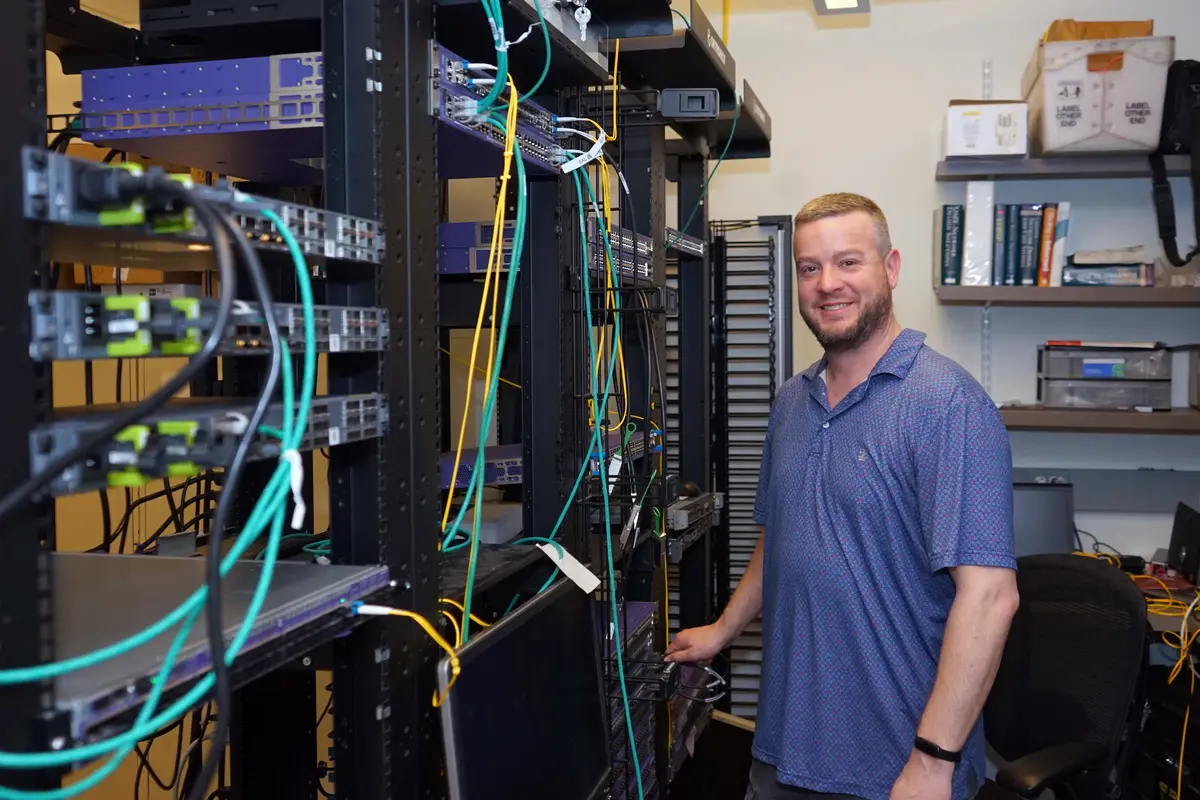
When UMass Lowell first began installing campus-wide wireless in the early 2000s, Chris McGee ’05 was there — running cable through residence halls, mounting early access points and helping build a system that students, faculty and staff now take for granted.
“It gave me real-world engineering experience,” he says.
Today, McGee serves as senior network engineer in the university’s Office of Information Technology (IT), helping oversee the infrastructure that keeps the campus connected. What started as a student work-study job has turned into a two-decade career in building and modernizing the digital backbone of the university.
Originally from Fremont, New Hampshire, McGee transferred to UMass Lowell from Northern Essex Community College, where he studied computer science and web development. Unsure of his exact career path, he enrolled in the Manning School of Business, earning a bachelor’s degree in business administration with concentrations in management information systems and marketing.
Within months of arriving on campus, McGee secured a work-study role with IT. That position placed him at the center of early wireless expansion efforts — an emerging technology at the time.
“That was when I realized that I could do this. I could figure this out,” he says.
After graduating, McGee became a network support specialist for UMass Lowell’s Division of Online and Continuing Education (now the Division of Graduate, Online and Professional Studies). In 2011, he moved into a broader network engineering role with IT.
The network he helps manage today supports tens of thousands of users across dozens of academic, research and residential buildings. From streaming lectures and powering research labs to connecting residence hall gaming systems and new devices each semester, demand continues to grow.
What McGee finds most rewarding is building infrastructure that lasts. While devices and platforms evolve, the backbone — the fiber pathways, equipment rooms and network layout — is designed to serve the campus for decades.
“The infrastructure I’m putting in is going to be here for probably the next 20 to 30 years,” he says. “By doing the upfront work, it saves us loads of time down the road.”
As the university continues to grow, so does McGee. More than two decades after arriving as a student, he is working toward an MBA from the Manning School while balancing life with his wife and three children.
“I credit UMass Lowell to my life and livelihood,” he says. “I wouldn’t be where I am today without the university.”