
 Image by Ed Brennen
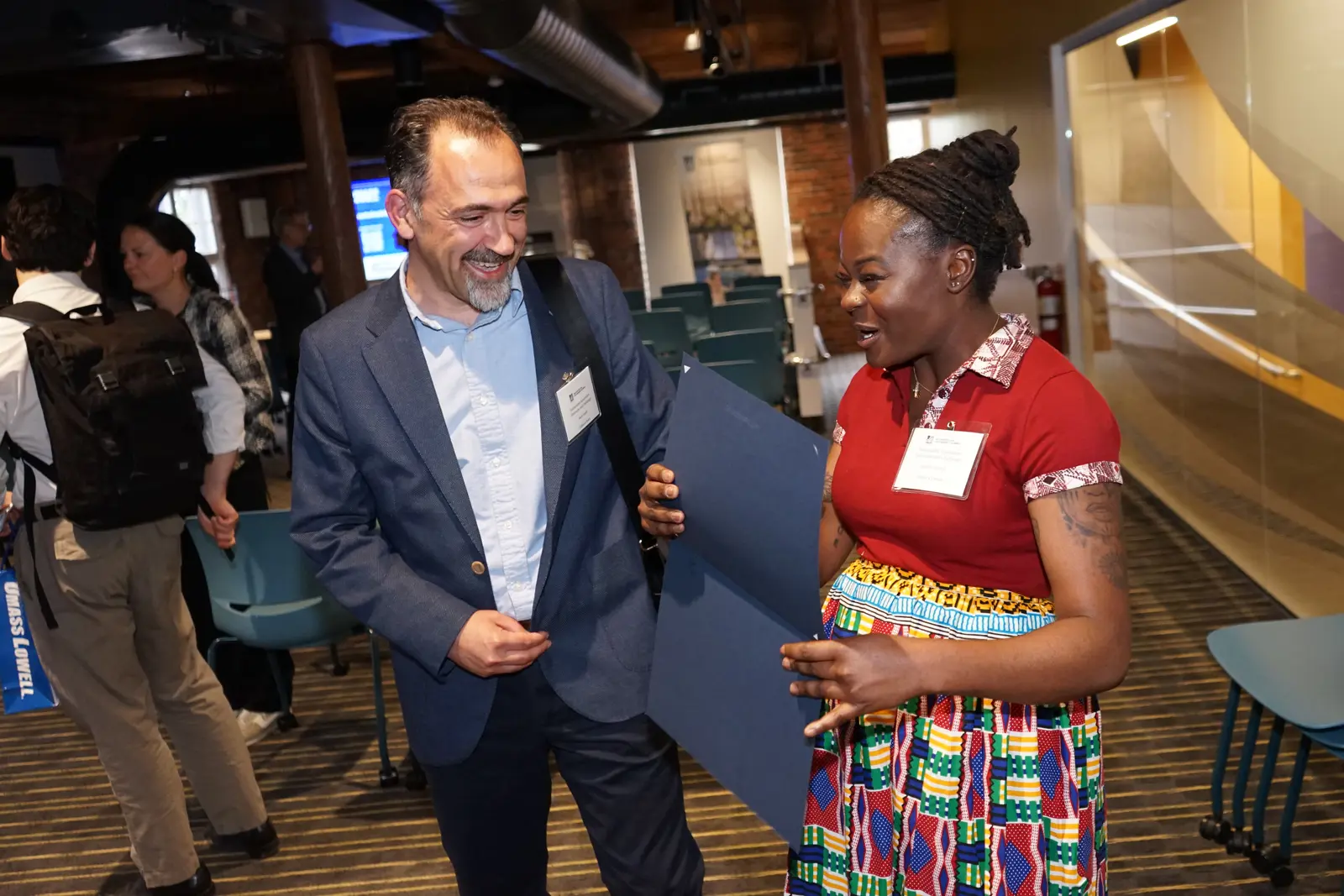
 Plastics Engineering Associate Professor Amir Ameli, left, winner of the $4,000 Sustainability Innovation Award, chats with plastics engineering major Joanita Amoah, who won the $3,000 Student Sustainability Innovation Award at the Rist Institute's inaugural pitch competition.
On a visit home to Ghana last year, plastics engineering major Joanita Amoah noticed plastic waste clogging waterways and piling up in communities.
Back at UMass Lowell, Amoah began developing “Plastos x Keevah,” a recycling business and nonprofit initiative aimed at transforming plastic waste into manufacturing material while helping support women affected by poverty and exploitation.
“I thought, ‘My goodness, what a great way to use what I’m learning and the skills that I’m developing to also help people back home,’” says Amoah, who formed a student team and entered Plastos x Keevah into the Rist DifferenceMaker Institute's $50,000 Idea Challenge — where it won the $4,000 Commitment to a Sustainable Environment award.
That momentum continued at the Rist Institute for Sustainability and Energy’s inaugural Sustainable Innovation Showcase and Challenge, where Amoah’s pitch recently earned her the $3,000 Student Sustainability Innovation Award.
Amoah says programs like DifferenceMaker and the Rist Institute showcase have helped her develop confidence as both an entrepreneur and presenter.
“I get to network, learn and practice presenting in front of people,” says Amoah, whose award included a one-year membership (with dedicated desk space) at the Rist Institute.
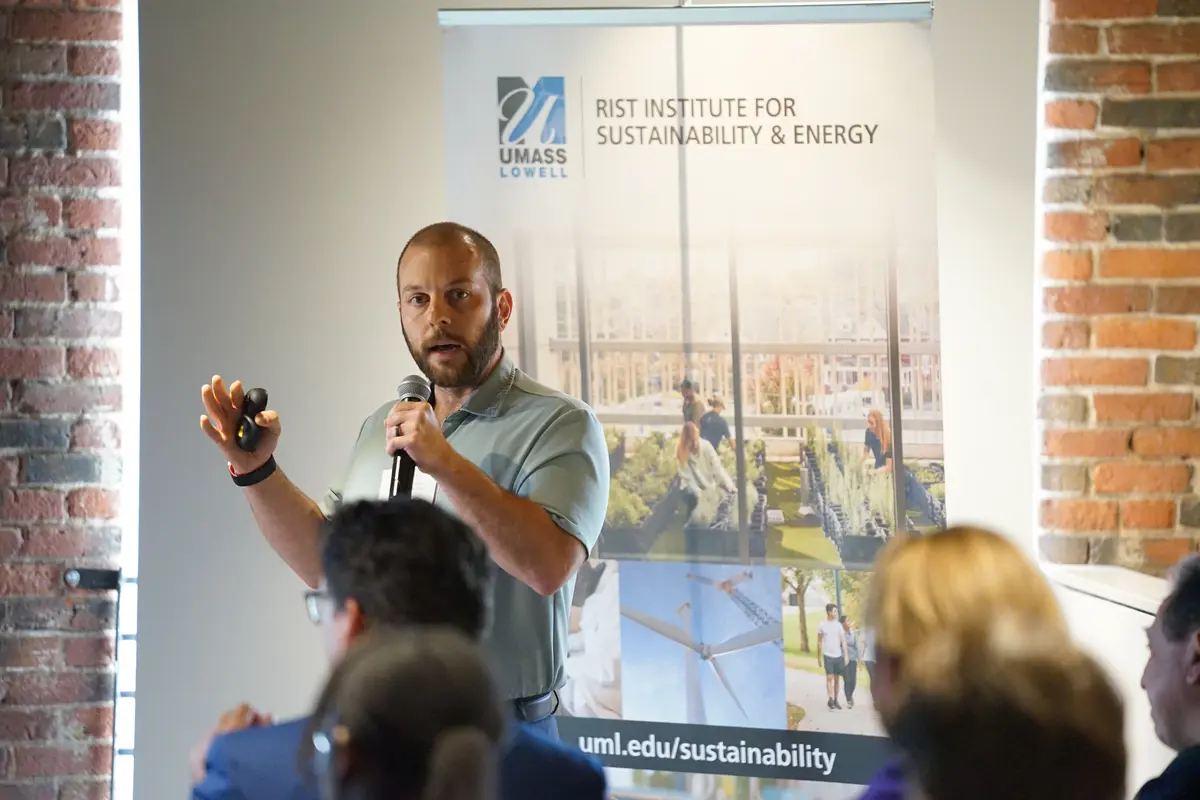 Image by Ed Brennen
 Associate Professor of Chemistry James Reuther pitches his polyurethane foam recycling technology "VitraFoam" during the inaugural Sustainable Innovation Showcase and Challenge, hosted recently by the Rist Institute for Sustainability and Energy.
Seven finalists presented ideas ranging from zero-waste hydroponics systems and worker heat-safety technology to lithium extraction systems and recyclable polyurethane foam technology.
Vice Chancellor for Research and Innovation Anne Maglia says the event highlights the role of the Rist Institute and the Lowell Innovation Network Corridor, or LINC, in building a regional innovation ecosystem around sustainability and climate technology.
“The challenges we face, whether related to energy, materials, manufacturing, waste, infrastructure or climate resilience, they’re all very complex,” Maglia says. “They require interdisciplinary thinking, partnerships and a willingness to test new ideas.”
Plastics Engineering Associate Professor Amir Ameli won the $4,000 Sustainability Innovation Award for his work developing recyclable cellulose foam for cold-chain packaging applications. The technology is designed as a sustainable alternative to expanded polystyrene foam commonly used in shipping and food packaging.
Ameli’s team recently received support from the UMass Office of Technology Commercialization and Ventures and filed a provisional patent through the university. The event marked the first time Ameli had presented the project in person.
“Once I saw the opportunity, I realized that this is a perfect place for me to showcase what we’ve been working on in the lab and see what the interest is from the judges and the audience,” says Ameli, who appreciated the opportunity to pitch alongside students.
“Even undergrads, they have such brilliant ideas,” he says. “It was wonderful to see.”
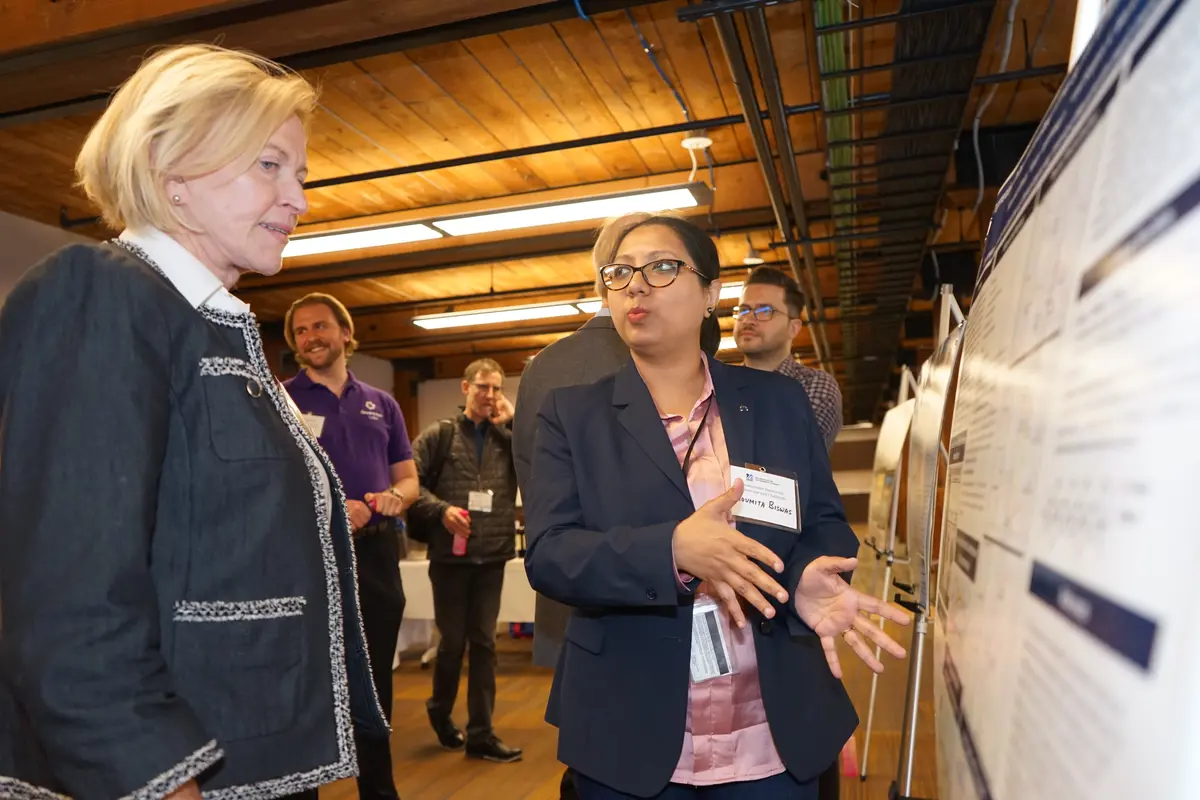 Image by Ed Brennen
 Moumita Biswas, a Ph.D. student in chemistry, shares her poster on regenerative, oxime-functionalized polymer systems for active nerve agent detoxification with Barbara Russell, one of the competition's three judges.
“I was waiting for a platform where I can showcase my project,” says Dhanasree, who also presented a poster for a separate project called NutriScan, a device that detects chemicals in tap water used for cooking.
Maroua Boumkouk, a rising senior computer engineering major, presented “HeatSafe,” a monitoring system that uses sensors and cloud-based alerts to help protect workers and trainees from dangerous heat exposure.
MBA student and retired Air Force veteran Crosby Newbill won the Outstanding Sustainability Poster award (and a pair of Bose headphones) for “Stewartship,” a project focused on land ownership and regenerative farming.
“The young people keep me motivated,” says Newbill, a Baltimore native who began developing Stewartship for the DifferenceMaker Idea Challenge.
Faculty finalists also included Plastics Engineering Associate Professor Grace Chen, who presented a process for converting mixed plastic and biomass waste into valuable chemicals and fuels, and Chemistry Associate Professor James Reuther, whose “VitraFoam” technology focuses on recyclable polyurethane foams.
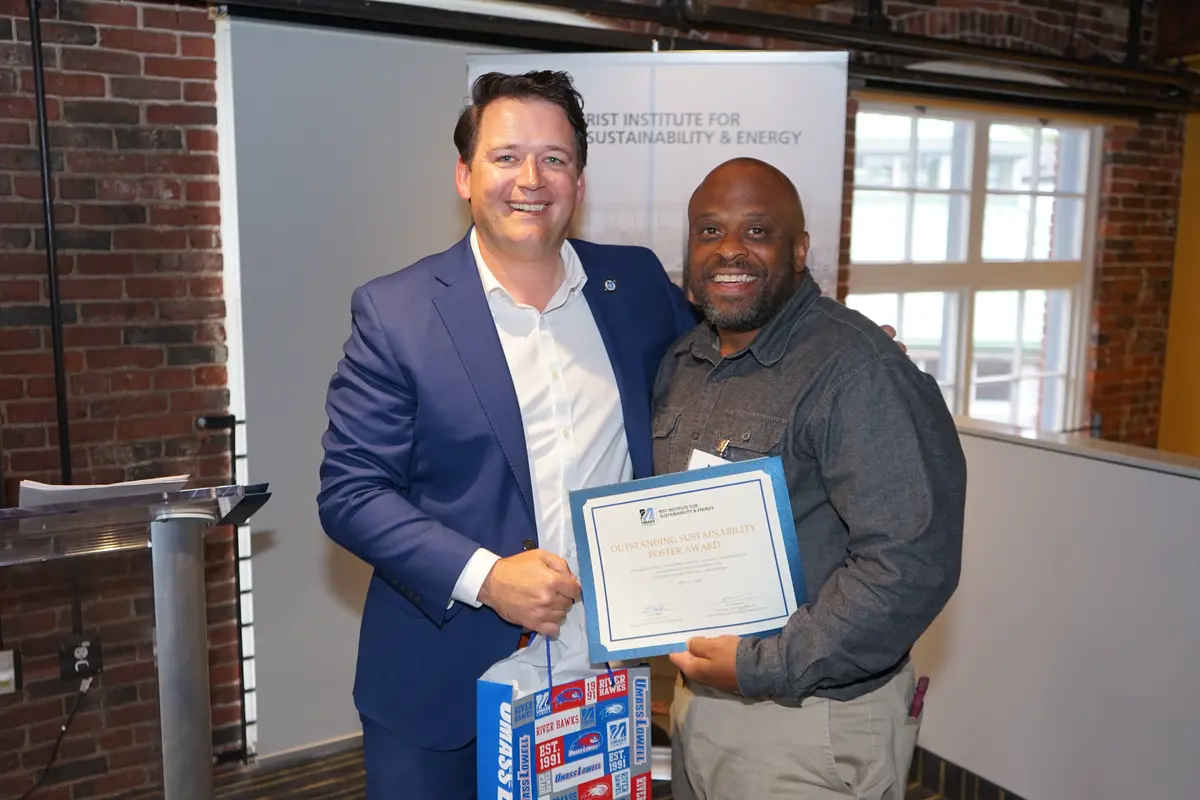 Image by Ed Brennen
 MBA student Crosby Newbill, right, accepts his Outstanding Sustainability Poster award from Ruairi O'Mahony, associate vice chancellor for sustainability and enterprise development.
Growing demand for electric vehicles, energy storage systems and consumer electronics is creating an increasing need for battery recycling solutions, the presenters explained during their pitch.
“For supply chain security and for environmental reasons, we need to make it feasible and economical to recycle these minerals domestically,” Foulke says.
The judging panel included Barbara Russell, an adjunct professor in the Manning School of Business and partner in venture capital firms CapW and Encourage Ventures; Mark Machowski of the manufacturing assistance nonprofit FORGE; and Benedikt Reynolds of the Massachusetts Clean Energy Center.
For organizers, the event represented the beginning of what they hope becomes a larger sustainability innovation community at UML.
“It’s exciting to see this intersection of faculty, student and external partners that are pitching their ideas on new climate-tech innovations and discovery,” says Ruairi O’Mahony, associate vice chancellor for sustainability and enterprise development. “We look forward to building on this and welcoming more partners to UMass Lowell to do some really cool and interesting work together.”
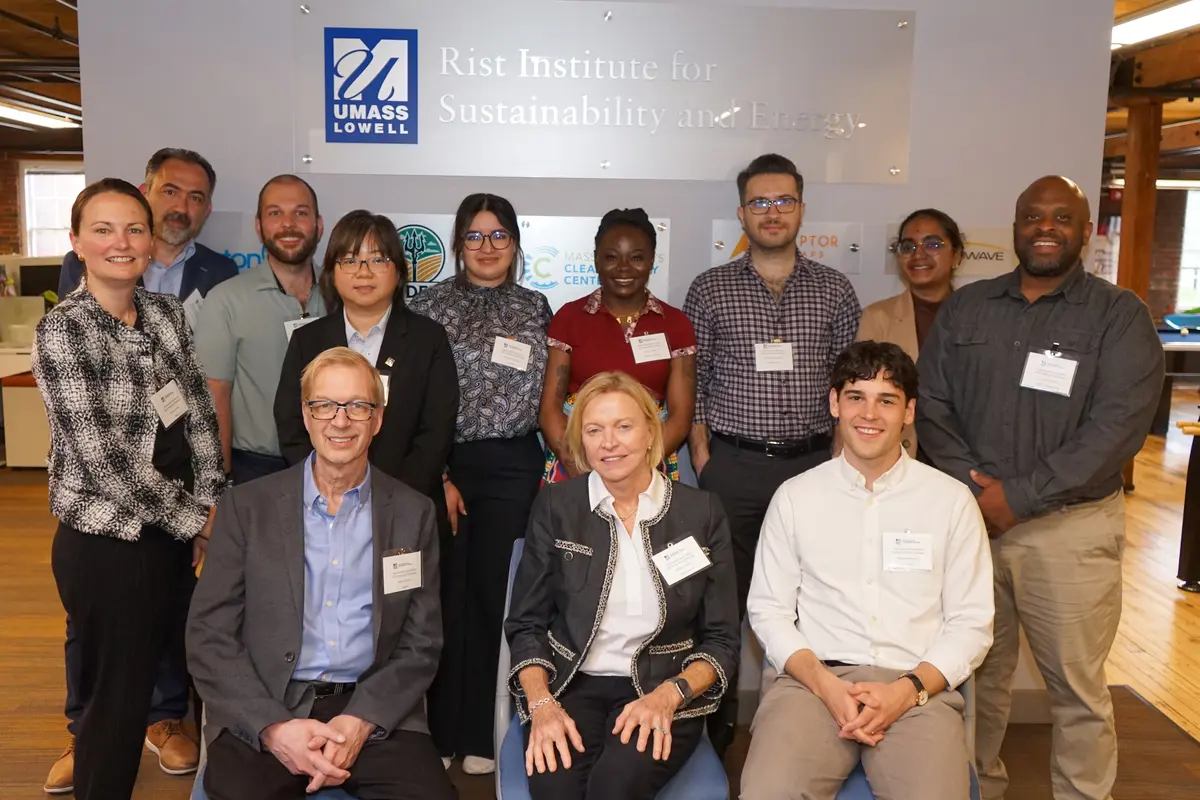 Image by Ed Brennen
 The judging panel of, front row left to right, Mark Machowski, Barbara Russell and Benedikt Reynolds poses with pitch finalists and poster presenters.