
 Image by Ed Brennen
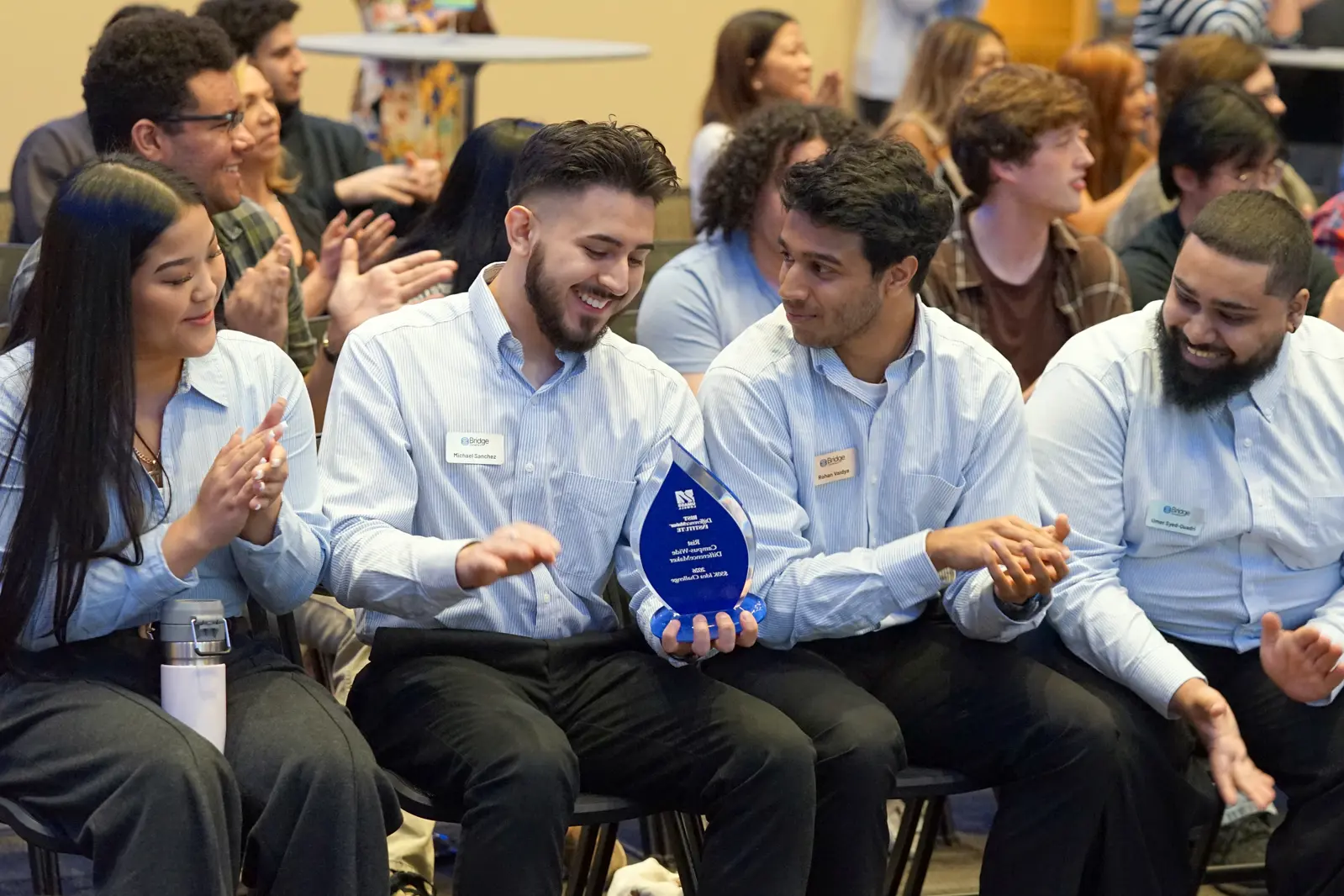
 Bridge Operations team members, from left, Nhu Le, Michael Sanchez, Rohan Vaidya and Umer Syed-Quadri admire the Rist Campus-Wide DifferenceMaker award they won at the recent $50,000 Idea Challenge at University Crossing.
When Michael Sanchez was deciding where to go to college, UMass Lowell’s DifferenceMaker program was just that — a difference-maker.
“It’s actually one of the factors that played into my choice,” Sanchez, a senior business major from Marlborough, said of the campus-wide student innovation and entrepreneurship program.
Four years later, Sanchez and his team won the top prize at the Rist DifferenceMaker Institute's $50,000 Idea Challenge. Their software platform Bridge Operations, which helps organizations manage facilities and maintenance, earned the $6,000 Rist Campus-Wide DifferenceMaker award.
“I wanted an idea that was feasible, something real that I’m proud of, and this is it,” said Sanchez, who came up with the data-driven solution while working at a family entertainment center, where maintenance schedules were tracked across whiteboards, outdated laptops and handwritten notes.
Sanchez and his teammates — biomedical engineering major Nhu Le, electrical engineering major Adam Embarch and computer science majors Rohan Vaidya and Umer Syed-Quadri — developed and refined the concept over the past six months through the AI Entrepreneurship Competition (where it finished second) and the Francis College of Engineering Prototyping Competition (where it finished third and won the People’s Choice Award).
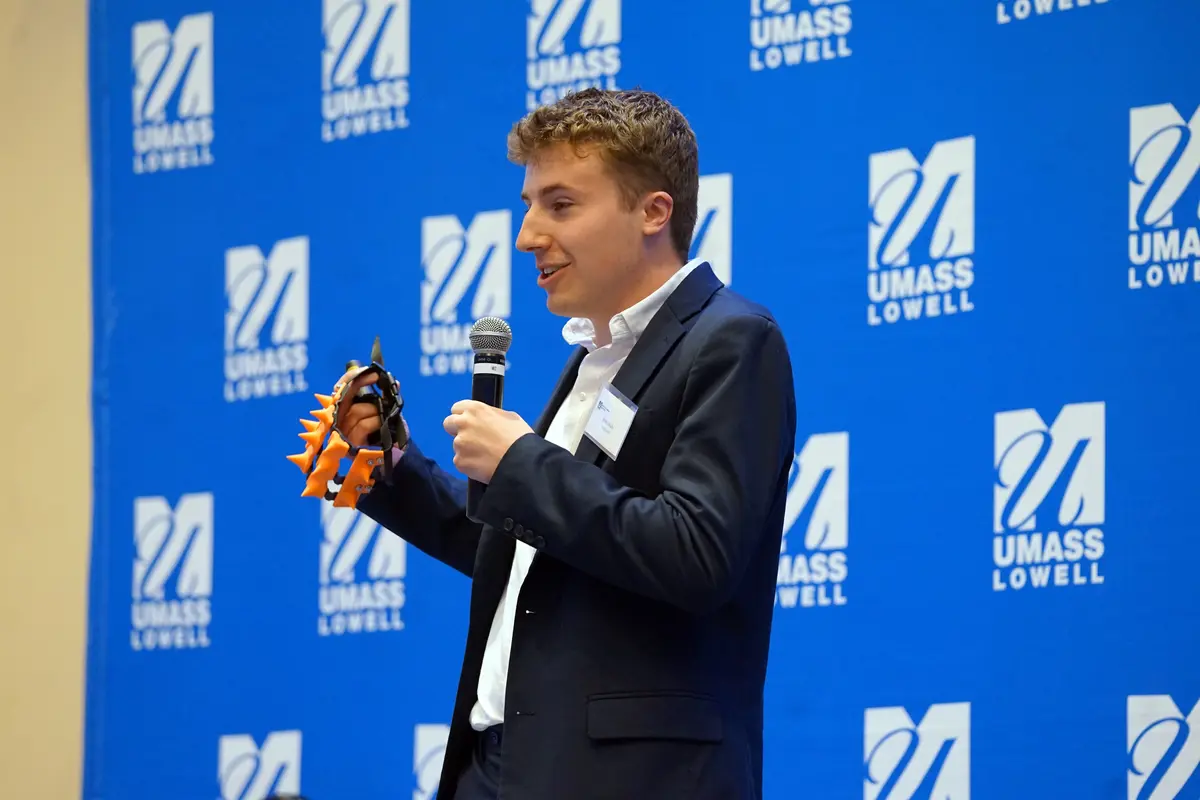 Image by Ed Brennen
 Energy engineering graduate student Brett Schultz holds a prototype of SwineShield, a protective device designed to reduce piglet suffocation deaths.
At the 14th annual Idea Challenge at University Crossing, 10 finalist teams presented solutions to problems ranging from health and wellness to cryptocurrency — and even piglet deaths on farms.
Senior business major Nate Marino received the $4,000 Sutherland Innovative Technology Solutions award for Markit, a platform designed to streamline leasing workflows for independent landlords.
“DifferenceMaker provides a real opportunity to put your idea in front of people, get funding and take the next steps,” said Marino, a licensed real estate agent from Tyngsboro.
SwineShield, a protective vest designed to reduce piglet suffocation deaths in the farming industry, earned the $4,000 Jack M. Wilson First to Market award.
Energy engineering graduate student Brett Schultz developed the prototype with his friend Ryan Ciulla, a UMass Amherst student who has worked on multiple farms. He found that sows often roll over on their piglets, causing them to suffocate.
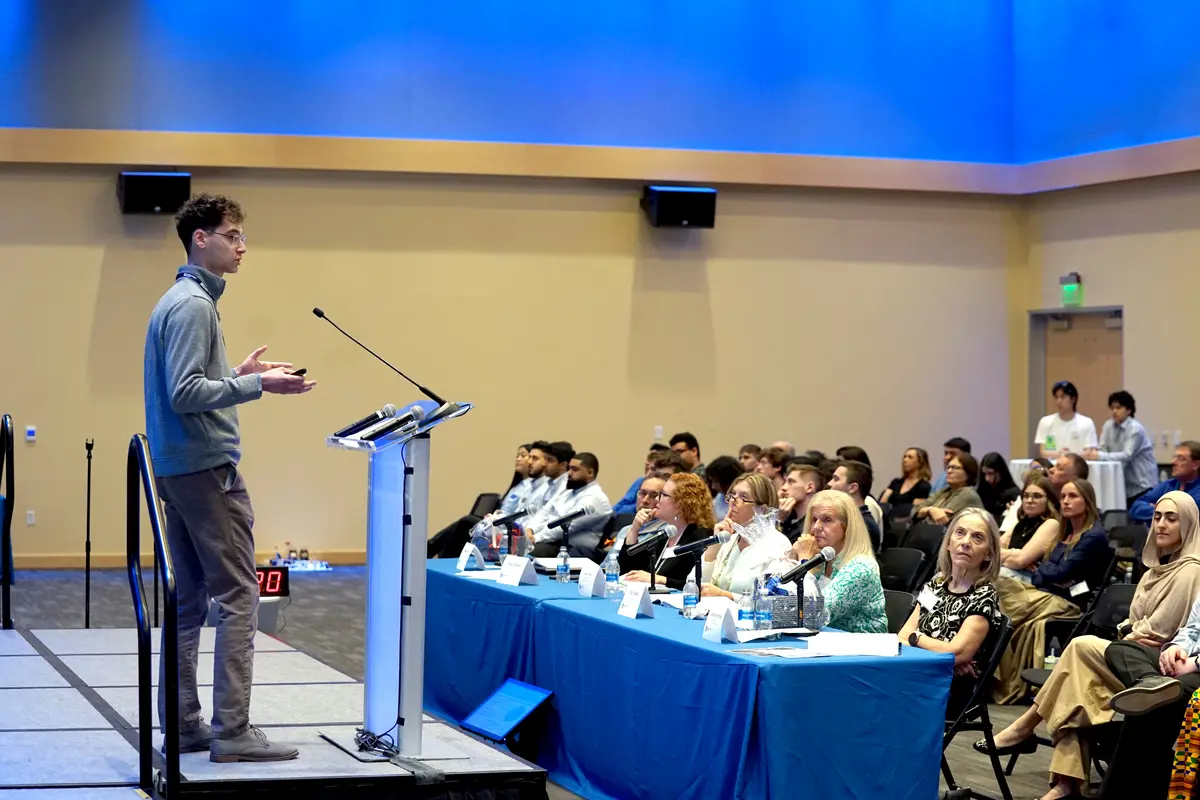 Image by Ed Brennen
 Senior business major Nate Marino pitches Markit, a platform to streamline leasing workflows for independent landlords.
Motion, a financial literacy app for students developed by first-year business major Wilmer Nunez, received the $4,000 Significant Social Impact award.
The team of business majors Aliah Ramos, Alicia Kasekende and Elizabeth Sentamu, nutritional science major Eva Picarski and computer science major Nancy Tekityamazzi won the $4,000 Contribution to a Healthier Lifestyle award for Balanced Campus, an app that helps college students optimize healthy eating at campus dining halls.
Plastics engineering majors Joanita Amoah and Brendan Viarella and public health major Amber AbuZahra won the $4,000 Commitment to a Sustainable Environment award for Plastos, a data-driven recycling enterprise and related nonprofit entity in Ghana.
Master of Public Health student Sydney Shea ’25 earned a $2,000 seed fund award for “Mindful vs. Mind Full,” a guided mental wellness journal that she developed through her undergraduate work with the Office of Student Life and Well-being.
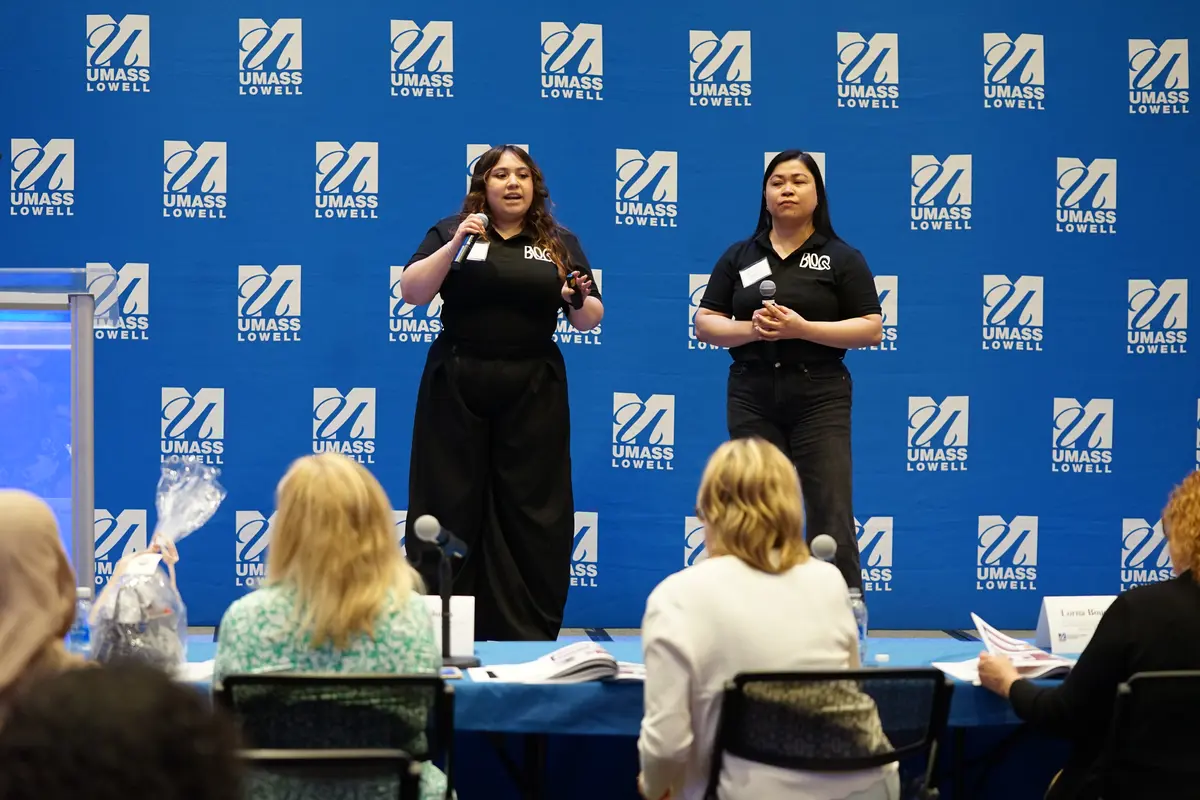 Image by Ed Brennen
 Business majors Alexandra Pace, left, and Loren Mae Lingat pitch their drink spiking protection device BLOQ to DifferenceMaker judges.
Business majors Alexandra Pace and Loren Mae Lingat earned a $2,000 seed fund award for BLOQ, a lockable lid and straw system designed to prevent drink spiking. They developed the concept in their Innovation and Emerging Technology course.
“It’s a big problem, and we wanted to create something that could protect people,” said Pace, a Billerica native. “DifferenceMaker really walks you through everything and makes you think beyond your ideas.”
Additional $2,000 seed fund awards went to cryptocurrency payment system Paycore (computer science majors Enea Nushi and Shkamb Tafarshiku) and dog training e-collar Bagul (business majors Kevin Tamayo, Paige Magner and Diya Nambiar).
First-year mechanical engineering major Rudshel Volcy won the $1,000 Fan Favorite award for ThermoLid, an advanced microwave food cover.
Students pitched to a panel of five alumni judges: Darlene Steffen ’76, Mary Burns ’84, Lorna Boucher ’86, Amy Hoey ’88 and Bhupen Shah ’92.
The range of ideas stood out to Shah.
“You’ve got the young generation thinking of things we haven’t thought about,” he said. “Then they explain it, and you realize it’s a real problem. And they come up with interesting solutions.”
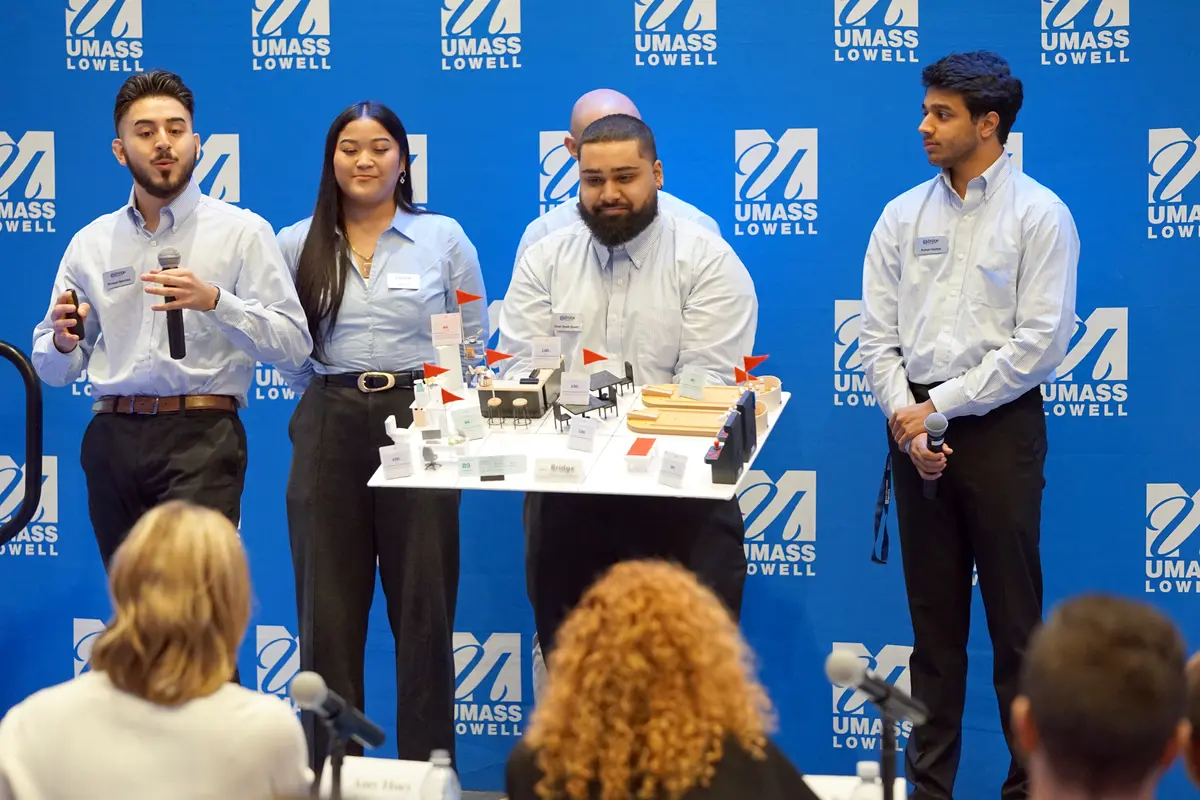 Image by Ed Brennen
 Bridge Operations team member Umer Syed-Quadri shows judges a scale model of an entertainment center that could benefit from the software platform.
“There was a high degree of preparedness among the teams,” said DifferenceMaker Director Richard Juknavorian ’98. “A lot of the teams took advantage of pitch coaching and our entrepreneurship workshop series, as well as seminars on public speaking.”
All of the finalists now have the opportunity to continue honing their ideas at the DifferenceMaker Summer Boot Camp. The winning teams also have access to $15,000 of in-kind legal services, provided by corporate sponsor Foley & Lardner LLP, where attorney and engineering alum Chris McKenna ’89 is office managing partner.
Sanchez and his Bridge Operations teammates are looking forward to the boot camp — and beyond.
“Now we have the resources to scale our prototype, start testing it even further and build it out,” said Sanchez, who credits DifferenceMaker for helping the team develop the platform.
“Before, it was something I wanted to do for myself,” he said. “Now it’s something that could truly be a real business.”