
 Image by Ed Brennen
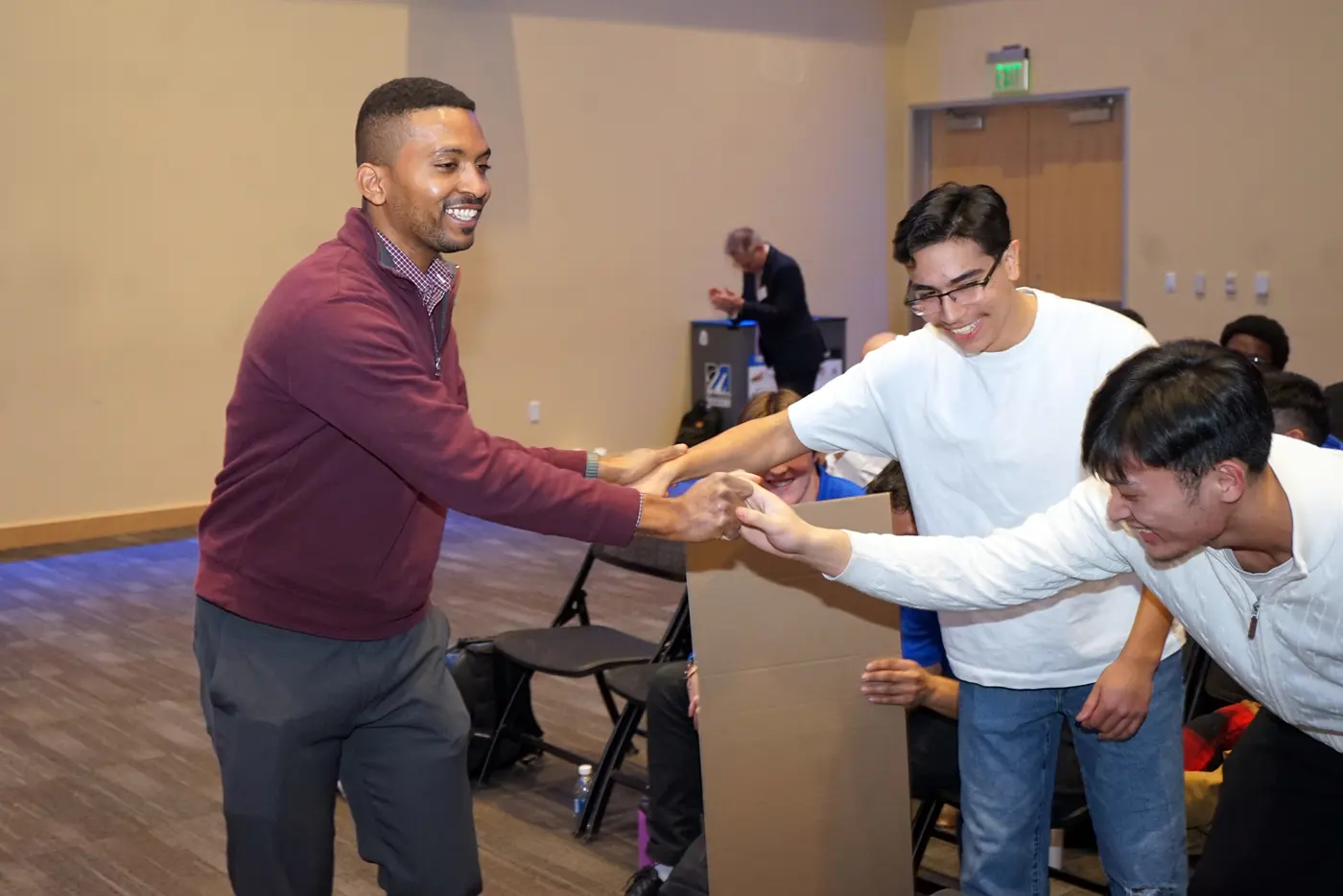
 Graduate student Diego King, left, is congratulated by fellow contestants after his barReleeze team won the Francis College of Engineering Prototyping Competition, hosted by the Rist DifferenceMaker Institute at University Crossing.
Designed to deter home intruders, permanently mounted window bars can also trap residents during a fire — a risk that has led to fatal tragedies.
Determined to solve that problem, Master of Business Administration (MBA) student Deigo King and junior mechanical engineering major Victor Tran created barReleeze, an emergency-release system that earned first place and $2,500 at this year’s Francis College of Engineering Prototyping Competition, hosted by the Rist DifferenceMaker Institute at University Crossing.
For King, the issue is personal. Members of his own family live in homes with barred windows, and while growing up in Jamaica, he had an elementary school classmate whose father died in a fire when he couldn’t escape.
“This was good to win, because the judges understood the magnitude of the problem and how a solution like barReleeze could really save lives,” said King, who is completing his online MBA this semester.
barReleeze integrates a rapid-release device into existing window bars and includes a mechanical override, smart-home functionality and remote operation that allows trusted users to unlock the system from anywhere in the world.
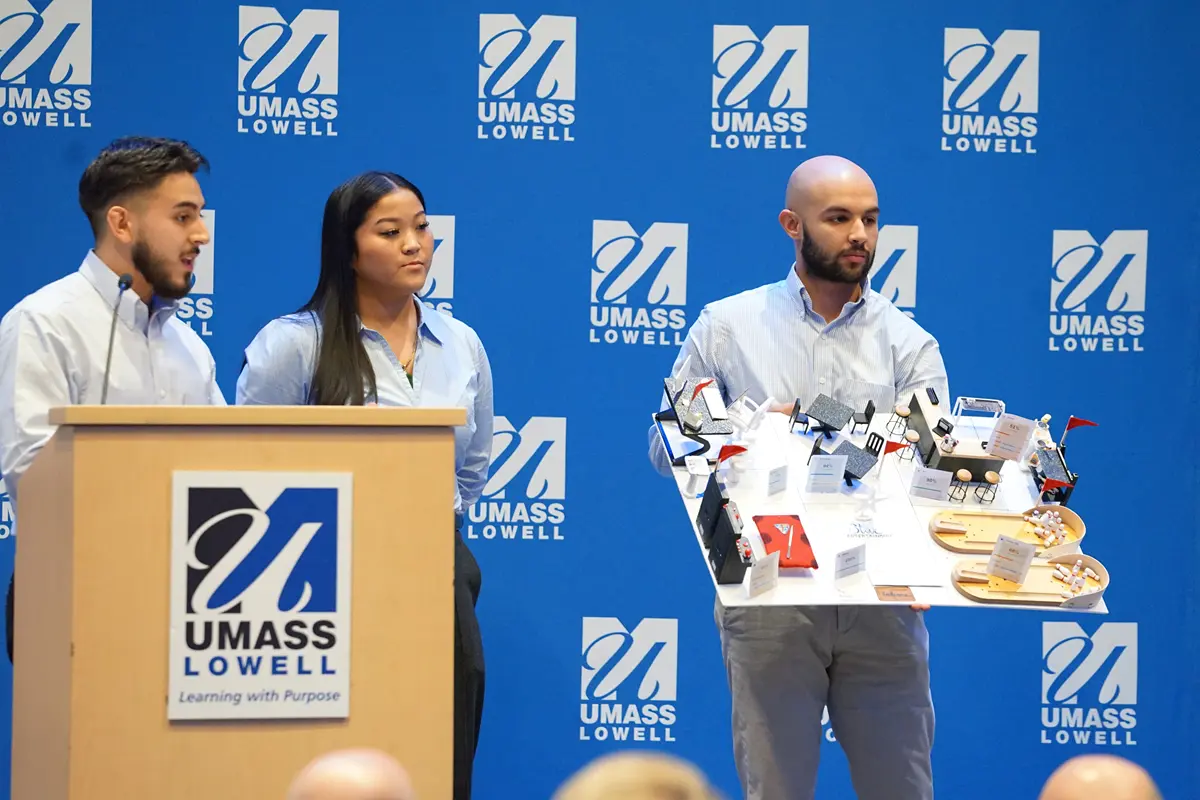 Image by Ed Brennen
 The Bridge Operations team of, from left, Michael Sanchez, Nhu Le and Adam Embarch deliver their pitch that earned third place and the People's Choice Award.
The top five advanced to the finals, where they made five-minute presentations to judges Chad LaFrance ’88, business operations and engineering manager at Texas Instruments; Ray Hamilton ’17, co-founder and CTO at invisaWear; Bill Geary ’80, patent and trademark attorney at Mintz Levin; and Kevin Riley, chief technology officer at Avid Technology.
Engineering Dean Susan Roberts, presiding over her first DifferenceMaker event, was “beyond impressed” with the students’ resourcefulness, determination, ingenuity and commitment.
“They all had an experience in life that inspired them to want to change things, and the impact that their ideas could have was just incredible,” Roberts said.
LaFrance, who has judged nearly every prototyping competition since its founding more than a decade ago, said barReleeze distinguished itself with both clarity and craftsmanship.
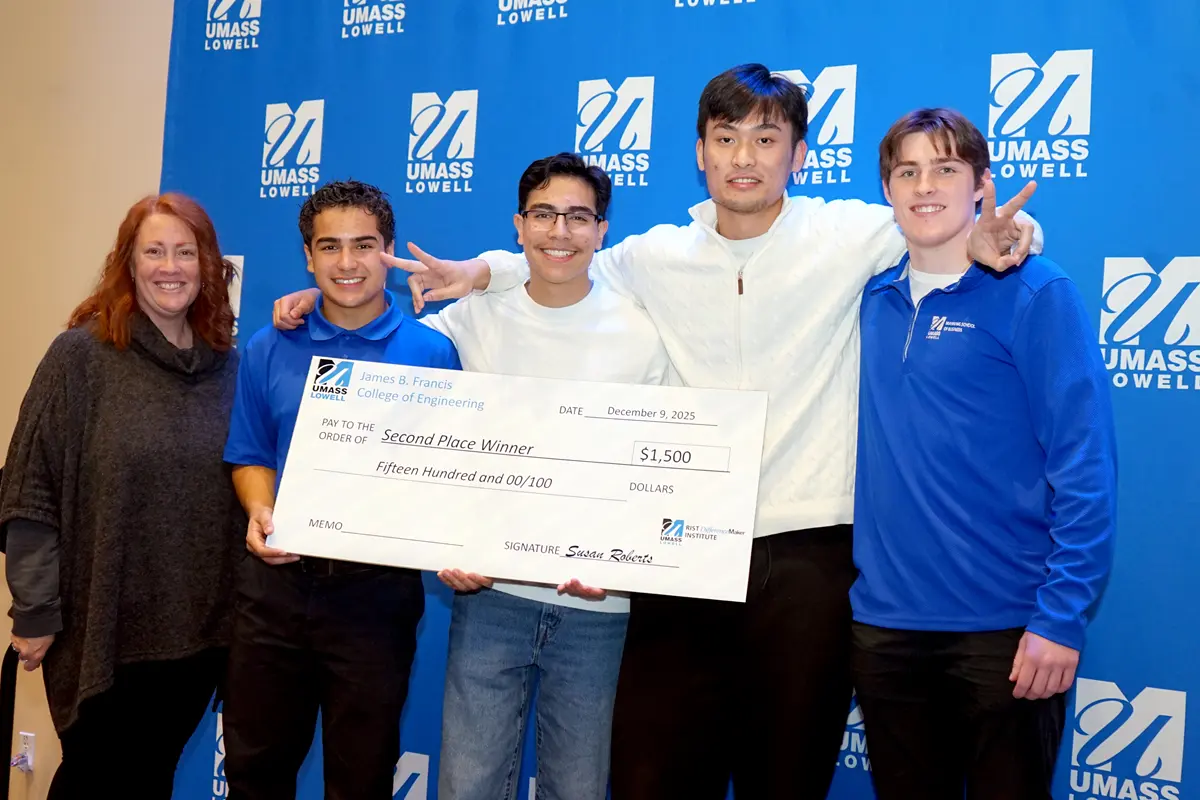 Image by Ed Brennen
 Francis College of Engineering Dean Susan Roberts, left, presents the second-place check to the FormMatch team of, from second to left, Brandon Diaz, Gabriel Palomeque, Phuc Ho and Quinn O'Brien.
Second place and $1,500 went to FormMatch, an artificial intelligence-powered athletic form analysis platform developed by junior business major Brandon Diaz, founder of the club boxing team at UML. FormMatch also includes sophomore computer engineering major Phuc Ho, junior computer science major Gabriel Palomeque and senior business majors Quinn O’Brien and Meghan Dearing.
The platform uses computer vision to analyze boxing movements and deliver real-time technique corrections. The team plans to expand into sports such as tennis, golf, baseball and weightlifting, creating what they describe as the first global library of AI coaching models.
Bridge Operations, a platform for managing facilities such as family entertainment centers, warehouses and hotels, took the $1,000 third-place prize, as well as the $500 People’s Choice Award.
Senior business major Michael Sanchez, senior electrical engineering major Adam Embarch and junior biomedical engineering major Nhu Le built the unified command center that consolidates inspections, maintenance, communication and scheduling. Their system uses AI to generate real-time scores for each zone.
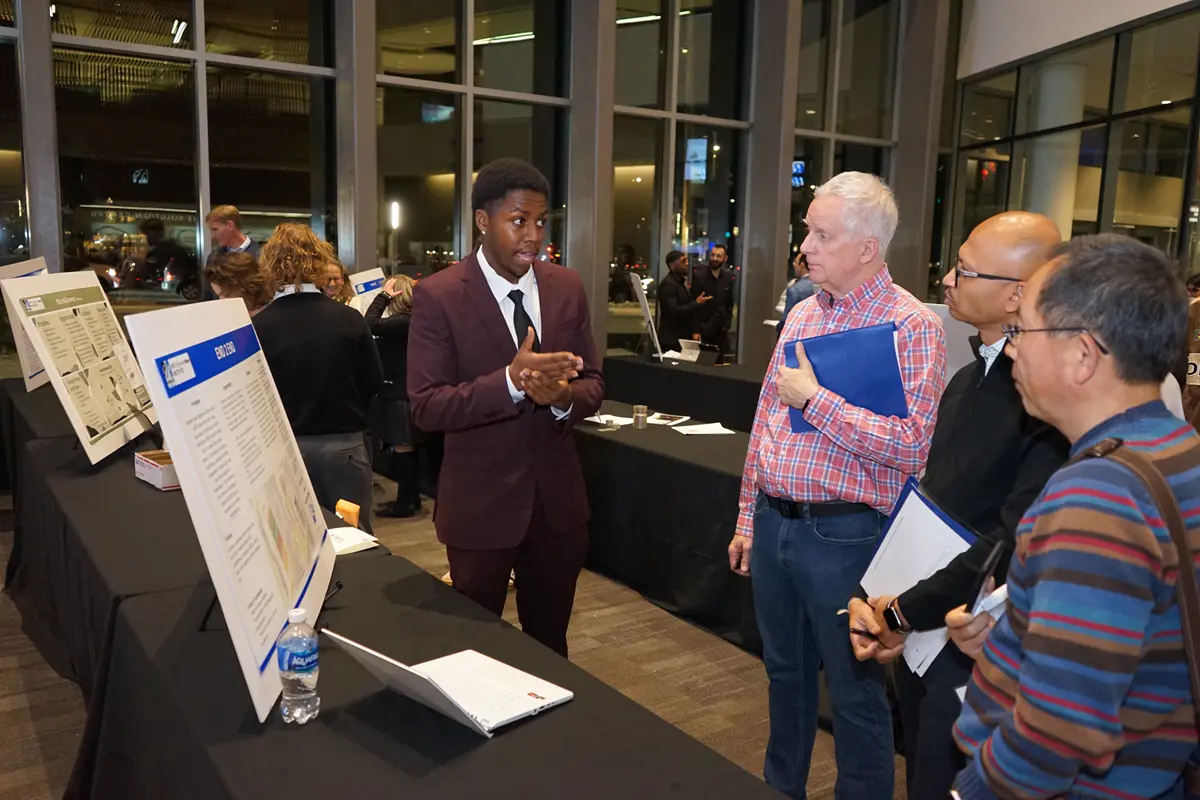 Image by Ed Brennen
 Junior computer engineering major Allen Kangethe, left, pitches his parking guidance platform End 2 End to preliminary-round judges in the University Crossing lobby.
Sophomore computer science major Elias Arachiche advanced to the prototyping competition finals with TranslateU AI, a web and mobile platform that translates real-time American Sign Language into text and speech using computer vision. The Leominster native said the competition was a “super valuable” way to push himself beyond typical classroom assignments.
“I want to build something that has some proof of use and find unique and different ways to apply AI,” Arachiche said.
Mechanical engineering majors Kazuma Marquez, Brendan Lindmark and Marcus Rideout, representing UML’s new student chapter of Engineers Without Borders, also made it to the finals with SustainaCare, a sustainable bandage system for those in need of immediate treatment in remote environments.
For Marquez, presenting onstage in the finals was both exhilarating and daunting.
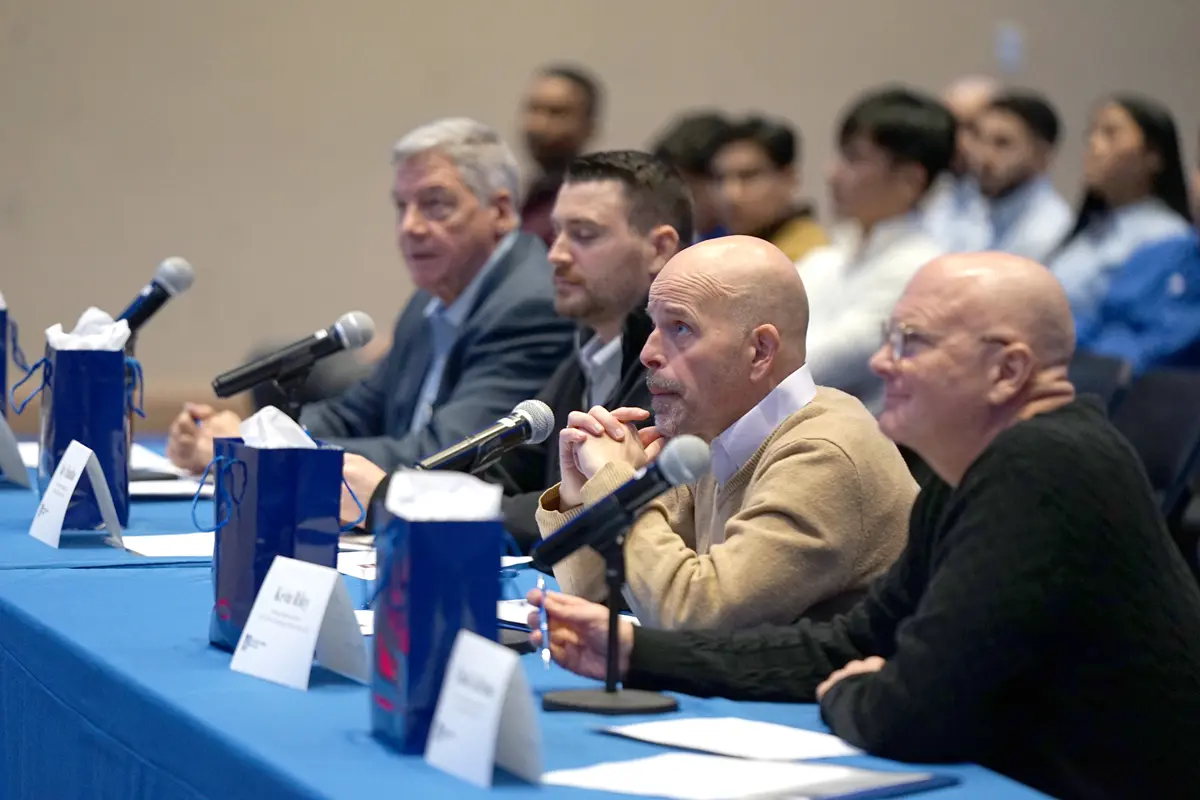 Image by Ed Brennen
 Engineering Prototyping judges, from left, Bill Geary '80, Ray Hamilton '17, Kevin Riley and Chad LaFrance '88 pose questions to a finalist.
King is also a return DifferenceMaker: He first pitched the barReleeze concept in the 2023 $50,000 Idea Challenge, earning an honorable mention and a $2,000 award. That funding helped him to begin prototyping and refining his research. Since then, he has worked with engineers, architects and manufacturers, secured multiple utility patents and continued improving the device.
King, who earned a bachelor’s degree in mechanical engineering at the New Jersey Institute of Technology, said DifferenceMaker has allowed him to “apply everything I know” from his undergraduate and MBA studies. As an online student who lives and works full time in Waltham, it has also provided him with a meaningful connection to the UML campus.
“Being able to come here and work on this project alongside my classes got me more engaged and made the experience more enjoyable,” said King, who advances directly to the preliminary round of this spring's DifferenceMaker $50K Idea Challenge. “Earning a master’s degree is a journey, and there’s so much to learn, so it’s good to be in person and connect with people.”
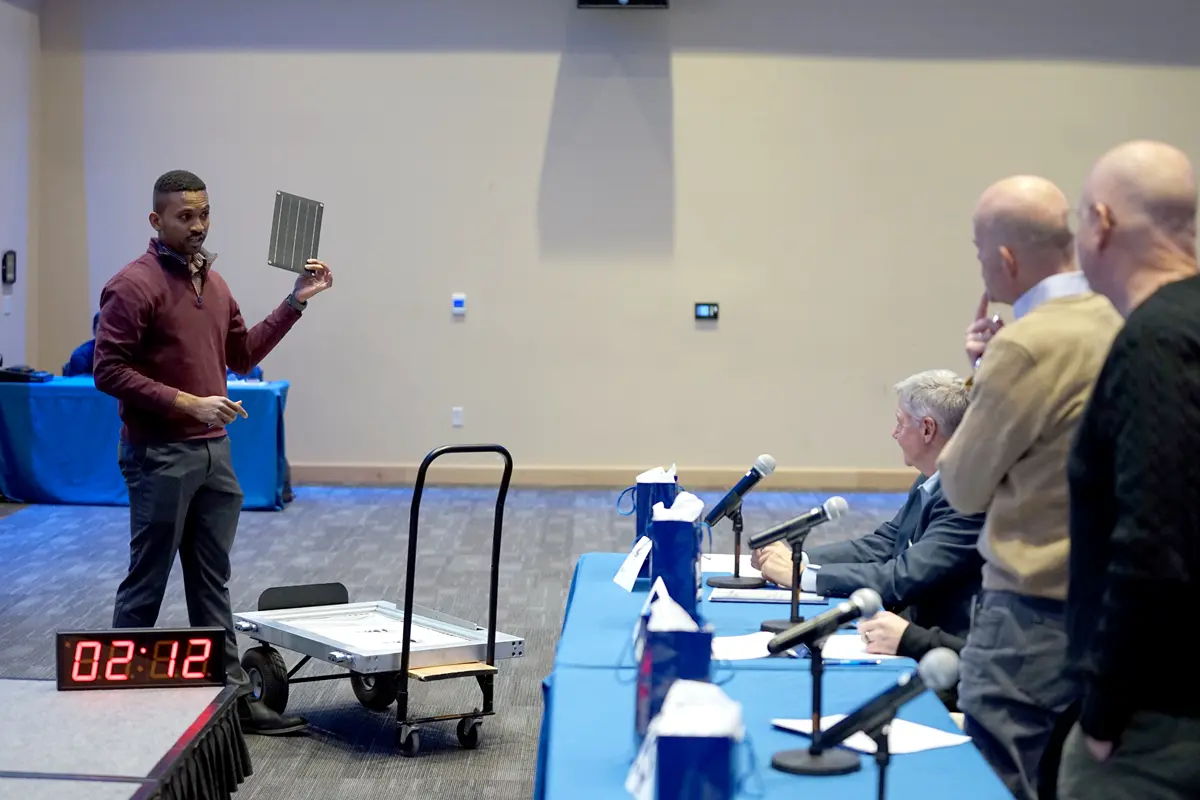 Image by Ed Brennen
 Graduate student Diego King, left, shows judges a solar panel that could help power his barReleeze system.