
 Image by Ed Brennen
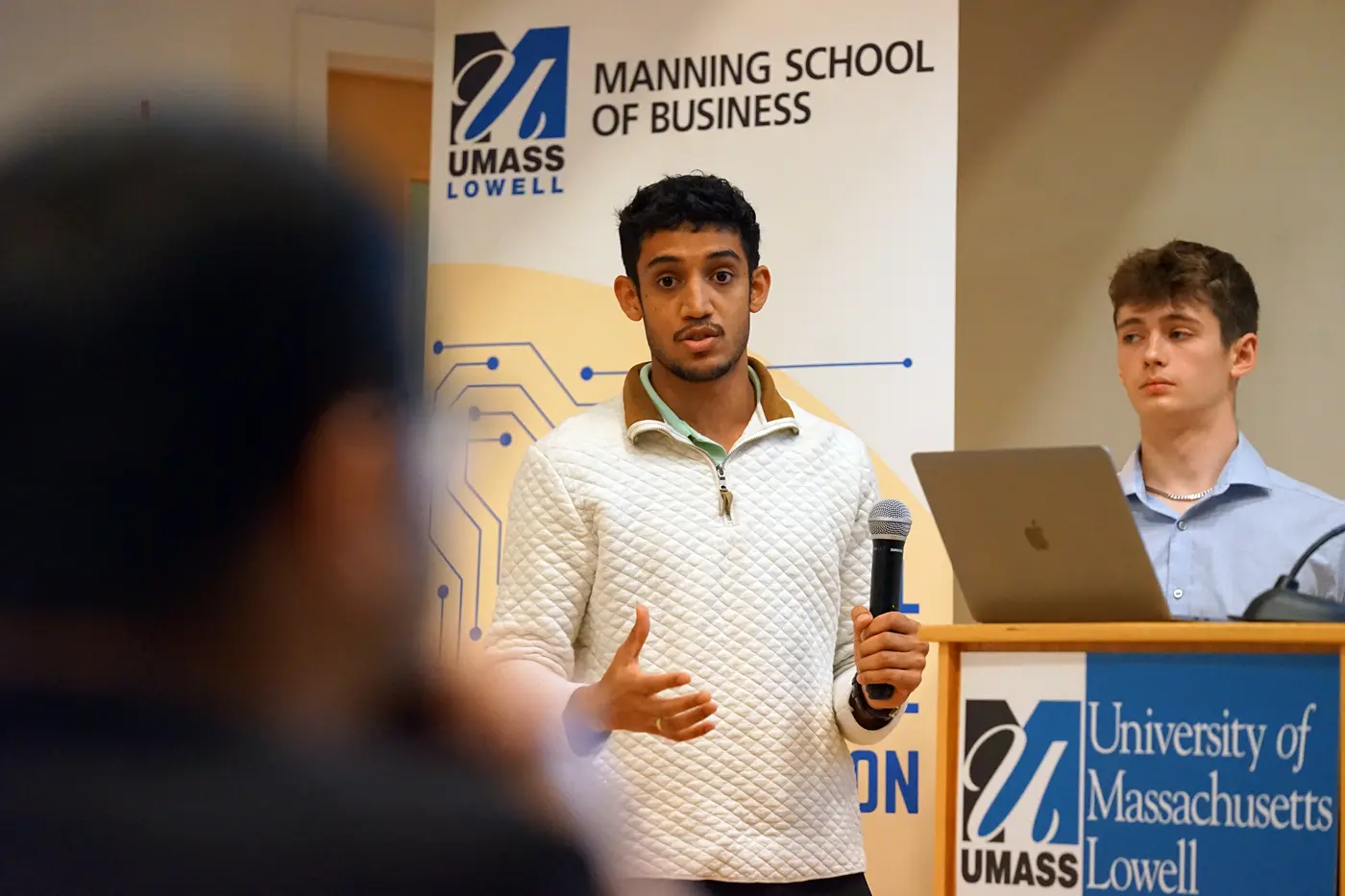
 Senior biomedical engineering major Varun Somasundaram pitches Code Smart to judges while teammate Cooper Looney looks on during the inaugural AI Entrepreneurship Competition, held recently at the Saab Emerging Technologies and Innovation Center.
A student-built platform that uses artificial intelligence (AI) to modernize medical coding took top honors in the Manning School of Business’ inaugural AI Entrepreneurship Competition.
Co-hosted by industry partner Helport AI, a San Diego-based company that builds AI-powered customer communication tools, the monthlong competition challenged students to pair AI development with business modeling and entrepreneurial thinking.
The Code Smart team of seniors Varun Somasundaram (biomedical engineering), John Aleid (business) and Cooper Looney (mechanical engineering) won the $1,000 first prize after delivering a fully functioning prototype that blends optical character recognition, natural language processing and automated rule checking to speed up hospital reimbursements while reducing claim denials and administrative costs.
Somasundaram had already been developing the platform through his work with a company in his native India that offers financial and administrative services to health care providers. He said Code Smart is designed to support medical coders, not replace them.
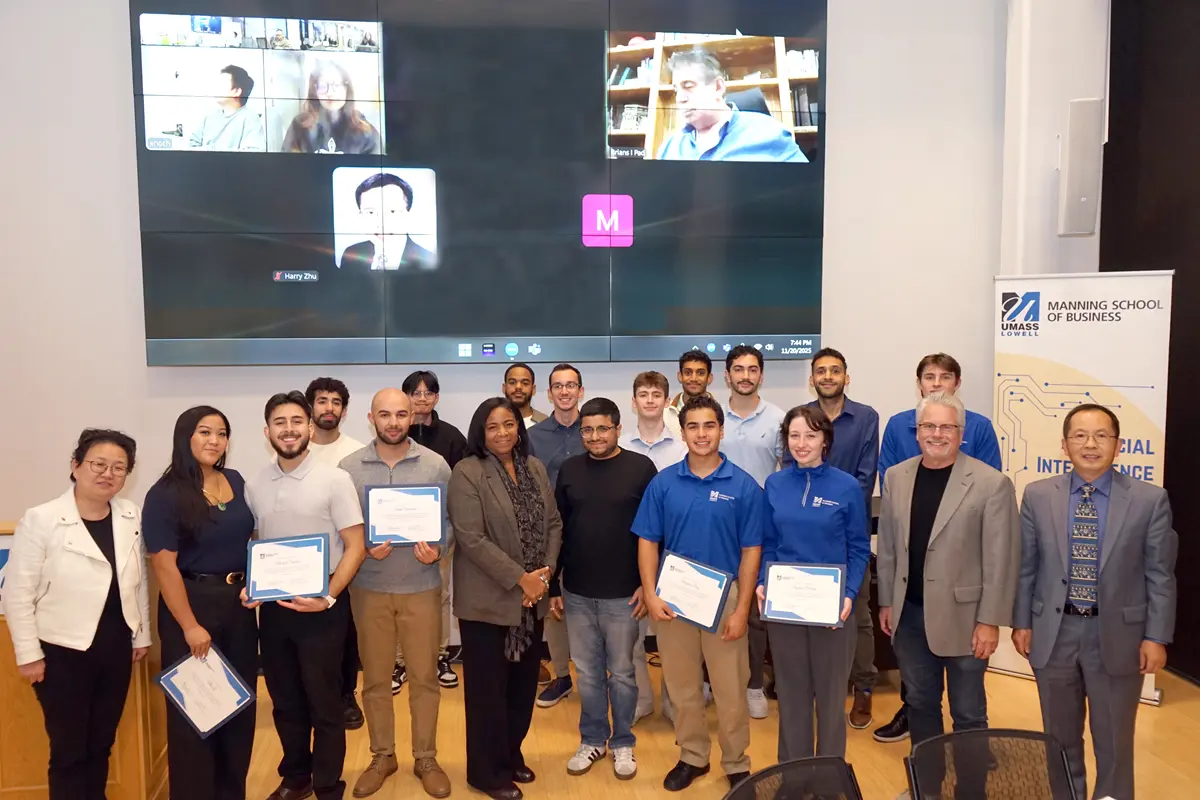 Image by Ed Brennen
 Five teams pitched their AI-driven solutions during the AI Entrepreneurship Competition, co-hosted by the Manning School of Business and Helport AI, a San Diego-based company.
The competition was developed by Operations and Information Systems Professor Harry Zhu, the newly appointed Manning Endowed Professor of AI — a position made possible by a gift from alum Brian Rist ’77, ’22, ’22 (H).
Zhu said he launched the competition to give students hands-on experience with AI and to help them understand how to work with the technology responsibly.
“AI and humans working together is the future,” he said. “If students learn how to use it in a practical and meaningful way, they’re already ahead.”
Over the course of four weeks, Helport AI engineers led training sessions and product workshops, helping teams turn their concepts into working prototypes. Teams had to include at least one business major.
 Image by Ed Brennen
 Form Match team members Brandon Diaz, right, and Quinn O'Brien pitch their fitness app that analyzes users' exercise form through a smartphone camera.
Projects were evaluated on innovation, technical feasibility, clarity of communication and potential for real-world implementation.
The second-place prize of $600 went to Bridge Operations, created by seniors Michael Sanchez (business), Nhu Le (biomedical engineering) and Adam Embarch (electrical engineering). Their platform unifies facilities, maintenance and operational management into one intelligent system capable of analyzing real-time operational health. Sanchez said the idea came from his job at a family entertainment center where information lived on whiteboards, outdated laptops and scattered notes.
Third place and $400 went to Form Match, a mobile fitness app that analyzes users’ exercise form through a smartphone camera. The team includes business majors Brandon Diaz, Quinn O’Brien, Meghan Dearing and Tyler Ros and computer engineering major Phuc Ho.
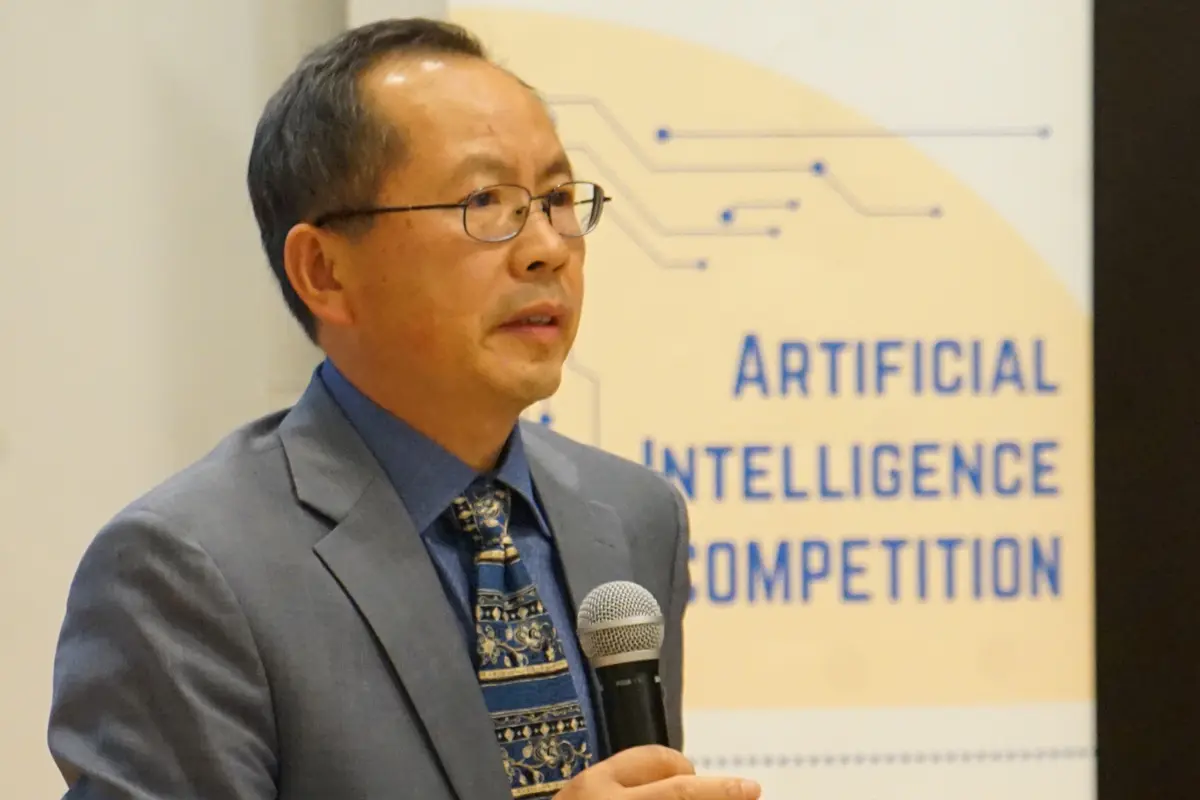 Image by Ed Brennen
 Operations and Information Systems Professor Harry Zhu, the new Manning Endowed Professor of AI, welcomes teams to the inaugural AI competition.
Two teams received honorable mentions: CoachHub AI, created by Peter Sullivan, Tai Dao, Ben Nguyen, Luka Metias, Gabe Asevedo and Ricardo Grispos, which helps personal trainers automate program planning and client tracking; and UML GradMate, an AI-driven academic advising chatbot built by Ammar Nagy.
Several of the teams plan to pitch their platforms in upcoming Rist DifferenceMaker Institute competitions.
Greer was impressed by the quality of the projects and by how quickly the teams learned to apply AI to real-world challenges.
“AI isn’t going anywhere,” she said. “As each of you showed in your proof of concept, it will be used in innovative ways to solve real problems.”
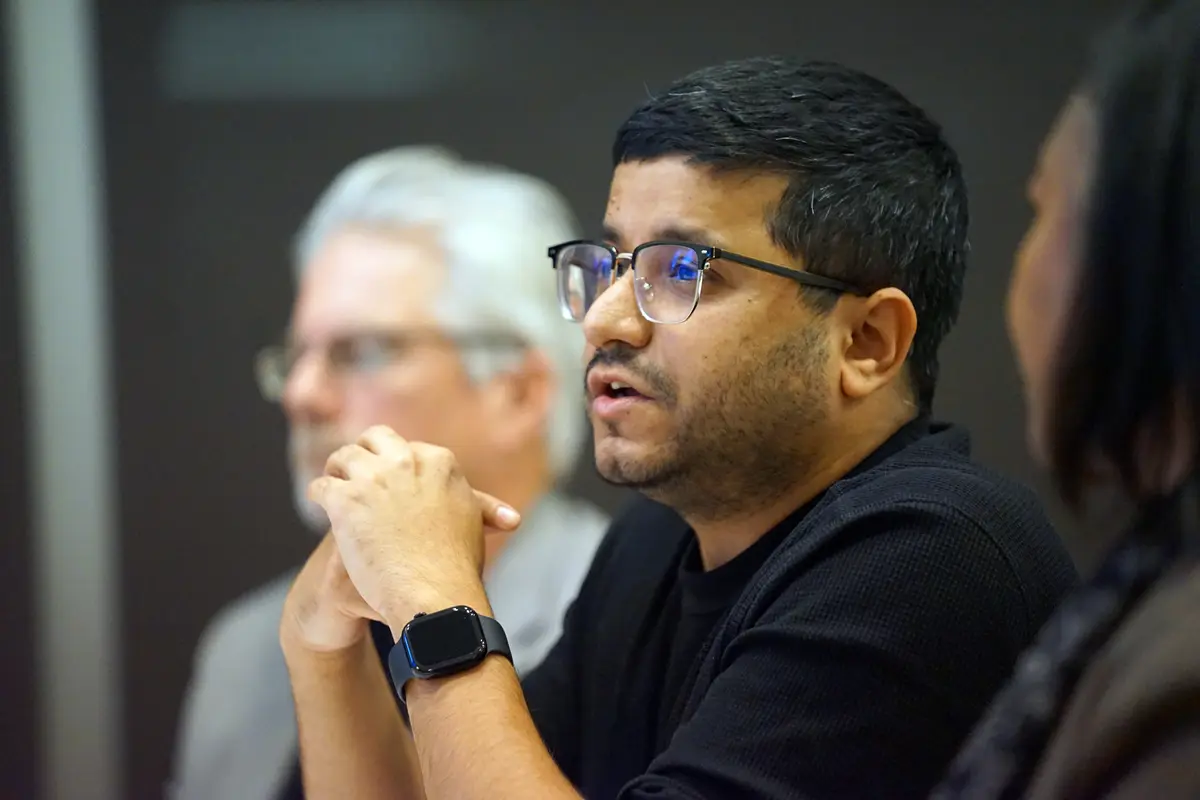 Image by Ed Brennen
 AI Entrepreneurship Competition judge Nakul Arora, a senior product manager at Kayak, questions a team following its presentation.