

Our hikes vary by semester. Below is a snapshot of some of our regular choices. Most involve a drive of between 1-2 hours. You can always read more on the Trip Calendar, or ask if you want to know more!
Wellness Day Hikes
- Explicitly easy and beginner-friendly. If you've never hiked before and/or if you're unsure of your physical ability, or you just want a relaxing time outside, this is a great hike to join.
- Less than 4 miles (6 kilometers) or so, with elevation gain of less than 1,000 feet (300 meters). Sometimes flat!
Beginner Hikes are the bulk of our program! We want to introduce beginner hikers to getting outside and will teach you what you need to know.
- You don't need any experience, and don't need to be totally fit, but there will be challenging uphill moments. A good attitude for the challenge is necessary.
- Typically 3-7 miles (5-11 kilometers) and/or less than 1,000 feet (300 meters) of elevation.
- Typically will be 2-5 hours of hiking.
- Participants can expect wider trails, travel or paved roads and possibly a gentle incline.
Intermediate Hikes
- Appropriate for a hiker who has hiked at least once, or a beginner who knows they are fit. No previous experience is required.
- Between 4-7 miles (6-11 kilometers) and/or elevation gain of between 1,000 to 1,800 feet (300-600 meters) or so.
- Typically 3-6 hours of hiking.
- Trails may be rocky, uneven, uprooted and include gradual switchbacks. Destinations may be considerable distance from the nearest road.
Advanced Hikes
- Previous hiking experience (ideally on an OAP hiking trip), proper footwear, good physical fitness and a willing attitude are required.
- Longer at 6+ miles (11+ kilometers), up to 9-10 miles (15-16 kilometers) maximum and/or have a large elevation gain of 1,800 to 3,000 feet (600-900 meters).
- Generally 5-8+ hours of hiking.
- Trails may be rugged and include scrambling and steep inclines and downhills. Destinations are often very far from nearest road.
 Image by Bethany Bourgault
 Mount Wachusett
Wellness Day Hike level. Mount Wachusett is home to both the Wachusett Mountain State Reservation and a downhill ski area. It has fantastic trails for hiking, and they are also used for biking or cross-country skiing. On clear days, you can see Mount Monadnock to the north in New Hampshire and even a far-off glimpse of Boston to the east. A band of old growth trees is just below the summit, with some trees which have been growing for over 350 years old! The name Wachusett is derived from a Native American Algonquin term meaning "mountain place." The trails here are more gentle compared to many NH peaks, so our Wellness Day Hike often heads to this location.
Mt Kearsarge
Beginner level. Mt Kearsarge near Winslow, N.H. has a beautiful 360-degree from its summit with a cool fire tower. It is an uphill through classic mountain ecosystems. We often choose this as a winter hiking skills location. Note, this is different than Mount Kearsarge North, which is north of Conway, N.H. Image by Daniel Cremin
 Lonesome Lake
Beginner level. Lonesome Lake is a 12.2-acre water body located in Franconia Notch in the White Mountains of New Hampshire, south of Cannon Mountain. There are several choices of trails, and all are occasionally steep. The lake features an Appalachian Mountain Club hut, which first opened in 1930, on its southwest shore. The lake lies in the Merrimack River watershed, meaning it eventually sends the same water flowing right past UMass Lowell on its way to the ocean.
 Image by Libby McGrosky
 Mount Monadnock
Beginner level (on the Intermediate end). Mount Monadnock is the most prominent mountain peak in southern New Hampshire. Monadnock has a bald only-rock summit, which provides awesome view all around! At 3,165 feet, Mount Monadnock is nearly 1,000 feet (305 meters) higher than any other mountain peak within 30 miles (48 kilometers) and rises 2,000 feet (610 meters) above the surrounding landscape. Ralph Waldo Emerson and Henry David Thoreau were known to write about Mount Monadnock.
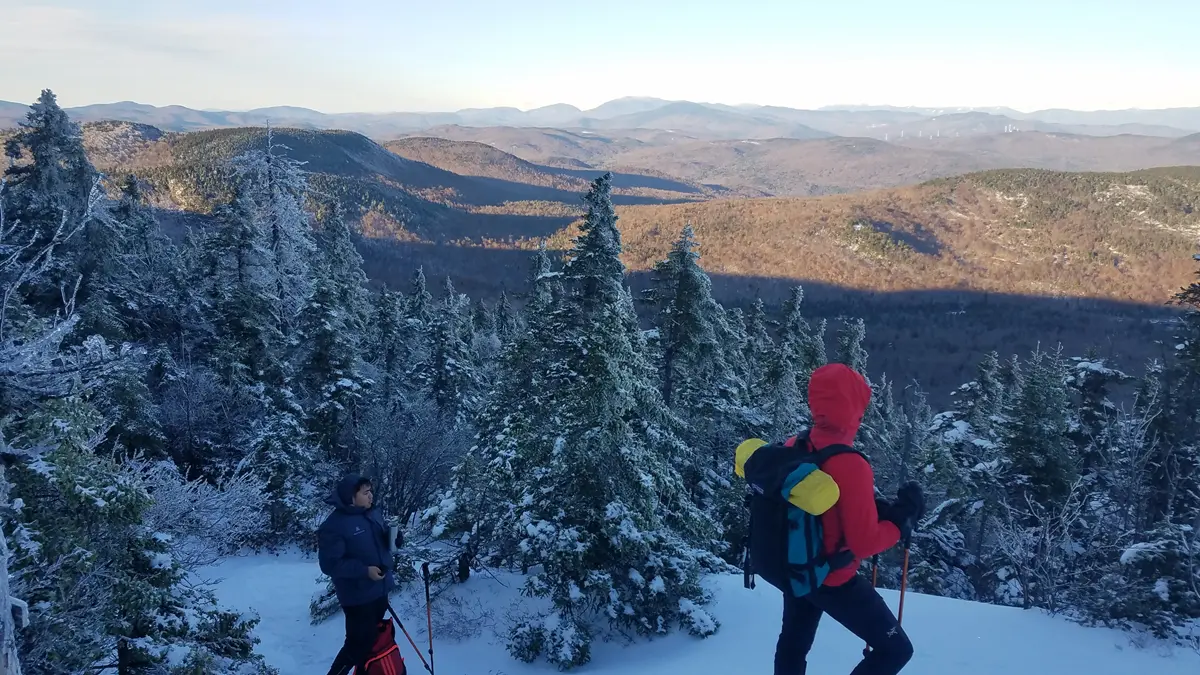
Mount Cardigan
Intermediate Hike. Mount Cardigan is a prominent bare-rock summit near the town of Orange in western New Hampshire. Its peak is only 3,155 feet (962 meters) above sea level, but because of its large areas of bare granite ledges and alpine scrub, it feels like a much higher mountain.

Mount Moosilauke
Advanced Hike. Mount Moosilauke is a 4,802-foot mountain at the southwestern end of the White Mountains. It is closest to the town of Benton, New Hampshire. It is the tenth highest and most southwesterly of the 4,000 foot summits in the White Mountains. The Appalachian Trail passes over Mount Moosilauke, and it has a bald top with lovely views all around.
Weather
Many of our hiking trips happen in fall or spring. Generally you can expect New England summits to be surprisingly cool and/or windy, even on a warm day. Most weather is perfectly great weather for hiking, even rain. The only weather that will cause us to pause while on the trail is thunderstorms/lightning. If it is very windy and/or cool, we may limit the time we spend on various high points. Be prepared for hiking in fall or spring (and even summer) by bringing warm layers and rain layers, even when the forecast is for warm weather in Lowell, and carefully review the packing list below. Remember, we do have some warm layers you can rent for free with your reservation on a day hiking trip.
Packing List
The items on this list are strongly recommended for your trip. The season, weather forecast and your thermal perception (i.e. if you generally feel cold easily or often feel hot) should be considered when packing.
- Online medical questionnaire and waiver
- Hiking Shoes or Boots with good tread, and ideally with ankle support
- Hiking Socks 1 pair wool mid-weight hiking style are required, especially for wet conditions and blister prevention; 2-3 pairs is ideal
- *Gaiters Useful in winter or early spring conditions
- Extra pair of Socks and Shoes to wear in the van, so you have happy feet to start and end your trip
- Bottoms Pants/Shorts/Skirt, Quick-dry, non-cotton, no jeans
- Shirts long-sleeve and/or short-sleeve, Quick-dry, non-cotton
- Base layer tops and bottoms recommended in cool or cold seasons (November through April). Quick-drying material such as nylon or polyester required
- Sunglasses Sun protection
- Baseball Cap/Full-Brim Hat Sun protection
- Bandana Versatile: sweat rag, hanky, napkin, etc.
- Warm jacket layers Fleece/wool/puffy top layer, should be compact
- *Warm Hat Cold weather; wool or fleece
- Gloves Cold weather
- Rain jacket/shell and rain pants, jacket is a must, as weather in the mountains can change suddenly.
- Camera (or camera phone), a protective case is highly recommended
- Personal environmental supplies Sunscreen, lip balm, bug spray
- Day pack small backpack for extra layers, water bottle and snacks
- Personal Medications
- Medical Insurance Card
- Money for food on the road and/or possible souvenirs
- *Headlamp You must provide 3 AAA batteries if borrowing one of ours
- *Trekking poles optional
- *2 Water Bottles Hydration; start hydrating the day before
*All items with an asterisk are available to check-out and included in the cost of your registration.
Any personal equipment you wish to bring is subject to trip leader approval.
OAP will provide all the necessary group items, including first aid kit, emergency communication device, and maps.
Register for upcoming trips on our Trips and Events Calendar webpage
Contact
- Email: OutdoorAdventure@uml.edu
- Phone: 978-934-1549