Professor Shannon Kelleher of the Department of Biomedical and Nutritional Sciences is working to uncover the biological reasons that affect milk supply to help mothers breastfeed.
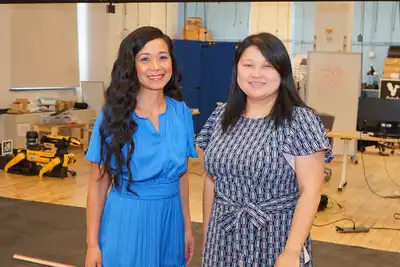
Biomedical engineering professors Lara Thompson ’03 and Yanfen Li have been inducted into the American Institute for Medical and Biological Engineering College of Fellows, a distinction recognizing the top 2% of engineers in the field.
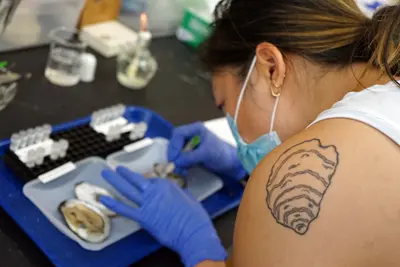
Assistant Professor of Biology Sarah Gignoux-Wolfsohn and her students are studying the genetics, microbiomes and resilience of wild and farmed oysters on the North Shore of Massachusetts to understand how climate change and disease affect coastal ecosystems and aquaculture.
Assoc. Prof. Kelsey Mangano of Biomedical and Nutritional Sciences in the Zuckerberg College of Health Sciences received a $900,000 grant from Harnessing Emerging Research Opportunities to Empower Soldiers (HEROES), a joint research and development initiative of UMass Lowell and the United States Army Combat Capabilities Development Command Soldier Center (DEVCOM), to study the natural production of omega-3s.
Asst. Prof. Fanfei Meng of the Biomedical and Nutritional Sciences Department is evaluating the effectiveness of combining antibiotics and anti-inflammatory drugs in a nanoparticle to treat sepsis.
Asst. Prof. Chiara Ghezzi will use her five-year, $650,000 CAREER grant to understand the connection between human oral tissue and the oral microbiome, and how they interact, by creating a model of the human gum tissue system in her laboratory.
Chemical Engineering Assoc. Prof. Gulden Camci-Unal was recently awarded a three-year collaborative research grant worth nearly $242,000 by the National Science Foundation to develop bioartificial pancreas-like engineered tissues that could someday help improve the quality of life of people with diabetes.
Funded by a $1.5 million grant, Biological Sciences Asst. Prof. Sarah Gignoux-Wolfsohn and a team of researchers are searching for a treatment for stony coral tissue loss disease.
Chemistry Asst. Prof. Manos Gkikas and his former student, Frances Skinner ’19, developed new anti-microbial drugs to fight multidrug-resistant bacteria that can cause infections in critically ill patients.
Lugging around a tapeworm that’s one-third your body weight can be a real drag. So threespine stickleback fish evolved resistance to tapeworms — but resistance has costs of its own, a team of researchers show in an article published in Science Thursday.
Biology Asst. Prof. Frédéric Chain’s research on gene regulation has been recognized by the National Science Foundation (NSF) with a prestigious national faculty early-career development award.
The National Institutes of Health (NIH) has awarded Chemical Engineering Asst. Prof. Gulden Camci-Unal a five-year grant worth nearly $2 million to support her research on repairing and regenerating bone.
A team of researchers from UMass Lowell and Northeastern University is creating and testing a low-cost, automated wireless sensor network that could detect SARS-CoV-2, the virus that causes COVID-19, in the air and in wastewater potentially days before an outbreak occurs.
DiSenDa (Disease Surveillance with Multi-modal Sensor Network & Data Analytics), led by UML Prof. Sheree Pagsuyoin, uses a wireless sensor network with patented sensor technologies, that detects pathogens in the air and in water up to one week before cases present in humans.
As the coronavirus pandemic continues to cripple social interaction, upend education, endanger health and disrupt business, the university’s researchers are exploring the ever-widening aspects of the virus’ presence. Several UML researchers recently earned grants to explore a wide array of COVID-19's effects.
This Browser is Not Supported
For an optimum web experience we recommend the latest version of Firefox, Chrome, Edge, or Safari. Please use one of the links below to install a supported browser.