Logo that says: HEROES UMass Lowell/US Army, DEVCOM Soldier Center, US Army

We collaborate with the department of defense, industries, and other academic institutions to leverage intellectual assets for the creation of knowledge, product prototypes and services to improve warfighter protection, sustainment, effectiveness.

This is a unique interdisciplinary research and development group that brings together students, staff, and faculty members with the DEVCOM SC scientists and engineers to transform ideas into products to enhance the capabilities of the U.S. warfighter.

18 New Research Projects Advance Soldier Protection and Performance

The UMass Lowell HEROES Center and the U.S. Army DEVCOM Soldier Center are launching 18 new research projects through the Transitioning High-Impact Research and Innovation through Versatile Engineering (THRIVE) and Bridging Research Advancement with Versatile Engineering II (BRAVE II) initiatives, with a kickoff event on November 13, 2026.

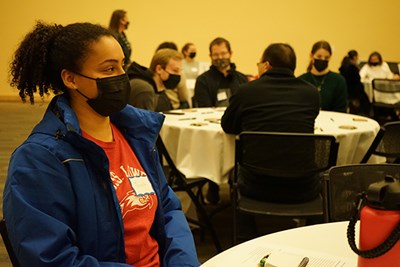
The event brings together university researchers, faculty and Army leadership to introduce the projects, share research priorities and strengthen collaboration across multiple departments and colleges. The program features presentations from Army and university leaders, an overview of the research initiatives and introductions to the new projects. Spanning five research thrust areas, the projects explore technologies and materials designed to advance soldier protection, sustainment and effectiveness.

Five Research Thrust Areas

Research in this area explores autonomous UAS evaluation, performance in complex and turbulent environments, and lightweight materials for parachute and aerial-delivery systems.

These projects investigate food-quality sensing, nutritional bioavailability, autonomous microfluidic systems and packaging designed to perform under demanding conditions.

This work applies digital-twin technology and multisensor systems to better understand human movement, mobility, task performance and readiness.

Projects focus on flexible power technologies, advanced material-based sensors, chemical and toxic-gas detection, textile-based electronic connections and equipment designed for field conditions.

Research in this thrust advances protective textile technologies, including PFAS-free coatings designed to repel a range of liquids and support demanding operational applications.

Promoting Innovation

  • $45M+
    in Research Expenditure
  • 180
    Projects Funded
  • 14
    Patents Filed and Awarded
  • 75+
    Papers Published
  • 81
    Faculty Researchers
  • 360+
    Student Researchers

University News

HEROES News