At a Glance
Year: 2027
Major: Computer Science, data science concentration
Activities: Founder and president of the Artificial Intelligence Multidisciplinary Society, Honors College, Delta Kappa Phi


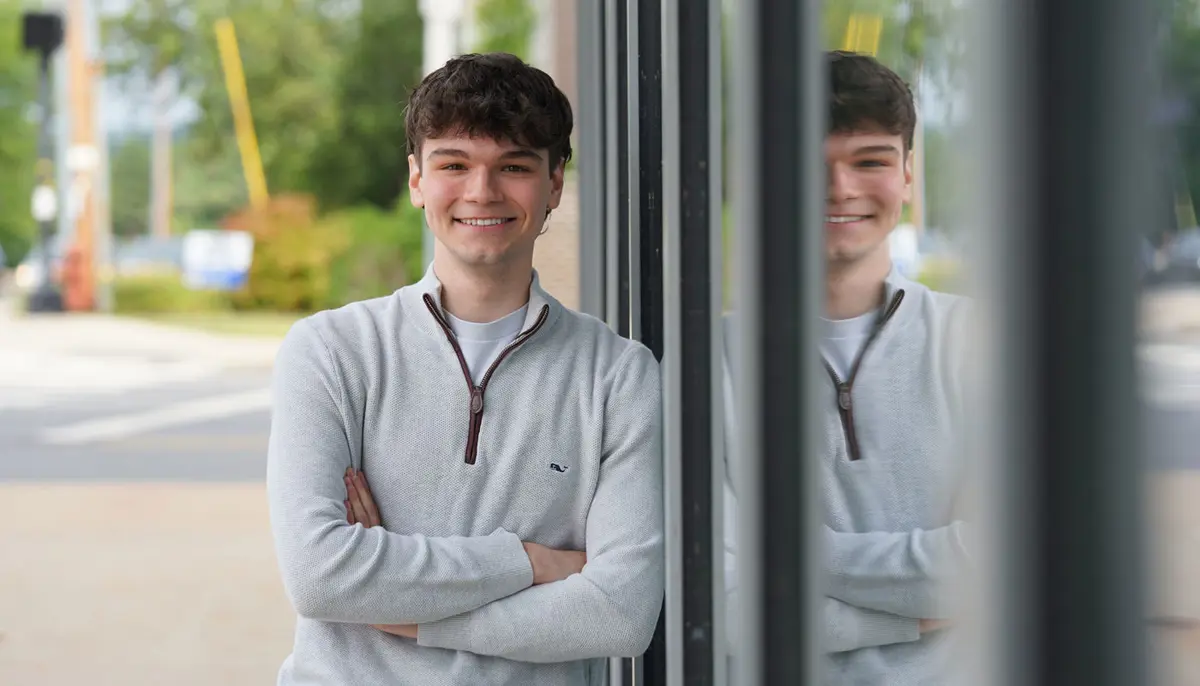
Artificial intelligence is often seen as a threat to the future of work. For computer science major Samuel Morse, it led to an internship.
In the summer before his senior year, Morse worked as a generative AI operations intern at Santander Bank’s U.S. headquarters in Boston. There, he helped develop tools that made it easier for call-center agents to find the information they needed.
“My job was created by AI,” Morse says. “I got an internship because of it.”
As the founding president of the Artificial Intelligence Multidisciplinary (AIM) Society, Morse is helping UMass Lowell students from any major see AI not simply as a technology, but as a force already changing their fields.
“I wanted to take a multidisciplinary approach,” says Morse, who started the student organization with fellow computer science majors Jordi Lopez and Harry Joshi. “AI is going to affect different people’s jobs, so it’s going to affect different people’s majors.”
Morse grew up in Agawam, where his mother, Stacy, raised him as a single parent while working as a teacher. “She taught me that academics and lifelong learning were important from a young age,” he says.
As a first-year student at UML, Morse joined Delta Kappa Phi and was soon leading academic initiatives for the fraternity, helping members from a variety of majors pursue internships and jobs. More than anything, he says, the fraternity gave him a community and helped him grow as a leader.
Morse’s interest in AI grew during his sophomore year, as ChatGPT and other tools became more prevalent. When he first used AI, Morse remembers being impressed by its power — but also unsettled by it.
“I was like, ‘Wow, this is a super powerful tool,’” he says. “This is really scary, because people can do so many things with it.”
As Morse learned more about how the technology worked, however, his fear gave way to curiosity and a sense of possibility. He began to see AI as a tool that could help people synthesize information, work more efficiently and explore opportunities that had not previously existed.
Through the Honors College Lowell City-ship Program, a yearlong paid program that connects students with community organizations and nonprofit leaders in Greater Lowell, Morse worked with the Honors Development Studies Center on AI literacy. He built and deployed an AI application for the course “Science and Technology in an Impoverished World,” then guest-lectured in the class about responsible AI use.
The project also reached students in Ghana, giving Morse an opportunity to share the AI application with an international audience. Morse says the opportunity was “super-exciting” because it allowed him to teach AI technologies to students who might not otherwise have access to them.
As he continued exploring AI’s potential, Morse also gained practical experience applying it. He began competing in hackathons at schools around Boston with Lopez and Joshi, developing technology-based solutions to problems in health care, energy and other fields. At an event at Tufts University, they created “Coal to Core,” a proposal for converting existing data centers to nuclear power. The team took third place and won the award for most innovative project.
Their collaboration helped Morse see the value of bringing that kind of hands-on, cross-disciplinary work to UMass Lowell, an idea that shaped the creation of AIM.
As he looks beyond UML, Morse is considering graduate school and remains interested in AI governance — the policies and practices that will determine how the technology is used. He believes the field needs leaders who understand not only how AI works, but also how it affects people and communities.
“AI is not a replacement for humans,” he says. “We still need humans.”
Don’t be scared of the future; educate yourself. Think about how the technology can supplement your knowledge and creativity rather than replace them.”