
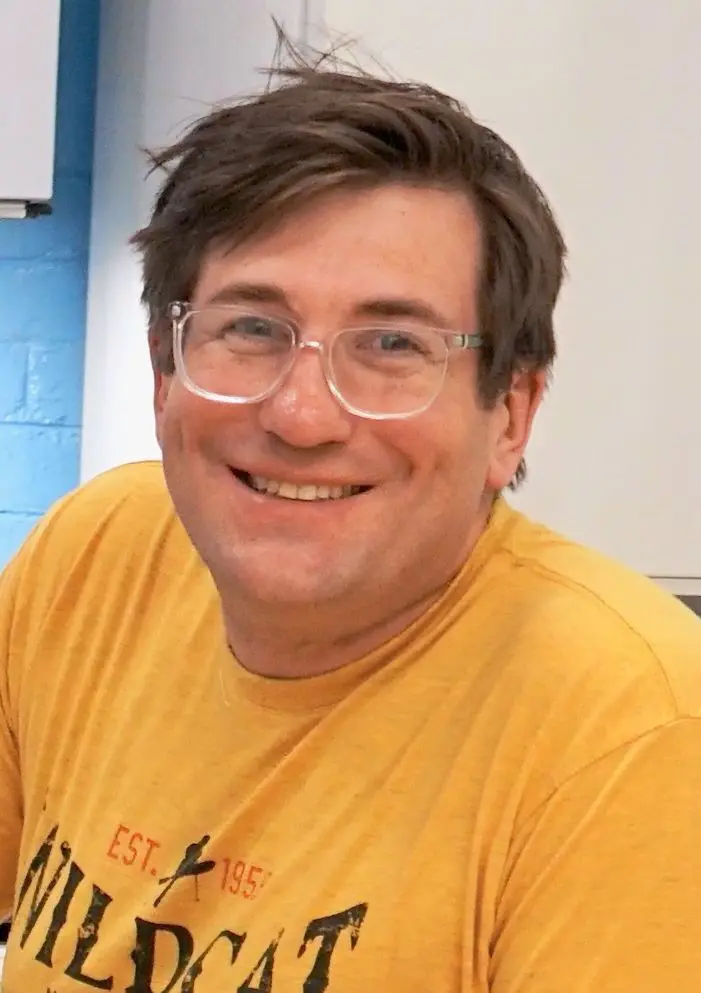
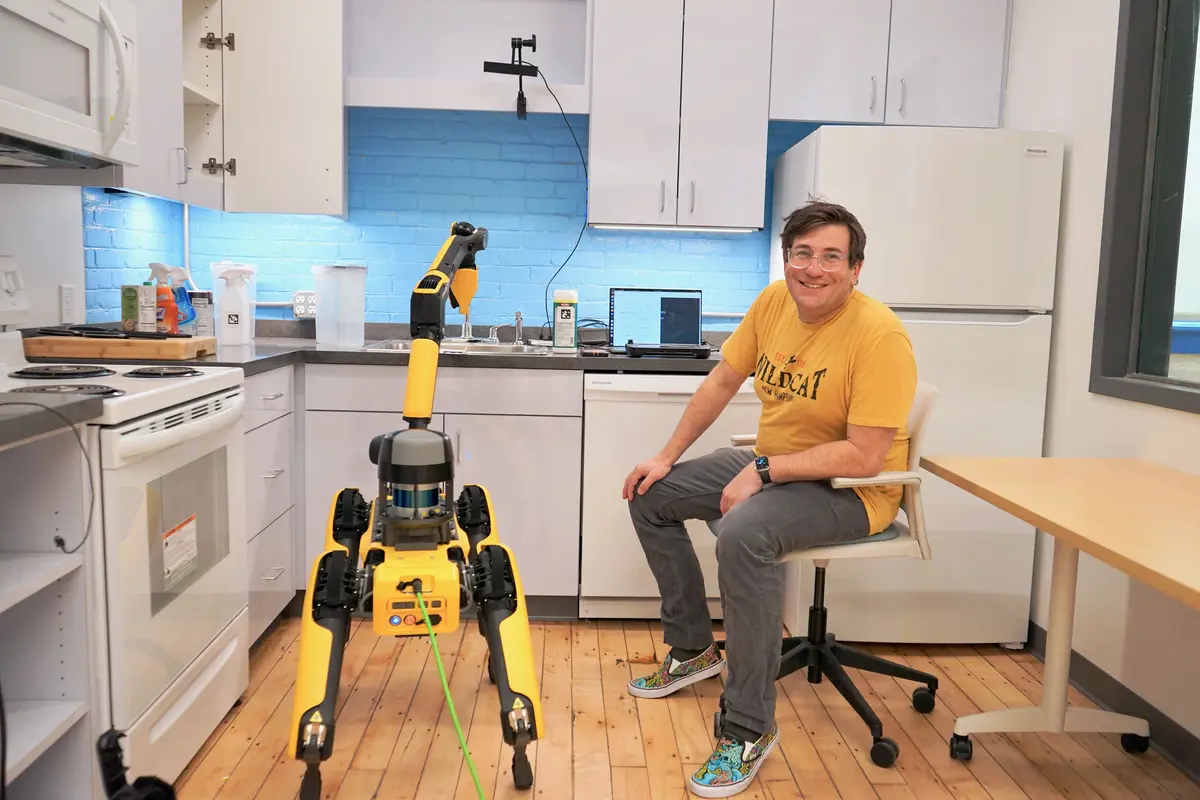
Long before he was studying trust between humans and robots, electrical engineering Ph.D. student Russ Perkins ’18, ’20 was making decisions where trust carried much higher stakes.
As an Army infantry officer, Perkins led soldiers during combat deployments to Iraq and Afghanistan, where confidence in fellow soldiers and the equipment they depended upon was essential to every mission.
Today, Perkins is exploring similar questions as part of the Artificial Intelligence Institute for Collaborative Assistance and Responsive Interaction for Networked Groups (AI-CARING), a National Science Foundation-funded institute developing AI technologies to help older adults live independently longer.
Perkins is researching how robots can better understand and respond to the people who rely on them while earning and maintaining people’s trust.
“If a robot understands its own performance and can observe how a person is reacting, it can estimate whether that person’s trust matches what the robot is actually capable of,” he says.
The goal is to help AI systems recognize when people trust them too much, too little or just enough. A robot assisting an older adult at home, for example, should be able to recognize when someone loses confidence after it makes a mistake while learning or when a person places too much faith in its abilities.
As part of AI-CARING, Perkins collaborates with faculty and students from UMass Lowell and partner institutions including Georgia Tech, Carnegie Mellon University and Northeastern University. The institute is developing AI systems that help older adults safely age in place by assisting with everyday activities while working alongside family members and caregivers.
“It’s going to provide them with a way that they can safely continue to live alone in their house without having to be burdened by expensive extra care,” he says.
Perkins took an unconventional path to AI research in the Francis College of Engineering.
A Massachusetts native, Perkins earned a bachelor’s degree in political science at UMass Amherst in 2004 before joining the Army through ROTC. He served for roughly a decade as an infantry officer, deploying in 2006 to Iraq, where he was shot in the hand during combat. He received a Purple Heart, an Army Commendation Medal with Valor and a Bronze Star before returning to finish the deployment. He later commanded a basic training company at Fort Benning and deployed to Afghanistan with the 10th Mountain Division.
Military service gave Perkins a valuable new perspective.
“What’s important gets kind of reshaped. You’ve dealt with situations that are a little bit more intense,” he says. “It’s a life experience that I would not trade.”
After leaving the Army, Perkins spent five years in medical device sales before deciding he wanted a career that better suited his analytical mindset. Using his GI Bill benefits, he enrolled at UMass Lowell. He admits he knew little about electrical engineering when an advisor suggested it as the quickest path to a degree.
“I said, ‘Great, what’s electrical engineering?’” he says with a laugh.
Perkins soon discovered a passion for signal processing, probability modeling and robotics. After earning bachelor’s and master’s degrees, he joined the research lab of Electrical and Computer Engineering Associate Professor Paul Robinette, where his interest shifted from the mathematics behind robotics to the people who use the technology. That curiosity eventually led him to study trust between humans and AI systems.
Although AI-CARING focuses on helping older adults, Perkins sees broader applications for his work. He recently collaborated on research exploring how AI could assist military personnel making battlefield medical evacuation decisions, and he believes understanding trust will become increasingly important as autonomous systems become more integrated into military operations.
After defending his dissertation, Perkins hopes to continue researching the relationship between people and intelligent machines in either academia or industry.
It’s a future he never imagined as a political science major at UMass Amherst or an Army officer expecting to spend a career in uniform.
Instead, he found a new mission at UML.
“UMass Lowell has been life-changing,” he says.