
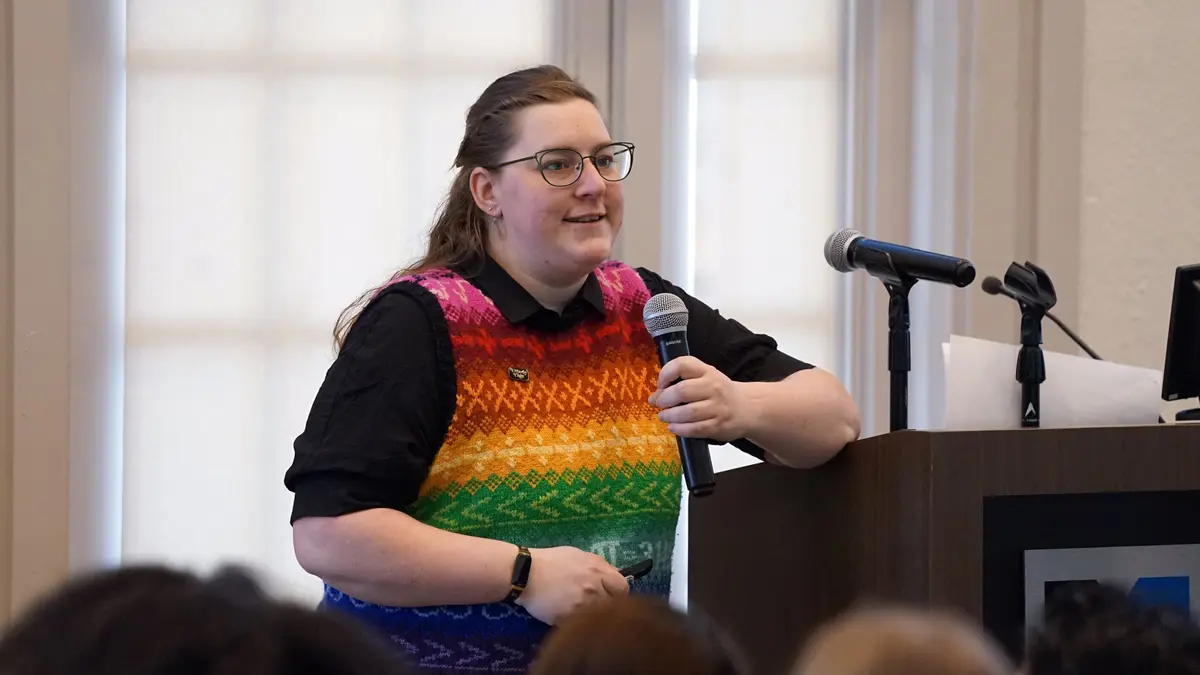
Year of Graduation: ’25, ’26
Major: Mathematics
Activities: UTeach, math learning assistant and math teaching assistant
Why UMass Lowell? “The UTeach and 4+1 programs let me pursue my love for math and teaching, and to get a master’s degree more quickly and without uprooting myself again.”
Visitors to the office of math department teaching assistant Molly Chase are greeted with a colorful, quilted Mobius strip, a twisted shape with a continuous surface. They are also welcomed with Chase’s belief that every motivated student can succeed in math.
The office decoration is just one example of how the graduate student knits together her love for mathematics with her love for fiber arts such as felting, embroidery, knitting, quilting and crochet. The welcoming belief is the result of her own winding journey to becoming a mathematics graduate student at UML.
“I always loved math,” Chase says. “I was always good at math. But I was intimidated by the thought of a math degree. I didn’t think I was smart enough.”
She first went to college as a creative writing major. When she experienced burnout in that program, she pursued her love of fiber arts on an alpaca farm in Vermont. Ill health brought Chase home to Massachusetts. She found herself looking for work during the pandemic. Meanwhile, friends of her parents were looking for a math tutor for their high school-age children.
Even though she hadn’t attended a math class in six years, Chase jumped right in. Her students succeeded, and she realized that she was succeeding, too. She went back to school with the goal of teaching math, starting slowly because of her health. She began her studies at Southern New Hampshire University and continued at Northern Essex Community College before transferring to UMass Lowell. The university’s 4+1 program, which would allow her to earn a master’s degree in just one additional year, made UML an easy choice.
As an undergrad, Chase participated in the UTeach program, a STEM teaching minor in which she found mentoring while gaining classroom experience at local schools. She also developed her teaching skills as a learning assistant, helping with undergraduate math classes. The experiences confirmed her dedication to teaching. Now as a teaching assistant, Chase teaches pre-calculus I for science students, including teaching future engineers who will rely heavily on calculus in their major.
“I love teaching college students,” she says.
Chase saw how math and knitting are entwined when she was first advancing her knitting skills in an eighth grade after-school club. Today, for example, she uses math to resize sweaters from existing patterns and to properly size the whimsical clothing she creates for the frog figures that she also knits.
When it came time to begin her UML senior project, Chase knew who she wanted as her advisor: Mathematics and Statistics Assistant Professor Amanda Redlich, who sometimes knits while waiting for students to complete problems in class.
Wanting to combine knitting and mathematics, Chase chose a project using Diophantine equations. First developed by Diophantus in ancient Greece, they are equations that have only whole number solutions. She used these equations to create a sweater that has only whole symbols or, as knitters say, “motifs” in repeating patterns. A fractional answer to the equation would indicate that the design would be cut off by a seam.
“I used math symbols, but I could have knit any image in this way: bunny rabbits, toy trains, any two-color bit pattern,” she says.
At UML’s International Day of Women and Girls in STEM celebration, Chase showed over 100 visiting high school students how she made the sweater. She explained to the students that math is part of just about any activity they enjoy, and that at UML, they can combine their interests with their coursework, just as she did.
Advice to new students:

“You are at the university because you are smart. If you are struggling with the material, that's because it's hard. There are resources all over school to help you get through that struggle. Come to office hours, go to tutoring or study together with friends. Let's unpack it together.”