
 Image by Ed Brennen
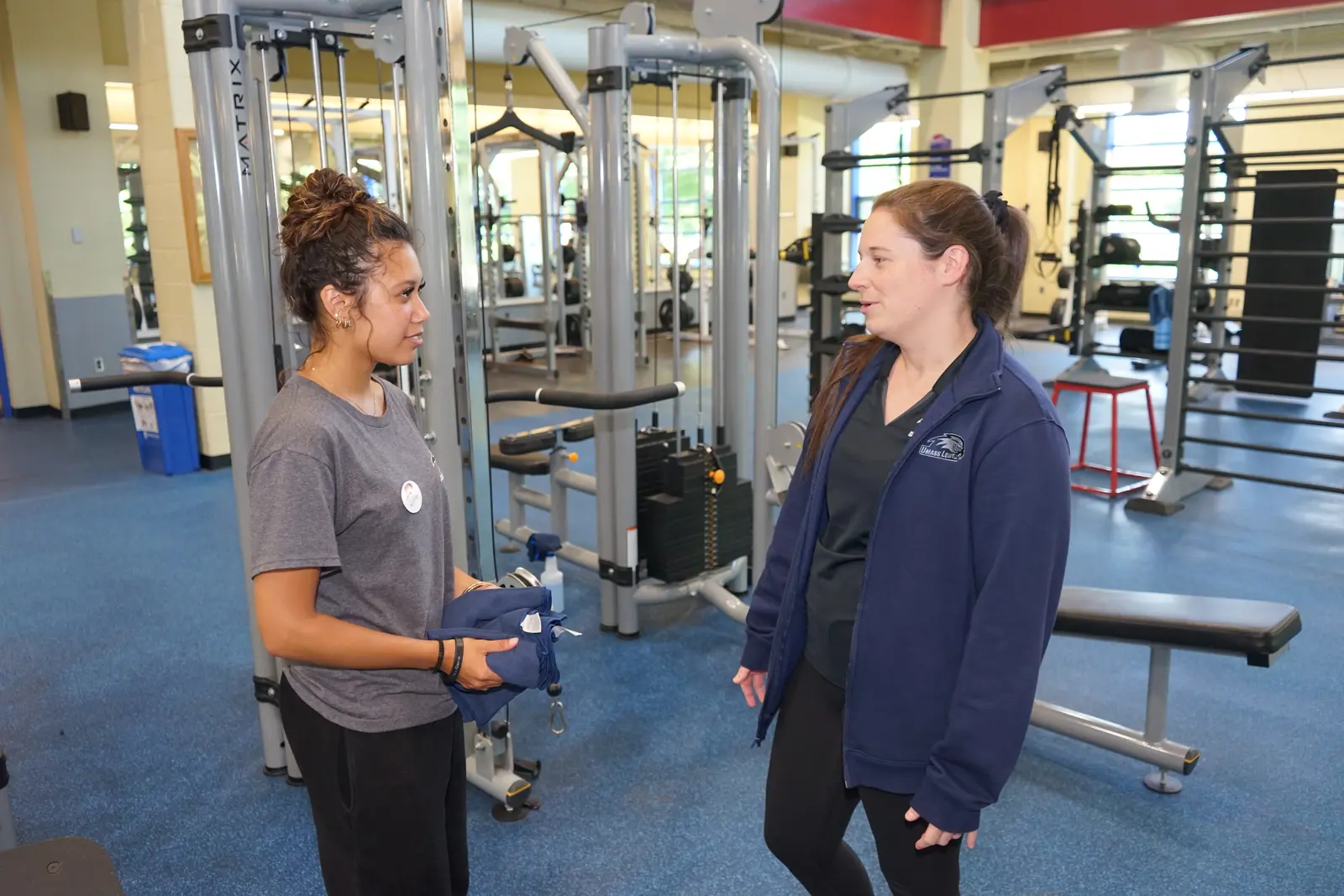
 Assistant Director of Recreation Center Operations Olivia Marshall, right, chats with student employee Audrina Soto, who took part in the UML GROW® pilot program last year.
Student employment plays a significant role in campus life at UMass Lowell. Last year, more than 2,300 students found campus jobs through JobHawk.
For mechanical engineering major Kat Chanthavong, working 10 hours a week at the Asian American Center for Excellence and Engagement (AACEE) during her sophomore year was an opportunity to become more connected to campus while earning a paycheck.
Chanthavong organized programs, led a weekly women’s group and served as one of the student coordinators for the annual Asian American Leadership Conference. Those experiences strengthened her communication, teamwork and leadership skills while complementing what she’s learning in the classroom.
“Being in engineering, you have to work with a lot of different people,” Chanthavong says. “Working at AACEE has really helped prepare me for that.”
Helping students recognize connections like that is the goal of UML GROW® (Guided Reflection on Work), a professional development initiative piloted during the 2025-26 academic year. Modeled after the University of Iowa’s GROW® program, it gives supervisors four reflection questions that encourage students to think about what they're learning on the job, how those experiences connect to their coursework and how the skills they’re developing can serve them after graduation.
Senior Student Employment Coordinator Juliana Gildea partnered with Candice Garabedian, associate director of student employment in the Career and Co-op Center, to pilot UML GROW®.
“We wanted student employment to be more than just a way for students to earn a paycheck between their classes,” Gildea says. “We wanted students to know that by working on campus, they can build valuable skills and graduate with a résumé they can be really proud of.”
Following a successful pilot involving 20 supervisors, the initiative will expand this fall to supervisors across campus who want to participate.
For Assistant Director of Recreation Center Operations Olivia Marshall, the framework gave structure to conversations she was already having with approximately 40 of her student employees.
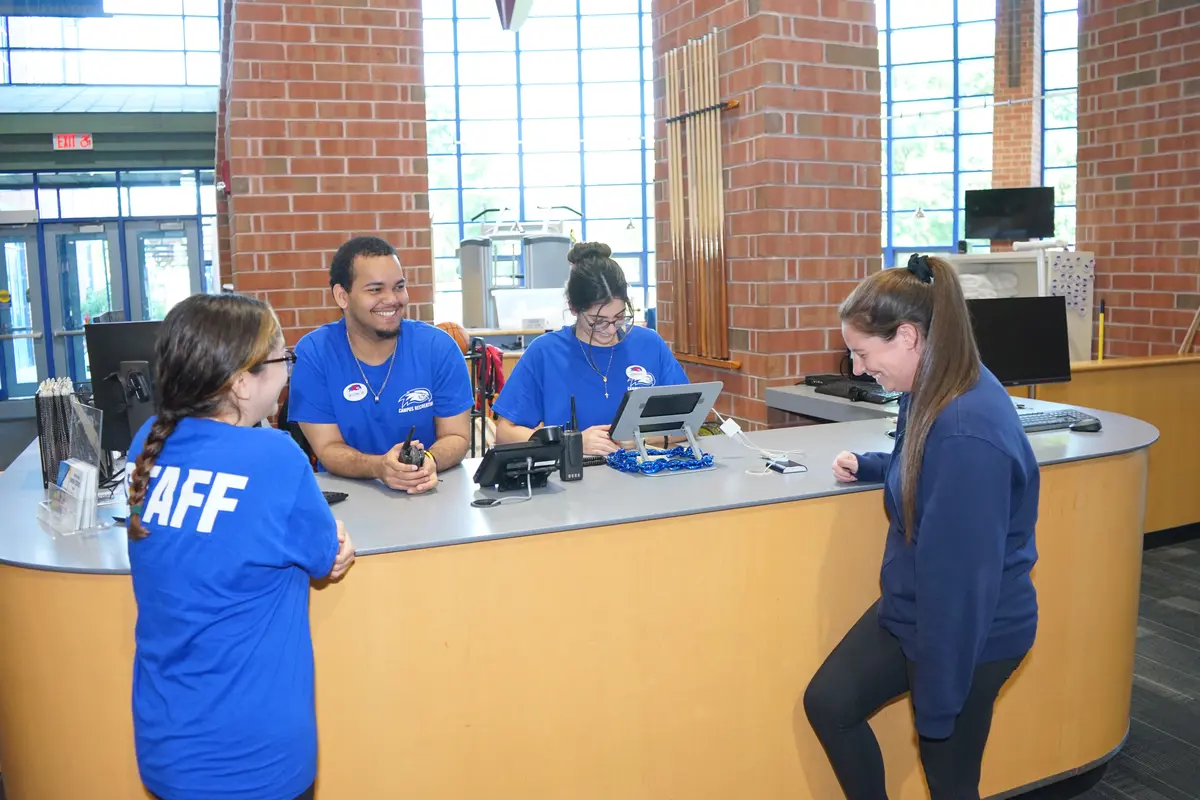 Image by Ed Brennen
 Electrical engineering major Yomil Reyes, second from left, says he's been able to improve his English and public speaking skills through his work at the Campus Recreation Center.
One of those conversations changed how Marshall viewed Campus Recreation Center student employee Yomil Reyes, a sophomore electrical engineering major from Lawrence.
When Reyes shared that he wanted to improve his English and public speaking skills, Marshall found opportunities for him to lead tours for prospective students. Less than a year after starting at Campus Rec, Reyes is now one of the department’s student supervisors.
“English is not my first language, so when I first started here, I was afraid to use my English. But now I'm more confident about it. I can just talk to people normally,” says Reyes, who has also gained customer service and time-management skills, earned CPR certification and learned how to supervise other student employees.
“You can learn from any situation,” he says.
Fellow Campus Rec student employee Audrina Soto says interacting with students and visitors every day has helped her become more outgoing.
“I was really shy before I had this job. Once I actually experienced interacting with people, it helped me get out of my bubble,” says Soto, a sophomore business major from Methuen.
Director of Student Affairs Adam Dunbar oversees up to 80 student employees at the Meehan Student Center. He says GROW® has helped supervisors think less about the tasks students perform and more about the skills they’re developing.
“They think they’re answering questions at a desk or setting up tables,” Dunbar says. “But they’re also learning customer service, troubleshooting, problem-solving and leadership.”
At AACEE, Program Coordinator Satyak Som found that the GROW® conversations encouraged students to think more intentionally about how their campus jobs complemented their academic experiences.
“They don’t think about it until you ask them,” Som says.
That was certainly true for Chanthavong. What began as a way to become more involved at UML evolved into an experience that sharpened the communication and leadership skills she’ll need in the future.
“I think the work that I’ve done will definitely translate to my engineering career,” she says. “I'm grateful for the experience.”