
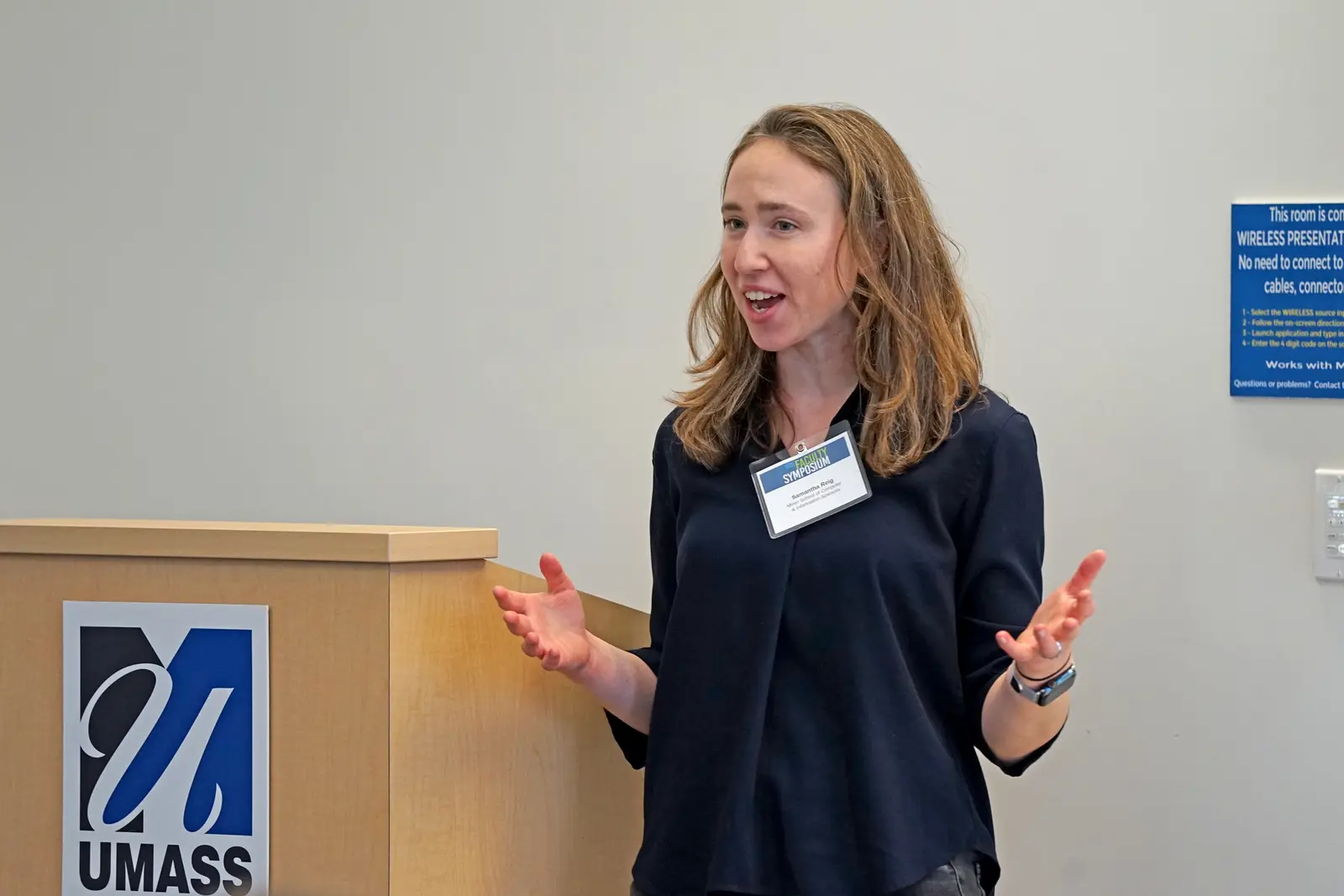
 Image by Brooke Coupal
 Assistant Professor Samantha Reig is researching how robots and AI can be designed to achieve for the best possible interactions with humans.
Samantha Reig, an assistant professor in the Miner School of Computer and Information Sciences, has been a researcher in the AI-CARING (Artificial Intelligence Institute for Collaborative Assistance and Responsive Interaction for Networked Groups) program since her Ph.D. studies at Carnegie Mellon University.
Funded by a $20 million National Science Foundation grant, the initiative is exploring how AI can be used to help care for older adults, especially those with mild cognitive impairment. It brings together researchers from seven universities: Georgia Tech, Carnegie Mellon University, Oregon State University, Oregon Health and Science University, the University of Texas at San Antonio, Northeastern University and UMass Lowell. Google and Amazon are its industry sponsors.
In her role in the project, Reig is focused on how older adults use language to interact with robots.
While AI-CARING will wind down in September, Reig has other projects ramping up. In June, she received a $15,000 UMass Lowell Internal Seed Grant that will kick-start her research into the social impacts of AI writing tools on students and workers, in collaboration with Associate Professor Jose-Mauricio Galli Geleilate of the Manning School of Business.
Of her work, Reig says, “We’re looking at not just what happens when we build robots and AI and how we should build them, but what happens when they are put out into the world. How can we design them for the best experience and impact?”
She sat down to share the unexpected path she took to this field and what she has discovered about people’s interactions with robots and AI.
What is your role in AI-CARING?
I'm a member of a team that spans seven institutions. The institute’s mission is to create artificial intelligence technologies that support older adults, and in particular to support people who are dealing with cognitive changes that can come with aging.
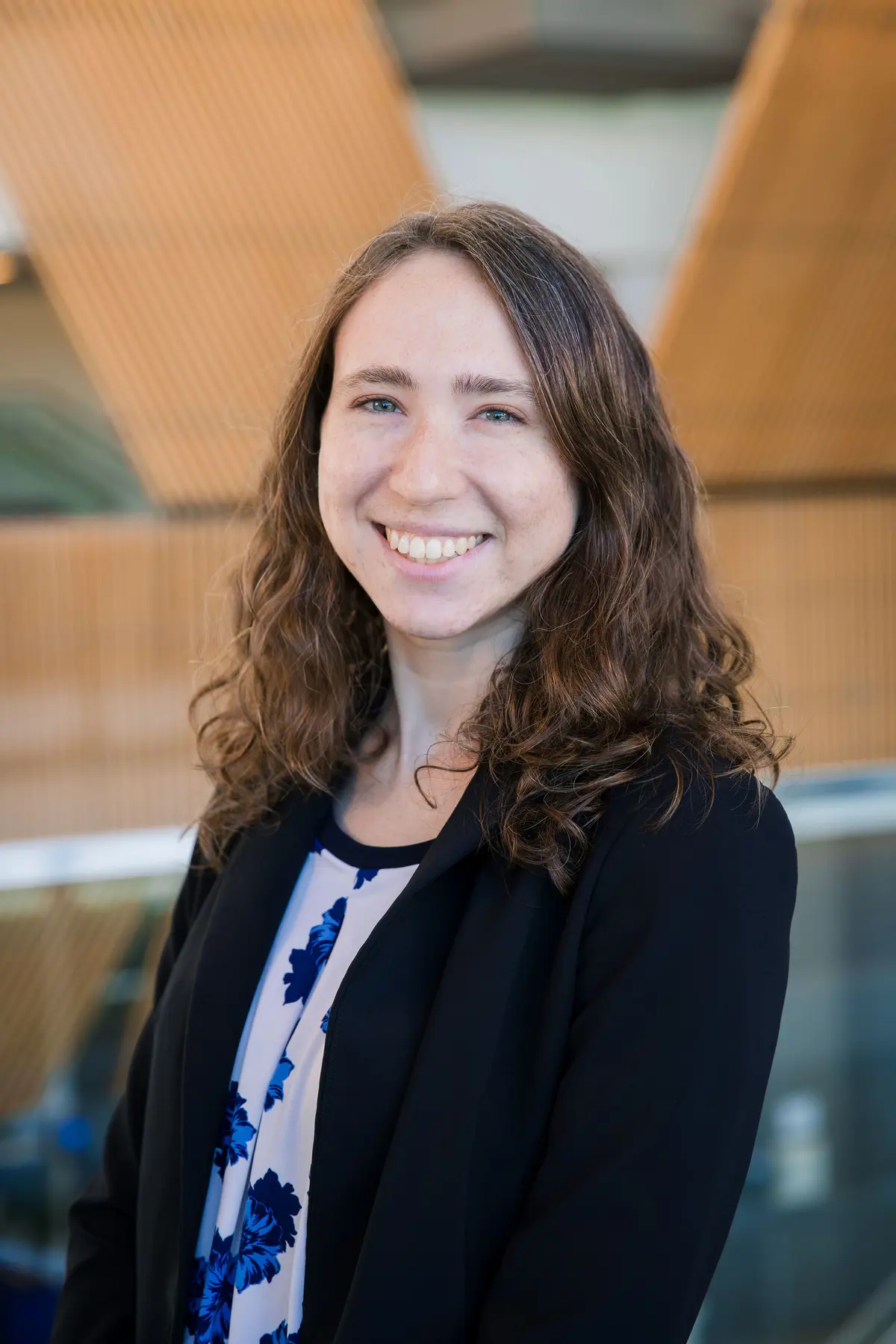
In addition to her AI-CARING work, Assistant Professor Samantha Reig has received a UML Internal Seed Grant to study the social impacts of AI writing tools on students and workers.
Do they say, “Bring me a cup of coffee with two milks and one sugar?” Or do they say, “It’s cold and I’m thirsty,” and expect the robot to infer that, because it’s 9 a.m., it should bring them a coffee?
We’ve only just started looking into this, but we're starting to see that there might be some predictable individual and generational differences in how much detail people provide in their requests.
You were also recently awarded a 2026 UMass Lowell Internal Seed Grant. Can you tell us about the project that the grant is funding?
The story behind this project is that I became an instructor and a faculty member at the exact right time to watch the effects of the AI boom on education happen in real time. I had a lot of questions, just like everybody else, about how tools like ChatGPT and Claude can support learning by giving a little help without doing the work. Can we add constraints – for example, asking AI to act like a mentor – into an interface so that AI is supporting students’ narrative voices, but not doing the thinking?
We’re also looking into how people perceive each other's use of AI when they're working together. We don't yet have norms around how people talk about their use of AI to collaborators. Might using constraints on AI help people see their peers as more competent and trustworthy?
Ideally, we want every new tool that's used among collaborators to be good for humanity and also support good team dynamics and good peer perceptions.
Caring for older adults and student writing are two very different topics. What do they have in common for you?
These are definitely different branches of my work, but they stem from the same vision, which is figuring out how AI and robots can fill gaps in day-to-day life without going beyond what’s needed. Across these projects, I’m trying to figure out what makes emerging technologies understandable and useful for everyday users, and what kinds of AI guardrails will help us live and work better rather than making things worse.
Studying how humans interact with robots and AI is a new and specific field of computer science. As a computer science professor, how did you get here?
I actually came to computer science by way of psychology. Halfway through freshman year (at Cornell University), I took Computer Science 101 because it fit in my schedule. And I just loved it. I added a major in information science to my psychology major.
As a continuation of a class project, I started doing research with a professor who was looking at team interactions with telepresence robots. It’s how I learned there is a field called “human-computer interaction” and that I loved the research process.
When I was in grad school, my grandmother’s senior center got this little robot dog. My grandmother, who had some lifelong cognitive disabilities, was happy living alone in an apartment near our family and never used a computer or smartphone. She loved the dog so much they let her take it home. Watching her interact with it and tell stories about it to her friends back at the center made me passionate about understanding the diverse ways that different people relate to robots and about designing them to support the expectations and experiences of all different kinds of users. That’s what’s underpinning the various threads I’m exploring now in my faculty career.
What other research is ahead for you?
In an AI-CARING study, we saw that a lot of interactions between older adults and younger relatives around technology are about troubleshooting and informal tech support.
Recently, my student Haritha Malladi began to poke at that a little more. Are there difficulties in those interactions that AI and robots could help with? Maybe they can help translate jargon, or mediate if emotions run high. As we’re interviewing people, we’re coming up with ideas for agents that might help without reducing agency or intruding in situations where people don’t want them to be involved. It’s been a meaningful project.