
Topics: Research Sciences Faculty & Staff
 Image by Sandi Gubin
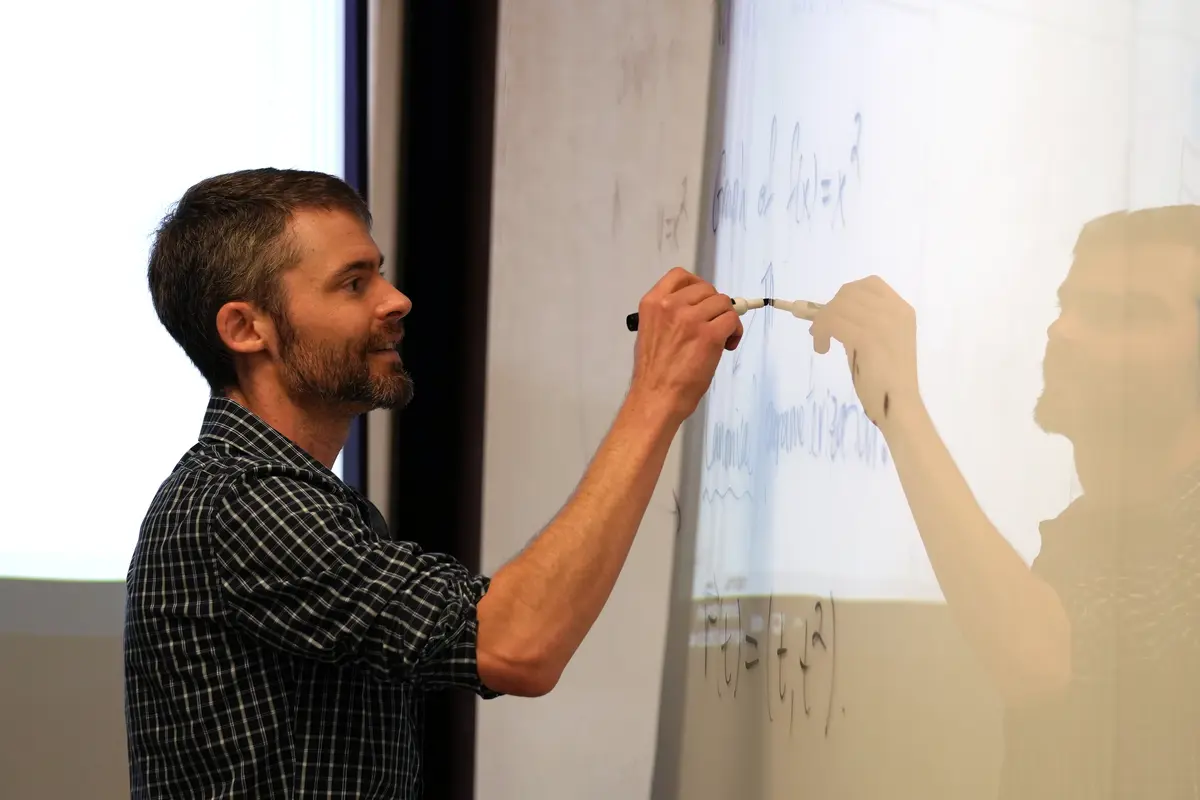
 Mathematics Professor James Propp is the first at UMass Lowell to win a prestigious Radcliffe Institute Fellowship.
Mathematics Professor James Propp is the first UMass Lowell faculty member to win a prestigious yearlong research fellowship at the Radcliffe Institute for Advanced Study at Harvard University.
Propp says that twice, he applied for the fellowship when he had a sabbatical year coming up. But after his second rejection, he calculated that if he only applied once every eight years, the probability that he would win one of the fellowships was low to none. So he began applying every year.
Those odds paid off when he was selected to spend the 2026-27 year in Cambridge, pursuing his own research and exchanging ideas with dozens of other fellowship winners. Propp is excited by the chances for collaboration – and fascinating conversations over lunches in Harvard Square.
“This gives me a chance to be around some amazing people,” he says, adding modestly, “Every time I was denied the fellowship and I saw who got one, I thought, ‘Yeah, I’d probably make the same call.’”
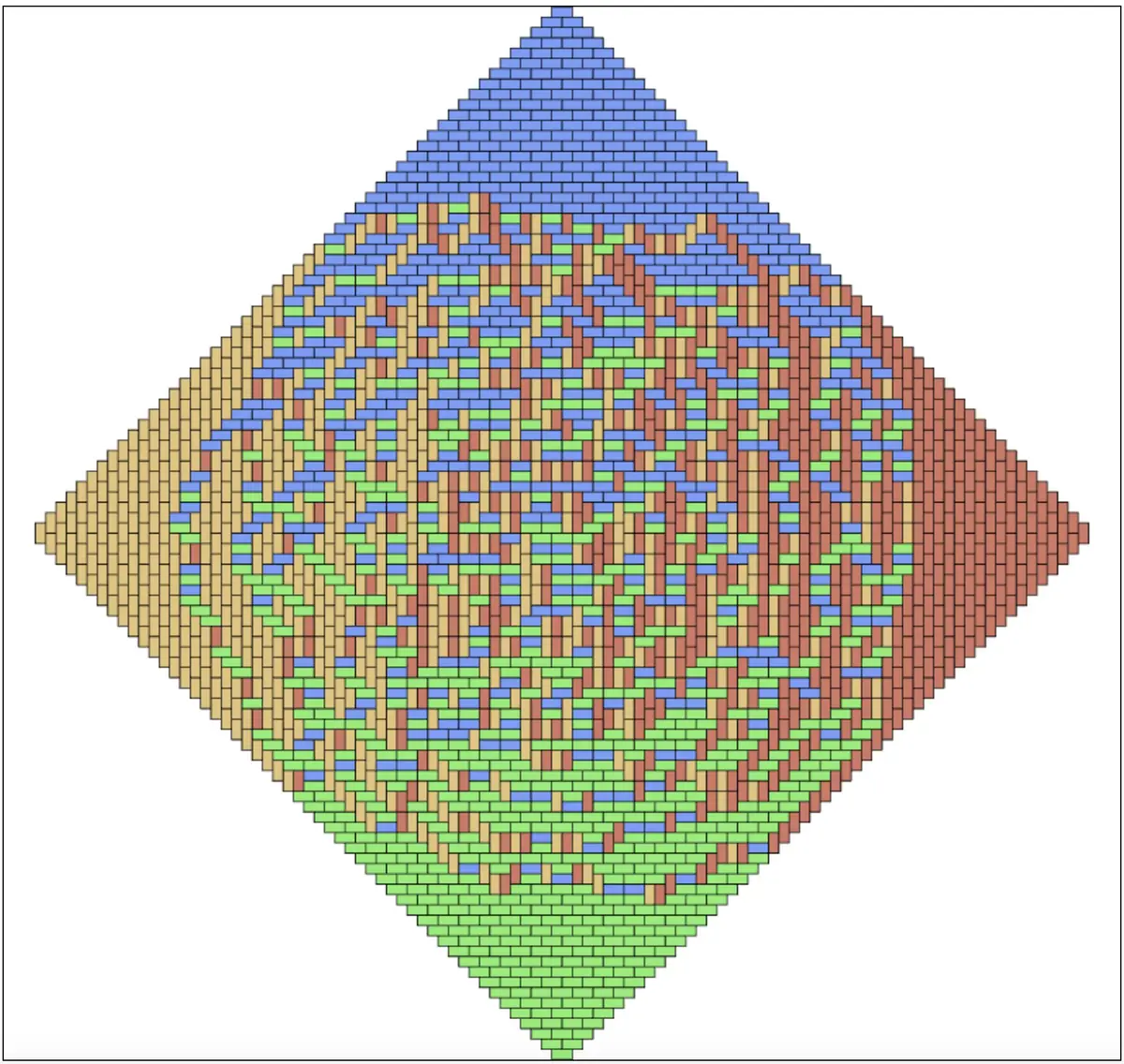 Image by Courtesy
 An Aztec diamond randomly tiled with "dimers" reveals a roughly circular boundary between randomness and order.
Propp’s plan is to expand his research into “tiling,” or covering a plane with repeated geometric shapes, with no gaps and no overlaps. It’s a highly theoretical branch of mathematics that takes its inspiration from physics and chemistry and could have implications for those fields as well, he says.
“My general philosophy of studying math is to see what really smart people have found and that not a lot of people have followed up on, and see what else is there,” he says.
Propp will be collaborating with Colin Defant, a postdoctoral fellow at Harvard, and Hanna Mularczyk, a graduate student at MIT, as well as other mathematicians he’s worked with previously over Zoom.
“My favorite kind of math is to get a bunch of people together and say, ‘Here’s what I did last week,’ and they say, ‘Here’s what I did last week,’” he says. “We’ll be thinking together, writing together and writing some code.”
Earlier in his career, Propp published a paper on tiling a shape known as an Aztec diamond – a squared diamond with stepped edges – with “dimers”: two squares stuck together to form a domino shape, with one square designated “positive” and the other “negative.”
Propp then assigns one of four colors to each dimer, depending on whether that dimer’s orientation is horizontal or vertical and whether the “positive” half is up or down, right or left. In tiling an Aztec diamond with these dimers, there is one rule: the positive square within each dimer can only be surrounded by negative squares and vice versa, like a checkerboard.
Propp and his colleagues found that if you tile an Aztec diamond randomly with these dimers following the checkerboard rule, a surprising type of organization emerges: a roughly circular boundary between a random mix of the four colors in the middle and a dominant solid color in each of the Aztec diamond’s four corners.
“For 99.99% of the tilings that you generate, you’ll see something close to a circle,” Propp says. “And the bigger you make this region (the Aztec diamond), the closer it comes to a perfect circle.”
That’s because once you place a dimer with a particular orientation along an edge of the Aztec diamond, other dimers along the edge are forced to share the same orientation, he says.
“You don’t have a lot of freedom near the edge, because the choices implicate other choices,” Propp says.
Of the circular boundary between the single colors that fill the corners and the disordered center, he says, “We often think of randomness and order as opposites. Yet in many systems, randomness itself generates striking patterns.”
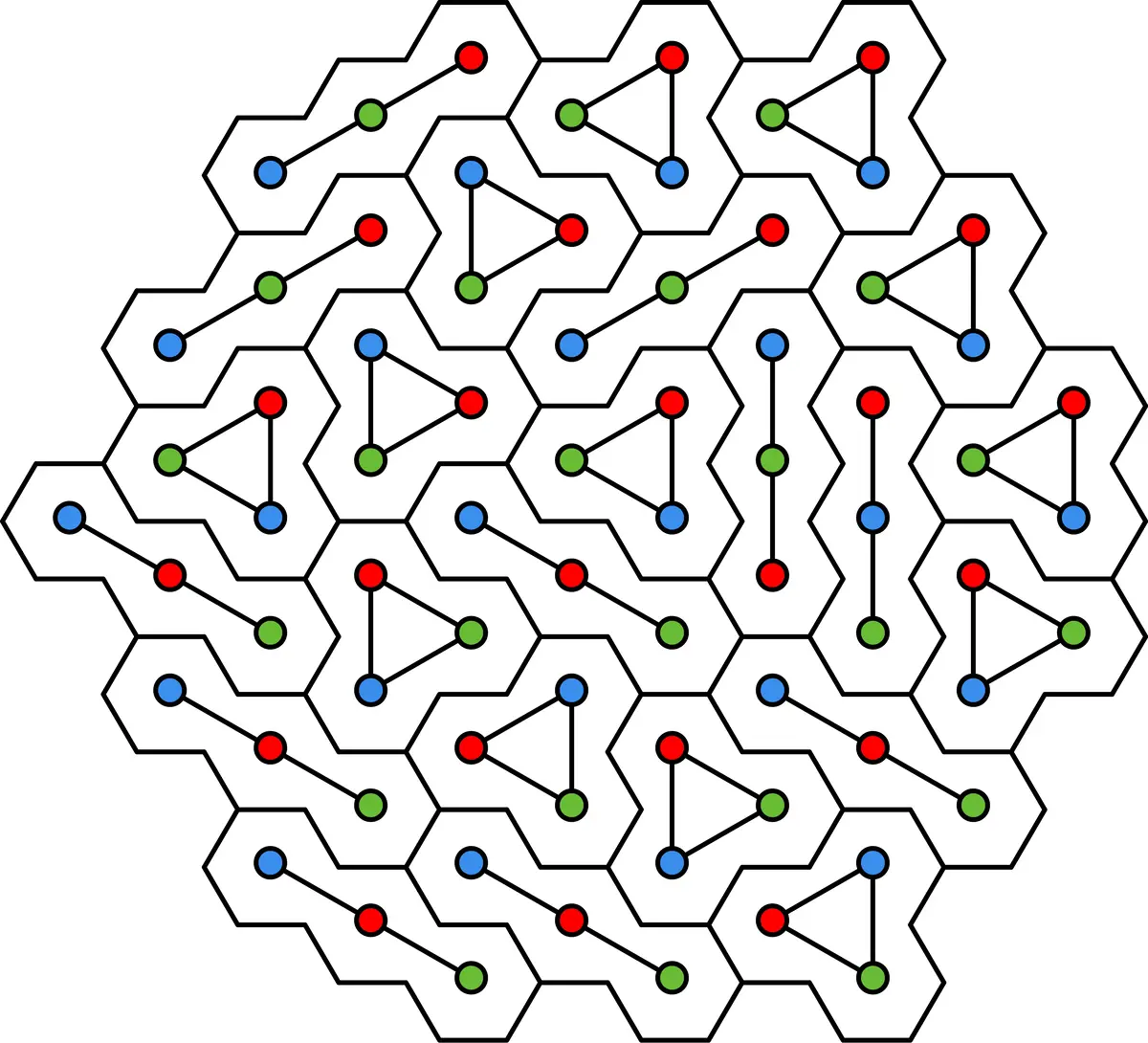 Image by Courtesy
 A benzel tiled with trimers made up of hexagons that Propp has dubbed "stones" -- clusters -- and "bones" -- straight lines.
Several years ago, Propp began looking at tilings involving “trimers,” shapes made up of three hexagons that are connected either in a cluster or a straight line – which he’s dubbed “stones” and “bones,” respectively – and what forms of order might emerge when they are used to randomly tile a region of a plane shaped as a “benzel.” That is the research he will pursue at the Radcliffe Institute as the William and Flora Hewlett Foundation Fellow.
“The work will be highly visual and computational, using pictures and simulations to probe mathematical reality,” Propp says.
While computers are an important tool in Propp’s research, they can’t simulate or comprehend an infinite plane that is tiled. Humans are much better at that, he says.
“Stones and bones are this enjoyable frustration. They’re one finite piece of an infinite puzzle,” he says. “You can’t just do a computer run that goes to infinity; you have to really understand what’s going on. That’s where computers aren’t very good.”