
 Image by Brooke Coupal
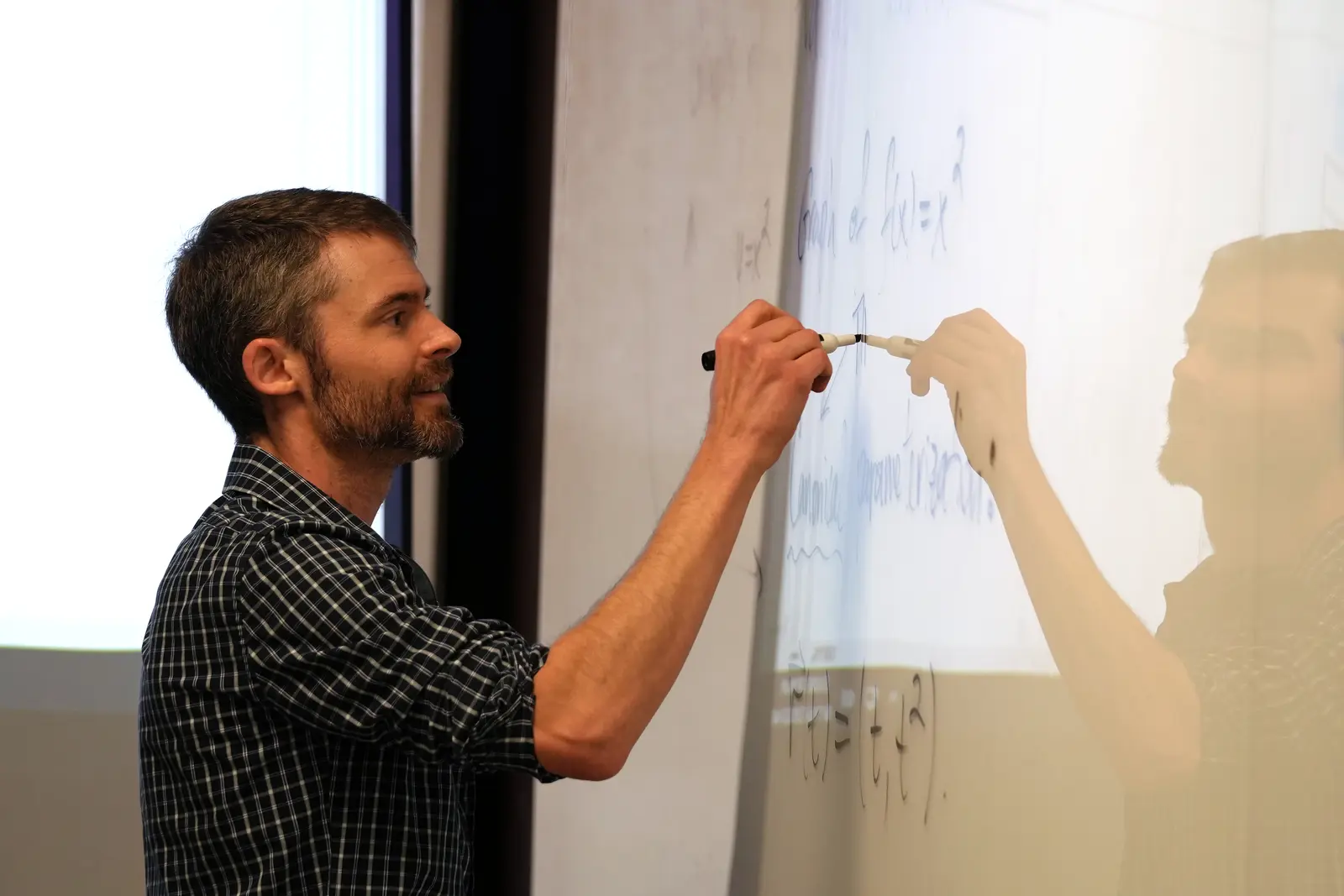
 Daniel Glasscock, an assistant professor of mathematics and statistics, tapped two undergraduate students to verify his research results using the Lean programming language.
Daniel Glasscock, an assistant professor of mathematics and statistics in the Kennedy College of Sciences, has been interested by Ramsey theory since his master’s degree studies at Central European University in Budapest, Hungary.
In 2024, he was awarded a prestigious National Science Foundation (NSF) LEAPS (Launching Early-Career Academic Pathways) grant to do research in a particular branch of Ramsey theory, a field of mathematics based on the idea that any mathematical structure that is large enough will have organized substructures within it. Glasscock is now in the final months of that two-year project.
While the project has been a success mathematically, with Glasscock developing new tools for working on Ramsey theory, the most surprising outcome for him has been discovering how undergraduate students can be true collaborators in difficult and entirely theoretical mathematical research.
Glasscock sat down to share how his Ramsey theory research led to this unexpected outcome.
You received an NSF grant to study Ramsey theory. What is that?
Ramsey theory is a field of math that is interested in the persistence of patterns. The general theme is that if you have a very large structure, regardless of how it’s organized, there have to be certain patterns present in it. One of the problems I worked on looked at the existence of three-term geometric progressions in sets where — at least so far — we only know of additive patterns existing. A geometric progression is one of the simplest multiplicative patterns: The first number is multiplied over and over by the same constant to obtain the next numbers. I was looking for this pattern in special sets that arise in theoretical math and physics.
Ramsey theory is sometimes called “pure mathematics.” I don't like the word “pure.” “Pure” has a moral connotation. I think “theoretical” is a better word. In this work, I'm not building widgets.
How are undergraduate researchers involved in the project?
When I set about looking for some undergraduates to bring in on this project, I wasn't sure how to involve them. I thought maybe I could have them help me develop the math. I was struggling with that for a long time, because one year is not enough time to get into the serious details. Like, how the heck are we going to do this? Then I thought they could help me with a particular computer program. I am excited and proud to say that I found something amazing for us to do together.
I hired two students, Lauren Detmold (’27, math and computer science), and Angelina Blahodatna (’28, computer science), who have computer science backgrounds, but know a bunch of math as well. The three of us decided that we would learn Lean. Lean is a computer programming language and a proof assistant. With the help of a growing math library, it can irrefutably check mathematical proofs for correctness.
These students are much better than I am at computer programming. When we go over the math that we would like to verify, they translate the math into this programming language to verify the results. While they are not coming up with the math, they are tied to the project in an important way, by verifying the results.
The immediate goals for my work with the students are to publish some papers that we are working on now. We also plan to present the results at a conference. There's some travel money in the grant for that.
What does getting this grant mean to you as a researcher?
It is absolutely remarkable that we live in a time and a place where money can be put behind theoretical endeavors. I’m grateful that there is funding to have students join me on this project, but the fact that the project could even be funded in the first place when I'm not building widgets remains to me an incredible thing.
This project has really benefited bringing on these undergraduates. It's given me a new perspective on applying for grants that would specifically bring in students. A lot of our students at UML are working jobs in addition to going to school. Because of the grant, I'm able to provide a stipend for my students, including a stipend over the summer. I think that allowed me to attract students who might not otherwise be able to take advantage of this opportunity.
Through this grant, I’m also running a two-week-long crash course in May, after the spring semester. I’m going to share what we learned about Lean and how we’ve integrated the Ramsey theory into it. The grant funding means I’ll be able to provide lunch and a small stipend for the participants.
What about this project surprised you?
I'm pleasantly surprised by how much these students will contribute to the project because they're also helping me learn Lean. This project is a great example of what can happen when students collaborate in research. Without these students joining this endeavor, I'm sure I would not have gone in this direction. It's been such a pleasure working with them and, through the grant, I'm looking forward to continuing working with them through the summer.
What’s next for you? Do you have plans for a similar project?
I'm looking forward to the next opportunity like this. I think that this has gone so well. The students have been able to do what I wish I had been able to do as an undergraduate — write a paper and go to a conference to present the paper.
I truly hope that this helps them do whatever they want to do next, because that would be my measure of success for the project: for the students to be able to leverage whatever we do together into the next step for them.