
 Image by Ed Brennen
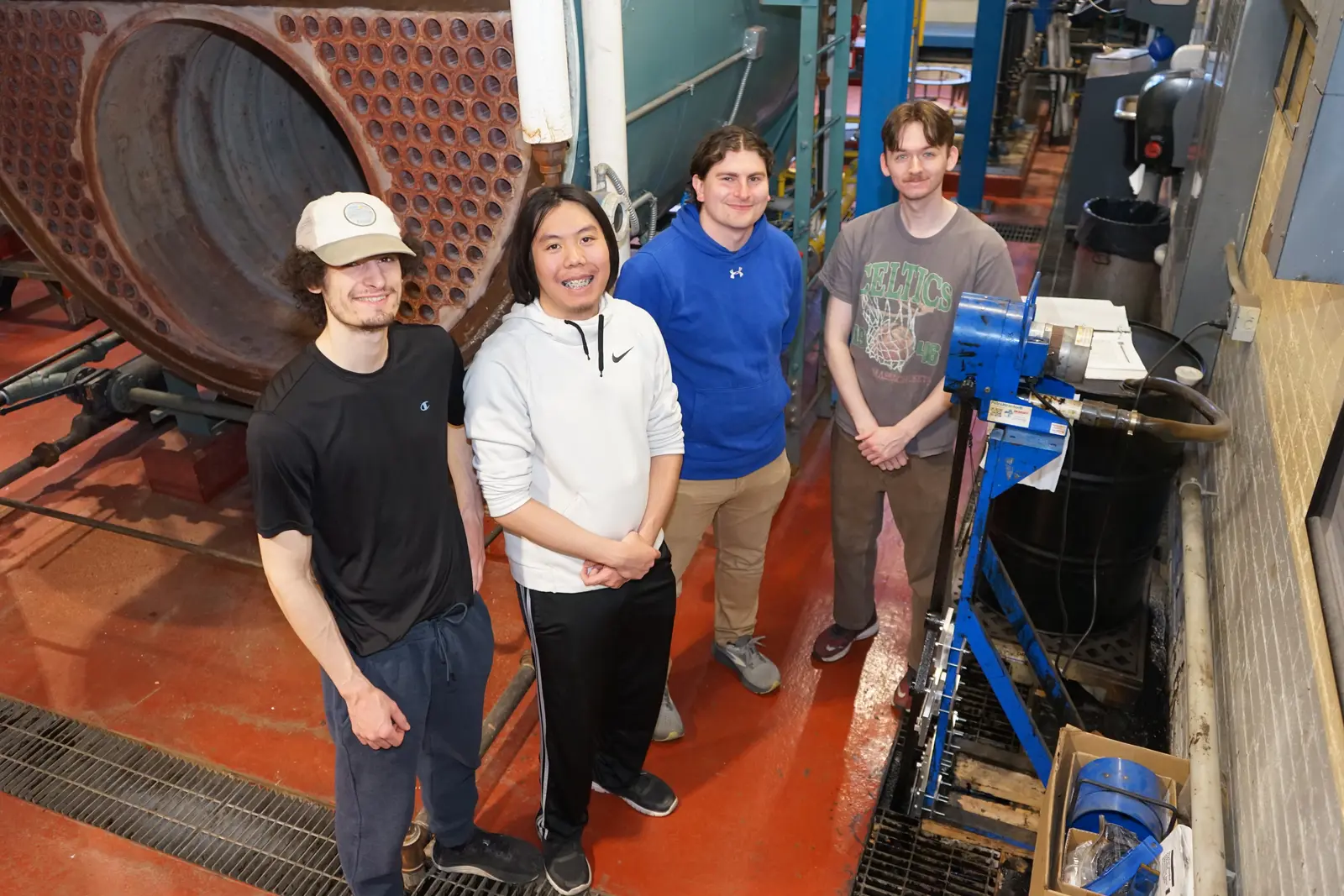
 Senior mechanical engineering majors, from left, Joseph Aumueller, Evan Lin, Jonathan D'Ambrosio and Corey Launsby designed and installed a new and improved oil skimmer for the North Campus power plant.
For years, a piece of equipment in UMass Lowell’s North Campus power plant struggled to do its job reliably. This semester, a team of mechanical engineering majors set out to fix it.
For their industrial capstone senior design project, Joseph Aumueller, Jonathan D’Ambrosio, Corey Launsby and Evan Lin redesigned an oil skimmer used to collect residual fuel oil from a trench system in the plant’s boiler room — a longstanding maintenance issue tied to an older fuel storage system.
“They made it clear this would be a huge help for the university, so it’s nice to feel like we’re leaving our mark before we graduate,” says D’Ambrosio, a Wakefield native with a minor in aerospace studies.
The project began when Facilities Management brought the problem to the Mechanical Engineering Department, looking for a student team to take it on as a capstone project. The skimmer, which uses a rotating belt to separate oil from water, had become unreliable due to the thick, viscous nature of the fuel oil as well as frequent mechanical issues.
“The biggest problem was that the belt would catch or jump and the system would stop working,” says Launsby, an Amesbury native.
The project was one of several capstone options offered to students, but the team was drawn to its real-world application and impact. Aumueller, a Westford native, says the project offered a chance to gain hands-on mechanical experience while helping the university.
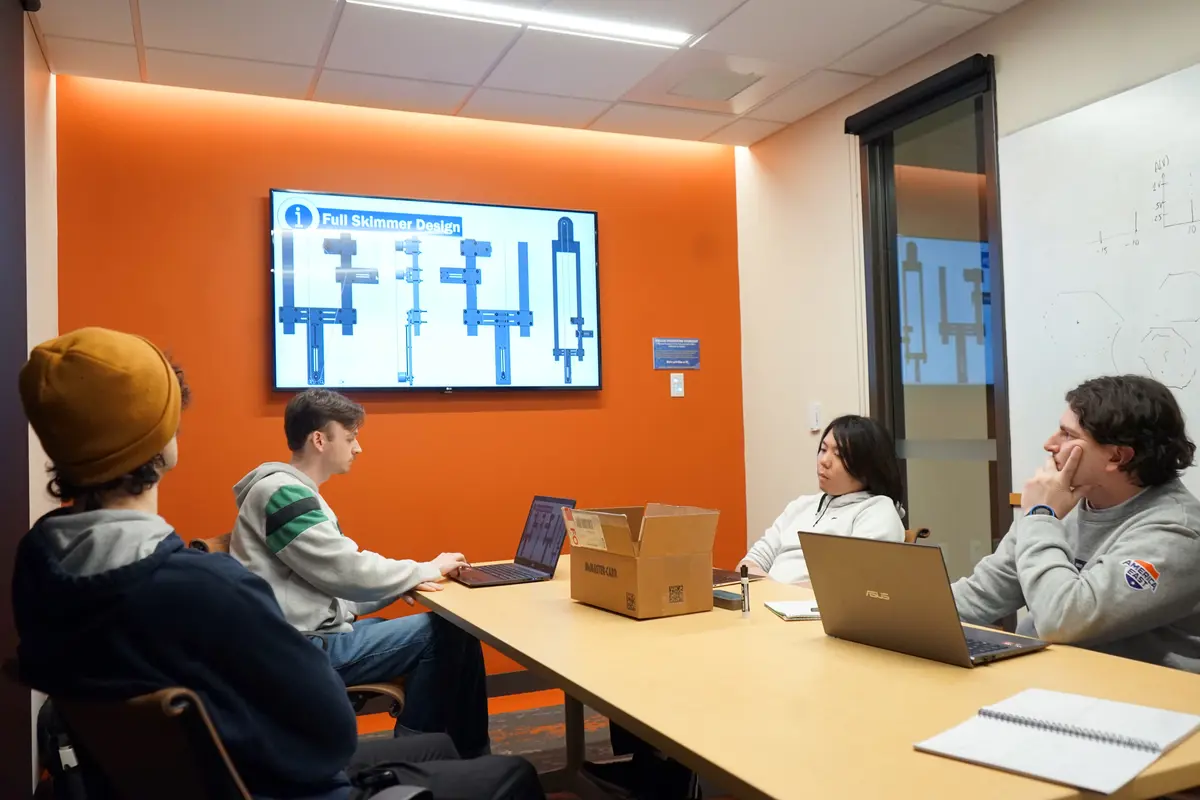 Image by Ed Brennen
 The industrial capstone senior design project team of, from left, Joseph Aumueller, Corey Launsby, Evan Lin and Jonathan D'Ambrosio work on their oil skimmer design during one of their weekly meetings at Dandeneau Hall.
One of the biggest challenges was proving the design would work before installing it.
“A lot of it was theoretical,” D’Ambrosio says. “We had to figure out how to validate what we were doing without being able to fully test it beforehand.”
The team, advised by Research Associate Professor Patrick Drane '00, '03, '24, leaned on both coursework and hands-on experience to guide their approach. D’Ambrosio says the process mirrored what he encountered during a six-month design engineering co-op at Anderson Power.
“It was the same process — design, analysis, then implementation — making sure what you’re doing is going to work before you actually build it,” he says.
After months of design, fabrication and testing, the team installed the updated system in late April. When they turned it on, it ran continuously without the issues that had plagued the previous setup.
“It was a long process, so seeing it actually work was really rewarding,” Launsby says.
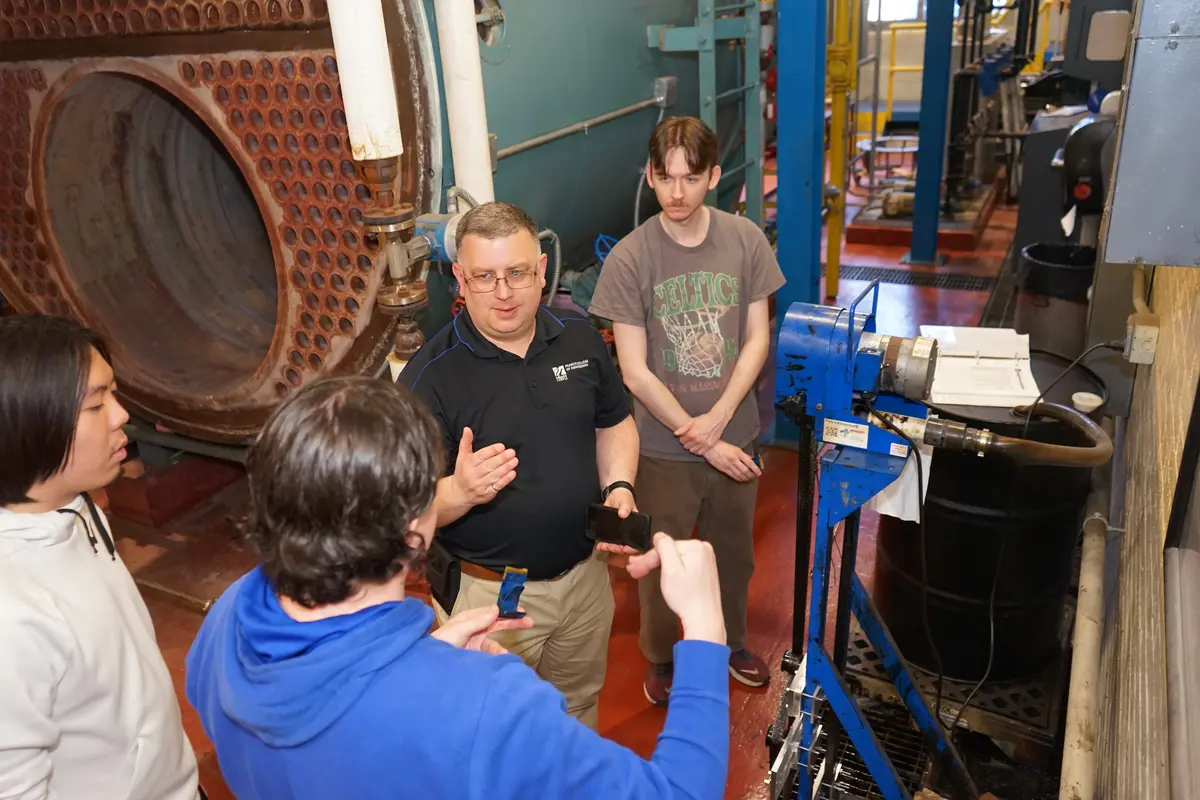 Image by Ed Brennen
 Research Associate Professor Patrick Drane, who advised the capstone team, discusses their oil skimmer after it was installed at the North Campus power plant.
As part of their final capstone presentation, the team detailed the system’s performance and cost. The materials came in at just under $400 — within the course budget — while a full cost analysis, including labor and manufacturing, valued the project at more than $20,000.
Early testing showed the system could steadily collect oil from the trench system, and university staff will continue monitoring its performance over time, with hopes that it will serve as a permanent fix.
For Matt Smith, institution chief power plant engineer, the project reflects a long tradition of collaboration between students and the facility’s staff.
“I’ve worked in this plant for more than 30 years, and when I first started, the chief at the time worked with students on an efficiency study of the old boilers,” Smith says. “Working with students in the field helps prepare them for their careers, and I appreciate what these students have accomplished.”
Joe Dussault ’06, director of mechanical, electrical and plumbing operations for Facilities Management, says the students’ work highlights the value of applying classroom knowledge to real-world challenges.
“I’m inspired by their ingenuity,” Dussault says. “This design isn’t just a technical innovation — it’s a meaningful step toward strengthening campus operations.”