
Into the 1920s, the city’s largest employers were the cotton manufacturing corporations. As extensively documented, during the early years of Lowell’s mills the workforce was composed largely of single, young Yankee women. After the Civil War and until the early 1880s the majority was Irish and native-born New Englanders. Increasingly, French Canadians were settling in Lowell and working in the mills and by the late 1880s they constituted the major part of this workforce. But beginning in the 1880s Lowell became home to many different immigrant populations. By 1910 this included Greeks, Poles, and Portuguese who comprised the fastest growing immigrant communities in the city. The majority of wage-earning immigrants from all nations found work in the cotton factories. This was clearly the case for Portuguese men and women in Back Central. Table 1 below shows the number of immigrants working in the city’s cotton mills in 1920, at which time employment in this industry peaked in Lowell.
Table 1: Employment in Lowell’s Cotton Mills among Select Immigrant Populations, 1920
| Country of Birth | French Canada | Ireland | Greece | England | Poland | Portugal and Atlantic Islands |
|---|---|---|---|---|---|---|
| Total Population | 10,171 | 7,497 | 3,727 | 3,658 | 2,225 | 1,943 |
| Total employed in cotton mills | 1,972 (19.4%) | 969 (12.9%) | 1,791 (48%) | 579 (15.8%) | 965 (43.4%) | 1,000 (51.5%) |
| Females employed in cotton mills | 718 (36.4%) | 498 (51.4%) | 736 (41.1%) | 207 (35.8%) | 423 (43.8%) | 412 (41.2%) |
| Males employed in cotton mills | 1,264 (63.6%) | 471 (48.6%) | 1,055 (58.9%) | 372 (64.2%) | 542 (56.2%) | 588 (58.8%) |
 Image by PADA/Camara Family Collection
 - Total Portuguese Population on Charles Street: 98
- Number of Portuguese Males and Females Employed in Cotton Mills: 70 (71.4%)
- Number of Portuguese Males Employed in Cotton Mills: 37 (52.8%)
- Number of Portuguese Females Employed in Cotton Mills: 33 (47.2%)
- Average Age of Portuguese Males Working in Cotton Mills Average: 32
- Age of Portuguese Females Working in Cotton Mills: 30
- Number of Married Portuguese Males Employed in Cotton Mills: 30 (81%)
- Number of Single Portuguese Males Employed in Cotton Mills: 7 (19%)
- Number of Married Portuguese Females Employed in Cotton Mills: 23 (70%)
- Number of Single Portuguese Females Employed in Cotton Mills: 9 (30%)
- Number of Portuguese Daughters Working in Cotton Mills, Marital Status, and Average Age: 9 (2 married, 7 single), 25.22 years old
- Number of Portuguese Sons Working in Cotton Mills Marital Status, and Average Age: 3 (0 married, 3 single), 18.76 years old
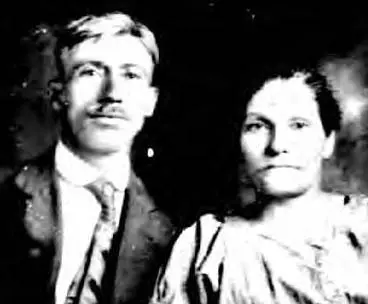
Moving beyond the numbers, the loom fixer, Manuel Nunes Cotta, is an interesting figure for his life reflects the experiences of many of his Azorean compatriots in Back Central. Born in 1872 in the village of Biscoitos on the Island of Terceira, Cotta likely had little formal education. (Although the 1920 census taker recorded that Manuel was literate, he signed a 1921 passport application with an “x,” indicating he could not write.) In 1893, at the age of 21, he departed Terceira for the United States and settled for a few years in Taunton, Massachusetts. He probably worked in the Whittenton Mills, one of the largest cotton mills in this area. In 1897 he married Marianna de Jesus Fagundes, who was 23 years old, a cotton mill worker (probably in the Whittenton), and had also immigrated from Terceira in 1893. Soon after their marriage, however, they moved to Lowell, where a cousin from Biscoitos, Manuel Martins Cotta, lived. They rented a flat in a tenement in Church Street Court, fully occupied by Azoreans and one block north of Charles Street. Manuel and Marianna quickly found jobs in one of Lowell’s large cotton factories, possibly joining Manuel Martins Cotta in the Prescott Mills.
In 1900, while living in this tenement, they had a son, Manuel Nunes Cotta, Jr. He would be their only child. As with many immigrants who rented their residence, the Cotta family moved a number of times during their years in Lowell. But like many other of the city’s Azoreans of their generation, they remained in the Back Central neighborhood. By about 1903 they relocated to another over-crowded tenement, this one in Proctor’s Court, a small, almost exclusively Azorean enclave, only a block from their first apartment in Lowell. That year both Manuel and Marianna received their U.S. citizenship. They continued to live in Proctor’s Court through 1911, with Manuel working in carding room in a cotton factory (quite possibly at the Prescott Mills where his cousin, Manuel Martins Cotta worked). It appears that Marianna had stopped working outside the home, at least temporarily.
A few years later the Cottas moved to Charles Street, renting a flat in a multiple-family dwelling that, although built prior to the Civil War, was very likely in far better condition than the tenements in which they had lived for over a decade. One other change in the Cotta family occurred after their move to Charles Street: Marianna rejoined the workforce finding a job as a weaver in a cotton mill. Over the next several years, their financial status likely improved. Manuel had worked his way up to become a loom fixer, while Marianna continued working as a weaver. Their son, Manuel Jr., contributed to the family income, having obtained a job at the age of 18 at the U.S. Cartridge Company’s factory near Back Central.
In the summer of 1921, Manuel and Marinna Cotta departed on a steamship at Providence, Rhode Island, bound for Terceira. They would never again live in Lowell. Instead, when Manuel and his wife returned to the United States they settled in California, a migration pattern they shared with many of Lowell’s Portuguese. It is not clear where they lived during their first years on the West Coast. His cousin Manuel Martins Cotta had moved with his wife from Lowell to California and he had another Terceira relative, Manuel Domingos Cotta, who had first immigrated to New Bedford, Massachusetts, in the 1886 before settling on a ranch by 1910 in Hanford, California, in the Central Valley, north of Bakersfield. By the 1940s Manuel Nunes Cotta had a house in nearby Tulare and the federal census recorded in 1950 that he was a widower in Tulare, “unable to work.” Residing with him was his son, Manuel Jr., who had married in Lowell and remained in the Spindle City into the 1940s, working as a machinist. He too followed this familiar path to California, with his wife and son. Manuel, Sr. remained in Tulare until his death in 1961 at the age of 88.
That Manuel and Marianna Cotta departed Lowell in 1921 is not surprising. During the 1920s many cities in the United States experienced economic growth and a population surge. By contrast, few in Lowell shared in the nation’s urban prosperity. The short-lived but severe recession of 1921, followed by massive wage cuts imposed by the city’s cotton manufacturers sparked a disastrous strike of textile workers in 1922. The large number of Portuguese and other immigrants employed in Lowell’s factories faced not only financial hardship but joblessness as a number of the major textile corporations closed the mills and moved production to the South. For the first time since the Civil War, Lowell began to lose population.
Further altering the social, economic, and cultural landscape in Lowell, as well as in other urban centers, was a rising tide of anti-immigrant sentiment. One result was series of federal immigration laws culminating in the most restrictive bill in the nation’s history, which Congress passed in 1924. Portuguese, primarily Azorean, immigration to the United States that had peaked in 1921, was essentially halted. As shown in Table 4, the Portuguese population in Lowell, similar to other immigrants from other nations, continued to grow through the 1910s, before declining in the 1920s.
Table 4: Population of Select Immigrant Groups in Lowell, 1905-1940
| Census Year / Country of Origin | 1905 (MA Census) | 1910 (US Census) | 1915 (MA Census) | 1920 (US Census) | 1930 (US Census) | 1940 (US Census) |
|---|---|---|---|---|---|---|
| Portugal and Atlantic Islands | 924 | 1,449 | 1,930 | 1,943 | 1,075 | 944 |
| Greece | 2,020 | 3,782 | 3,852 | 3,733 | 1,951 | 1,737 |
| Poland | Not included | Not included | 3,108 | 2,298 | 1,608 | 1,398 |
| Italy | 160 | 259 | 380 | 435 | 336 | 314 |
| Lithuania | Not included | Not included | 438 | 787 | 475 | 438 |
Notes: The published federal census is used for 1910 and 1920, with the exception of the number stated for those from Portugal in 1920. The published figure for the federal census of 1920, which is given as 1,666, is erroneous and likely resulted from local census takers being inconsistent in recording country of origin of the city’s Portuguese. Most commonly the country noted was “Portugal” but In some cases “Azores” was written while others recorded the country as “Madeira.” It appears that the tabulation for the published census for Lowell in 1920 counted only those recorded as being from “Portugal.” The figure of 1,943 for the year 1920 was obtained through a search of the fully digitized federal manuscript census available via Ancestry.com. Similarly for the years 1930 and 1940, in which the figures in the published federal census for all immigrants in Lowell were not noted, a search revealed the numbers shown in this table. Immigrants from Italy and Lithuania are included in this table because Back Central was home to the largest number of Italians and Lithuanians in Lowell. Between 1915 and 1940 Greeks, Poles, and Portuguese were, respectively, the fourth, fifth, and sixth largest immigrant groups in the city. French Canadians constituted the largest of the city’s immigrant populations, but they represented a relatively small percentage of Back Central residents.
Despite the faltering fortunes of Lowell and the diminishing number of new immigrants settling in the city, the Portuguese in Back Central, joined by Lithuanians, Armenians, Poles, Italians, Russian Jews, and even some Turks and Syrians, remained a significant presence in the neighborhood. A small but growing number of Portuguese purchased properties, notably along Tyler, Charles, North, Union, and Lawrence streets. The overwhelming majority, however, continued to rent rooms in multiple-family homes most of which were wood-frame structures built prior to the Civil War. Some lived, at least for a short time, in decrepit tenements in Bent’s Court, between Charles and Central streets, or in the run-down buildings in the adjacent Reis Court (formerly Proctor’s Court), owned by Manuel P. Reis, one of the city’s early Portuguese real estate speculators.