Mars Orfanos has turned appreciations for eelgrass and bay windows into an ambitious career goal that will allow him to serve his community by designing environmentally sustainable buildings.
It’s an interdisciplinary aspiration, and Orfanos found that UMass Lowell (UML) supported that aim almost from the moment he stepped on campus. “On Accepted Students’ Day, the professors set a good tone for how various academic disciplines work together at the university,” Orfanos says.
In his hometown of Beverly, Orfanos learned to appreciate building design, including how the bay windows found in historical homes bring in a lot of light, which is especially welcome in rentals and affordable housing. “It’s a nuance we don’t see as much today,” he says.
He also kindled an interest in the environment on a boat trip when he was 10 years old, where he learned that eelgrass protects against coastal storms, buffers against pollution and is a nursery for sea creatures.
Orfanos says it was the significance of eelgrass to coastal communities like his that drew him in. This idea, of environmental stewardship as a community service, meshed with what he was learning and doing as a Boy Scout. “This is one of the core principles of Scouting today,” he says.
For his Eagle Scout project, he identified 16 species of trees in a Beverly park, then created signs identifying a tree of each species and a map guiding visitors to the trees. It was an early experience in combining design and the environment.
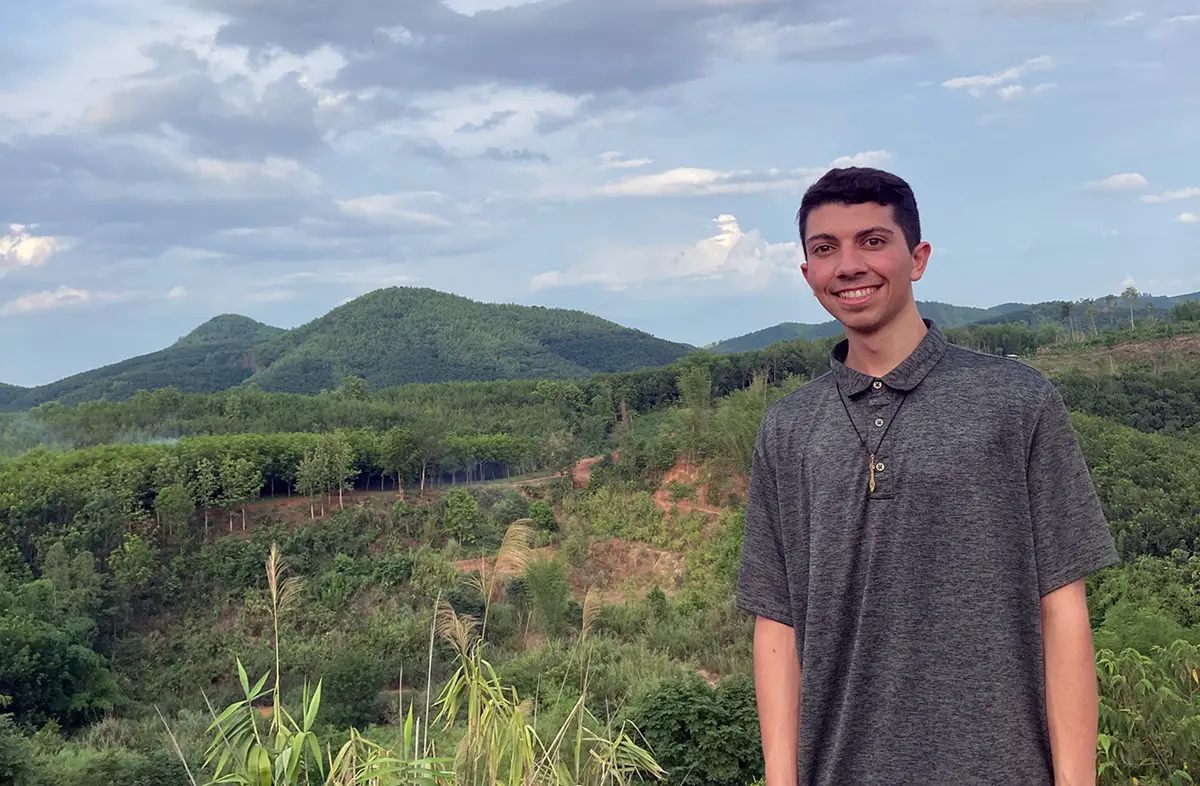
At UMass Lowell, Orfanos was able to put his interests in design and the environment to work immediately. As a first-year student, he traveled to Thailand thanks to support from the Immersive Scholars Program. There, the students helped residents of a region harmed by mining with projects the residents themselves requested.
The experience was a lesson in connection, he says.
Connection was also a part of his honors thesis project researching designs for plant-filled living walls. “The heavy living walls they put on huge new buildings restricts their use,” he says. “If you could make a lightweight wall that could be added to older buildings, you could make it accessible to more places and people.”
The project addresses the disparity between affordability and sustainability in housing, he says, adding that a major benefit of living walls is cooling urban heat islands.
Orfanos created a living wall for the Food Forest shed on South Campus, where the plants are being tested for temperature insulation and rainwater nutrient retention.
“One of the most amazing things is that I was able to install a living wall on campus,” he says. This created a connection between his project and the university community. The hardiest native plant in his living wall, purslane, is an herb used in many cultures worldwide, providing additional benefits to the living wall’s cooling effects.
The opportunities Orfanos has had at UML have allowed him to pursue his goals and to make connections: to places, academic disciplines, scientific research and people. He says, “I would not be in the same place at another school. Coming here was my best decision.”