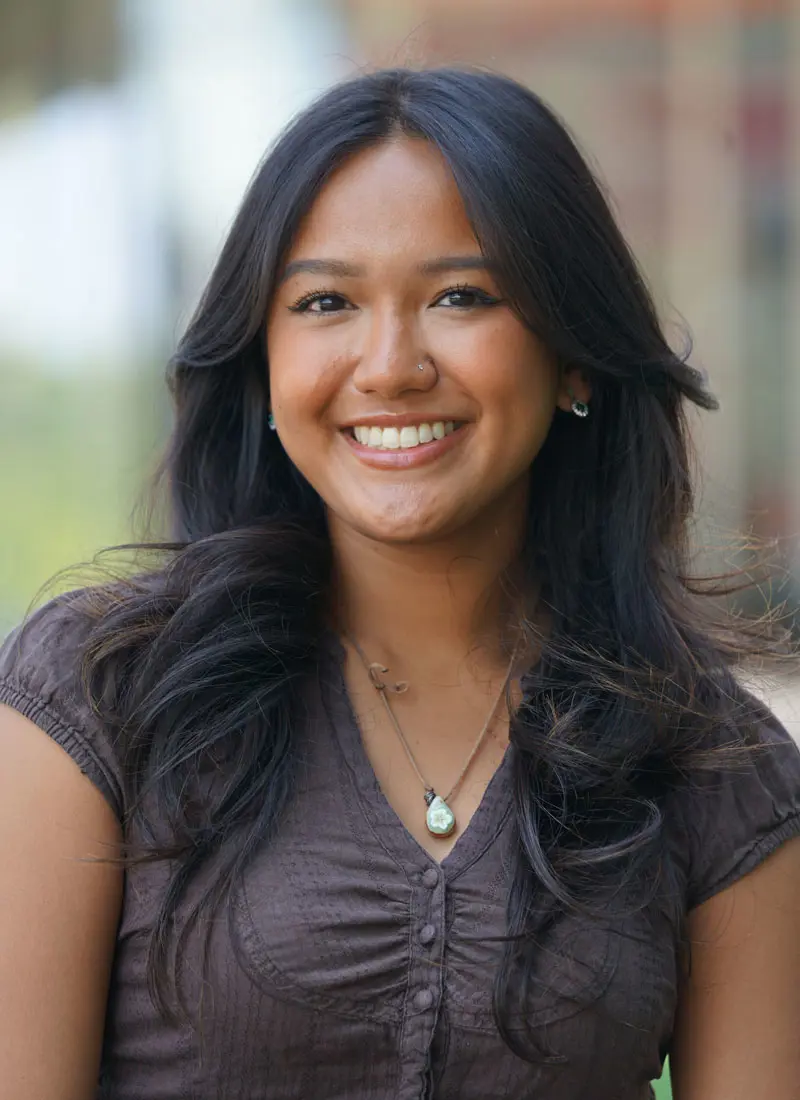
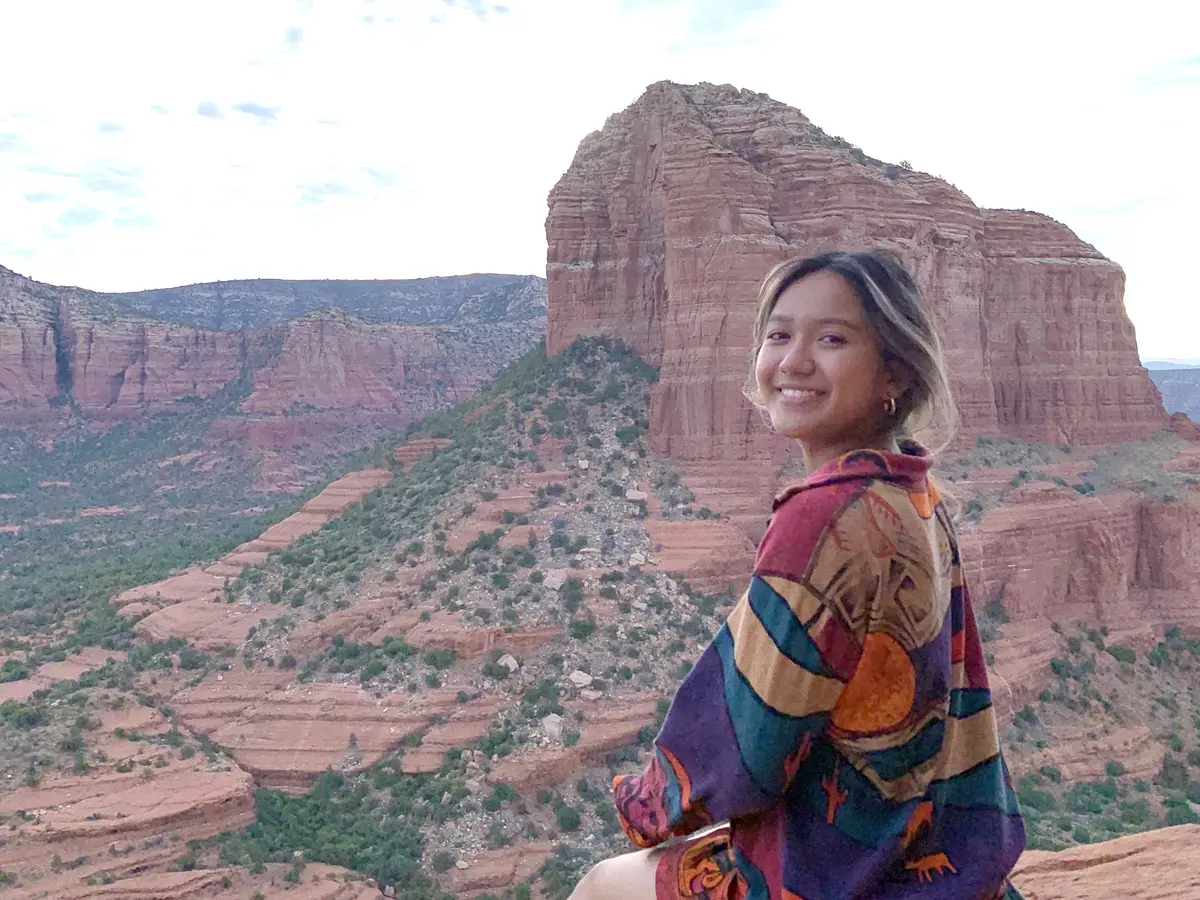
Before her sophomore year at UMass Lowell, Jasmine Seng ’25 drove across the country to Arizona for a summer research program in geotechnical engineering. As the scenery outside her car window changed, so did her future.
Seeing forests give way to rolling plains and, eventually, towering mountains and dramatic rock formations, Seng found herself captivated by the geology of the American West.
“I became instantly curious about the formations — how they formed, how old they were, what they were composed of,” she recalls. “Everything. I fell in love with the vastness of it all, and it solidified what I wanted to do.”
When the Lowell native returned home, she switched her major from environmental engineering to environmental science with a geoscience concentration after meeting with Environmental, Earth and Atmospheric Sciences Teaching Professor Lori Weeden.
“She’s probably the primary reason why I joined the program,” says Seng, who is now pursuing a master’s degree in geoscience in the Kennedy College of Sciences. “I have no regrets.”
As she progressed through the program, Seng looked for opportunities to apply geoscience to climate resilience and clean energy.
She served as a Sustainability Eco Representative with the Rist Institute for Sustainability and Energy and as a community liaison for Lowell's St. Louis Sponge Park Project, where she developed skills in public outreach and community engagement.
Those experiences helped prepare Seng for a six-month municipal fellowship with UMass Lowell’s Clean Energy and Environment Legacy Transition (CELT) initiative during her first year of graduate school.
Working 20 hours a week with the town of Franklin, Seng helped raise awareness of the community’s sustainability initiatives — from solar installations and municipal composting to energy-efficient LED lighting — by creating an interactive online map that explained how the projects benefit residents while reducing greenhouse gas emissions.
“I realized how important community engagement is,” Seng says. “These sustainability projects don't do much good if people don't know about them.”
A first-generation college student, Seng has served as a Kennedy College of Sciences Ambassador, helping prospective students and their families navigate the college search process. She has also worked part time as a patient access coordinator at Lowell General Hospital.
While her graduate studies focus on geoscience, she hopes to build a career in renewable energy and climate resilience, helping communities better understand the importance of sustainable solutions.
Working alongside students from colleges and universities across Massachusetts as a CELT fellow reinforced Seng’s optimism about the future of climate resilience.
“You had students from diverse backgrounds who all shared the same interest and were all in this fight against climate change,” she says. “It definitely feels like not all hope is lost.”