
 Image by Ed Brennen
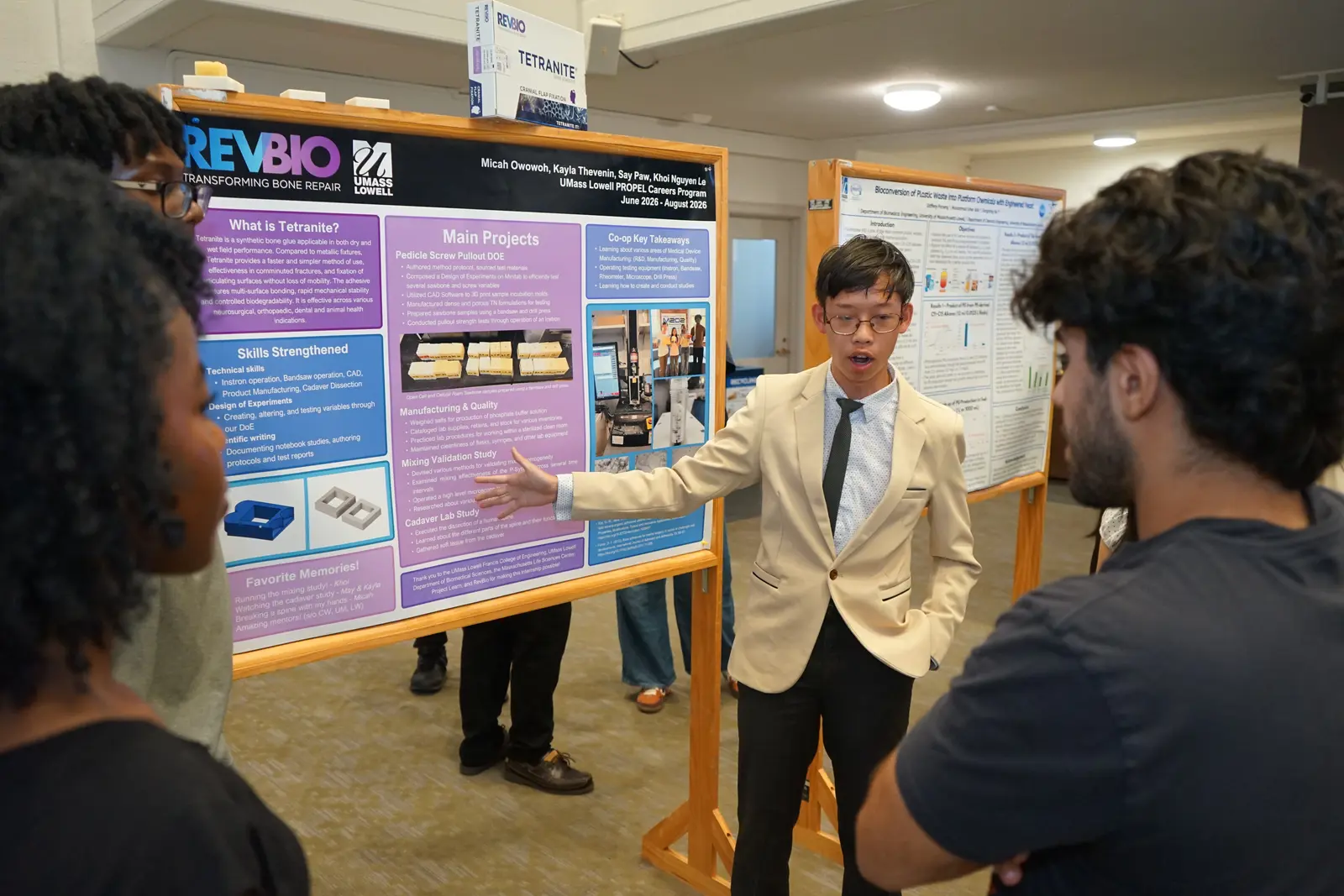
 Khoi Nguyen Le of Haverhill presents the research he conducted on bone repair as part of the Professional Research Opportunities to Prepare for Engineering and Life Sciences Careers Program this summer at UMass Lowell.
Brendan Soeung’s first hands-on research experience at UMass Lowell involved working with a material designed to behave like skin.
Through PROPEL, or the Professional Research Opportunities to Prepare for Engineering and Life Sciences Careers Program, the Lowell High School graduate spent part of his summer assisting Biomedical Engineering Assistant Professor Walfre Franco with a project that tested silicone as a low-cost material for artificial skin models.
The experience gave Soeung an early look at research before he begins classes this fall in the Francis College of Engineering.
“It gave me some experience with biomedical engineering and engineering in general,” Soeung says. “I didn’t know too much about it before this.”
Thanks to two new grants totaling nearly $629,000, Biomedical Engineering Assistant Professor Yanfen Li will be able to expand those kinds of hands-on science, technology, engineering and math (STEM) research opportunities for high school students and teachers.
The funding includes a $29,000 grant from the Boston Scientific Foundation to support PROPEL and a $599,963 National Science Foundation (NSF) award to create a teacher training program focused on bringing current engineering research into high school classrooms.
Launched in 2021, PROPEL gives high school students paid summer internships in UML labs, where they work alongside faculty and student mentors on research projects in engineering and the life sciences.
The Boston Scientific Foundation funding will support PROPEL for one year, helping cover lab supplies and other project costs. Li says that support allows faculty mentors to develop more advanced research experiences for students.
“In the past, the mentors have donated their own lab supplies,” Li says. “But because of Boston Scientific’s donation, we’re able to offset some of the lab costs, which means the labs can do some more advanced projects.”
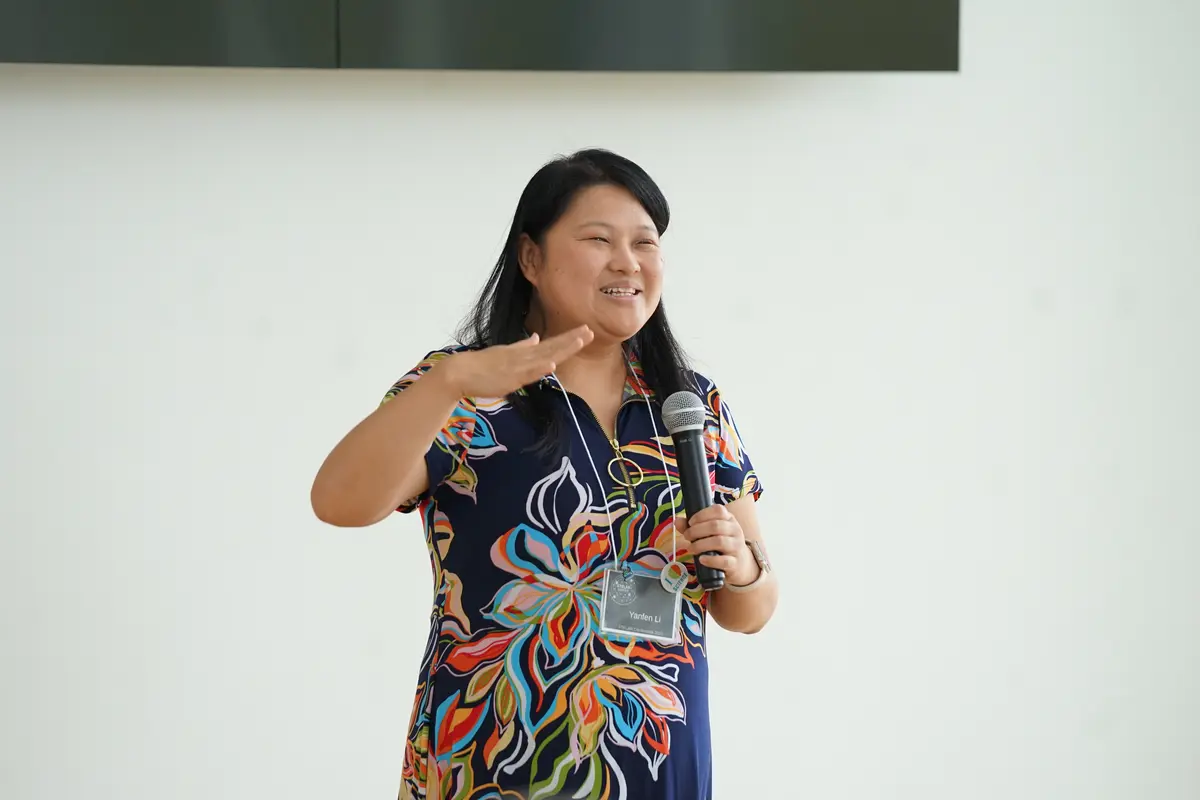 Image by Ed Brennen
 Biomedical Engineering Assistant Professor Yanfen Li recently received two grants for nearly $629,000 to expand hands-on STEM research opportunities for high school students and teachers at UML.
“That way, we can actually spend more time really planning out the program,” Li says.
The NSF grant will establish Engineering Classrooms And Research Experiences for Health, or ECARE for Health, a three-year teacher training program led by Li and UTeach Director Sumudu Lewis, an associate clinical professor in the School of Education.
Beginning next summer, the program will bring eight high school math and science teachers from Massachusetts Gateway Cities to campus each year for a six-week research experience with UML engineering faculty. Their projects will focus on biomedical engineering, medical devices, rehabilitation technologies and other fields connected to improving health care access in low-resource settings.
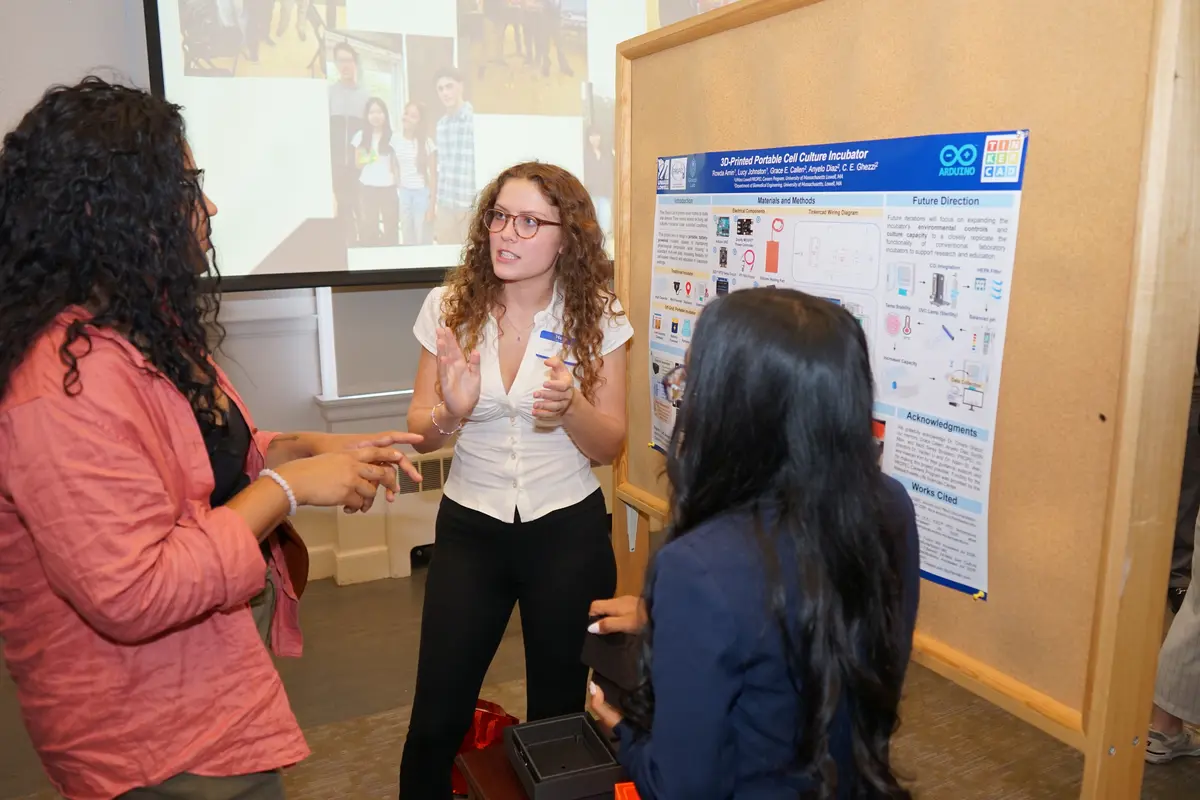 Image by Ed Brennen
 PROPEL participant Lucy Johnston, center, shares the research work she did with Biomedical Engineering Associate Professor Chiara Ghezzi this summer.
Li says the idea grew out of PROPEL, whose student research model led her to think about a broader question.
“How do we give that same experience to K-12 teachers, so they can learn about the cool new science that is happening and bring it back into their classrooms?” Li says.
This summer, PROPEL served 34 high school students, its largest group yet. The students presented their work at an end-of-summer showcase that also included participants from PROPEL Advanced, a new group of students from biotechnology certificate programs who are preparing to enter the workforce, and two community college students from New Hampshire working with Dandeneau Endowed Professor of Plastics Engineering Amy Peterson.
Li says the showcase reflected the growing network of research opportunities for students at different stages of their education.
“They’re all doing intensive research, housed within different labs, learning about what research is like,” Li says. “I always call it the edge of human knowledge, but they’re really seeing what future innovations are coming out of UMass Lowell.”
The grants are part of a broader effort by Li to expand biomedical engineering pathways; she is also involved in two recently announced Massachusetts Life Sciences Center grants supporting a new tissue engineering training laboratory and an intensive biomedical summer program for high school students.
Li was recently inducted into the American Institute for Medical and Biological Engineering College of Fellows for her work advancing equity-driven biomedical engineering education. She says programs such as PROPEL and ECARE for Health are designed to help more students and teachers see what is possible in STEM.
“Next summer, we’re going to have a group of teachers presenting at the showcase as well,” Li says. “It’s going to be amazing.”