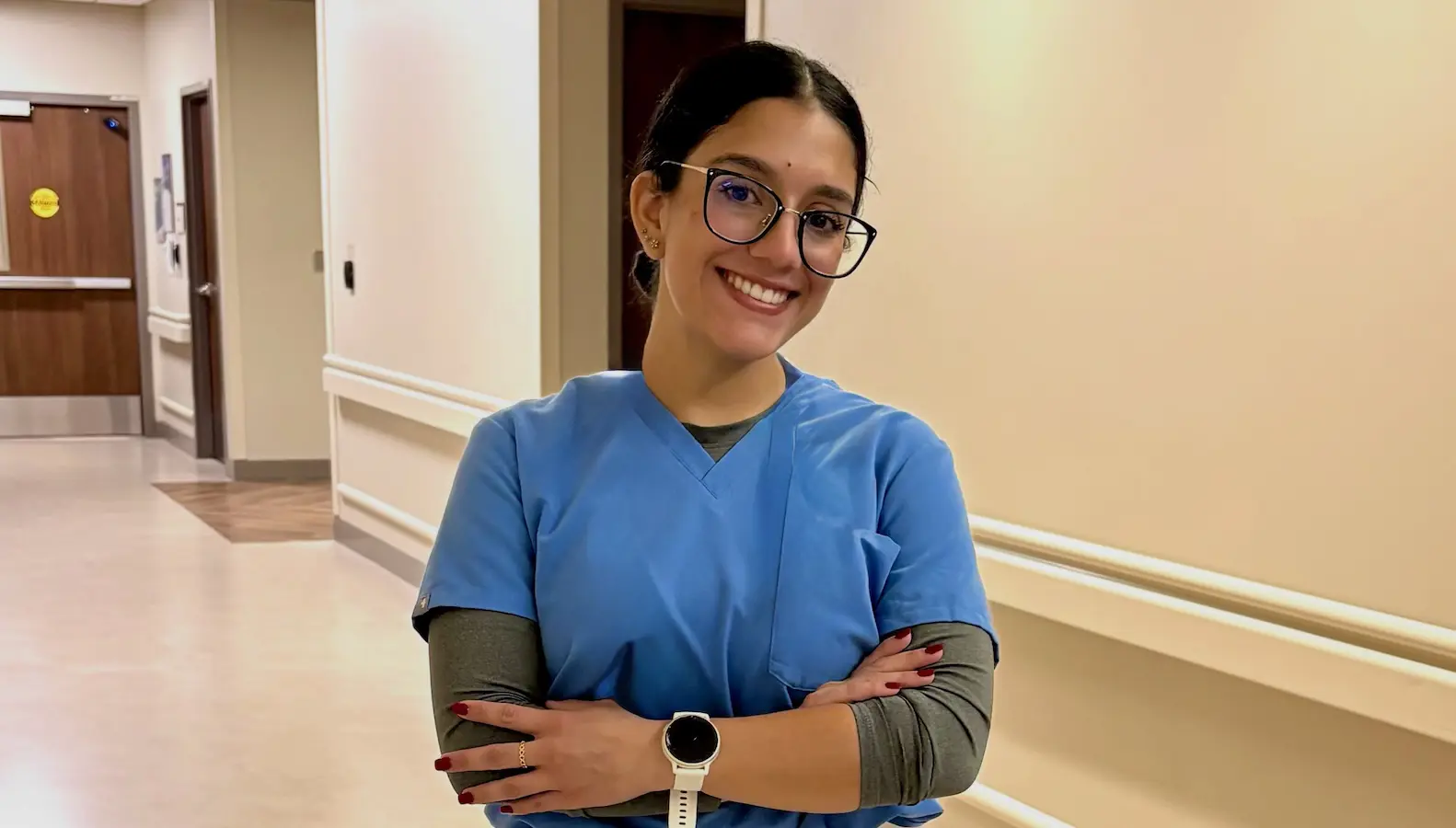
Laura Cuartas completed the RN to B.S. Nursing program in less than a year, which paved the way for her to get her license in Florida and start a graduate registered nursing residency.
For the past five years, Jolian Mowatt has worked as a licensed practical nurse in hospice care on Cape Cod. Although she became a registered nurse (RN) in 2025, the Yarmouth resident was eager to earn a Bachelor of Science (B.S.) degree to gain knowledge that she could apply to the daily care of her hospice patients.
But while raising two boys and working full time, Mowatt didn’t have the time or flexibility to pursue a B.S. in nursing. Then she heard about UMass Lowell’s new RN to B.S. online nursing program and decided to enroll. She completed the required courses within 10 months.
“I was able to bring what I learned in the RN to B.S. program directly to the care of my patients,” says Mowatt, who took two online classes every eight weeks. “I learned about evidence-based practice, community health and, overall, how to be a better nurse for the patients I care for every day.”
Word about the program is getting around. Enrollment spiked from 11 students in September 2025 when it was launched to more than 70 students this fall.
“Jolian represents the type of nursing professional our new RN to B.S. program is intended for,” says Clinical Assistant Professor Chantal Cole of the Solomont School of Nursing, who meets with every student to guide them through the process of admissions, course selection and the path to graduation. “Entirely online, our program is affordable and flexible for working nurses, many of whom have children, and our courses are taught by high-caliber faculty.”
A B.S. in nursing helps nurses expand their knowledge and clinical skills, strengthen critical thinking and leadership abilities and prepare for a broader scope of practice, according to the American Association of Colleges of Nursing. Research also has linked a higher proportion of B.S.-prepared nurses with better patient outcomes, including lower mortality and hospital readmission rates.
“Some of our students want to be eligible for leadership roles, some want to know the latest research to improve care for patients, and some want to pursue a graduate nursing program,” says Cole. “There are many nursing positions in hospitals, especially in New England, that require a B.S. in nursing.”
Laura Cuartas, who also recently completed the program, was able to start a graduate registered nurse residency at a Florida hospital in the intensive care unit.
“UMass Lowell really opened their doors and gave me the opportunity to continue advancing my education,” says Cuartas, an RN in Massachusetts who wanted to get her nursing license in Florida. “I’m extremely grateful for how supportive the faculty were throughout the entire process. I would honestly recommend the UMass Lowell RN to B.S. Online Nursing program to anyone looking to continue their nursing education.”
Students can take one or two online classes every eight weeks. The recorded weekly lectures allow students to listen when it fits their schedules, with assignments due each week.
“The program was very convenient and flexible, because I could complete my assignments on my own time while still having reliable support from my professors,” says Cuartas. “I always felt like the professors and staff truly cared about my success, and having that kind of support made such a big difference to my success.”
Developed by the School of Nursing and Graduate, Online and Professional Studies, the program includes interactive resources such as discussion boards, evidence-based journal articles, videos, case studies, a digital clinical simulation platform and a variety of assignments.
“I think some people worry that online classes mean you won’t learn as much, but that was not my experience at all,” says Cuartas. “There were so many resources available that made the content easy to understand, so that I could practice assessments through virtual patient simulations that felt very realistic.”