
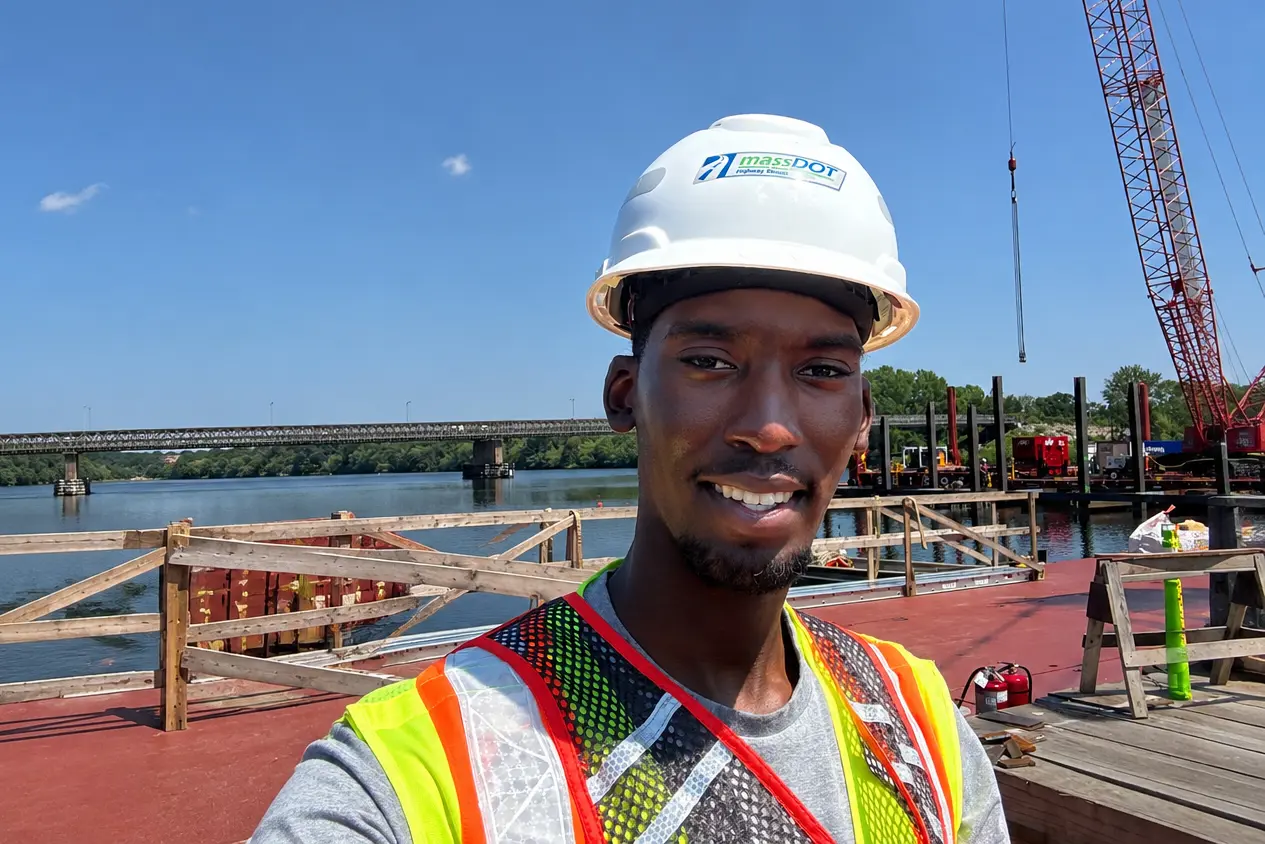
 Image by Kenneth Celestin
 Mechanical engineering major Kenneth Celestin is working on the long-awaited Rourke Bridge replacement project in Lowell as a co-op with the Massachusetts Department of Transportation.
Built in 1983 as a temporary span, Lowell’s Rourke Bridge has carried traffic across the Merrimack River for more than four decades — far longer than intended. Now, construction is finally underway on its permanent replacement, and mechanical engineering major Kenneth Celestin is getting a firsthand look at how one of the city’s largest infrastructure projects is coming together.
As a co-op with the Massachusetts Department of Transportation (MassDOT), Celestin reviews contractor submittals, documents construction progress and performs quality-control testing as work ramps up on the new $303 million bridge. It’s one of several bridge projects he’s worked on during a co-op that began in January and has continued through the summer.
“It's nice to get out there and see how the work you’re doing in the office correlates with the real world,” says Celestin, a senior from Medford.
Along with providing UMass Lowell students with co-op and internship opportunities, MassDOT collaborates with university researchers on projects ranging from traffic safety and bridge monitoring to artificial intelligence applications that improve transportation planning. Many UML alumni have also gone on to engineering careers with the state agency.
Celestin joined fellow Francis College of Engineering students Fatin Rahman, Dutt Patel and Obioma Dike as spring co-ops at MassDOT. This summer, civil engineering majors Reid Hannabury, Matthew Cerrato, Jared Ali, Brianna Moss and Abigail Sanford are working as interns.
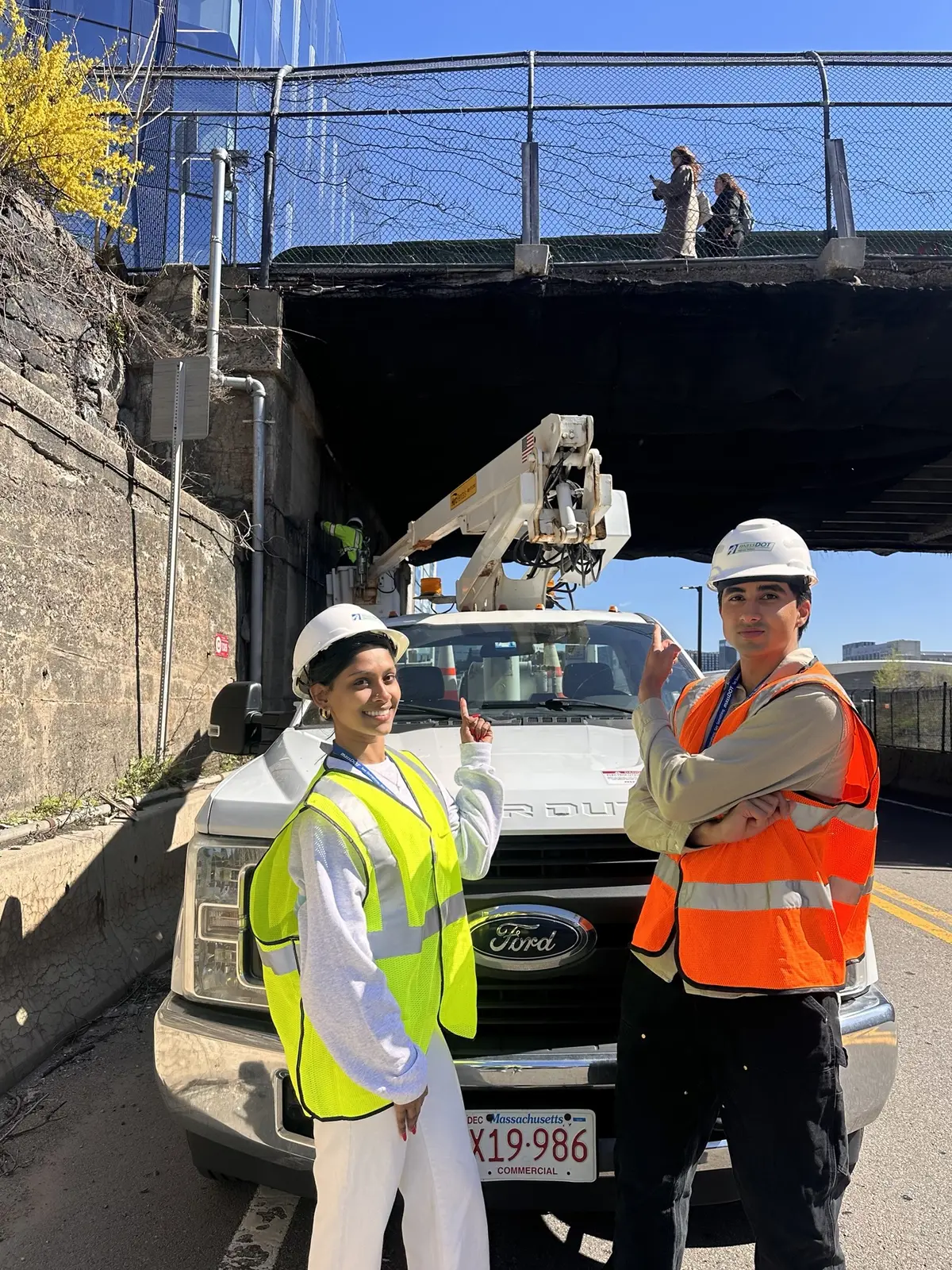 Image by courtesy
 During their spring semester co-ops with MassDOT, civil engineering majors Fatin Rahman, left, and Dutt Patel helped inspect and preserve bridges across the commonwealth.
“The co-op helped me learn so much about the industry,” says Rahman, an honors student who serves as chapter president of the Society of Women Engineers. “You see how everything comes together.”
Now preparing for her senior year, Rahman will help introduce UML’s Professional Co-op Program to other students as a co-op program assistant this fall.
“I want to focus on inspiring more people of other cultures to pursue co-ops,” says Rahman, an international student from Bangladesh who was initially unsure if she could become a co-op. “These opportunities are for you as well.”
Patel, a rising senior from Middleton, worked as a bridge inspection co-op. He traveled to inspection sites across the state and even rode on a barge beneath a bridge near Boston’s Museum of Science to observe engineers at work.
The co-op helped Patel confirm his interest in bridge engineering. He’s now spending the summer working on bridge design as an intern with Stantec in Burlington.
“Co-ops are kind of like a tryout — you get to see if you really want to do something,” he says.
At MassDOT, Patel met UML alum Frederick Nohelty ’71, supervisor of bridge technical review, who has spent more than 50 years with the agency. The two bonded over their shared UML connection as Nohelty showed him photos of the campus when it was still Lowell Tech and described how bridge plans were once drafted entirely by hand.
“Meeting him and so many other people from different backgrounds was my favorite part of the co-op,” Patel says.
One of the projects Celestin worked on was the replacement of the Interstate 495 bridge over Route 28 in Andover. After months of reviewing plans and documenting construction progress, driving across the newly completed section for the first time was a memorable moment for Celestin.
“It was surreal, because I saw a lot of the process to get to that point,” he says.
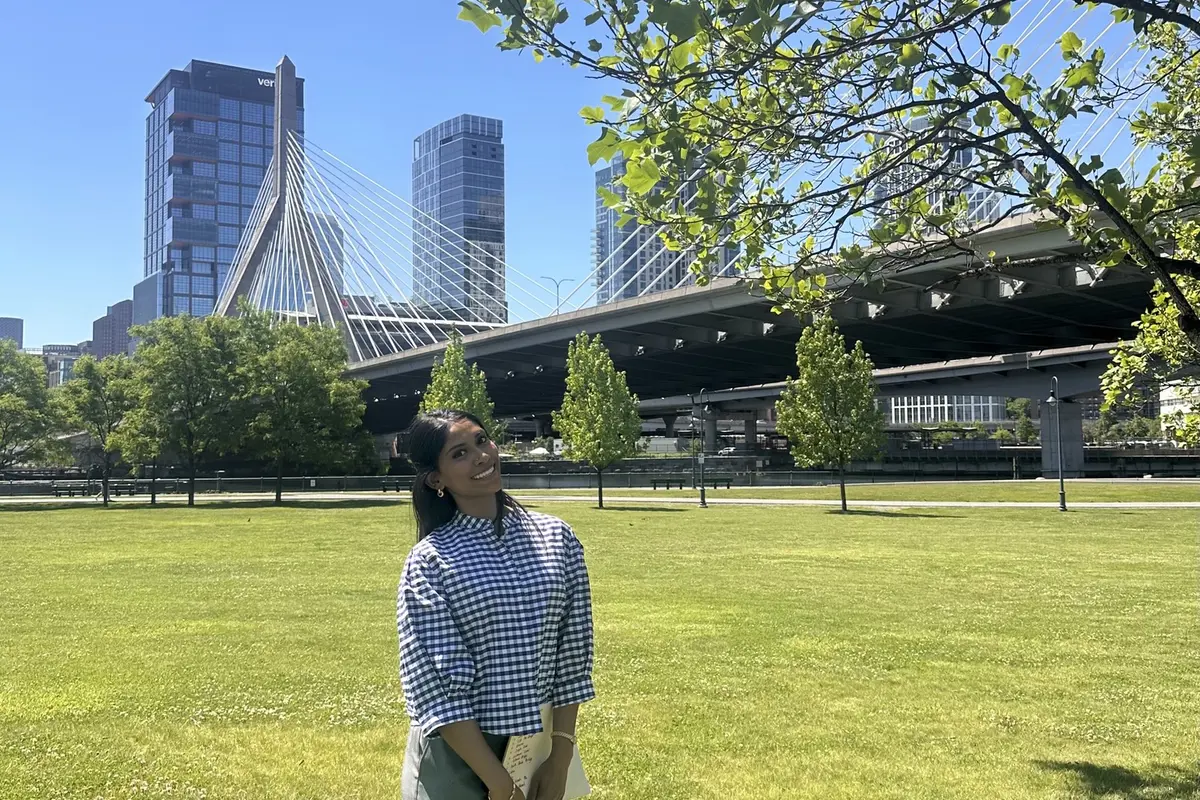 Image by courtesy
 Senior civil engineering major Fatin Rahman, seen here in front of the Zakim Bridge in Boston, will help other students learn about UML's Professional Co-op Program this fall.
Like Rahman and Patel, Celestin says the co-op complements what he’s learning in the classroom by showing him how engineering concepts are applied in the field.
“Being in the classroom, you don't really get the full scope of the work that you're doing and the meaning behind it,” he says.
The work has also broadened Celestin’s career interests. Although he’s studying mechanical engineering, he can now envision a future in civil infrastructure and bridge construction.
“I can definitely see myself doing this as a future career,” he says.