

Professor Shannon Kelleher is researching the biological reasons that affect low milk supply to help mother's breastfeed.
For many mothers, one question looms over the early days of caring for a newborn: “Am I making enough milk?” It’s a concern shared by nearly all breastfeeding moms, and studies suggest that for roughly 30% of them, it’s an ongoing challenge.
Yet when milk supply falls short, women may receive trial and error tips such as “pump more,” “try a supplement” or “change your diet” — without clear answers about what’s causing the problem. That uncertainty can take a toll, turning an already demanding postpartum period into one marked by stress, frustration and, for some, a sense of shame.
Professor Shannon Kelleher of the Department of Biomedical and Nutritional Sciences is working to uncover the biological reasons that affect milk supply to translate the information into tools that can be used clinically, or even at home, to help mothers breastfeed. During a recent sabbatical, Kelleher used her expertise to advise startups and early-stage companies on how to integrate rigorous science into product development.
Kelleher sat down to discuss how her latest research can usher in a new era of precision lactation for mothers and their newborns.
What is your lab currently working on?
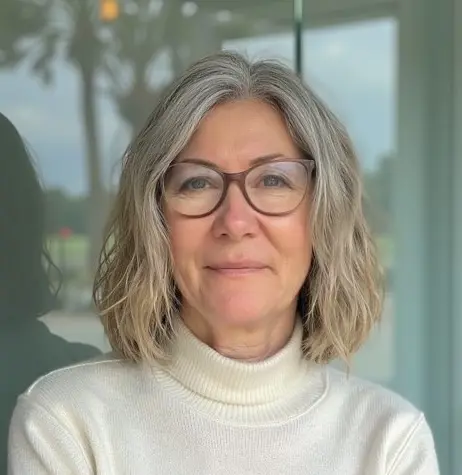
Professor Shannon Kelleher discusses how her latest research can usher in a new era of precision lactation for mothers and their newborns.
How did your sabbatical last year advance the science into products that could help mothers?
My sabbatical was intentionally different from traditional academic work. I spent that time embedded in the innovation ecosystem, working directly with startups and early-stage companies focused on human milk and lactation. I advised founders on how to integrate rigorous science into product development, on everything from sensors that measure milk volume in real time to breast pump design; from biomaterials for milk storage to AI-driven nutrition platforms. These were founder-to-founder conversations about how to align biology, engineering and real-world use. That experience fundamentally changed how I think about my research and its impact. It made clear that there’s a gap between what we know scientifically and what actually reaches families, and that gap is where I now focus much of my energy.
Why is the field of lactation research interesting to you?
What excites me most is that lactation is one of the most dynamic and underappreciated systems in human biology. The mammary gland can rapidly shift between states, producing large volumes of milk, adapting to infant demand or shutting down when something goes wrong. But until recently, we assumed that it just “magically worked” after you had a baby, because we haven’t had tools to measure these transitions. We aim to give mothers and clinicians objective information about what’s happening biologically, whether it’s a delay in secretory activation, inflammation, metabolic stress or something else, or confirmation that they’re doing just fine. This work is about helping moms by replacing uncertainty with clarity and moving toward evidence-based, personalized support for lactation.
Once you find out the reasons for low milk supply, what can be done about it?
This is the critical next step and where the field needs to go. Once we can define why low milk supply is happening, interventions can become much more targeted. For example, if we find the underlying issues are delayed secretory activation, inflammation or cellular stress, nutrient transport or metabolism or genetic factors, we can develop molecular therapies that are evidence-based to help moms. Right now, all of these are treated as the same problem, but they’re not. The long-term vision is to move toward precision lactation, where we match the treatment to the biology, similar to what we’re seeing in other areas of medicine.
You have undergraduate and master’s students who are majoring in applied biomedical sciences, pharmaceutical sciences and biology working in your lab. What are they working on?
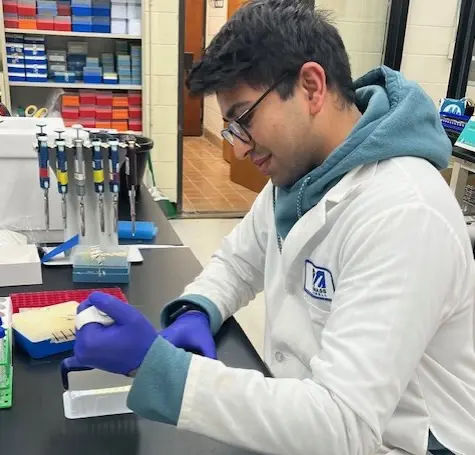
Applied Biomedical Sciences major Jai Patel conducts research in Kelleher's lab.