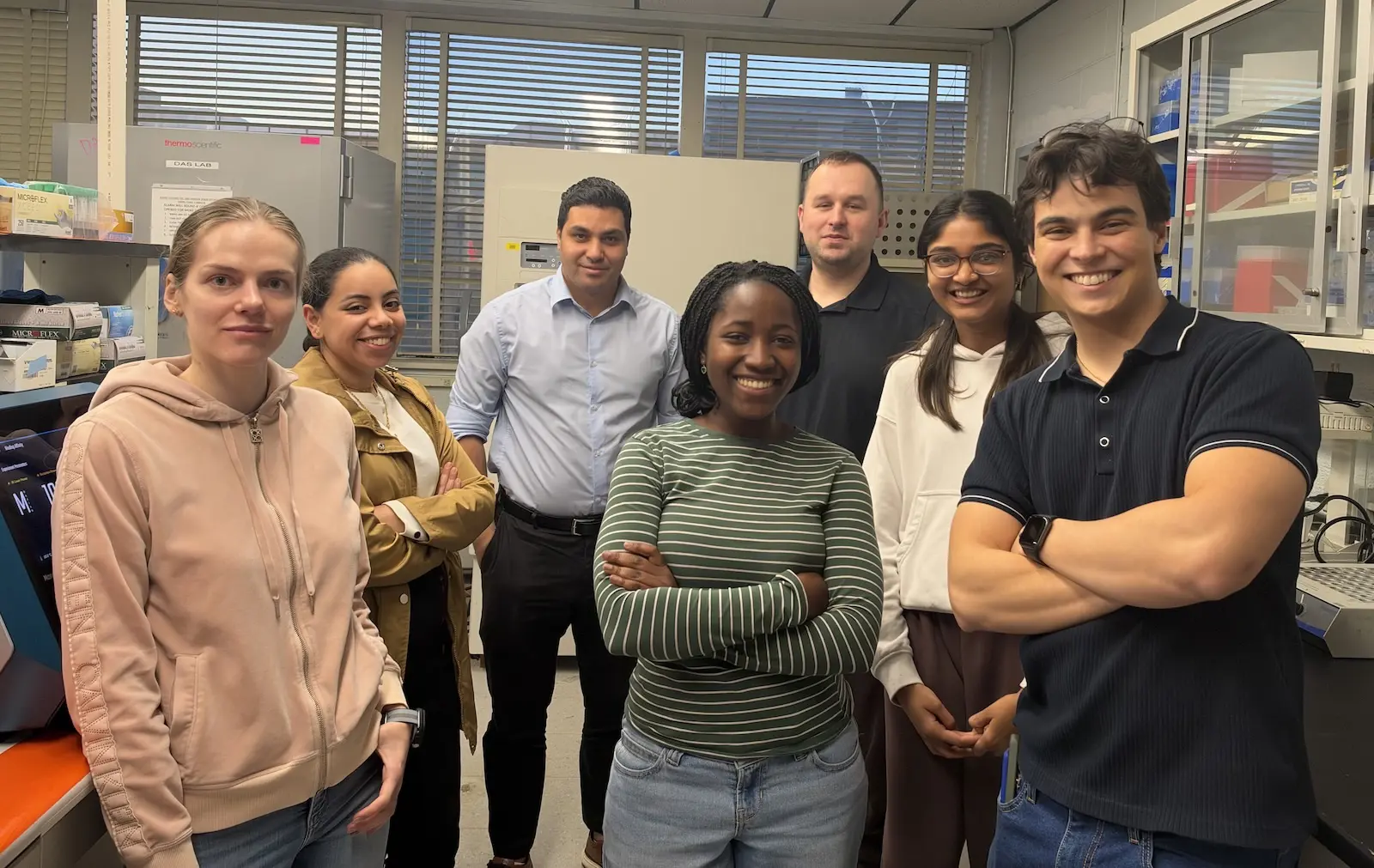
Third from left, Hossam Hammouda, trains undergraduate and graduate students in his lab.
Assistant Professor Hossam Hammouda of the Biomedical and Nutritional Sciences Department is on a mission to accelerate the early stages of the drug discovery process.
Using AI-assisted methods and laboratory testing, his lab screens and identifies promising compounds for cancers and neurodegenerative diseases in about one week, a process that historically takes about a year. To make the compounds suitable drug candidates, Hammouda refines the compounds to reduce potency, a process that takes about two months, compared to a typical one-year timeframe.
“We are able to quickly and cost-effectively identify compounds that show a promising interaction with the target protein,” says Hammouda, a medicinal chemist who recently joined UMass Lowell. “Our lab saves time and money, and we are identifying more possible compounds for further testing.”
Hammouda sat down to discuss his work and how he is applying his expertise to innovate drug discovery.
Q. Why are you targeting cancers and neurogenerative diseases such as Alzheimer’s disease with your research?
Cancer remains one of the leading causes of death worldwide, and no therapy can yet halt the progression of Alzheimer’s disease. In both cases, some of the proteins driving these diseases have resisted drug development for decades, remaining beyond the reach of conventional methods. This is the problem that my lab is built to solve.
Q. Why is it so difficult to find drugs for these diseases?
Most approved drugs work by fitting into a pocket on a protein, roughly the way a key fits a lock. The difficulty is that only a small fraction of human proteins has such a pocket. The rest are flat, smooth or constantly shifting in shape, so there is nowhere obvious for a small molecule to sit.
Those are the proteins we call undruggable, and by most estimates, they make up most of the human proteome – the complete set of proteins expressed by a cell, tissue or organism at a specific time.
The frustrating part is that many of them are precisely the proteins that drive disease. DKK1 (Dickkopf-related protein 1) is a good example. It is a secreted protein with no classical binding pocket and has been linked to bone destruction in multiple myeloma and to neurodegeneration. For decades, no one has produced a small molecule drug against it. The only options have been antibodies, which are expensive and cannot cross into the brain.
Q. What is the potential breakthrough of your research?
If we can reliably identify small molecules that target these hard-to-reach proteins, we could open up much more of human biology to drug development. That is the real breakthrough. It's not about discovering one drug; it's about gaining access to a part of the proteome that has largely been closed off to drug development.
Q. How are you conducting the research?
In my lab, I use an integrated discovery loop that includes AI prediction, chemical optimization and biological validation.
Traditionally, pharmaceutical companies screen large libraries of compounds to identify those that show enough promise to advance to preclinical testing. This initial screening can take about a year and cost anywhere from $50,000 to $1 million. Even after that investment, about 90% of drug candidates that enter preclinical development fail.
My lab is working to make the early stages of drug discovery faster and more efficient. The process has three parts that feed into each other.
First, our AI platform that we built, called DrugID, ranks compounds and peptides by how likely they are to bind to a specific protein target. This allows us to start with a shorter, more promising list of potential drug candidates.
Next, we chemically modify the most promising candidates to help them bind more tightly and behave better in the body, meaning with less toxicity and side effects.
Finally, we test our predictions at the bench using biophysical measurements.
Those results feed directly back into the AI model, helping to improve its next round of predictions. I does not replace laboratory work. It helps us identify which experiments are most worth pursuing.
Q. Why did you decide to join UMass Lowell?
I came to UMass Lowell because of the combination of people and facilities. The Biomedical and Nutritional Sciences Department has strong expertise in cell and organoid models, which is exactly what my chemistry needs to be tested biologically. The university’s Core Research Facilities give me access to nuclear magnetic resonance, mass spectrometry and high-performance computing.
I also wanted to be somewhere I could build a program rather than join an existing one.
Over the past four months, I have set up my laboratory in Pinanski Hall, including a microscale thermophoresis instrument that lets us measure how tightly our compounds bind their targets. I have recruited my first two doctoral students, and we are currently looking for a third Ph.D. student. We also have two master’s students and an undergraduate student who are training in the lab.
Collaborations with colleagues in my own department and across the Zuckerberg College of Health Sciences came together quickly, and the proof-of-concept work we are generating here is already supporting grant applications and partnerships with industry.