
Topics: Research Social Sciences
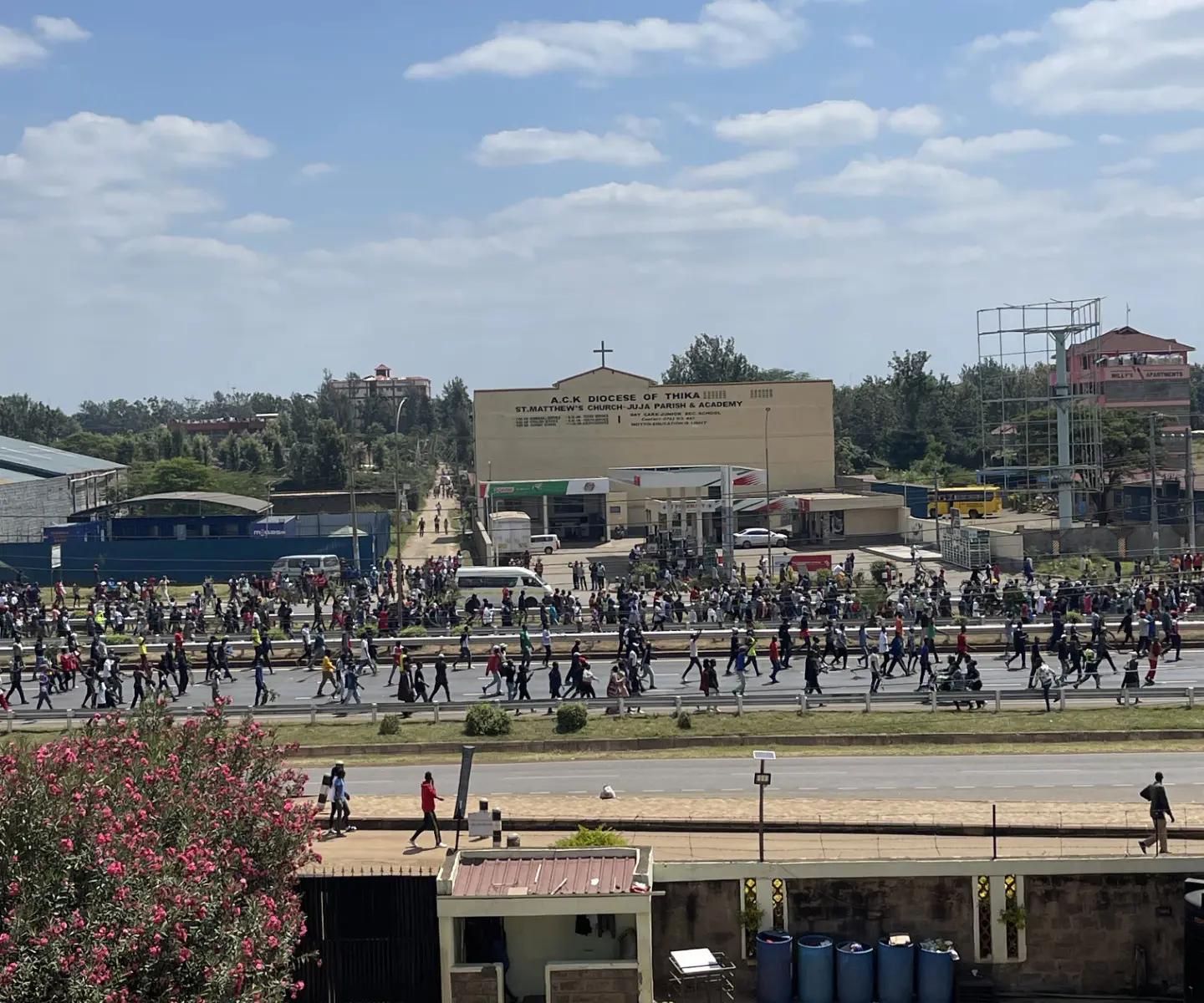 Image by Joselyne Chenane
 Students marching from Jomo Kenyatta University of Agriculture and Technology to parliament on June 25, 2024
As the emerging, youth-led “Cockroach Janta Party” challenged India’s Hindu nationalist government this spring and summer, two associate professors in UMass Lowell’s School of Criminology and Justice Studies, Joselyne Chenane and Claire Lee, were awarded internal grants for research into Gen Z protest movements in India, Kenya and other countries.
Chenane was in Kenya two summers ago, on a Carnegie African Diaspora Fellowship to study how the news media portrayed police and how that influenced public opinion, when students across Nairobi led a June 25 mass march on Parliament.
The students were protesting the country’s annual budget bill to finance the government, which would have raised taxes and health care costs amid high youth unemployment and stagnating wages. The government was caught off guard by the protests, which were organized rapidly on social media, Chenane says.
“There was a buildup to this,” she says. “But I think the government did not take Gen Z seriously until they stormed the parliament.”
Police responded with brute force, killing at least 60 protestors, injuring hundreds and arresting and “disappearing” still more, according to international human rights groups.
The protests quickly spread across the country, fueled by public anger over the police response, growing economic inequality and suspicions of government corruption. By July, President William Ruto was forced to withdraw the government finance bill and fire the attorney general and most of his cabinet, Chenane says.
The students, whom Chenane could see marching toward the city center from her apartment 20 miles away near Jomo Kenyatta University of Agriculture and Technology, also organized across tribes and religions. Previously, most of Kenya’s political violence stemmed from tensions between tribal groups, she says.
“Gen Z was saying, ‘We’re one generation – there are no tribes,’” she says.
Chenane collected news coverage from early June through August 2024 to assess the media’s portrayal of police actions during the Gen Z protests and its effect on public attitudes toward police.
Preliminary results, which she is analyzing under a $4,985 Researchers and Scholars Investment (RSI) Fund grant from the university’s Office of Research Development, suggest that most people supported the Gen Z protests, despite a consistent government narrative blaming the violence on “disruptive” students, she says.
Now, under another $4,185 RSI Fund grant titled “From Social Media to the Streets,” Chenane will collaborate with Lee, an expert in analyzing social media, to look at the role of social media in Kenya’s protests and compare it with Gen Z protests in several Asian countries. The two have collaborated on previous research.
“We want to know what they are asking for, what are their modes (of organizing), and were they successful – and how do we even define success?” Chenane says.
In Kenya, for example, despite the protests’ initial success, anniversary marches in June 2025 and this past June have drawn fewer participants, while the government continues to ignore the demonstrators’ demands for anti-corruption measures, action against femicide and police accountability for the deaths and disappearances of protestors in 2024, she says.
This summer, Lee and Chenane hope that a research assistant who is already in India can gather some preliminary information on how the current “cockroach” protests are being organized using social media.
The Cockroach Janta Party (the Cockroach People’s Party) began as a satirical online movement in May after the chief justice of India’s Supreme Court, Surya Kant, referred to “youngsters like cockroaches” – depicting them as lazy, unemployed parasites who spent all their time attacking India’s institutions, including the ruling Bharatiya Janata Party, on social media.
Abhijeet Dipke, a former public relations professional for a rival political party, responded by creating the Cockroach Janta (or Janata) Party for “the lazy (and) the unemployed” who are “chronically online” and able to “rant professionally.” More than 20 million people followed the Cockroach Janta Party on Instagram within the first week.
 Image by Cockroach Janta Party
 A graphic indicating free membership in India's youth-led Cockroach Janta Party.
The members quickly began organizing real-life protests over the high unemployment rate for India’s youth, including among university graduates, as well as the latest testing scandal. Their primary demand: the resignation of the minister of education over leaks of highly competitive government exams for civil service jobs and public universities.
The education minister resigned on July 25, following a massive protest march in Delhi on July 20. But the movement has other goals, including reform of the national exam system, compensation for the families of students who committed suicide after the results of May’s medical school entrance tests were cancelled, and accountability for police violence against protestors.
The two researchers are also looking into comparing the Kenya protests with Gen Z protests in Thailand in 2020, Sri Lanka in 2022, Bangladesh in 2024 and Nepal in 2025. Although there are specific local issues, many of the protestors’ concerns are similar across countries: high youth unemployment, economic inequality and government repression.
“It’s not only happening in one place; it’s happening in different countries and continents. But we believe there is a resemblance in patterns,” says Lee, who researches cybersecurity, cybercrime and how crime victims talk about their experiences on social media.
The choice of countries to compare will depend in part on the challenges of gathering social media postings years after the protests, Lee says, including government shutdowns of some social media platforms, privacy protections on others, and the financial cost of obtaining data for research. Some countries may also pose translation challenges.