

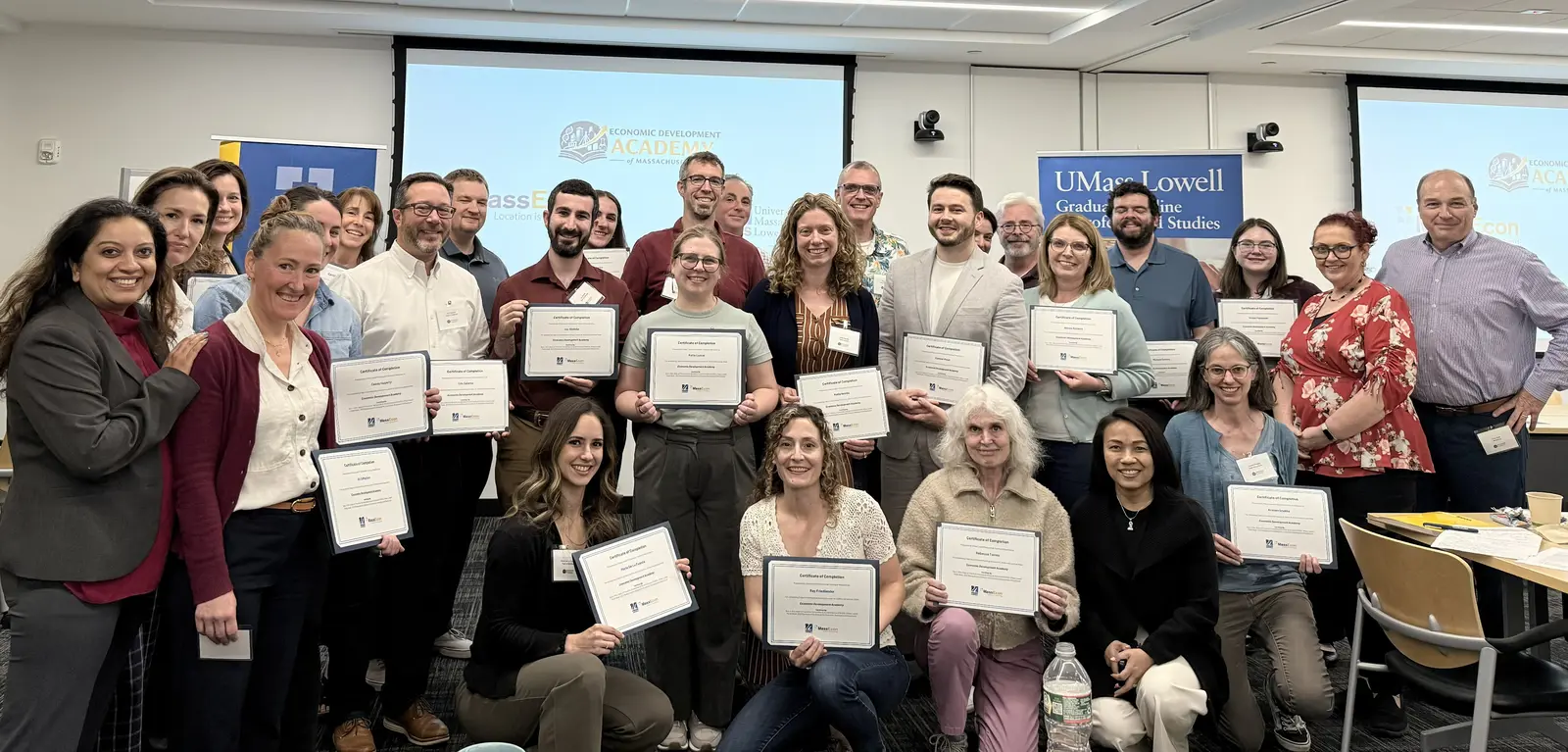
 Image by Sandhya Iyer
 Town and city leaders in the first, two-day Economic Development Academy offered by UMass Lowell with MassEcon display the certificates they earned.
When Sandhya Iyer, fresh out of school with a master’s degree in communications, began working a decade ago for the Massachusetts Life Sciences Center, she sought to learn more about economic development, the state-funded group’s focus.
But short of going back to school for another master’s degree in either public administration or public policy, “the continuing education options for economic development were almost zero,” she says.
Iyer’s need for professional development became even more urgent after she became the tourism and economic development director for the town of Lexington. She read books, took courses and attended national and international conferences, but nothing focused on local or regional conditions and opportunities, Iyer says.
So she took matters into her own hands, reaching out to the Massachusetts Alliance for Economic Development (MassEcon) and working with them to outline a two-day workshop. She just needed to find an organization to implement it.
That’s when “someone said, ‘Why don’t you talk to UMass Lowell?’” says Sara Leng, program development manager for the university’s Corporate Training program.
Two years later, their collaboration with adjunct faculty member Melissa Nemon resulted in the Economic Development Academy, a two-day workshop first offered in June at the MassEcon offices in Watertown.
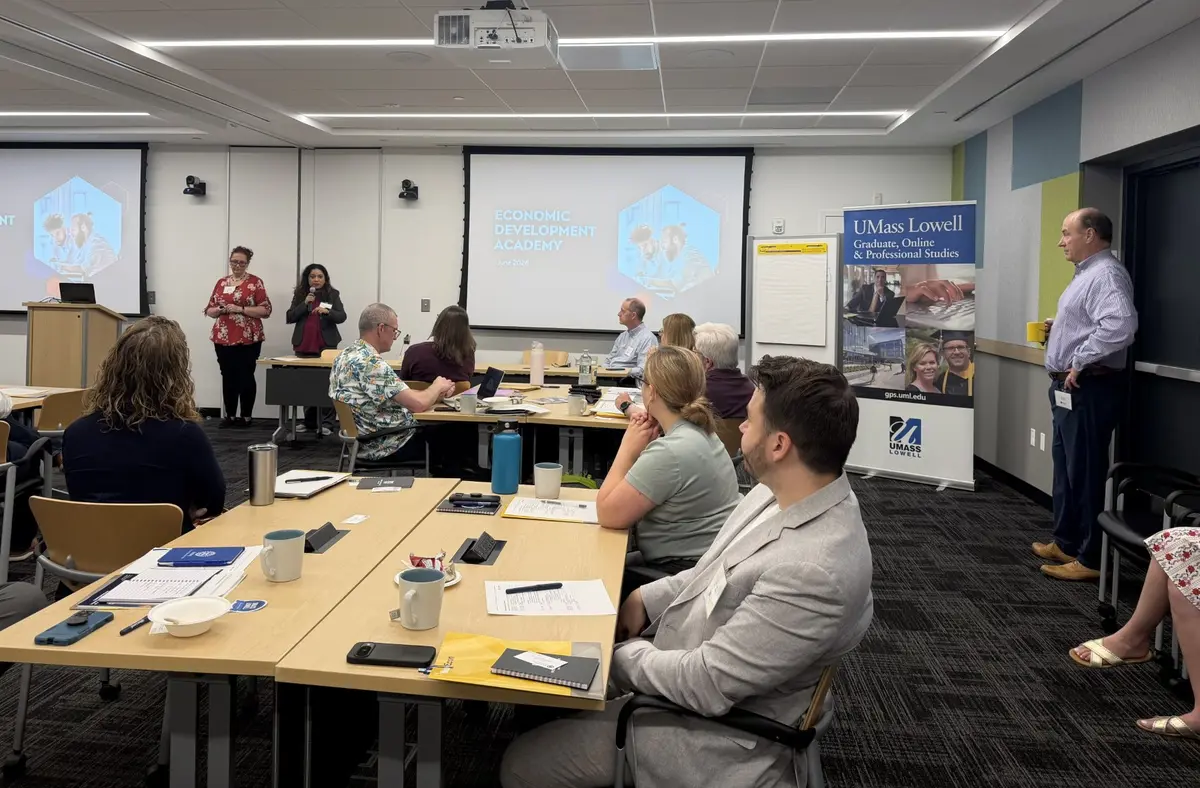 Image by Sara Leng
 Adjunct faculty member Melissa Nemon and former Lexington economic development director Sandhya Iyer helped to develop the Economic Development Academy.
Over two days, 24 staff members from 21 towns learned about economic development from guest speakers and panelists including Iyer, who is now executive director of TiE Boston, a nonprofit that fosters entrepreneurship. They mapped out an economic development project for their city or town. They also discussed workforce development more broadly.
Maria De La Fuente, director of land use and planning in Medfield, says she found the workshop useful because she had an opportunity to network and brainstorm with people in similar jobs.
“For me, the most helpful thing was to have conversations about the issues all of us are facing,” she says, such as the need for more affordable housing.
While the particulars vary from community to community – some need a larger commercial or light industrial tax base and local jobs, while others want more recreational opportunities or a more vibrant, small-business downtown – De La Fuente says the small group exercises allowed people to share solutions that could help now or in the future.
“That sense of community was really helpful … collaborating and figuring out what worked for you, and how can we make that work for us,” she says.
The two-day workshop was so popular – a half-dozen people joined the waiting list – that the university is offering another one on November 9 and 10 at the Springfield Innovation Center, also co-sponsored by MassEcon, that will add tourism as a topic. The Massachusetts Municipal Association is helping to market the workshops..
The Economic Development Academy sessions also mark the first formal offerings of the “Municipal Leadership Academy” that is being developed by the College of Fine Arts, Humanities and Social Sciences (FAHSS), says Stacy Szczesiul, associate dean for educational and community partnerships.
The goal of the Municipal Leadership Academy is to provide pathways for skill development and career advancement for municipal employees across the region while also opening up internships and job opportunities for UMass Lowell students, she says.
“It’s all about building the capacity of towns and cities through workforce development,” says Szczesiul, who oversees similar partnerships between the School of Education and public school systems.
“We want to ensure that the state’s Gateway Cities, in particular, are able to staff municipal positions with people who have the expertise they need, or that they can equip existing staff with the skills they need, especially in consequential areas like cybersecurity and economic development,” she says.
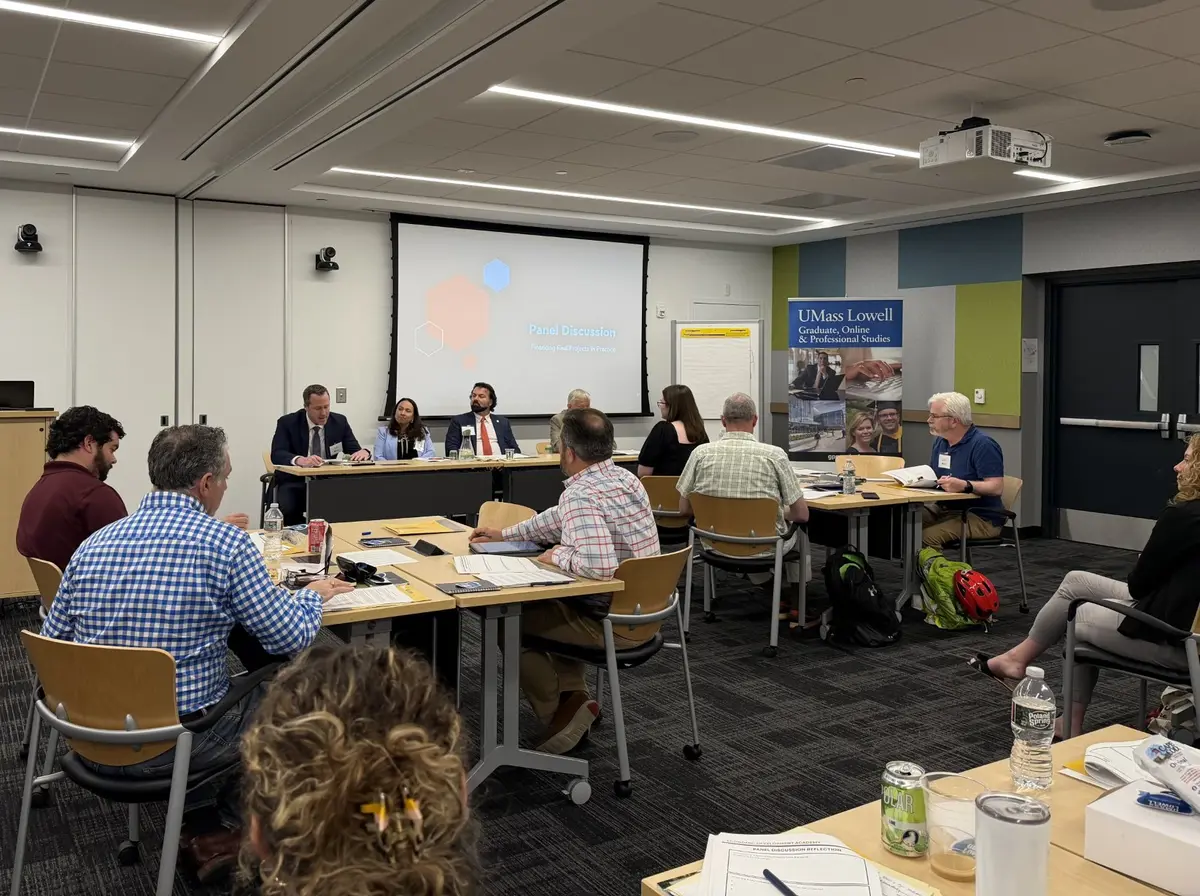 Image by Sara Leng
 Conor Baldwin, assistant city manager of Lowell and an adjunct faculty member at UMass Lowell, and other panelists speak during a practical workshop.
Faculty across the college such as Nemon, an economic development consultant who teaches community economic development and other courses in the university’s Master of Public Administration (MPA) program, are key to that effort, Szczesiul says.
Through the Municipal Leadership Academy, cities and towns looking to promote existing staff may provide them with financial assistance to earn an MPA degree, which develops students’ management, financial and planning skills for government and nonprofit jobs, Szczesiul says. Some may also enroll their IT staff in cybersecurity certificate programs, an urgent and growing need.
The idea for the Municipal Leadership Academy grew in part from a collaboration with the state and the Lawrence public schools on a “Grow Your Own Teachers” program that provides paraprofessionals with the education and classroom experience they need to become licensed teachers.
Szczesiul says that the Lawrence public schools also had administrative staff they wanted to prepare for career advancement. The university created a similar program that helped those staff members earn an MPA, a master’s of education in education administration or, for those who already had a master’s degree, an Education Specialist degree in educational administration.
The next steps for the Municipal Leadership Academy include forging partnerships with cities and towns, first by learning what they need, Szczesiul says. With the support of Sara Leng, the college has already begun the process with Lowell and will soon be reaching out to other communities in the Merrimack Valley.
Meantime, UMass Lowell undergraduates, especially in the humanities, aren’t always aware of the career opportunities in public service, Szczesiul says. The Municipal Leadership Academy will develop pathways to help them turn their passion for social justice and their critical thinking, writing and research skills into public and nonprofit careers, she says.
“Many of our undergraduates are justice-minded, so how do we help them think about that in terms of a career?” she says. “Bachelor’s to master’s to career, building in internships along the way, is definitely an important part of the Municipal Leadership Academy.”

