
 Image by courtesy
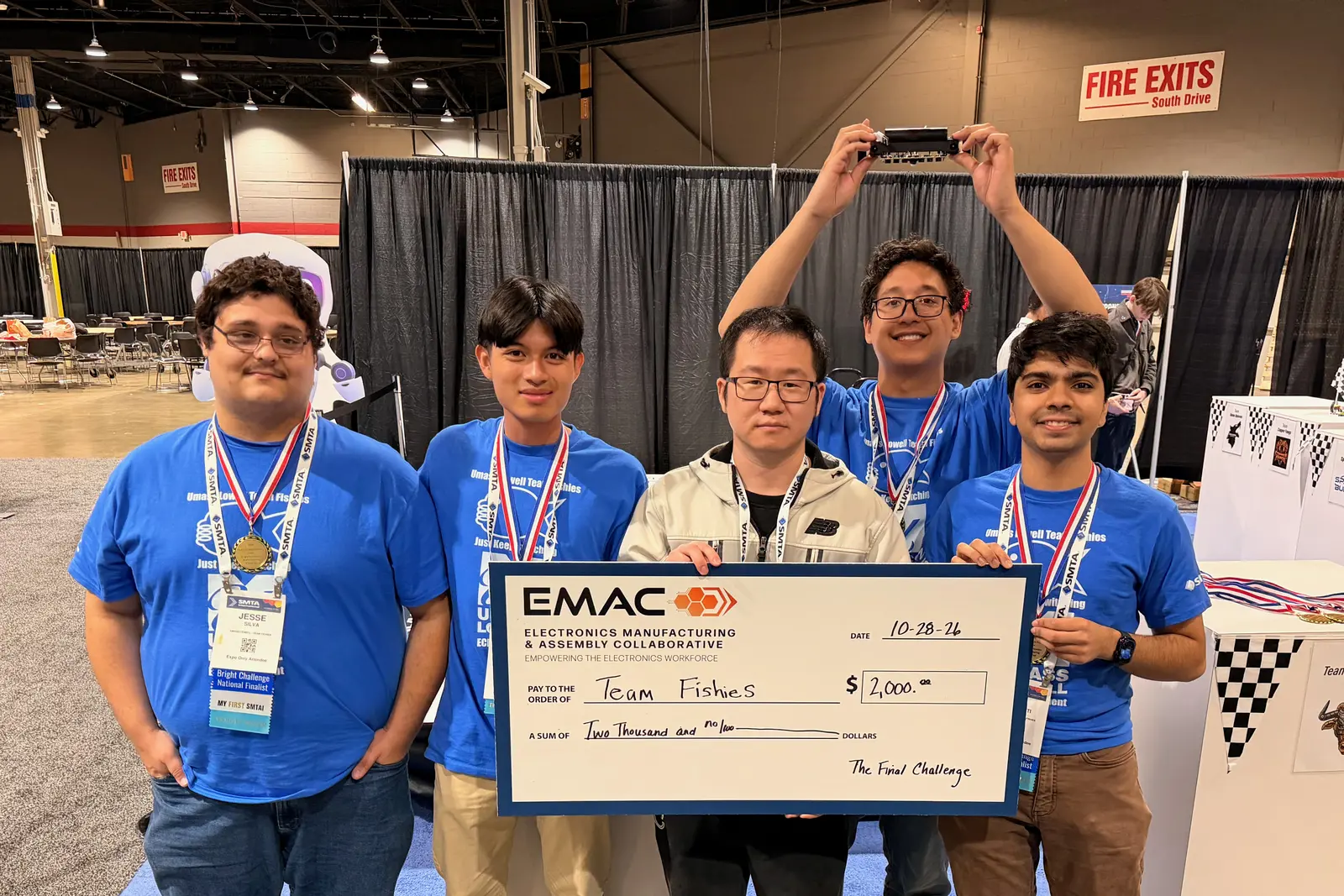
Led by adviser Hong Tang, center, Francis College of Engineering students, from left, Jesse Silva, Nico Ly, Jackson Doan and Neil Prajapati captured the first-place prize of $2,000 at the recent Bright Electronics Manufacturing Challenge in Rosemont, Illinois.
It was 3 a.m. at a hotel just outside of Chicago, and UMass Lowell’s Team Fishies had a problem.
The final round of the Bright Electronics Manufacturing Challenge, a national competition that requires college students to design and build a robot that can independently navigate a winding route, was just hours away.
Team Fishies, which included computer engineering majors Jesse Silva and Neil Prajapati, electrical engineering major Nico Ly and mechanical engineering major Jackson Doan, was working late into the night fine-tuning its robot on a test track — as were the other 10 finalist teams staying at their hotel.
The UML students noticed that the University at Buffalo team’s robot was successfully navigating the trickiest part of the course — an obstacle their own robot still couldn’t handle.
“We need to get this fixed now if we want to win this,” Silva, a senior from Peabody, remembers thinking.
So Doan and Prajapati kept working until 5 a.m.
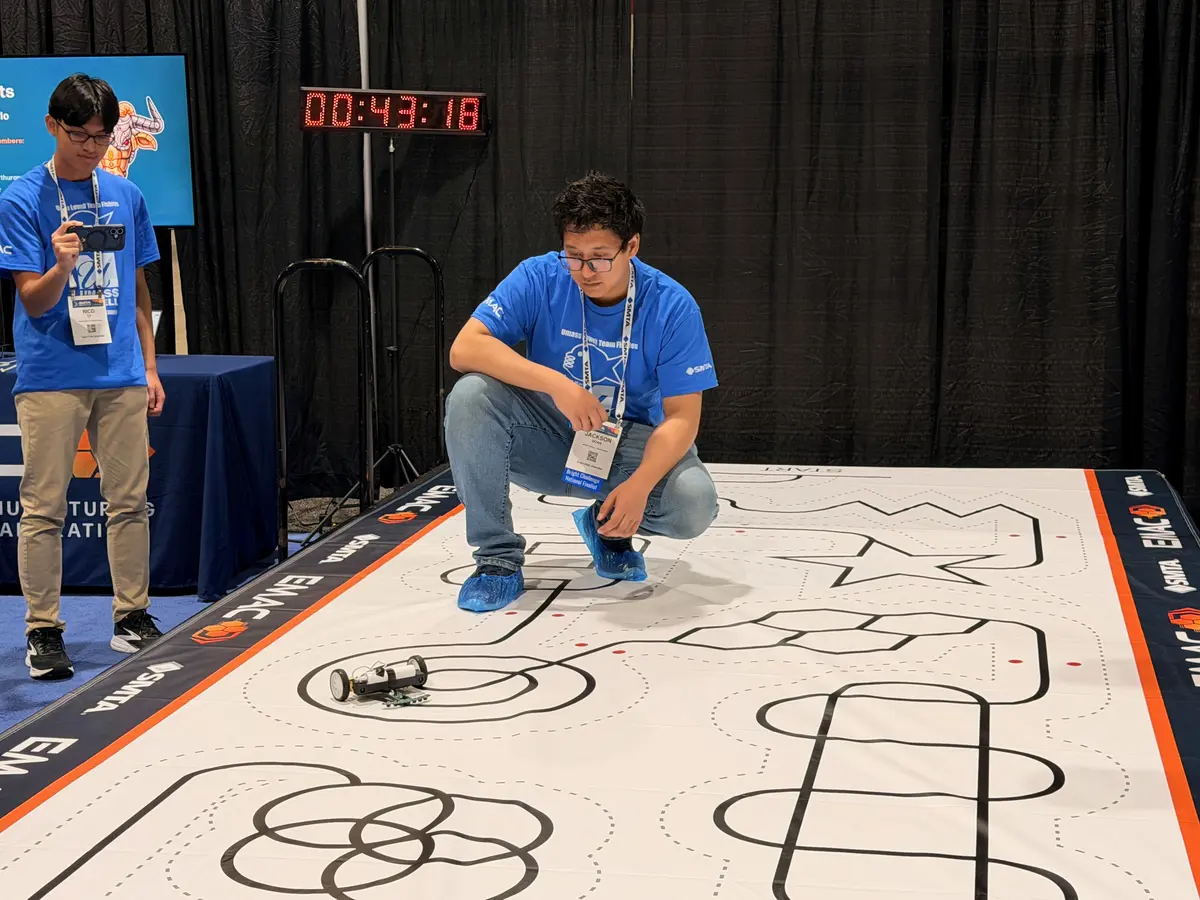 Image by courtesy
Senior mechanical engineering major Jackson Doan watches the Team Fishies robot navigate the course while teammate Nico Ly records the action on his phone.
“It was a long night, but it was great to see the fruition of that hard work with a win,” says Doan, a senior from Whitinsville.
The second annual competition, organized by the Electronics Manufacturing and Assembly Collaborative, drew 31 teams from 14 schools, including Boston University, Drexel University and the University of Minnesota.
Teams are required to design, assemble and test a custom-printed circuit board that serves as the control center for a robot.
The Francis College of Engineering had seven teams enter the competition’s first round, which was held remotely over the summer and focused on printed circuit board design. Team Fishies, advised by Electrical and Computer Engineering (ECE) Senior Lab Manager Hong Tang, was the university’s only team to advance to the final in Rosemont, Illinois, after it tied for first place with Michigan Technological University.
Senior computer engineering major Kingsley Dike was also part of the team, but could not attend the final round.
The robot in the final round uses optical sensors to detect and follow a black line on the course. Wheel encoders helped the students measure distance and synchronize the wheel speeds, while an inertial measurement unit tracked the robot’s rate of rotation.
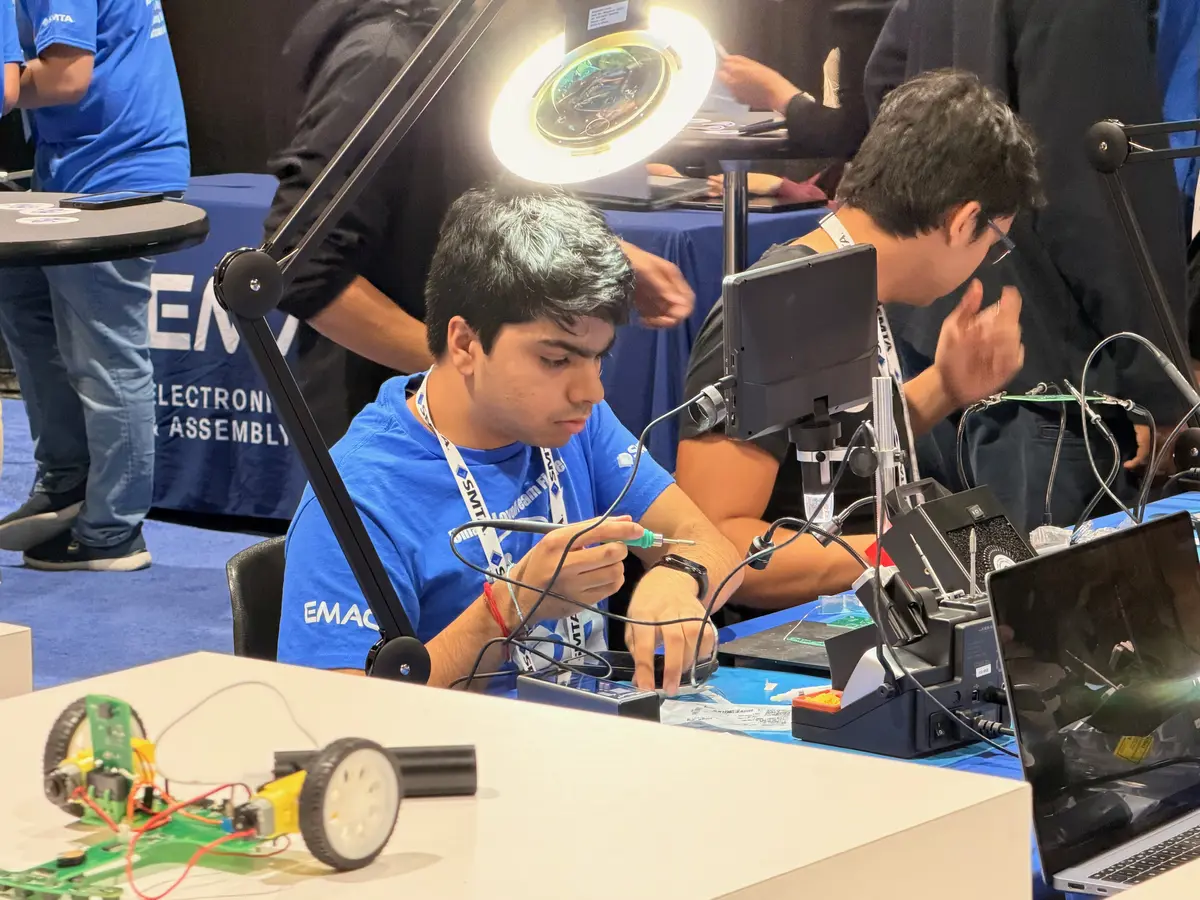 Image by courtesy
Senior computer engineering major Neil Prajapati solders the Team Fishies robot during the assembly round of the Bright Electronics Manufacturing Challenge.
“I got to take my skills that I’ve learned as a student and actually apply them to a real engineering project,” says Prajapati, a junior from Minnesota. “It’s fun to work with students on a group project when it’s not really tied to grades or work.”
For Doan, the project gave him a chance to work with electronics and controls in ways he normally would not as a mechanical engineering student.
“This was a much more hands-on experience, and I was able to learn a lot faster,” he says. “It helped me get my feet wet in some of the electronics components that I normally wouldn’t otherwise have learned.”
For Ly, Prajapati and Dike, the victory was especially meaningful; all three competed in the inaugural event last year, finishing third overall. While balancing the competition with industry co-ops, the students built and tested their printed circuit board earlier this year and arrived at the competition better prepared, they say.
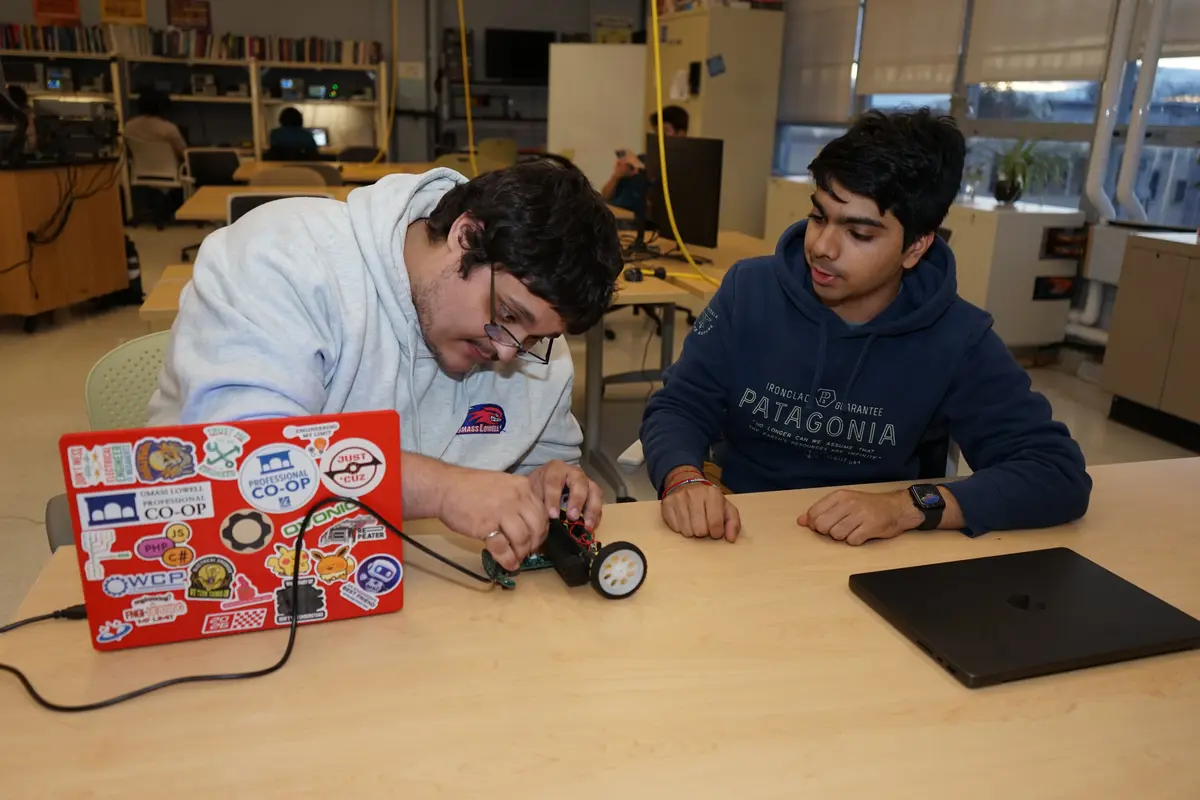 Image by Ed Brennen
Team Fishies members Jesse Silva, left, and Neil Prajapati inspect their winning robot at the Electrical and Computer Engineering MakerSpace at Ball Hall.
The name “Team Fishies” came from a bonus question on an exam, Silva says. Associate Teaching Professor Rachel Wakim had used a drawing of fish in a question involving inductors, and the students adapted the image for their logo.
The trip to the national competition was funded by the ECE department and Brooks Automation, which also supports the ECE MakerSpace at Ball Hall.
The competition gave the students a chance to meet recruiters and industry professionals. Silva brought several of his personal projects to show, including an LED business card, as he built his professional network.
He encourages other engineering students to seek out similar opportunities.
“Get your friends together, do projects and go out to competitions. Companies love this kind of stuff,” Silva says. “I’m proud to represent UMass Lowell and even prouder of what our team accomplished.”