
Topics: Graduate Student Success Education
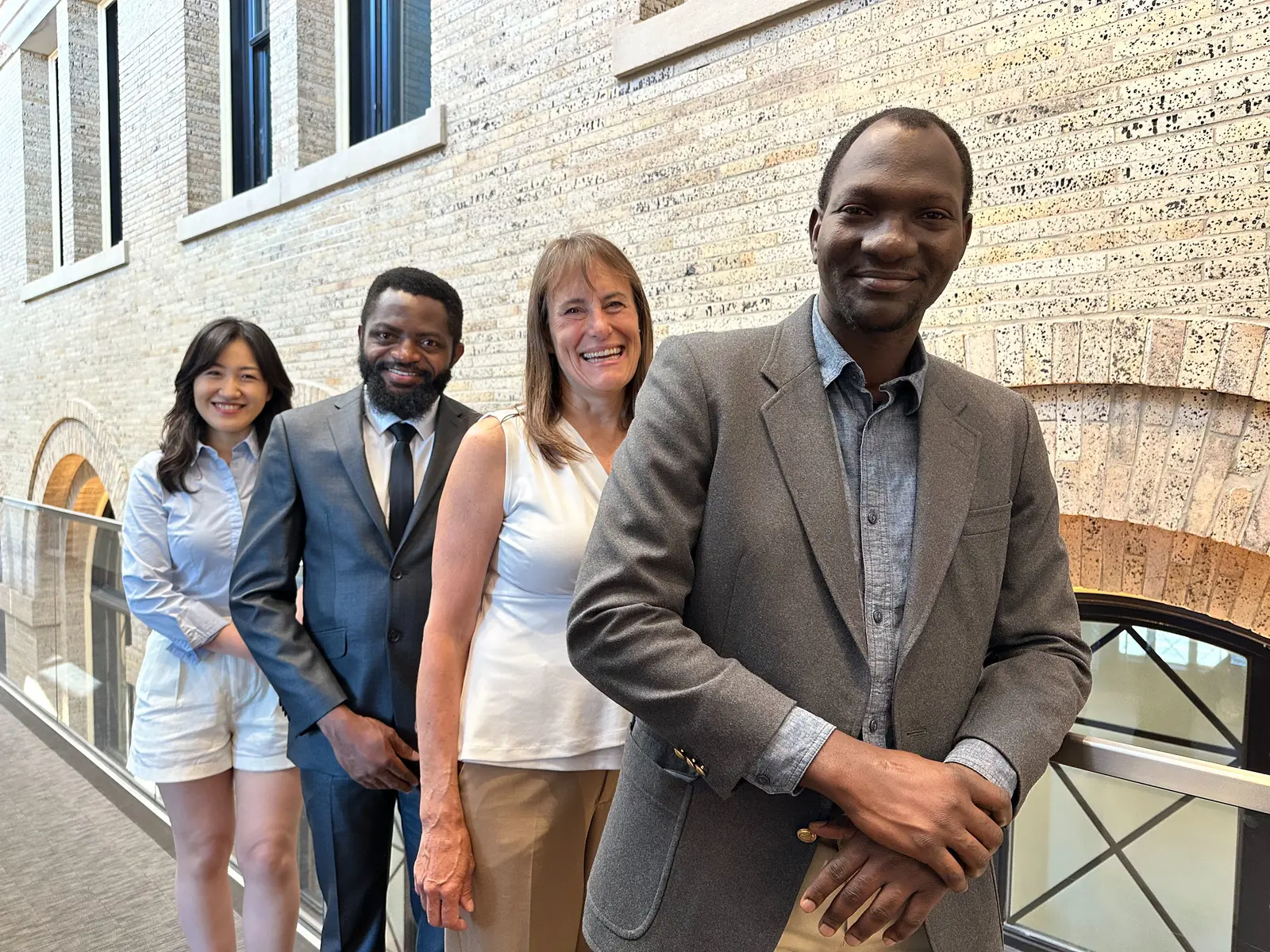 Image by K. Webster
 Education Ph.D. students in research and evaluation Youlim Lee, left, Terkuma Asongo, second from left, and Adefisayo Ojo, right, won a national program evaluation competition this year with coaching from Associate Dean of Graduate Studies Jill Hendrickson.
When their team of education Ph.D. students won second place in a national program evaluation competition last year, Terkuma Asongo and Adefisayo Ojo were satisfied.
“For me and Terkuma, it was just an opportunity to explore and to have some experience in evaluation outside our course,” Ojo says. “We thought, ‘That’s not so bad.’”
But another teammate, Youlim Lee, says that coming in second left her so frustrated and doubtful of her own abilities that “I cried.” She insisted that the three of them compete again this year in the American Evaluation Association’s Student Case Competition.
They did – and they won, besting teams fielded by other colleges and universities with strong evaluation programs. They will represent the United States in the World Evaluation Case Competition this November.
Competing this year boosted the trio’s confidence in their professional futures, Asongo says.
“It has given us a level of confidence that if there is funding for program evaluation, we can apply,” he says. “Because if we have the best plan of all these teams, then we can win the funding.”
It’s the second time in four years that a UMass Lowell team studying research and evaluation in education has won first place in the American Evaluation Association’s annual contest for students. A different UMass Lowell team won the inaugural U.S. contest in 2023 and placed third in the world competition that year.
Program evaluation, which is essential to education, public health, criminal justice and other social institutions and initiatives, is the process of collecting and analyzing both quantitative and qualitative data to determine the effectiveness of programs, policies and organizations.
The American Evaluation Association contest, which is held online, gives teams of three to five college or university students eight hours from the time they open the “case” – the program and policies they must plan to evaluate – to choose the appropriate evaluation framework and detail how they would apply it, from interviewing people to analyzing data.
This year’s case involved studying how and whether four different countries were adhering to the policy on engagement with Indigenous people adopted in 2022 by the International Fund for Agricultural Development, a United Nations agency that addresses rural poverty.
The standard requires freely given, prior and informed consent by the Indigenous people and communities where the agency works, rights-based participation in the agency’s programs, and culturally responsive engagement.
The three teammates, all of whom are pursuing the Research and Evaluation in Education option within the education Ph.D. program, agreed right away on the appropriate framework: culturally responsive evaluation. Then, they outlined a plan for evaluating whether the standard was being implemented in India, the Philippines, Nepal and Laos.
The three judges in the final round praised the UMass Lowell team’s understanding of how the U.N. agency’s work with Indigenous people should be assessed both within and between countries.
“One of the strongest aspects of this submission is how consistent and connected the overall framework feels. Culturally responsive evaluation is not just mentioned as a concept, but is reflected throughout the proposal,” one judge wrote. “That level of alignment is not common in student submissions and shows thoughtful evaluation design.”
The students credit their work with Associate Dean of the School of Graduate Studies Jill Hendrickson, the founding director of the university’s Center for Program Evaluation and the team’s coach.
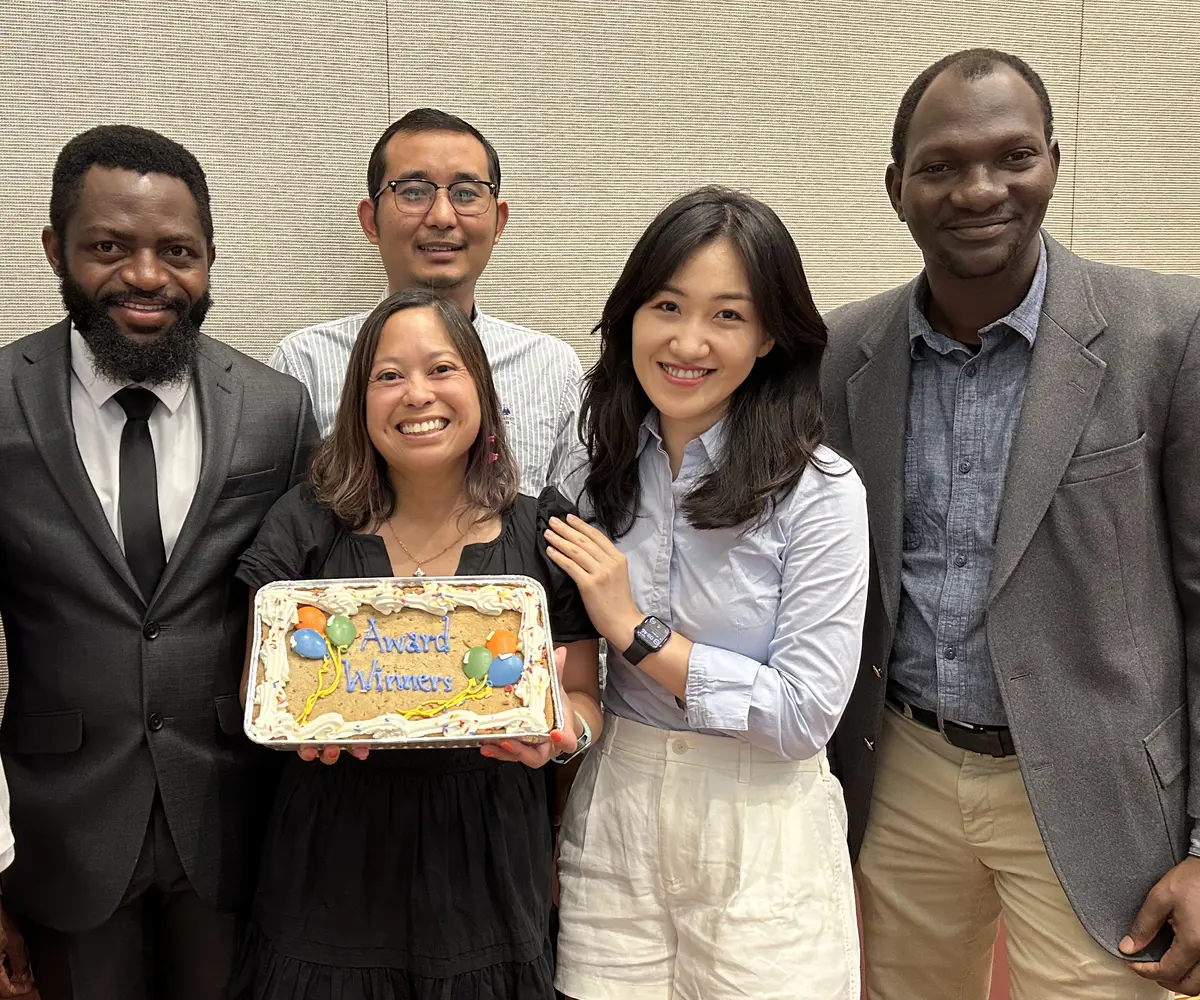 Image by K. Webster
 Asongo, Lee and Ojo pose around a "winners" cake with fellow research and evaluation Ph.D. student Lugyi No, who just won a Spencer Foundation Dissertation Fellowship, and Assistant Professor Christine Leider, who coordinates the education Ph.D. program.
Hendrickson teaches Advanced Program Evaluation, in which she groups students into teams that must choose a real-world nonprofit program to evaluate, decide on the appropriate framework and design the evaluation questions and methods. The students then conduct the evaluation and write a report to share with the nonprofit.
“We learn problem-solving, stakeholder analysis and evaluation design … data interpretation and even research communication,” Asongo says.
Hendrickson says that students are not required to compete in the U.S. Student Case Competition – no one took up the challenge in 2024, and the university fielded two teams last year – but students who do compete get the benefit of thoughtful critiques by seasoned professionals.
“It’s meant to be a learning experience,” Hendrickson says. “The judges take seriously the opportunity to provide feedback in an educational way.”
The three students said that the judges’ comments from last year’s contest helped them up their game this year.
Asongo, a fourth-year Ph.D. candidate from Makurdi, Nigeria, who plans to use his degree to improve schools and better understand how artificial intelligence is affecting teachers, says that before he took Hendrickson’s class, he preferred working on his own. Now, he understands the importance of teamwork.
“Other people challenge your assumptions – how you know what you know, what you think is right – and you come to a compromise,” he says.
Ojo, who is from Lagos, Nigeria, says he was attracted to UMass Lowell’s education Ph.D. because of the range of students’ backgrounds – “I have a math background, Youlim has an English background and Terkuma has a science background” – and the opportunity for each student to pursue their own research interests.
As he enters his third year in the Ph.D. program, Ojo is leaning toward research into predictors of student outcomes, so that he can help schools and universities better understand what interventions will help struggling students to succeed.
Lee, previously an English teacher from Busan, South Korea, who is also starting her third year, says she plans to do research that will help her to teach students how to use artificial intelligence “wisely.”
She says she came to UMass Lowell because it was founded as a teaching college and because she wanted to expand her horizons. For the same reason, she and her teammates are looking forward to the online World Evaluation Case Competition, where they will get to meet – and measure their skills against – students from many different countries.
“I like challenges,” Lee says. “I don’t want to be a frog in a well. I want to see the broad world.”