
 Image by courtesy
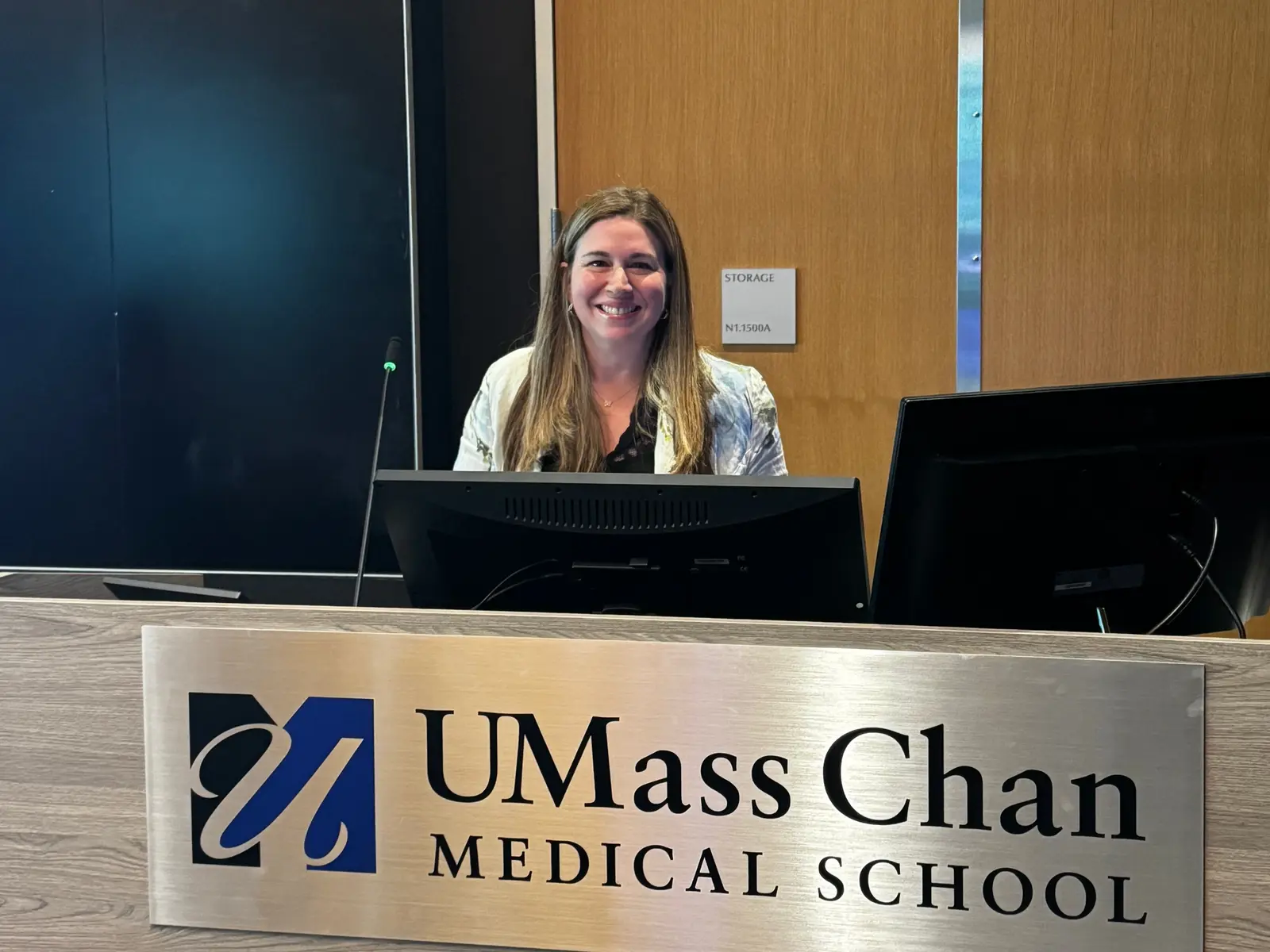
Manning School of Business Associate Professor Denise Dunlap is helping researchers develop a model for bringing suicide prevention training to hospitals and health care organizations.
Hospital staff may encounter patients at risk of suicide without having specialized training in how to care for them. Researchers at UMass Chan Medical School are working to address that gap by developing training that can help health care professionals provide more effective support.
But getting that training into hospitals — and making sure it can be sustained — is a challenge of its own. Health care organizations face staff shortages, limited funding, overcrowding and competing demands, while mental health services are not always easy to support through existing reimbursement models.
Denise Dunlap, an associate professor in UMass Lowell’s Manning School of Business, is helping researchers think through those challenges. As the business development unit lead for the Center for Accelerating Practices to End Suicide, or CAPES, she brings expertise in entrepreneurship, innovation and commercialization to the effort.
This summer, Dunlap co-hosted the Project Catalyst Business Canvas Retreat with CAPES Co-Director Edwin Boudreaux, a professor at UMass Chan Medical School. The two-day event brought together researchers, clinicians, implementation specialists and business experts to explore how Care Catalyst, a suite of suicide prevention training services, could reach more hospitals and health care organizations.
Dunlap involved two first-year doctoral students in UMass Lowell’s Marketing, Entrepreneurship and Innovation department, Farhana Akther and Sai Chaitanya, in the retreat. The students helped Dunlap develop case studies and prepare a business model canvas, a template that defines the building blocks for developing businesses. Their work helped participants consider who would use Care Catalyst, how hospitals could support it and what would be needed to sustain the program.
Project Catalyst is supported by Four Pines Fund, a philanthropic organization dedicated to expanding access to evidence-based suicide care for all who need it.
Dunlap’s work with Project Catalyst is part of her broader focus on improving mental health through research, innovation and collaboration. In 2024, she organized UMass Lowell’s “Friend or Foe: Transforming Social Media & AI for a Healthy Future” symposium, which was co-hosted by CAPES and brought together researchers, students and mental health experts to examine the effects of technology on well-being. She recently spoke about related issues at the Make America Healthy Again (MAHA) Institute’s Summit on Screen and Social Media Harms in Washington, D.C.
Dunlap sat down to discuss Care Catalyst, the retreat and the role of business expertise in helping academic innovations reach the people who need them.
What is Care Catalyst, and what problem is it designed to address?
Edwin Boudreaux saw hospitals asking for training to help their staff work with people who are suicidal. He was providing that training himself, but he is only one person. Care Catalyst is a suite of online training services that could have a broader impact across multiple hospitals. The goal is to help people in health care settings provide better care to patients who are experiencing suicidal thoughts or behavior.
Why is it difficult to move suicide prevention research into hospitals and other health care organizations?
Health care systems are already struggling with limited funding, limited time and overcrowding. Asking people to add training when they are already working long hours is difficult. There is also the question of how the hospital pays for it. This is not something that can necessarily be charged directly to a consumer. It has to come out of an internal budget.
You are also dealing with a vulnerable patient population that often does not have the resources to pay for help. Ideally, people would receive support before they reach the emergency room, but sometimes that is where they end up because other systems have failed or they could not find the resources they needed.
When people hear “commercialization,” they may think about developing a product to sell for a profit. Is it difficult to apply that way of thinking to suicide prevention?
It’s very difficult. It doesn’t feel like this should be treated as a profitable business. It feels like it should be part of the hospital system or supported through a nonprofit model.
The researchers and clinicians working on these innovations are focused on helping people. The last thing many of them want to think about is business. They may assume that if the idea is good enough, it will naturally reach the people who need it. But that is not usually how it works.
If Care Catalyst is going to reach more than one hospital, the team has to think about funding, partnerships, implementation and scale. The goal is not simply to make money from suicide prevention; it is to find a sustainable way for the training to continue and reach more people.
What does business expertise add to that process?
Researchers and clinicians can have excellent ideas, but they may not have the experience needed to bring those innovations into practice. Someone has to think about who will use the training, how hospitals will support it, what evidence they need and how the model can grow.
What did you hope your Ph.D. students would take away from working on the project?
They are both early in their doctoral programs, so I wanted to involve them in this work as soon as possible. They were able to learn about the business model canvas, develop case studies and then see how those tools applied to people working on a real health care challenge. They were excited because, in entrepreneurship, we often talk about business models in the abstract. This gave them the opportunity to see the people and the problem behind the work.
What do you hope comes next for Project Catalyst?
I hope it leads to more collaboration between business and medical researchers. People are often working in silos, even though there are tremendous opportunities to learn from one another. I would also like to see UMass Lowell build an even stronger entrepreneurial culture — one that gives researchers more support as they move promising ideas into practice. Universities are well-positioned to develop new solutions, and I would like to see more of those solutions reach the people and communities they are intended to serve.