
 Image by Liz Cole
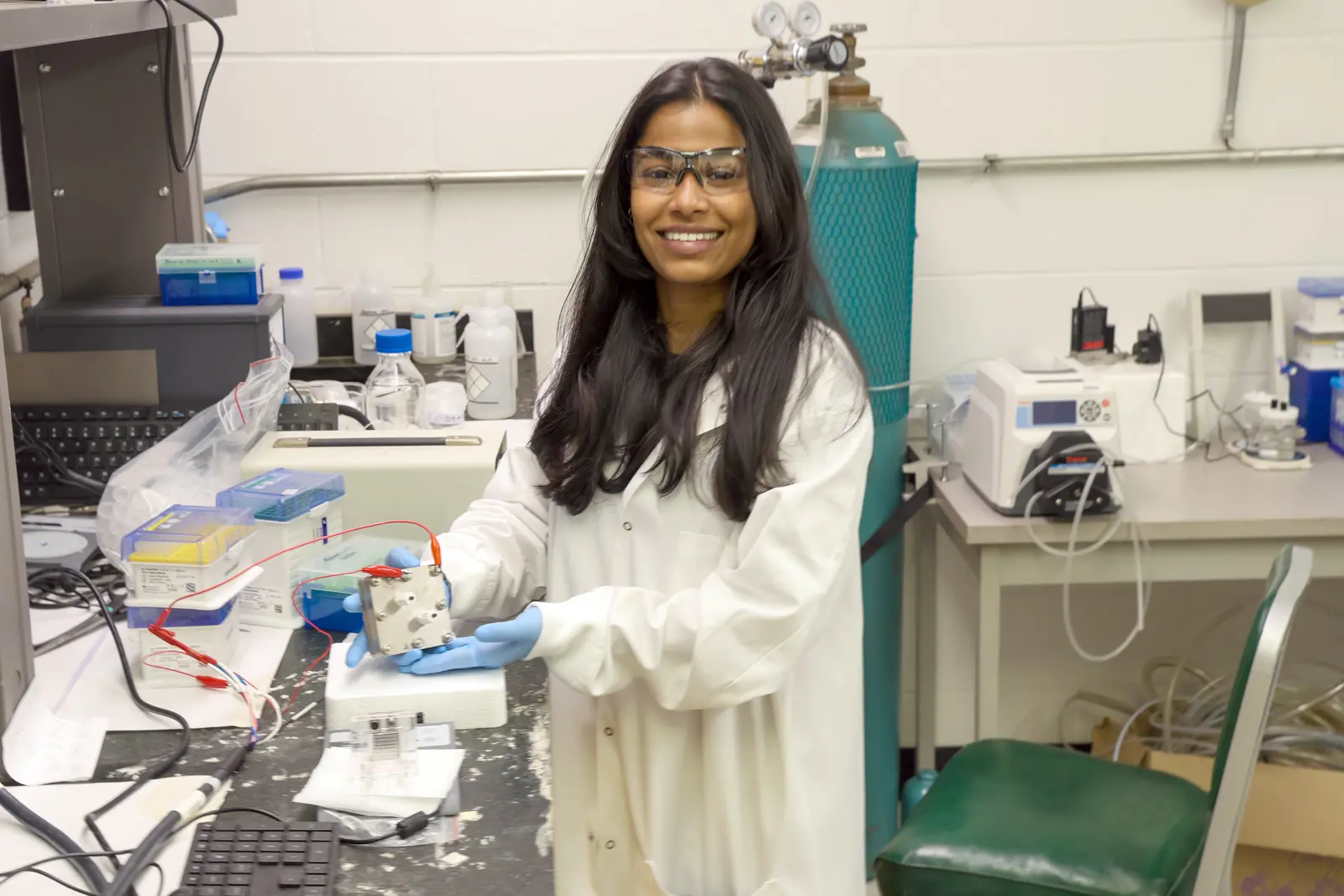
 Chemistry Ph.D. student Porvajja Nagarajan was recently recognized as the top female energy engineering student in the United States for her work in advancing clean, sustainable energy.
Chemistry doctoral student Porvajja Nagarajan is researching a process that uses electricity and metal nanoparticles to turn carbon dioxide (CO2), an important, long-lived greenhouse gas that contributes to climate change, into chemical feedstocks for fuels, perfumes and other materials. The process means that fewer fossil fuels need to come out of the ground and that human-created CO2 can be removed from the air.
“You’re taking a molecule with one carbon, CO2, breaking that bond and adding more carbons to try to turn it into a molecule with two or more carbons or, in the case of jet fuel, eight or more carbons,” Nagarajan says. Her work is to make the process more efficient: “It’s quite challenging.”
Nagarajan was recently awarded the Ruth Whitlock Scholarship by the Association of Energy Engineers (AEE), recognizing her as the top female energy engineering student in the United States. Just one other Ruth Whitlock scholarship is awarded by the organization each year, to the top female energy engineering student studying overseas.
AEE says that the scholarship winners represent the next generation of leaders committed to advancing a clean and sustainable future. The organization gave Nagarajan a $4,000 scholarship for her continuing studies.
Nagarajan learned about the scholarship through the university’s Center for Energy Innovation, an initiative that facilitates research collaborations between the university and industry partners.
“I think it’s super-impressive that Porvajja was one of two women in the world recognized by this scholarship,” says Michael Ross, an associate professor of chemistry. “There are different kinds of awards, and this one is a recognition of all her accomplishments.”
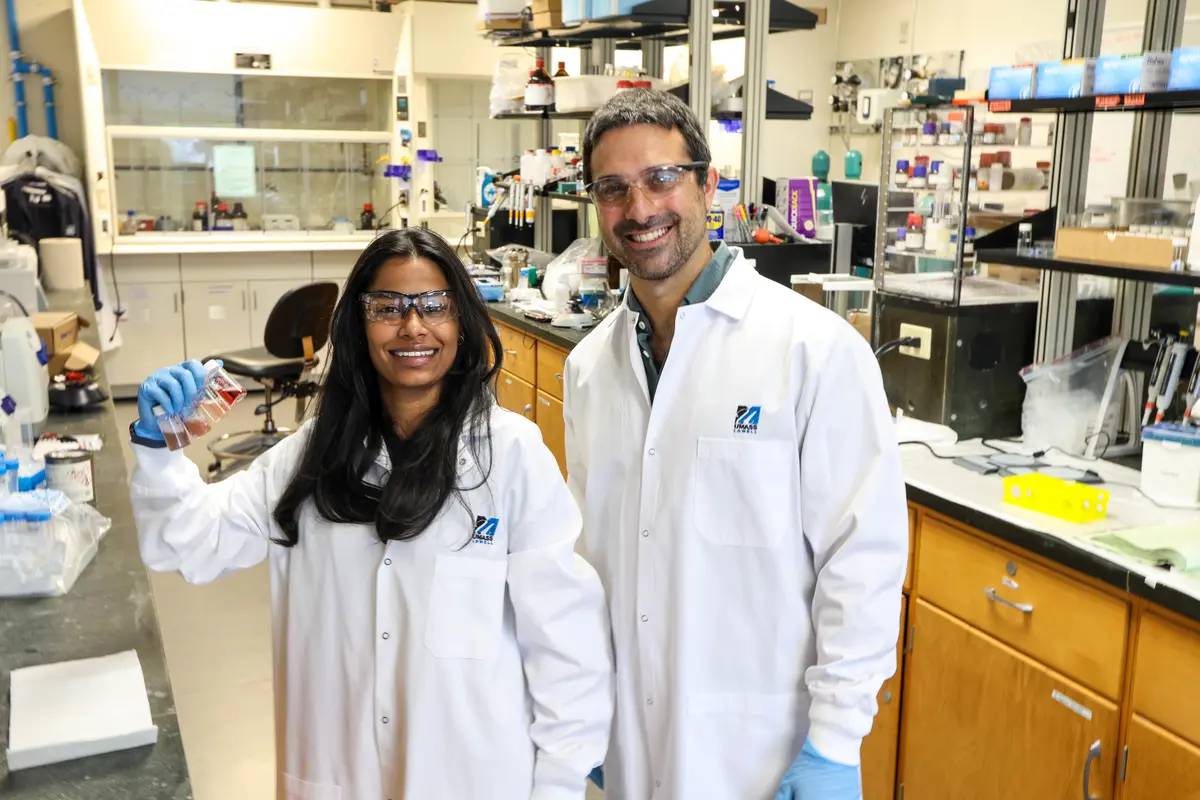 Image by Liz Cole
 Working in the lab of Associate Professor of Chemistry Michael Ross, right, Ph.D. student Porvajja Nagarajan is researching a process that uses electricity and metal nanoparticles to turn carbon dioxide into chemical feedstocks for fuels, perfumes and other materials.
“One of the interesting things about Porvajja is that her undergraduate degrees are in chemical engineering, but my lab is in chemistry,” Ross says. “She’s brought a distinct expertise to my lab.”
After completing her undergraduate degree in chemical engineering at Shanmugha Arts, Science, Technology and Research Academy in India, where she did her thesis on ways to cool hydrogen fuel cells so that they could be safely used in motorized vehicles, Nagarajan spent a year as a researcher, where she was introduced to large-scale CO2 conversion systems.
She was drawn to chemical engineering because it allowed her to include many engineering disciplines, such as mechanical and electrical engineering, into her undergraduate courses. She says she’s interested in the field of energy in general because it offers her the right amount of challenge, she says.
Nagarajan, who grew up in India, was considering graduate programs in Europe when the COVID-19 pandemic convinced her to choose a location that was closer to family, including a sibling and cousins in the U.S. When she saw a social media post that Ross had made looking for a Ph.D. student in his lab at UML, she replied immediately. What he was looking for was an exact match for her experience and skills.
Within a week of seeing that social media post, she had met with Ross by videoconference, gave up her search for a European program and put her focus on Ross’s lab and UML.
Nagarajan says that her biggest challenge during her Ph.D. program was learning to think like a chemist and not just like a chemical engineer. She says that thanks to all of her experiences at UML, from her colleagues in the Ross lab, her work as a teaching assistant and encouragement from professors, she has achieved a good balance between those mindsets.
That mix means Nagarajan feels confident in her abilities as she plans for her future by applying to postdoctoral programs. “I think I know what I’m doing,” she says, “and that's the progress I want to keep building on."