Topics: Faculty & Staff Sustainability
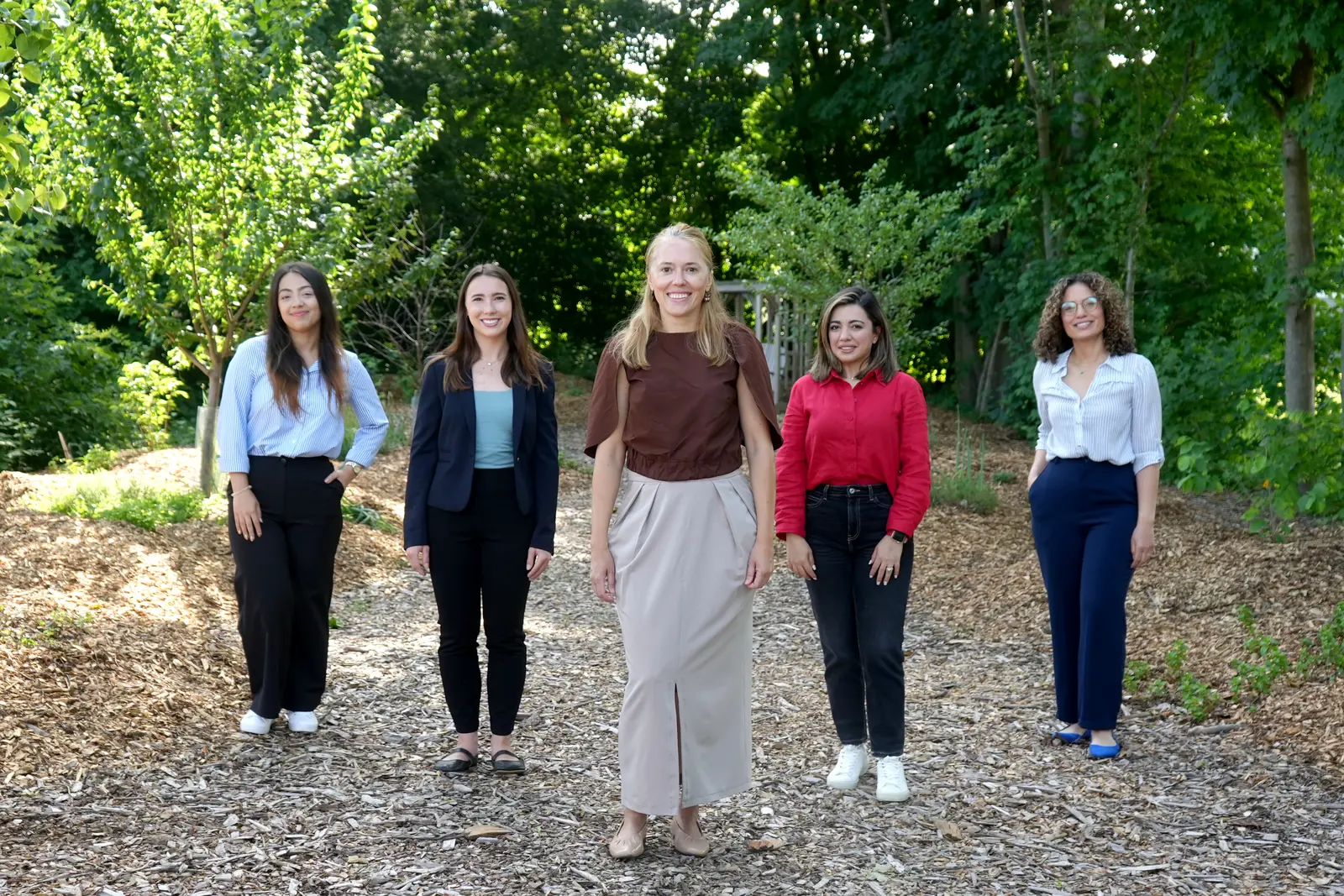 Image by Brooke Coupal
 Mechanical and Industrial Engineering Assistant Professor Jasmina Burek, center, recently won a National Science Foundation CAREER award. She will be working on her project with her research group, including, from left, Ph.D. students Aytan Hajiyeva, Alana Griggs, Mahsa Ghandi and Andrea Boero.
A common thread runs through Mechanical and Industrial Engineering Assistant Professor Jasmina Burek's life: fashion.
Growing up in Croatia, Burek had all her clothes made by her maternal grandmother, a talented seamstress. Those skills were passed down to Burek’s mother, who continues to make clothes for Burek. Burek’s father and paternal grandmother knitted and sold sweaters. At one point, Burek considered becoming a fashion designer.
And now, Burek is integrating fashion into her research.
The National Science Foundation (NSF) awarded Burek a Faculty Early Career Development (CAREER) grant worth nearly $600,000 to develop tools that will help decision-makers find the most sustainable strategies for keeping unwanted clothing and other textiles out of landfills. CAREER grants are the NSF’s most prestigious awards in support of young faculty who have the potential to serve as academic role models in research and education.
“I actually tracked the hours I spent on my project proposal. It was 300 hours. I put my heart and soul into it,” Burek says. “This is recognition that my work matters.”
Reuse, Repair or Recycle
What should a person do once they’re done with a garment? Repair it? Recycle it? Repurpose it?
All those options keep the textiles in circulation, but as Burek says, “Not everything that is circular is necessarily sustainable.”
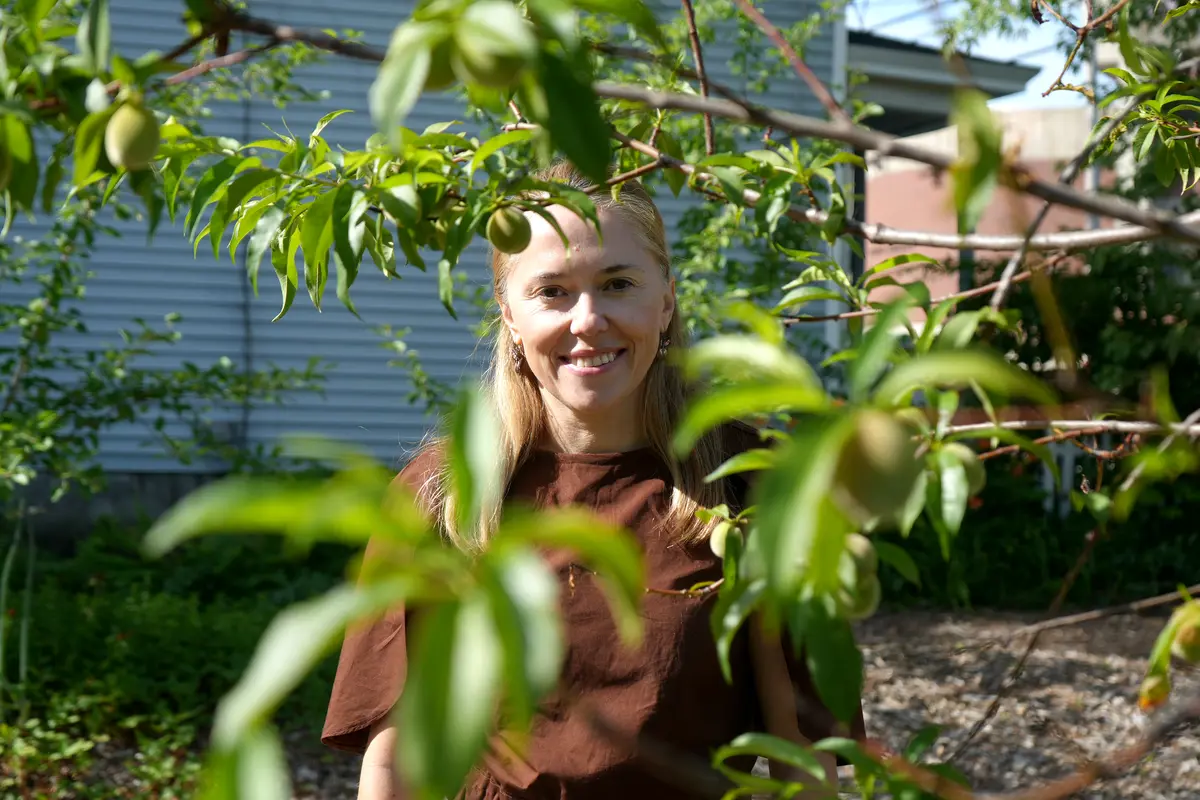 Image by Brooke Coupal
 Assistant Professor Jasmina Burek stands behind a peach tree in the UMass Lowell Food Forest. As part of her NSF CAREER award, she plans to host a fashion show of collected garments in the Food Forest.
Through her NSF CAREER-funded project, titled Sustainable Textile Industry Through Circular Handling (STITCH), Burek is studying the environmental impacts of reuse, repair and recycling strategies to find the most sustainable options. The STITCH framework will integrate life cycle assessment – a method to assess a product’s environmental impact throughout its life cycle, circular economy assessment, machine learning and predictive modeling to evaluate circular textile systems and inform policy.
“There’s a general notion that circularity is good. But how good? And which circular strategies are better?” she asks. “There’s always a trade-off.”
For instance, a person may decide to donate their unwanted clothing by putting it in a collection bin. The benefit is that the clothes will stay out of a landfill. However, the energy used to collect the unwanted clothing can negatively impact the environment. The collection bin required energy to be produced and will require additional energy when the garments are collected, sorted and repurposed. The unwanted clothing is also typically placed in a plastic bag, adding to the world’s plastic pollution.
“We are reducing our environmental impact in one way, but we are shifting the burden somewhere else,” Burek says. “I want to solve the problem of circularity and educate others on how we can minimize our impact.”
Informed Decision-Making
In November 2022, Massachusetts banned clothing, footwear and other textiles from disposal. The state maintains the “Beyond the Bin Recycling Directory” for residents and businesses to find nearby locations to donate their textiles.
Burek plans to work with the Massachusetts Department of Environmental Protection, as well as textile recovery organizations such as Helpsy and Planet Aid, to collect data on the state’s textile reuse pathways. She sees her research helping the state make better-informed decisions.
“I want my research to positively affect policy,” Burek says. “I want to end up with a textile program that can be replicated across the United States.”
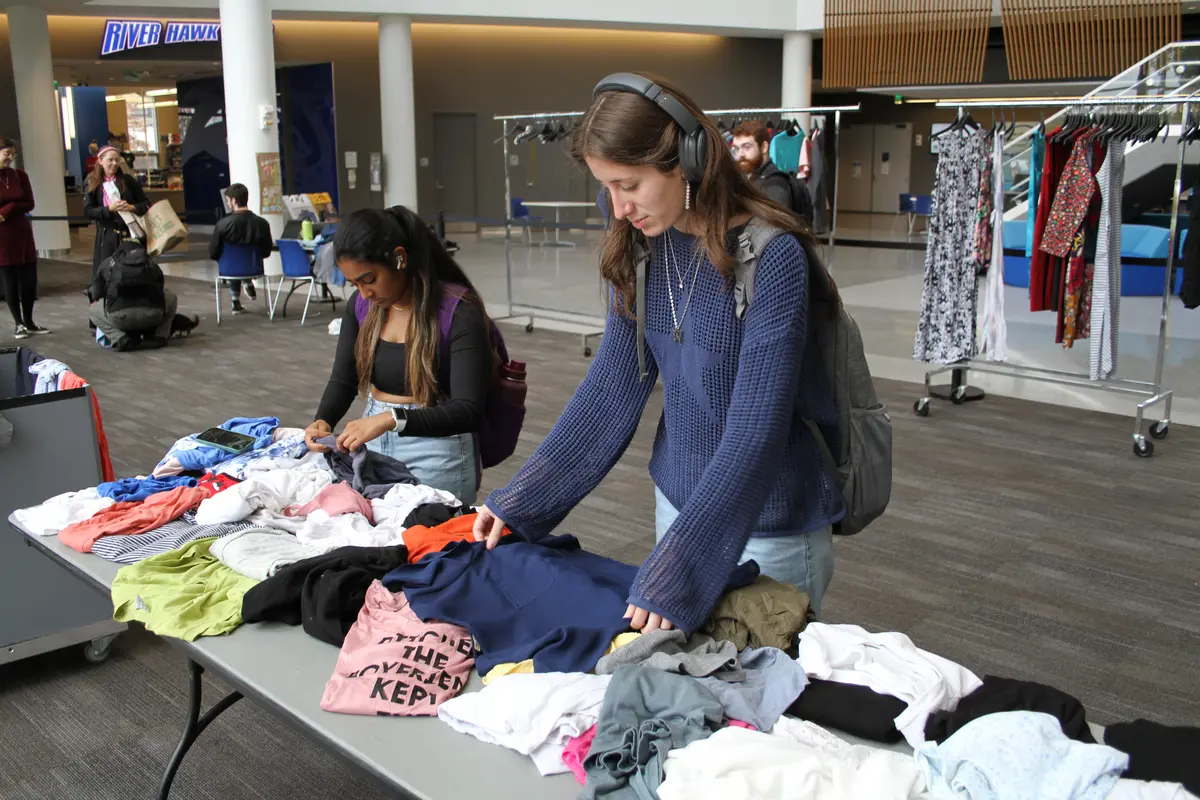 Image by Brooke Coupal
 Students sift through donated clothes during Thrift Day at the Meehan Student Center. Assistant Professor Jasmina Burek is examining what UMass Lowell does to keep textiles out of landfills through initiatives like Thrift Day.
Burek is also analyzing what UMass Lowell – the highest-rated campus in Massachusetts for sustainability – is doing to keep textiles out of landfills. She is collaborating with the Rist Institute for Sustainability and Energy and the Student Society for Sustainability to examine how programs like Thrift Day help the environment.
Working with the Department of Plastics Engineering and the Fabric Discovery Center, Burek is also investigating the quality of textiles over time.
“When people think about circularity, they imagine that materials come back to their origins. But it’s more like baking a cake — you can’t get the eggs from it,” she says. “We can reuse the material, but it’s not going to be the same. So how many times can you reuse, repair or recycle it?”
To better understand how garments move through multiple lives, Burek is using thermodynamics, probabilistic modeling and machine learning to predict how quickly garments degrade and the likelihood of the garments being reused, repaired or recycled.
Her findings will result in publicly available tools that will help policymakers, industries, researchers and the public decide the most sustainable ways to get rid of unwanted clothing and other textiles.
A team of student researchers will be assisting her with the project, which will include a fashion show of collected garments at the UMass Lowell Food Forest on South Campus.
“I want the students to make changes that have a positive effect on the communities around us and beyond,” Burek says.