
Expertise
(Quantitative Methods) Statistical Analysis, (Qualitative Methods) Interviewing and Focus Groups, Research Design, Visual Inquiry, Art and Archives
Research Interests
Program Evaluation, Psychometrics, Measurement of Learning, Language and Psychology
Education
- Doctor of Philosophy (Ph.D.), Research and Evaluation in Education - University of Massachusetts Lowell, USA - in progress
- Master of Arts (M.A.), Education - King's College London, United Kingdom
- Bachelor of Arts (B.A.), Social Anthropology - University of Kent, Canterbury, United Kingdom
- Bachelor of Education (B.Ed.), Teaching English and Social Sciences (License) - University of Mumbai, India
Biosketch
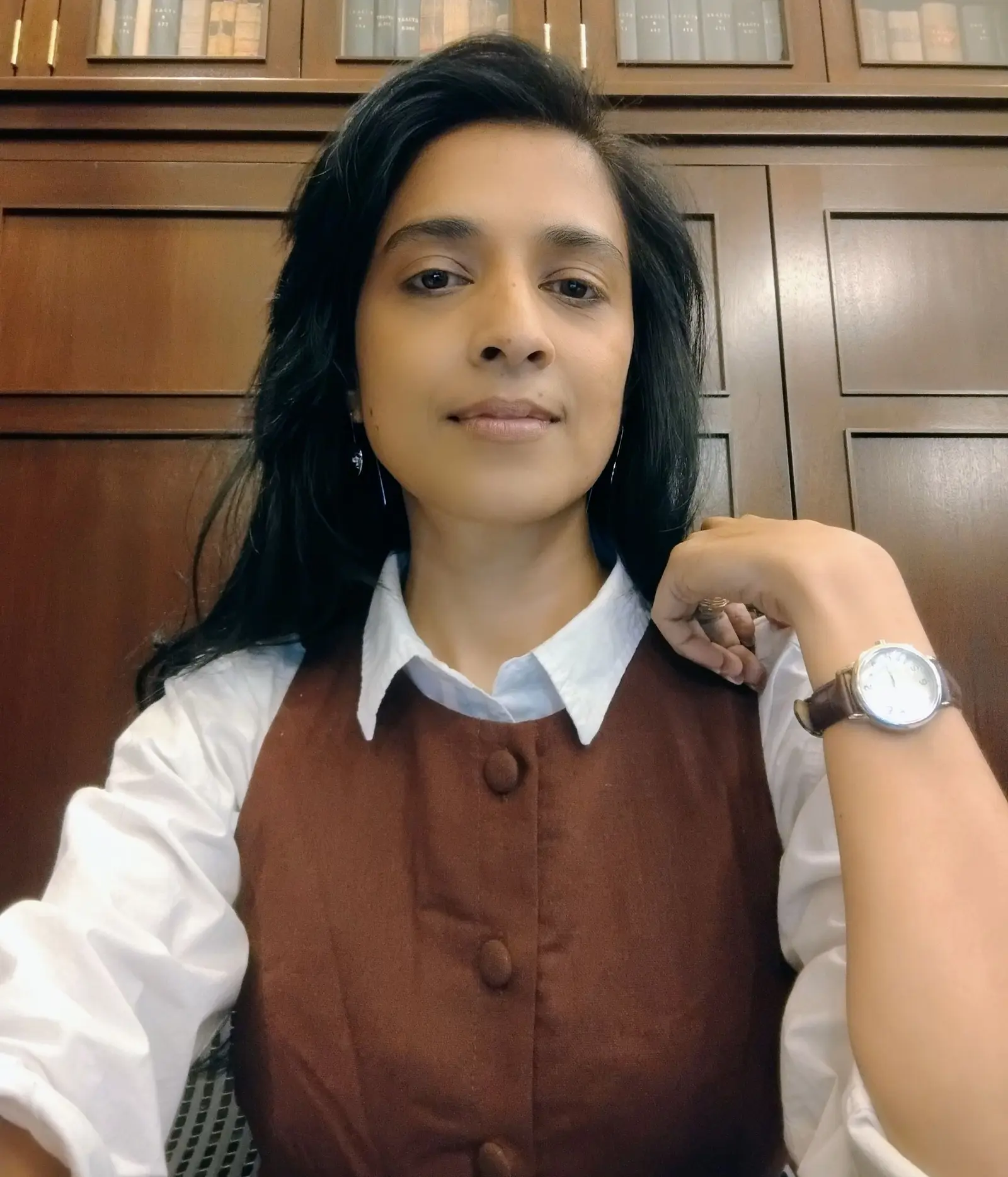
Dhanashree Karandikar is a doctoral student in Research and Evaluation in Education at the University of Massachusetts Lowell, with a background spanning education, social anthropology, and program evaluation. Her work is driven by an interest in how we understand, measure, and evaluate complex human experiences—particularly learning—and in what conventional methods may overlook. Drawing across quantitative, qualitative, and creative forms of inquiry, she is interested in research that is methodologically rigorous while remaining attentive to context, difference, and the ways people make meaning. At the heart of her work is a simple question: What becomes visible—or invisible—depending on how we choose to measure it?
Selected Awards and Honors
- Moloney Scholar’s Fund, EcoSonic Playground Project— University of Massachusetts Lowell, with Associate Professor, Elissa Johnson-Green, 2025
- Most Promising Teacher— University of Mumbai, 2012
- Best Community Project Award, “Shantivan” Community Project— University of Mumbai, 2012
Selected Presentations
- Karandikar, D. M., & Yazdani, N. (2025). *Comparing Focus Group Discussions and Individual Surveys.* Poster presented at the Annual American Evaluation Association Conference, Kansas City.
Research Currently in Progress
Center for Program Evaluation (CPE), UMass Lowell
As a Graduate Research Assistant at CPE, I contribute to applied program evaluation and research across education, workforce development, public health and safety, Science, Technology, Engineering, and Mathematics (STEM), and community-based initiatives. My work includes mixed-methods evaluation design, survey development and analysis, qualitative interviewing and coding, literature reviews, data analysis, and translating findings into evaluation reports and other products for program stakeholders. Working within CPE’s interdisciplinary environment has also shaped my growing interest in a deceptively simple question: what evidence actually allows us to say that a program “worked”? CPE itself brings together researchers from education, criminology, health, social sciences, and other disciplines to conduct internal and external evaluation work.
First-Year Writing Program: Student Success, Assessment, and Equity, UMass Lowell
I am currently working on research examining student success, persistence, and DWF patterns in UMass Lowell’s First-Year Writing Program. The project investigates what available institutional and program data can—and cannot—tell us about why students struggle in foundational writing courses, with particular attention to student characteristics, course structures, assessment, equity, and contextual barriers to success. My work includes reviewing prior assessment research, examining historical success and DWF data, identifying available and needed data, developing answerable research questions, and helping build the analytic foundation for subsequent quantitative and qualitative inquiry. The broader goal is not simply to identify who succeeds or struggles, but to better understand the conditions surrounding those outcomes and generate evidence that can inform programmatic improvement.