
Michael Gallagher, Gallagher & Cavanaugh Limited Liability Company (LLC)
Michael Gallagher’s contributions to the city of Lowell exemplify the high standards that he and the other interviewees in this archive set to jumpstart its revitalization. Michael’s initial involvement with the city came through public education organizations and programs; as he says in his interview here, the focus had to be on substantive change and not “more turkey raffles.” He grew up in the Fort Hill / Shedd Park neighborhood of Lowell. After obtaining his law degree and working for a Legal Aid Society in New York, he returned to Lowell in 1981 and joined Dick Donahue’s law firm, Donahue & Donahue. He soon became Chair of the Citywide Parent Council; he and Fred Faust (see the related interview) formed the Community Alliance for School Excellence; he was Lowell’s representative to the Commonwealth’s Commission on the Common Core of Learning; and encouraged by Paul Tsongas, he ran (successfully) for the School Committee. In the 1990s he founded the Youth Commission and co-founded the Healthy Summer and Community Schools Programs. In addition to his contributions in education, he also supported the physical rehabilitation of the city’s historic buildings. He deliberately located his own law firm, Gallagher & Cavanaugh, in the Gas Light Building (1859) at 22 Shattuck Street; and he used his formidable fund-raising skills to help non-profits in the city, such as the Lowell Community Health Center (LCHC), renovate historic mill buildings into modern facilities that created jobs and served the citizens of Lowell.
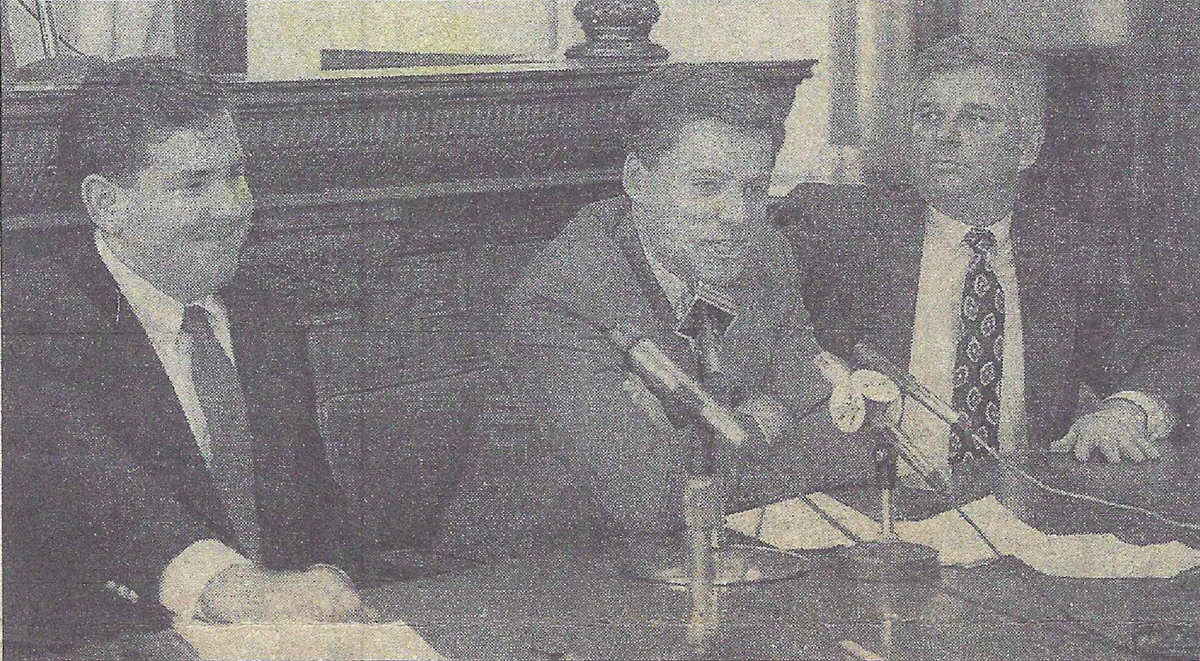 Image by Lowell Sun / Peter Costello
 Photo from the Lowell Sun newspaper, December 1995, of Roger Lang, Michael Gallagher, and Brian Martin.
Courtesy of Michael Gallagher.
The Interview
In his interview here, Michael begins with recollections of his own childhood in Lowell before turning to a lucid account of the challenges facing the city’s schools and students after his return in 1981. One of the schools still in use, the Colburn School (1848) at 136 Lawrence St., dated back to the Polk administration. Through the combined efforts of entities in the city that included the Citywide Parent Council, the schools were desegregated and a bond of $131 million floated to build fourteen new schools in the city. Michael underscores not only the community effort behind these substantial changes but also the efforts of the university through individuals such as Don Pierson, the Dean of the School of Education. Near the end of the interview, he relates the story behind his innovative idea for the ArtUp program that helped raise funds for the LCHC. Michael’s sense of social responsibility and ethics has its roots in his Jesuit education: the Greek concept of the polis, and the Roman concept of civitas: “where things are done for the common good.”