
 Image by Ed Brennen
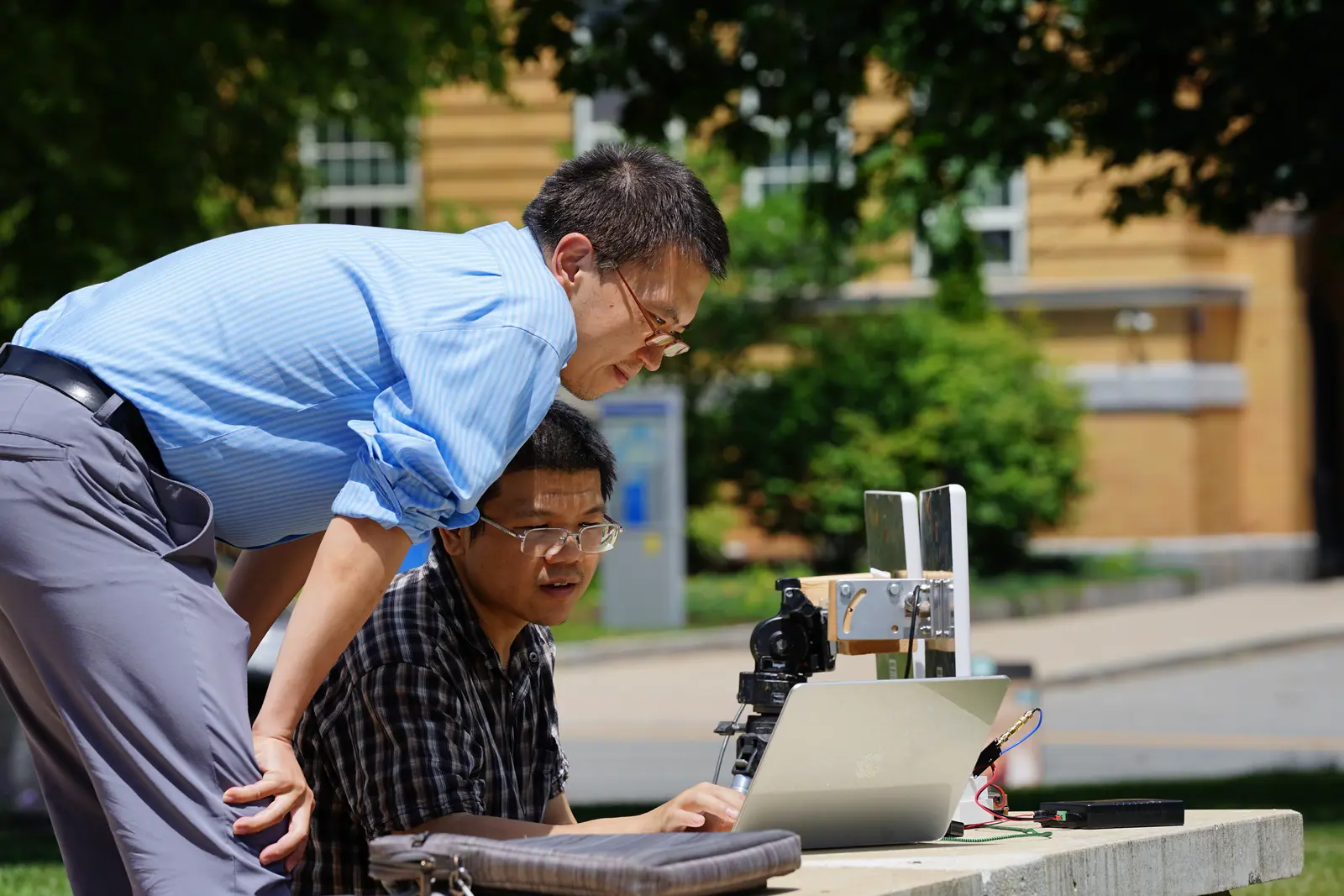
 Professor Hualiang Zhang, left, seen here working on remote sensing measurement project on North Campus, is part of an international research team that has won National Science Foundation funding to develop faster wireless communication technology.
When it comes to cellular communications and Wi-Fi, we simply cannot get enough. We want virtual reality, glitch-free video streaming and instant updates. We want more data, faster data, more devices and more connections.
The National Science Foundation (NSF) has awarded a three-year grant to an international research team co-led by Professor Hualiang Zhang of the Francis College of Engineering’s Electrical and Computer Engineering Department to study how using an untapped communications frequency, combined with a technique for using light to steer the beam of electromagnetic energy that carries data, will increase the capacity of wireless digital networks by 20 to 30 times.
“That's a truly high data rate for the next generation of wireless communication,” Zhang says.
The project is called “pHotonically-drivEn ReConfigUrabLe terahertz rEflectarrayS (or HERCULES) for High Performance Beam Steering and Forming.” In addition to wireless telecommunications, new tools created by the research can be used for medical imaging, security screening and chemical and biological sensing. UMass Lowell’s share of the grant is $301,350, with the overall award to the research team expected to be about $1.5 million.
Electrical and Computer Engineering Professor Hualiang Zhang says the research work could increase the capacity of wireless digital networks by 20 to 30 times.
“When you increase the operating frequencies by 20 or 30 times, because this is a linear scale, your bandwidth will increase by 20 to 30 times,” Zhang says.
But beyond 100 GHz is a frequency range known to researchers as the “terahertz gap,” because so little practical research has been done using frequencies in this range. This electromagnetic frequency range, which starts at 0.1 terahertz (THz) or 100 GHz – and is also known as tremendously high frequency, submillimeter radiation, terahertz waves and T-rays – pushes at the limit of that radio and microwave frequency slice of the spectrum, into the infrared range.
“People have spent a significant effort in the past 70 years on the microwave range, which is your radio and your communications, and also on the other side of the terahertz range, studying light and photonics for even longer,” Zhang says. “This unexplored territory between them deserves serious investigation.”
Zhang himself has a long history in microwave and photonics research, which is where he focused his investigations when he first became a faculty member in 2009. This is one reason he is intrigued by the other aspect of this research: beam steering.
Zhang points out that everyone who has been on an airplane recently is familiar with mechanical beam steering. When you step into an airport security body scanner, a vertical bar sweeps in a half-circle in front of you. Those bars, Zhang explains, are steering an electromagnetic beam, often millimeter waves, around your body.
The current research project will develop a way to steer and form electromagnetic beams electronically – more specifically, using light or photonically.
“What’s the big deal in moving between mechanical and electronic steering?” he asks. “The key word is ‘speed.’ It’s the difference between moving the beam in one second and moving the beam in a microsecond, which is a million times faster.”
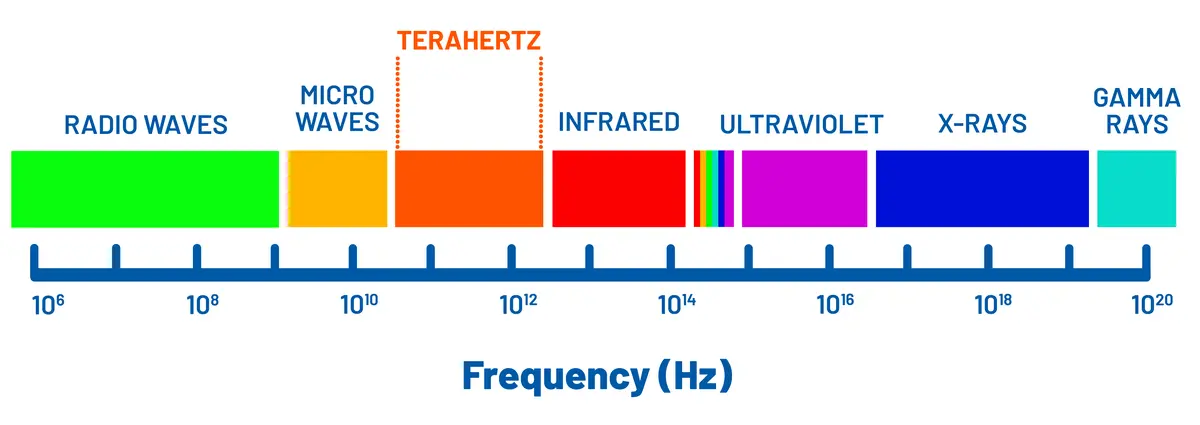 Image by Sabrina Patrizio
 A graphic displaying frequency ranges from 10 to the power of six to 10 to the power of 20 hertz, showing where each frequency (Radio Waves, Microwaves, Terahertz, Infrared, Ultraviolet, X-rays and Gamma Rays) lands. The HERCULES project is focused on the unexplored "terahertz gap" between the microwave and infrared frequencies on the electromagnetic spectrum.
The international team that Zhang co-leads includes researchers at the University of Notre Dame in Indiana, the Tyndall National Institute in Cork, Ireland and Queen's University Belfast in Northern Ireland.
The NSF award means that the Irish researchers’ funding will be fast-tracked by their own governments, Zhang says.
Professor Lei Liu, a terahertz expert at the University of Notre Dame, will research that aspect of the project, while the teams in Ireland and Northern Ireland will work on developing the technology into practical wireless communication applications. Zhang will lead the heart of the research into light-driven beam steering.
Students at each of the universities will participate in the research project. It’s another example of how, Zhang says, “UML is a great place for research and development in addition to our top-notch education program.”
Zhang describes the project as creating a bridge connecting decades of research in photonics with a similar depth of knowledge in terahertz frequency systems in an international collaboration.
“I'm really excited about this new adventure,” he says.