
 Image by Courtesy
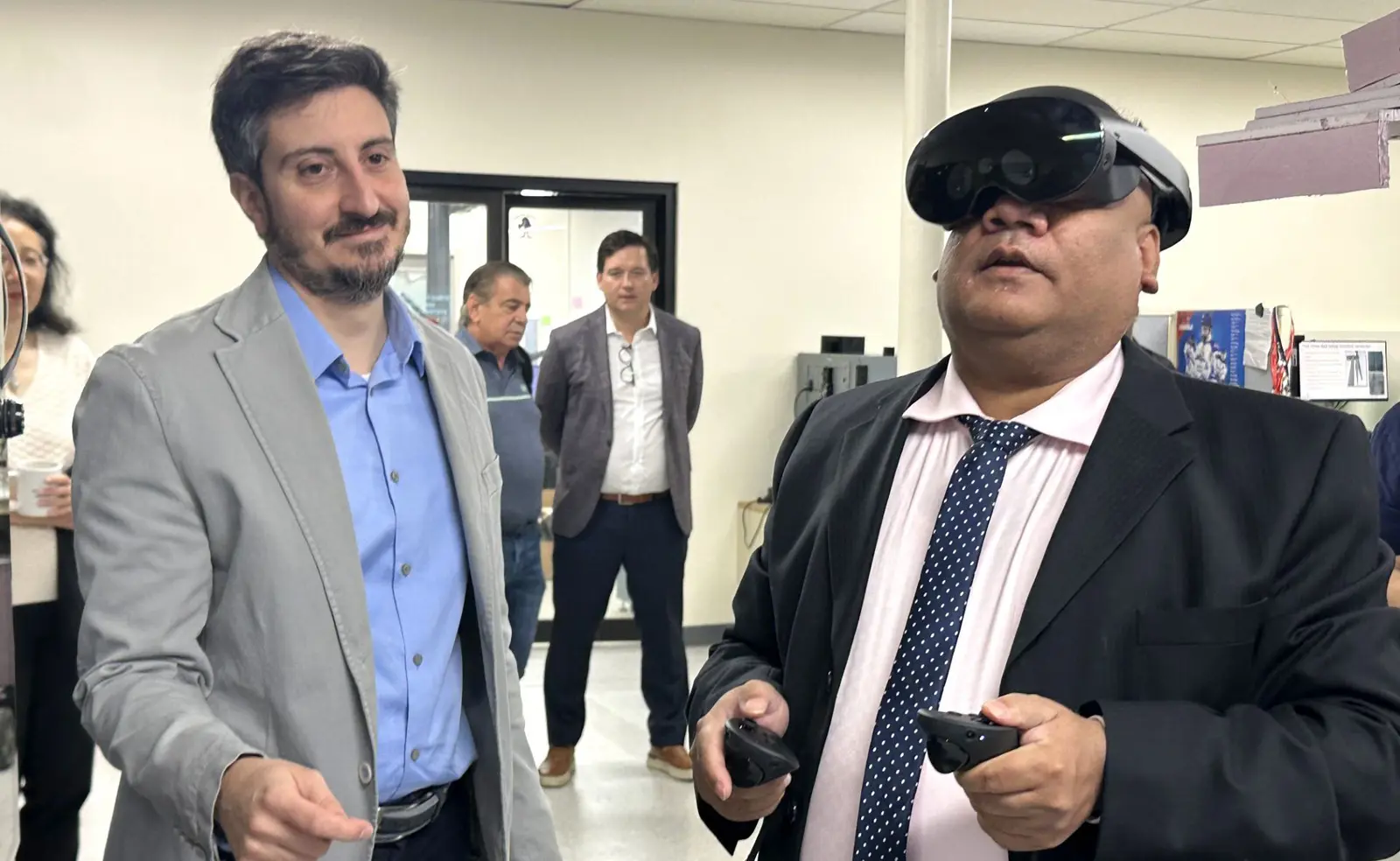
 Huzefa Kagdi, Whitaker College of Engineering dean at Florida Gulf Coast University, uses a virtual reality headset, right, in the lab of Mechanical and Industrial Engineering Associate Professor Alessandro Sabato, left. Sabato is one of several faculty members who received a grant from the UMass Lowell-FGCU Collaborative Seed Funding Program.
Cindy Chen, the chair of the Miner School of Computer and Information Sciences, always makes sure to turn her lights off when she leaves her office.
“I care about environmental issues,” she says. “Whatever little things I can do to help the environment, I want to do it.”
That’s why Chen is developing a data-driven computer model to predict and reduce plastic waste. And she’s not doing it alone.
Through the new UMass Lowell-Florida Gulf Coast University (FGCU) Collaborative Seed Funding Program, Chen has teamed up with FGCU Data Science Professor Leandro de Castro. Their project is one of five collaborative research projects to receive $20,000 in funding through the program.
“This collaborative seed funding program reflects our commitment to advancing research excellence through strategic partnerships,” says Anne Maglia, vice chancellor for research, innovation and economic development at UMass Lowell. “By connecting faculty researchers from UMass Lowell and FGCU, we are accelerating innovative solutions to address complex global challenges.”
“The seed grant program is designed to promote collaborative projects between faculty from both institutions in areas of critical importance that demonstrate high potential for impactful and long-term contributions,” adds Huzefa Kagdi, Whitaker College of Engineering dean at FGCU.
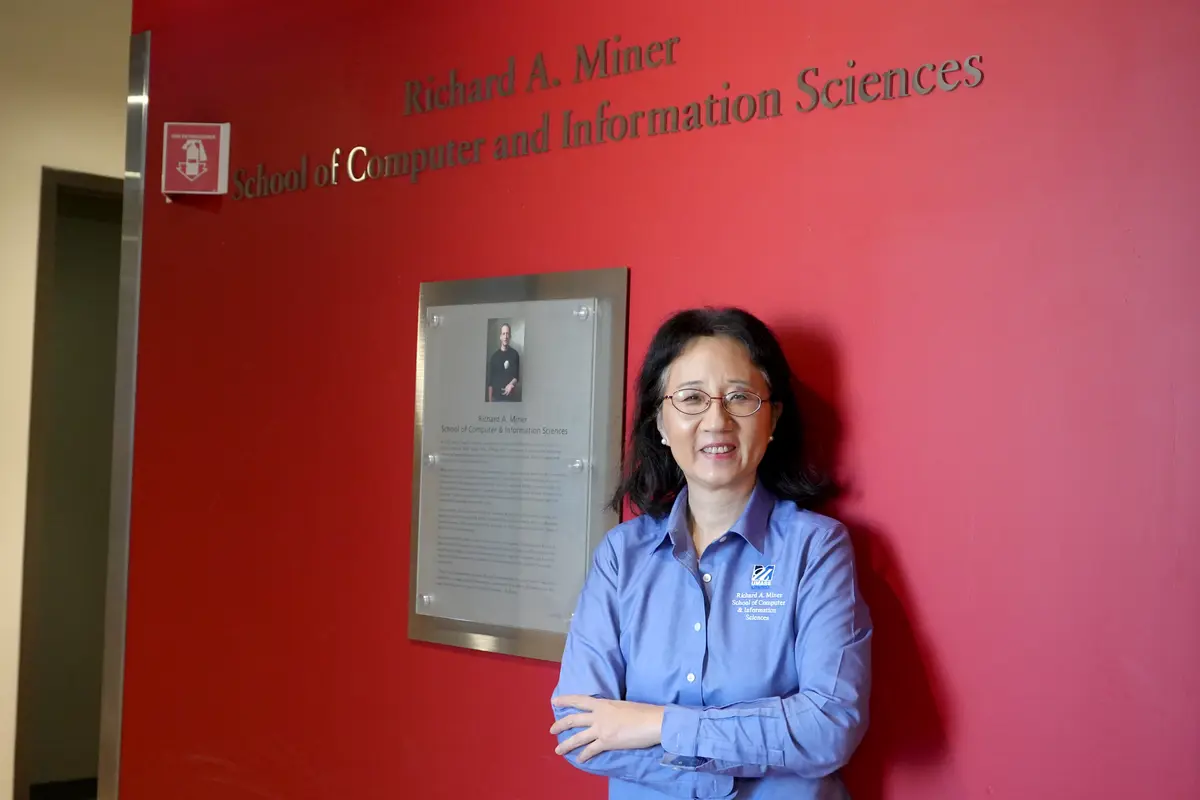 Image by Brooke Coupal
 Cindy Chen, the chair of the Miner School of Computer and Information Sciences, is working with FGCU Data Science Professor Leandro de Castro to develop a data-driven computer model to predict and reduce plastic waste.
Julie Zhang, an operations and information systems professor in the Manning School of Business at UMass Lowell, is working with Chengyi Qu, a computing and data science assistant professor at FGCU, to protect the elderly and other vulnerable populations from artificial intelligence (AI)-powered scams. They are creating an AI-driven fraud prevention system that analyzes multiple warning signs to better detect suspicious activity.
With a background in AI-driven security, threat detection and advanced machine learning, “Qu brings specialized knowledge that strengthens the intellectual breadth of the project,” Zhang says.
Like Zhang and Qu, Ali Ozdagli, a civil engineering assistant professor at FGCU, and Alessandro Sabato, a mechanical and industrial engineering associate professor at UMass Lowell, are using AI in their joint project. The two researchers are developing a tool equipped with AI to help iterate design specifications of buildings that are cost-effective and resilient to weather events such as hurricanes.
“This will be a great tool for institutions that don’t have a large facility to test different building designs,” Sabato says. “The seed program is a very cool initiative, because it will allow us to generate initial results that we can share with agencies like the National Science Foundation to pursue additional funding.”
Christopher Skinner and Mathew Barlow, both environmental, earth and atmospheric science professors at UMass Lowell, and Christopher Daly, a marine and earth sciences assistant professor at FGCU, are analyzing how compound flooding events, which occur when storm surge and heavy rainfall happen simultaneously, could alter Southwest Florida’s coastline and protective barrier islands. The researchers will specifically examine how global warming will change tropical cyclone characteristics, including their likelihood of driving compound flooding, by using climate model simulations.
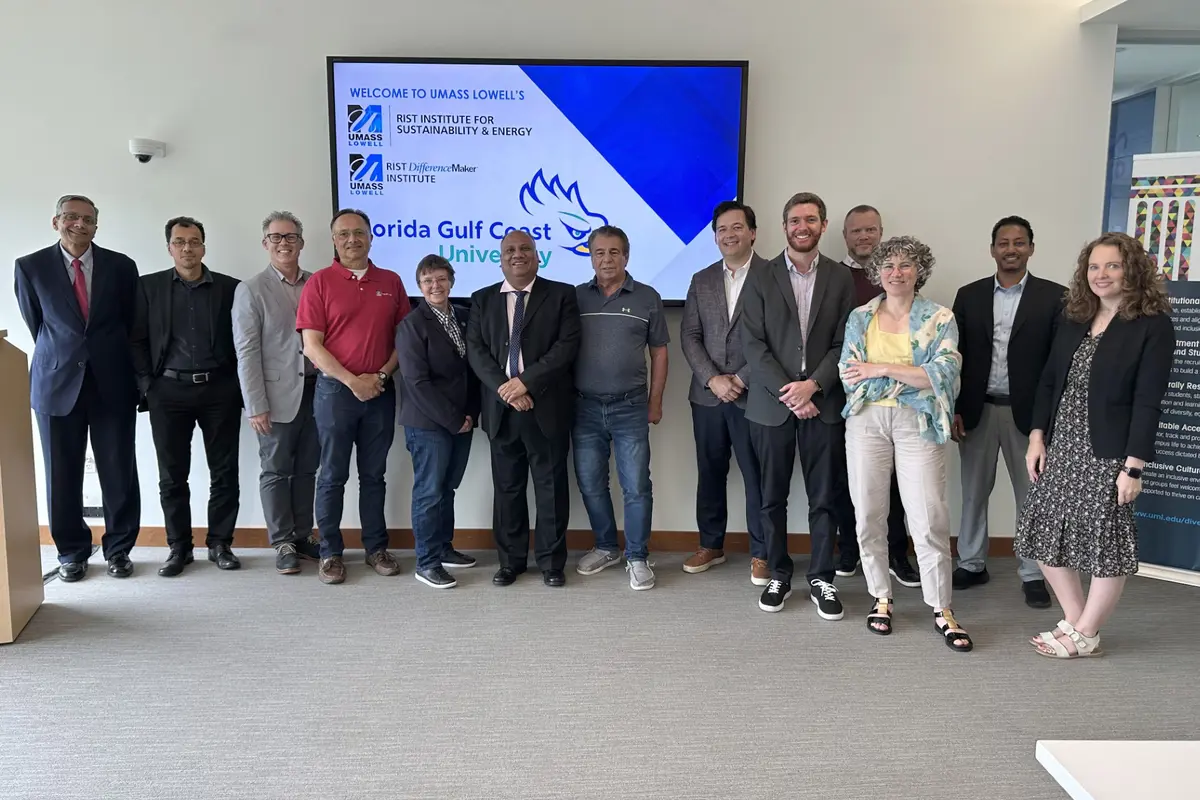 Image by Courtesy
 FGCU faculty visited UMass Lowell along with Brian Rist ’77, ’22, ’22 (H), center, to talk about research collaborations.
Christopher Niezrecki, a mechanical and industrial engineering professor at UMass Lowell, is leading a team of 19 faculty members from UML and FGCU to further foster research collaborations focused on energy and sustainability. The group will use the seed funding to establish three workshops at which faculty can brainstorm innovative research ideas and create project proposals.
The UMass Lowell - FGCU Collaborative Seed Funding Program grew out of a formal partnership agreement between the two institutions to establish joint education, research and career-connected opportunities. Brian Rist ’77, ’22, ’22 (H) facilitated the agreement between the universities.
“When these two universities formalized their partnership, the goal was to create meaningful collaborations that would lead to real-world results. It’s exciting to see that vision taking shape through joint research and innovation projects,” says Rist, the namesake of UMass Lowell’s Rist Institute for Sustainability and Energy and Rist DifferenceMaker Institute. “By working together, UMass Lowell and FGCU are building a lasting partnership that will benefit students, communities and industries in both regions for years to come.”