
 Image by Brooke Coupal
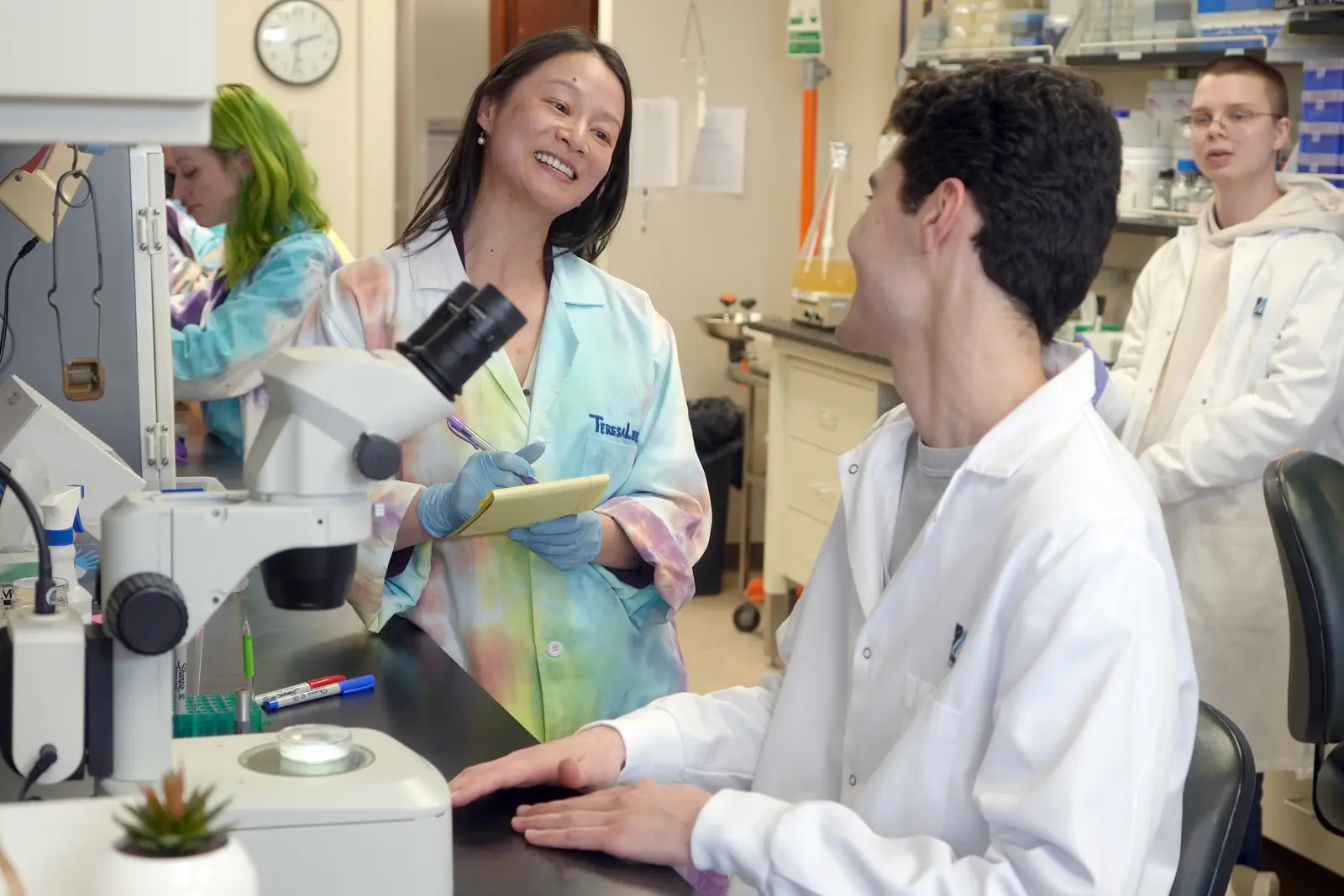
 Biology Assistant Professor Teresa Lee had received a five-year, $1.1 million CAREER grant from the National Science Foundation. Part of the grant will fund the development of innovative programs to incorporate hands-on biology research into the undergraduate student experience.
The importance of genes to the health and survival of organisms is widely recognized, but how DNA is packaged, unpackaged for use and repackaged also influences how long an organism lives and whether a cell survives or dies, an embryo develops or cancerous growth is sparked.
The National Science Foundation (NSF) has awarded Assistant Professor Teresa Lee of the Department of Biological Sciences a five-year CAREER grant totaling $1.1 million to study how the proteins that package DNA are passed down from parent to child, which is one aspect of the emerging field of epigenetics. The prestigious and competitive Faculty Early Career Development Award Program (CAREER) grants are awarded to the nation’s best young, tenure-track faculty scholars.
Lee researches both epigenetics – the study of how behavior and environment cause changes in the way genes function – and longevity, using tiny nematode worms known as Caenorhabditis elegans or C. elegans. The CAREER grant will fund projects within her epigenetics research.
Lee specializes in the subdiscipline of epigenetic regulation, which studies the proteins that package our genomes into familiar-looking chromosomes, stuffing long strands of DNA into tight helixes. “In the last 20 years, we've come to appreciate that it's how the DNA itself is packaged that controls how it's used, and how it’s used is what really matters,” she says.
“This particular grant was funded to ask how the packaging of our genomes – the term for that is ‘chromatin’ – gets passed down from parent to child,” she says.
For the grant, Lee will examine what happens to the chromatin late in life that controls when you die versus what happens early in life that sets an organism up for success.
“For a long time, we thought the information in the chromatin had to be completely erased when passed from parent to child,” Lee says. “Now we know there's a lot from your parents that you need to keep in order to set yourself up for success.”
The grant will also fund the development of innovative programs to incorporate hands-on research into the undergraduate experience for biology students.
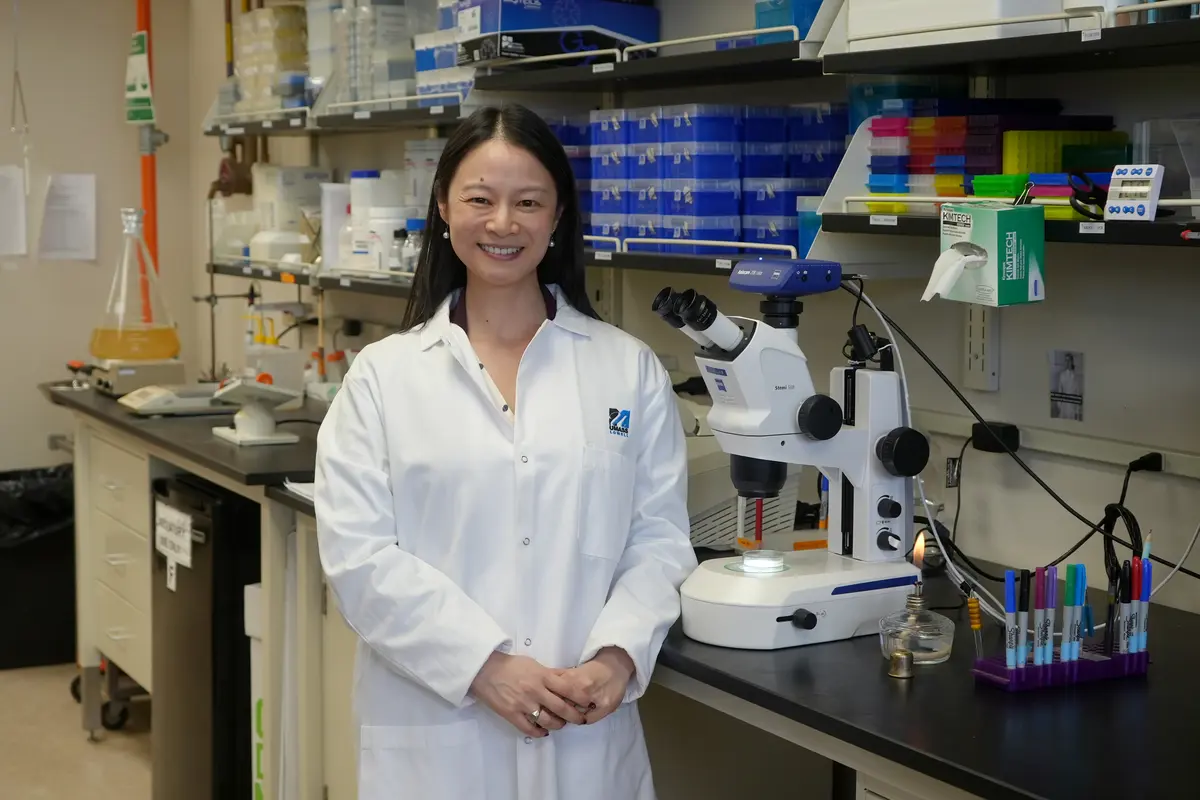 Image by Brooke Coupal
 "What I really love about this particular award is that you have to have an educational component that is meaningfully integrated with your research," Teresa Lee says of the $1.1 million NSF CAREER grant.
Lee came to UMass Lowell in 2020 after earning a Ph.D. in molecular and cell biology at the University of California, Berkeley; post-doctoral work at Emory University; and experience teaching at several other educational institutions through a National Institutes of Health (NIH) Institutional Research and Academic Career Development Awards (IRACDA) fellowship.
“One of the reasons I chose to join the faculty at UMass Lowell is that I could tell – certainly in the biology department, but also widely across campus – that people here value our role as educators,” she says.
One of Lee’s goals for the grant is to create a course-based undergraduate research experience, or CURE, in the Biology Department. Many biology classes focus on lectures, memorization and labs that replicate well-known results, leading students to believe that science is about repetition instead of discovery, Lee says.
A CURE aims to introduce undergraduates to the excitement of scientific discovery early in their education through laboratory experiments that don’t have a known outcome. This is important, Lee says, because not all students are ready to do extracurricular work in a professor’s lab.
“What I like about CUREs is that they make doing research more of a default than an opt-in. They're not necessarily competitive in the way it is to get into a research lab,” she says. “For example, I have about 11 undergraduates in my lab, which is a lot, but that's 11 out of 500 biology majors. CUREs make research more accessible and level the playing field.”
Another project Lee is working on through the grant is SUNRISE, or Supporting Undergraduate Networks with Research in Science and Epigenetics. This program is an extension of her work with the River Hawk Scholars Academy (RHSA), a university program that supports first-generation undergraduate students.
The RHSA program aims to give students hands-on scientific research experience before they even begin their undergraduate classes. Lee envisions it being available to all RHSA students, not just those majoring in the sciences.
Lee completed honors theses in both biology and creative writing during her undergraduate studies; she didn’t fall in love with science until she participated in real scientific research. She is driven to make sure that students experience the exciting parts of science as early as possible in their college careers.
In the SUNRISE program, students who are interested in health or science would participate in a several-week long introductory lab class, gaining more experience with microscopes and worms. “I tell my students that science is similar to cooking,” Lee says. “The first time you make any dish, it takes twice as long.”
At the end of the class, she says, the students will have the technical skills to succeed in a biology lab. It will also prepare students for a semester-long CURE class.
“The idea is to put curiosity and wonder back into the classroom,” Lee says. “I’m blessed, because what I study is approachable and exciting.”