
 Image by Ed Brennen
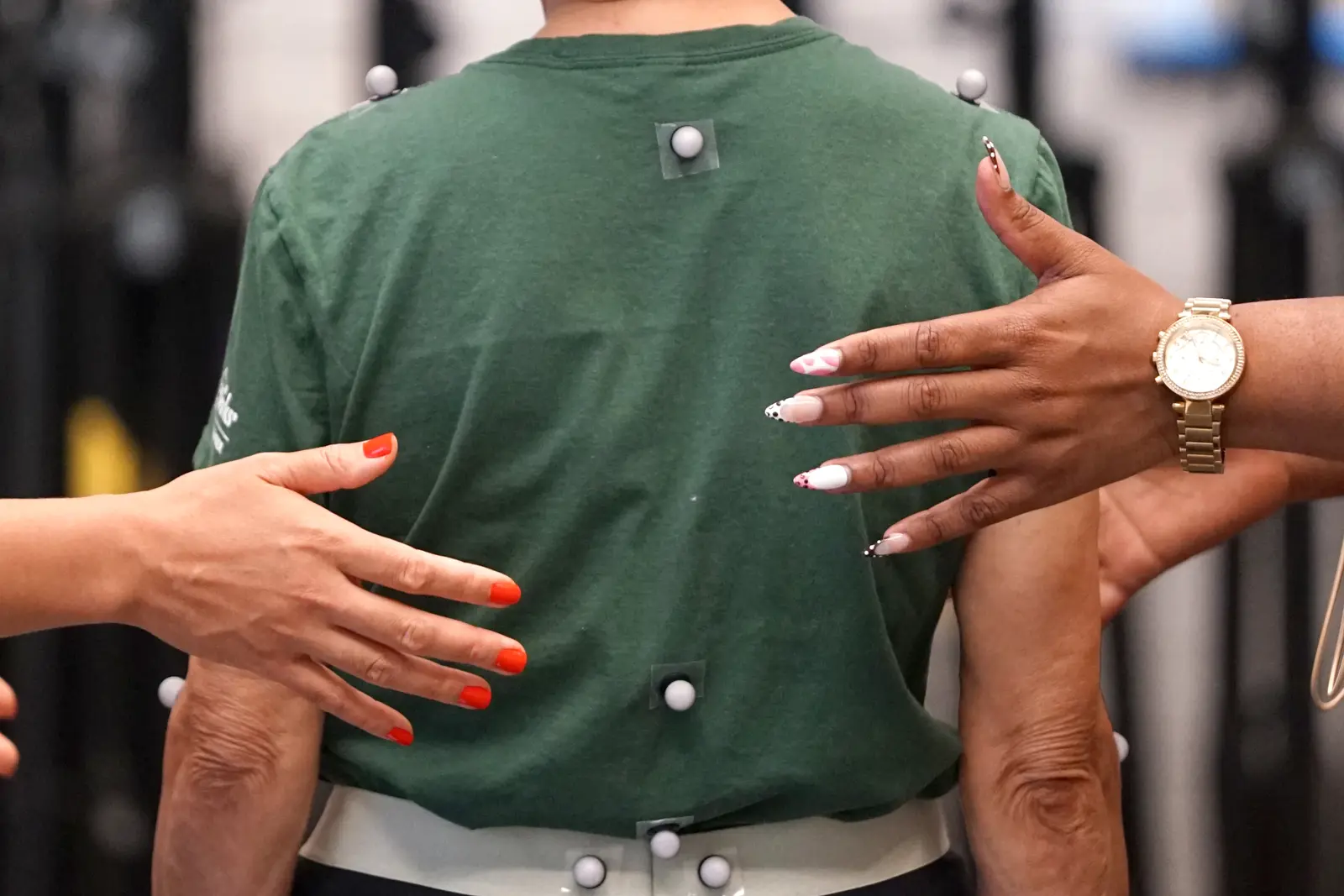
 Members of the REACH Lab offer steadying hands to a research participant taking part in a balance exercise.
An older adult pulls on a virtual-reality headset as graduate researchers prepare to begin a balance assessment. Roni Romero, a Ph.D. candidate in biomedical engineering, monitors the data while his colleagues guide the participant through a series of tasks that alter the visual and physical information used to maintain balance.
The students are part of the Rehabilitation Engineering and Assistive Technology Center for Human Performance, or REACH Lab, led by Biomedical Engineering Professor Lara Thompson ’03.
Thompson joined UMass Lowell in 2025 after 12 years at the University of the District of Columbia (UDC), bringing with her a five-year, $1 million National Science Foundation Alan T. Waterman Award — and many of the graduate students who had been working with her.
Thompson’s award is helping to support the REACH Lab’s new biomechanics research space at Southwick Hall. During its first year at UMass Lowell, researchers at the lab began three studies involving human participants.
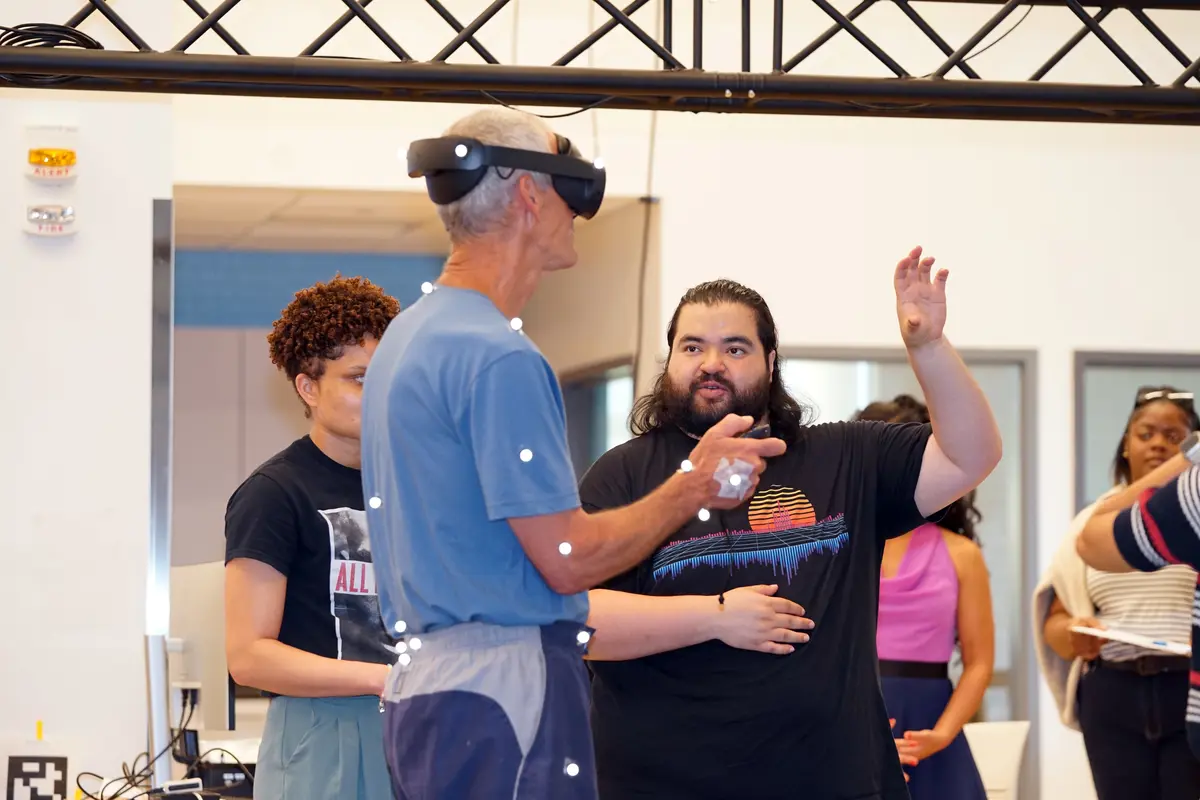 Image by Ed Brennen
 Biomedical engineering Ph.D. candidate Roni Romero, right, helps a participant learn how to use a virtual-reality headset for his research work on multisensory re-weighting, which he is conducting with the Rehabilitation Engineering and Assistive Technology Center for Human Performance, or REACH Lab.
“Our team is excited to integrate biomedical engineering research with clinical aspects that we know will benefit both the Lowell community and the broader public,” she says.
Romero began working with Thompson as an undergraduate at UDC in 2016. His dissertation focuses on multisensory re-weighting — the brain’s ability to shift between different senses to maintain balance. As people stand and move, they rely on vision, the vestibular system in the inner ear and somatosensory information, including touch and pressure from their feet.
“As adults get older, they kind of lose that ability — the re-weighting to quickly be able to catch their balance if they’re about to fall,” says Romero, who notes that he’s motivated in part by watching his own parents grow older.
To study that process, participants complete balance assessments with their eyes open, their eyes closed and while wearing a virtual-reality headset that introduces moving visual stimuli. Researchers also change the surface beneath participants’ feet, making it more difficult to rely on touch and pressure information.
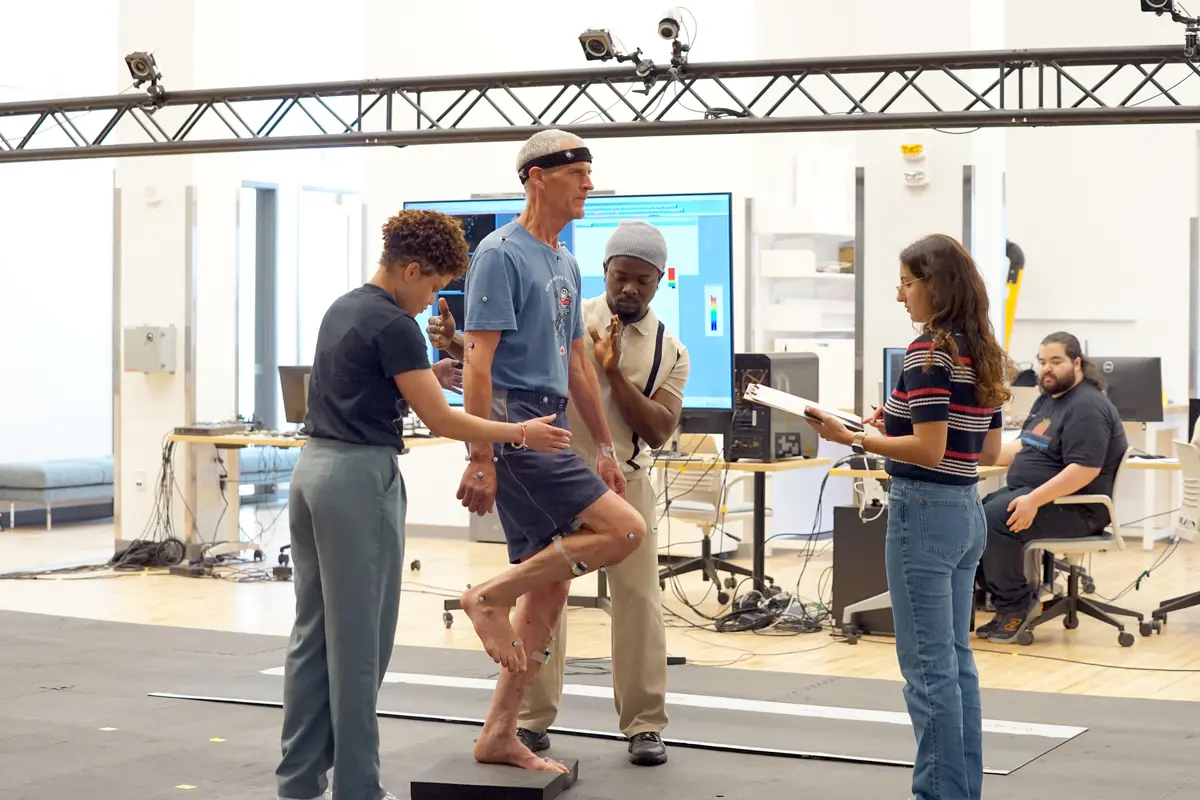 Image by Ed Brennen
 REACH Lab members, from left, Aliya Newby and Oluwasola Okhuoya are ready to assist a research participant while undergraduate student researcher Maria Eduarda Servare looks on during a balance exercise at the Lowell Advanced Robotics Initiative Lab at Southwick Hall.
The team recruits participants through the Lowell Council on Aging. It tested nearly 20 older adults this summer as part of Romero’s study.
“Falls in older adults are a major societal issue,” says Thompson, who notes that falls affect more than 27% of adults aged 65 and over each year. “Proactive clinical evaluation and targeted prevention are essential for maintaining safety and independence in aging adults.”
The lab’s equipment allows students to measure movement in several ways. Reflective markers placed on a participant’s body are tracked by infrared motion-capture cameras. The system records movement in three dimensions, including direction, angles and the time required to complete a task.
Electromyography, or EMG, sensors record muscle activity. A force-plate walkway measures how participants distribute weight and respond to changes in balance. The virtual-reality system introduces controlled visual disturbances, while eye tracking records where participants look and how quickly their eyes move.
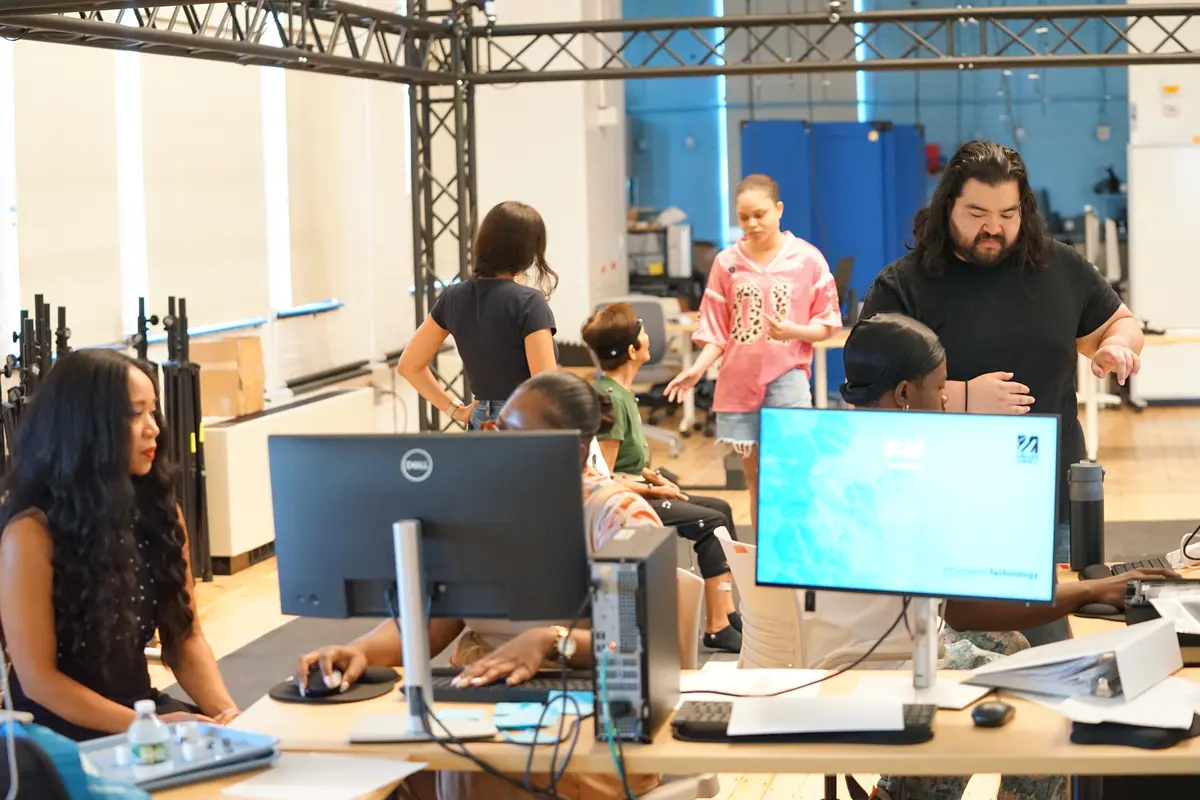 Image by Ed Brennen
 Biomedical Engineering Professor Lara Thompson '03, left, brought many of the REACH Lab members with her to UMass Lowell from the University of the District of Columbia.
Wilson is learning to use technology that is found in private industry.
“So for me, this is good experience,” she says.
Visalakshi Chockalingam, a second-year biomedical engineering Ph.D. student, studies muscle activation and energy use in the same group of student-athletes.
Her research examines which muscles activate normally and whether concussion affects the timing or activity of those muscles. She uses EMG sensors to track muscle activity as participants walk and perform balance tasks.
The students’ projects overlap, giving them opportunities to see how rehabilitation research can be applied to different conditions and populations.
“It is nice to be able to do projects like this and explore different aspects of rehabilitation,” says Aliya Newby, a Ph.D. candidate in biomedical engineering and biotechnology.
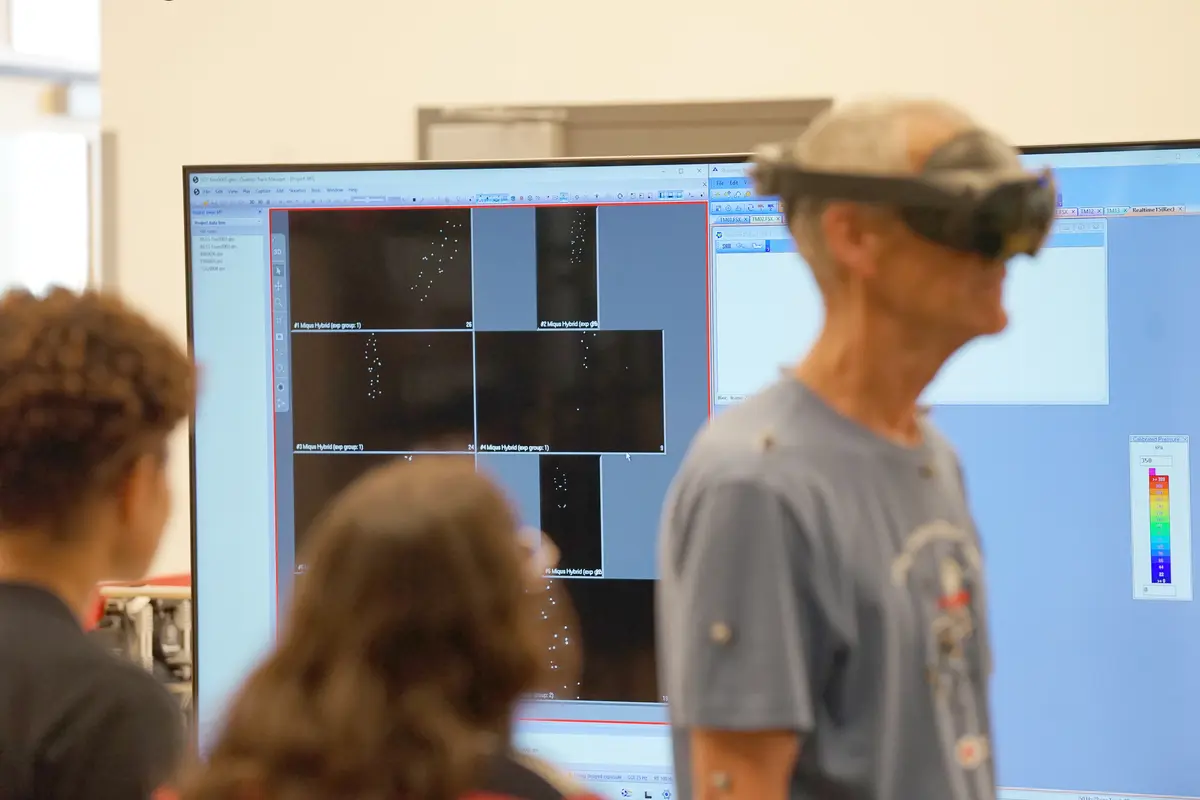 Image by Ed Brennen
 Research participants' movements are tracked by infrared-motion cameras and displayed as data points on a computer monitor.
Oluwasola Okhuoya, a first-year biomedical engineering Ph.D. student, studies biomarkers that could lead to more accessible and less invasive approaches to diagnosing Alzheimer’s disease.
“We have different students with different forms of experience, and they’ve been helping a lot,” Okhuoya says.
The lab’s first year has given students opportunities to advance their own research while gaining experience with human participants and sophisticated equipment. Five Ph.D. candidates successfully defended their dissertation research plans during the year.
The work also gives students a chance to get to know the people behind the data.
“It’s nice to connect with people from the community,” Romero says.
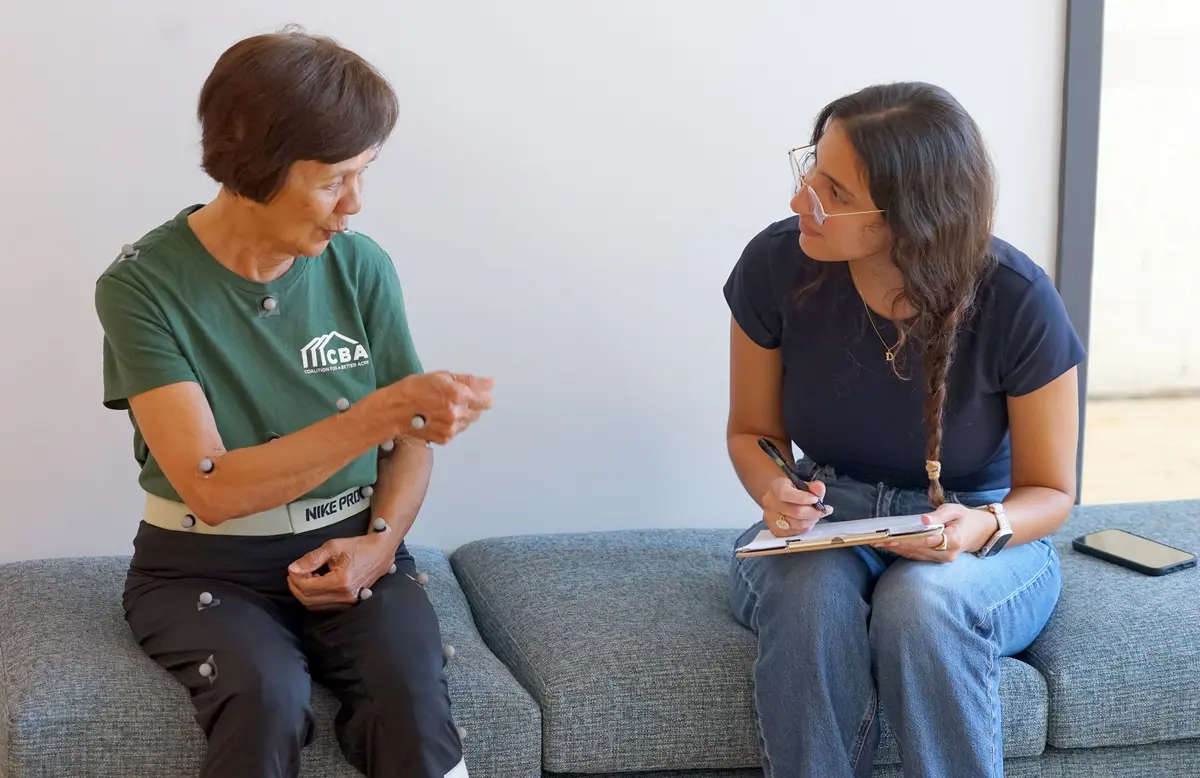 Image by Ed Brennen
 Senior biomedical engineering major Maria Eduarda Servare conducts an exit interview with a volunteer research participant from the Lowell Council on Aging.