 Image by Brooke Coupal
 Noah Mason ’23, who is now a Ph.D. student at the University of Chicago, led a research project on nanoparticles while he was an undergraduate; the results were recently published in a scientific journal.
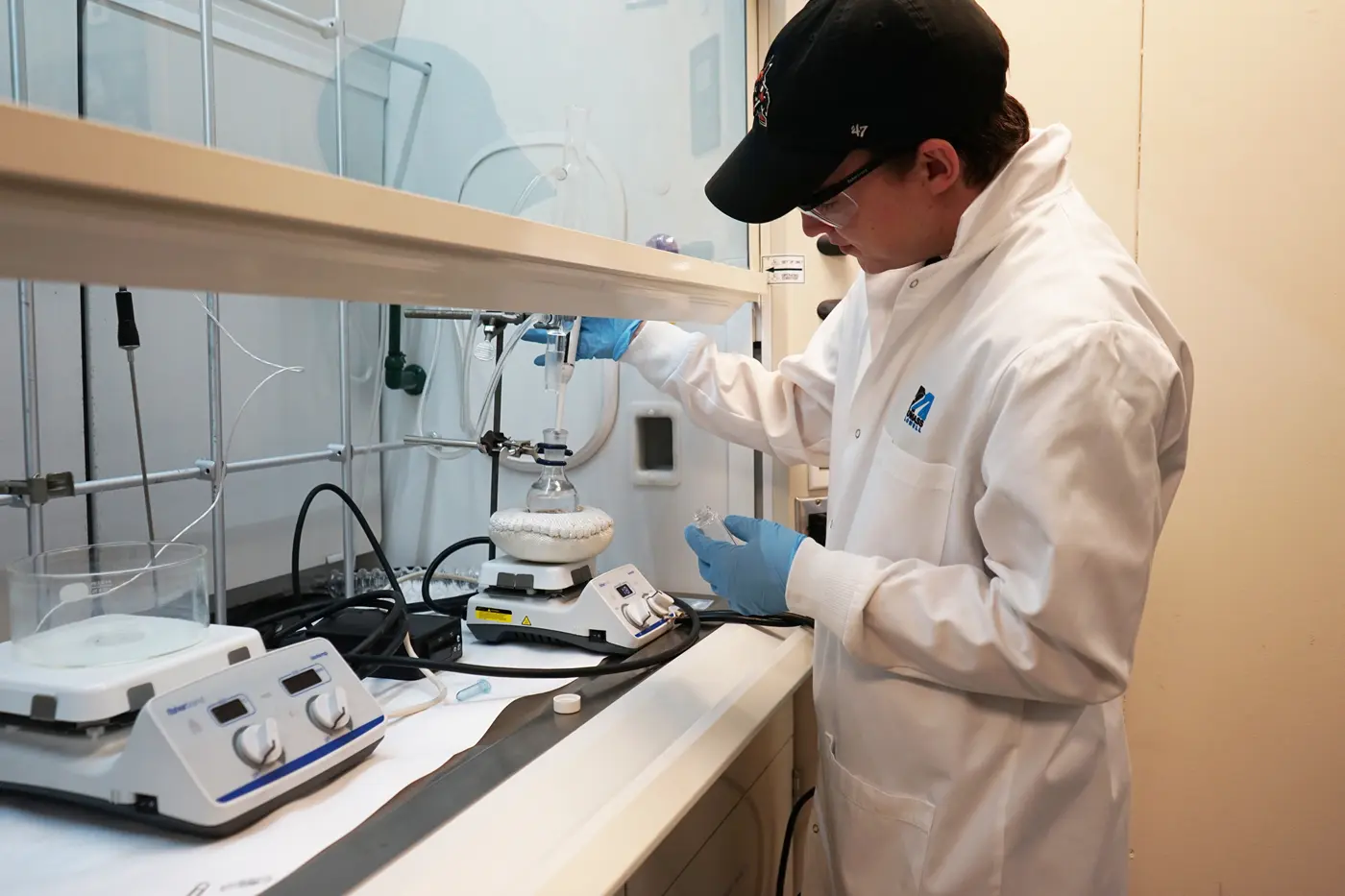
One summer day in 2022, the first cohort of CatalyzeUML, a free summer program for incoming first-year chemistry majors, gathered in a laboratory in the Louis A. Olney Science Center on the UMass Lowell campus. It was soon after the COVID-19 lockdown, and some students had missed doing any laboratory work in high school. Some had never even worked with a pipette, that workhorse of lab tools.
It was a big day for Noah Mason ’23, too. As a member of the student chapter of the American Chemical Society at UMass Lowell and a first-generation college student, he had advocated for the creation of the CatalyzeUML program. Now, the program’s participants were going to play a vital role in his undergraduate honors research project.
Mason’s research examined the creation of a particular type of nanoparticle, one that combines gold and tin to create a substance that can influence the speed of chemical reactions, serve as a precise chemical sensor and convert solar energy to chemical energy. There was just one problem: Getting the nanoparticles to form correctly is difficult.
“It is so well-known how unreproducible so much nanoscience synthesis is,” says Associate Professor of Chemistry Michael B. Ross, the faculty leader for CatalyzeUML.
For the experiment, Mason was going to try to solve the problem of reproducibility for these bimetallic nanoparticles. He and Ross worked together to create a tutorial packet on how to create these nanoparticles. The CatalyzeUML cohort was the first to test it.
“It’s important for everyone to try benchtop research,” Mason says. “Through the CatalyzeUML program, these incoming freshmen were able to do that before attending their first class.”
“The CatalyzeUML program addresses the most important aspects of chemistry student success,” Ross says. “We do lab work on the second day. In this case, they got hands-on experience with nanoparticles.”
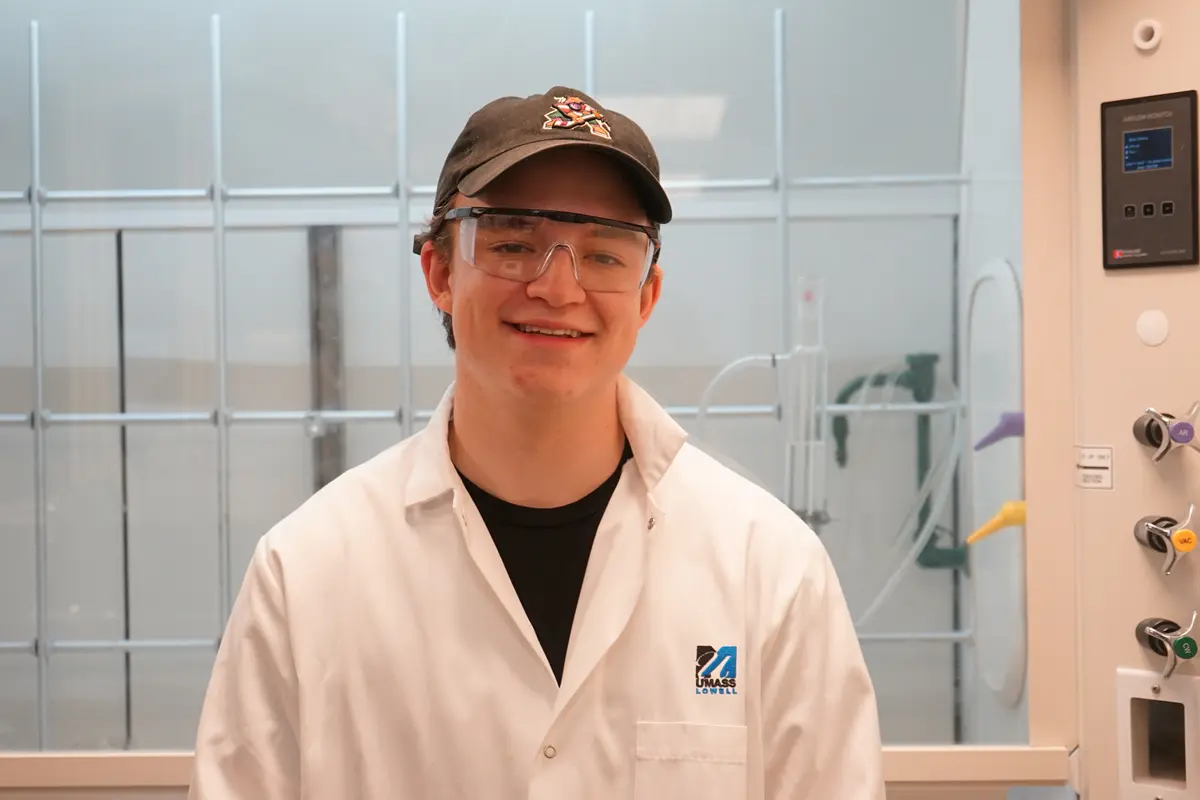 Image by Brooke Coupal
 “I’m grateful for my experiences at UMass Lowell," says chemistry alum Noah Mason '23.
“After annealing, the samples were all the same color,” Mason says, peach for the 20% tin solutions and burnt orange for the 40% tin solutions.
The CatalyzeUML students had all successfully created unique nanoparticles that work with a broader spectrum of solar energy than the substances traditionally used to generate solar power. The results were so interesting that Mason and the other CatalyzeUML peer leaders stayed in the lab late into the night, analyzing the data.
The research became Mason’s honors thesis, which earned him a Balasubramanian Family Honors Thesis Award, given to honors students who conduct the best STEM-related honors thesis or project presentation. Mason, who is now a third-year doctoral student in chemistry at the University of Chicago, was the first author on a paper about the research that was published in the journal Chemistry of Materials last fall.
The other CatalyzeUML peer leaders who helped in the lab that day and worked with Mason into the night are co-authors on the paper: Anthony Braco, Sunhao Liu, Maëlisse Trancart, Sangmin Jeong, Connor S. Sullivan, Sarah S. Dawes, Smita Chatterjee and Sophia Manukian.
Mason plans to continue in academia through his Ph.D. to postdoctoral research and beyond. “Coming out of high school, I didn’t expect to be interested in academia,” he says. His experiences at UMass Lowell, as an undergraduate researcher, a tutor and learning assistant, made him realize it was a career path that he would enjoy.
The CatalyzeUML program continues to introduce incoming chemistry majors to the skills and information they need to succeed. In the program, they meet their peers, explore the university’s facilities, sleep in a residence hall, learn the finer points of a STEM class schedule, meet their professors and, of course, get hands-on experience doing lab work.
For Mason, the research project was a distillation of his experiences at the university. “I’m grateful for my experiences at UMass Lowell. I learned a lot in my classes,” he says. “Mike was a great mentor to me. All of my professors were encouraging. I worked with friends on the research and collaborated with researchers at other universities. I was allowed to think for myself.
“I felt like a scientist.”